
Final interview prep: AI strategies that get you hired

TL;DR:Final interviews focus on cultural fit, strategic thinking, and market awareness, not just skills.In-depth research and AI-powered practice tools enhance storytelling and confidence for high-stakes conversations.Successful candidates demonstrate insider thinking, strong nonverbal presence, and avoid common mistakes.
You made it to the final round. That means one thing: you’re already qualified. The company knows you can do the job. What they don’t know yet is whether you’re the right person for their team, culture, and future. That shift from proving competency to demonstrating fit is where most candidates stumble. Final interviews are high-pressure, often involve senior leadership, and test your ability to think like an insider rather than just answer questions correctly. This guide gives you actionable, AI-powered strategies to walk in with confidence, handle every curveball, and leave a lasting impression.
Table of Contents
- Understand the final interview’s true purpose
- Essential preparation: AI-powered tools and foundational research
- Structuring responses and handling high-stakes scenarios
- Troubleshooting: Avoiding common mistakes and deal-breakers
- Why conventional final interview prep needs an upgrade
- Upgrade your interview prep with AI-driven support
- Frequently asked questions
Key Takeaways
| Point | Details |
|---|---|
| Chemistry matters most | Final interviews focus on interpersonal fit and executive presence rather than just skills. |
| Leverage AI tools | Smart interview platforms can simulate advanced scenarios and refine your responses for maximum impact. |
| Avoid common pitfalls | Skip vague answers and early salary talk, boost your credibility with research and confident communication. |
| Structure answers for clarity | Use the STAR method and leadership narratives to tailor responses for behavioral and scenario questions. |
Understand the final interview’s true purpose
Most candidates prepare for final interviews the same way they prepped for earlier rounds: review the job description, rehearse answers, and research the company basics. That approach misses the point entirely.
Final interviews aren’t about verifying your skills. Those boxes are already checked. This round is about trust, chemistry, and whether you think like someone who already belongs at that table. Interviewers are asking themselves: Can I work with this person? Will they represent us well? Do they understand our challenges at a deeper level?
The evaluation shifts dramatically at this stage. Here’s a quick breakdown of what changes:
| Early rounds | Final round |
|---|---|
| Technical skills and role fit | Cultural intelligence and executive presence |
| Can you do the job? | Do you think like an insider? |
| Task-specific examples | Strategic, cross-functional leadership stories |
| Structured competency review | Organic conversation and relationship dynamics |
The qualities interviewers watch for most closely include:
- Market awareness: Can you speak to industry trends affecting their business?
- Political intelligence: Do you understand how decisions get made internally?
- Collaboration signals: How do you talk about your team versus your own wins?
- Cultural adaptability: Do your values and working style align with theirs?
Nonverbal communication also carries more weight here. In early rounds, a confident answer can mask nervous body language. In final rounds, senior leaders notice everything: your eye contact, how you handle silence, whether you listen before you speak.
For effective final round answers, grounding your responses in company-specific context matters far more than delivering technically perfect replies.
Knowing what common interview questions appear at this stage helps you prepare the right stories rather than generic ones.
As one executive coach puts it, chemistry over competency is the true final round standard: demonstrate you think like an insider with market analysis, political awareness, and cultural intelligence.
With the importance of this final stage established, next we’ll prepare your strategic toolkit.
Essential preparation: AI-powered tools and foundational research
The candidates who perform best in final interviews don’t just rehearse. They research obsessively, then use that research to tell better stories under pressure.
Deep company research means going well beyond the About page. You need to understand their current market position, recent leadership changes, competitor moves, and internal culture signals from platforms like Glassdoor or LinkedIn. When you walk in referencing their latest earnings challenge or a recent product pivot, you signal that you’re already thinking like a team member.
Here’s a checklist of must-have research items before your final interview:
- Recent press releases, earnings calls, or product announcements
- The leadership team’s backgrounds and stated priorities
- The company’s competitive landscape and market pressures
- Current organizational challenges based on job postings and news
- Culture signals from employee reviews and social media
AI-powered platforms take your preparation further by simulating the pressure of real scenarios. For technical interview simulation, you can practice high-stakes questions and receive feedback on both structure and substance. This kind of repetition builds genuine confidence rather than scripted polish.

Here’s a comparison of key features across AI prep approaches:
| Feature | Basic practice tools | AI-powered platforms |
|---|---|---|
| Behavioral question practice | Yes | Yes, with structured feedback |
| Executive scenario simulation | Limited | Advanced, role-specific |
| STAR response analysis | No | Detailed narrative breakdown |
| Real-time coaching | No | Available during mock sessions |
| Personalized story refinement | No | Tailored to your experience |
Mastering the STAR method for managers is essential because leadership stories are the currency of final interviews. Situation, Task, Action, Result. Each element serves a purpose. The Result is where most people cut short, yet it’s the piece that proves real impact.
According to research on AI-assisted prep, using tools to simulate executive scenarios, practice STAR responses, and analyze personal narratives enhances confidence through repetition in ways that solo rehearsal simply can’t replicate.
Pro Tip: Record yourself answering three leadership stories using STAR, then use an AI tool to evaluate your response clarity, impact language, and any filler habits. One iteration of this exercise can sharpen your delivery dramatically before the real conversation.
With your understanding of the stakes, let’s explore actionable steps for impactful preparation.
Structuring responses and handling high-stakes scenarios
Knowing what to say matters. Knowing how to say it under pressure is the actual skill.
Here’s a step-by-step approach for handling behavioral, leadership, and scenario questions:
- Pause before answering. Two seconds of silence feels longer to you than to them. Use it to select the right story.
- Set the context briefly. State the Situation and Task in two to three sentences. Don’t over-explain the setup.
- Focus on your specific actions. Not the team’s actions. Not what you recommended. What you did.
- Lead with the result. Quantify whenever possible. Revenue impact, time saved, team performance improvement.
- Connect back to the role. End by linking your result to a challenge this company faces.
Using interview best practices like this framework keeps your answers tight and memorable instead of sprawling into unnecessary detail.
The STAR method structures behavioral responses to prevent the rambling that makes interviewers mentally check out.
Pro Tip: After each mock session with an AI tool, ask for feedback specifically on your Action step. That’s the part most candidates rush, yet it’s where interviewers form their clearest impression of your judgment.
High-stakes scenario questions often involve incomplete information. You might be asked how you’d handle a budget cut mid-project or lead a team through an acquisition. The goal isn’t a perfect answer. It’s to show a calm, structured thought process. Verbalize your reasoning, name your assumptions, and invite dialogue.
On compensation: avoid early salary talk until an offer is on the table. Bringing up numbers before they do signals that you’re more focused on the deal than the role, which undercuts the very chemistry you’ve been building.
For a strong confident closing statement, end by expressing specific enthusiasm for the role and asking a forward-looking question. Something like: “Based on what we’ve discussed, I’m genuinely excited about the opportunity to tackle the market expansion challenge. What does success look like in the first 90 days?” That question signals commitment without desperation.
Also review technical interview tips if your role involves any problem-solving or case-based components at the final stage.
Troubleshooting: Avoiding common mistakes and deal-breakers
Final round mistakes are expensive. You’ve invested weeks in getting here. The errors that derail candidates at this stage are almost always avoidable.
Here are the most common deal-breakers:
- Lack of company-specific research. Generic answers that could apply to any employer signal low motivation.
- Vague answers without metrics. Saying “I improved team performance” without a number is forgettable. “I reduced turnover by 30% in 18 months” is not.
- Discussing compensation too early. This consistently ranks among the top reasons candidates get passed over at final rounds.
- Poor nonverbal presence. Weak eye contact, slouching, or looking distracted during a video call sends the wrong message about your leadership confidence.
- Over-rehearsed answers. Robotic delivery suggests you’re reciting rather than thinking. Interviewers can feel the difference.
- Badmouthing previous employers. Even when invited to discuss a difficult boss or company, keep your framing objective and forward-focused.
Knowing what interview pitfalls to sidestep gives you an edge that most candidates underestimate.
Solutions are straightforward but require intentional practice:
Common deal-breakers at the final round include lack of enthusiasm, dishonesty, and surface-level research. Interviewers at this level are experienced evaluators. They can spot the difference between rehearsed polish and genuine understanding.
For those preparing via screen, remote interview preparation deserves its own attention. Your background, audio quality, lighting, and camera angle all communicate professionalism before you say a word.
The fix for most of these mistakes is the same: specific preparation combined with honest self-review. Use AI tools to catch the patterns you can’t see yourself.
Why conventional final interview prep needs an upgrade
Here’s an uncomfortable truth: most final interview advice is optimized for getting to the final round, not for winning it.
The standard playbook, rehearse your stories, know the STAR method, research the company, still matters. But at the executive or senior leadership level, chemistry and market awareness matter more than polished delivery. And that’s a fundamentally different preparation challenge.
Rehearsed answers signal preparation. Adaptive, contextually-aware answers signal genuine fit. The best candidates we see aren’t the ones with the sharpest script. They’re the ones who can pivot mid-conversation when the interviewer takes an unexpected direction, and still land their key points.
AI tools change this equation. When you practice with narrative analysis, you start to notice how your stories land emotionally, not just structurally. You learn which parts make interviewers lean in and which parts lose momentum. That feedback loop is impossible to get from rehearsing alone in a mirror.
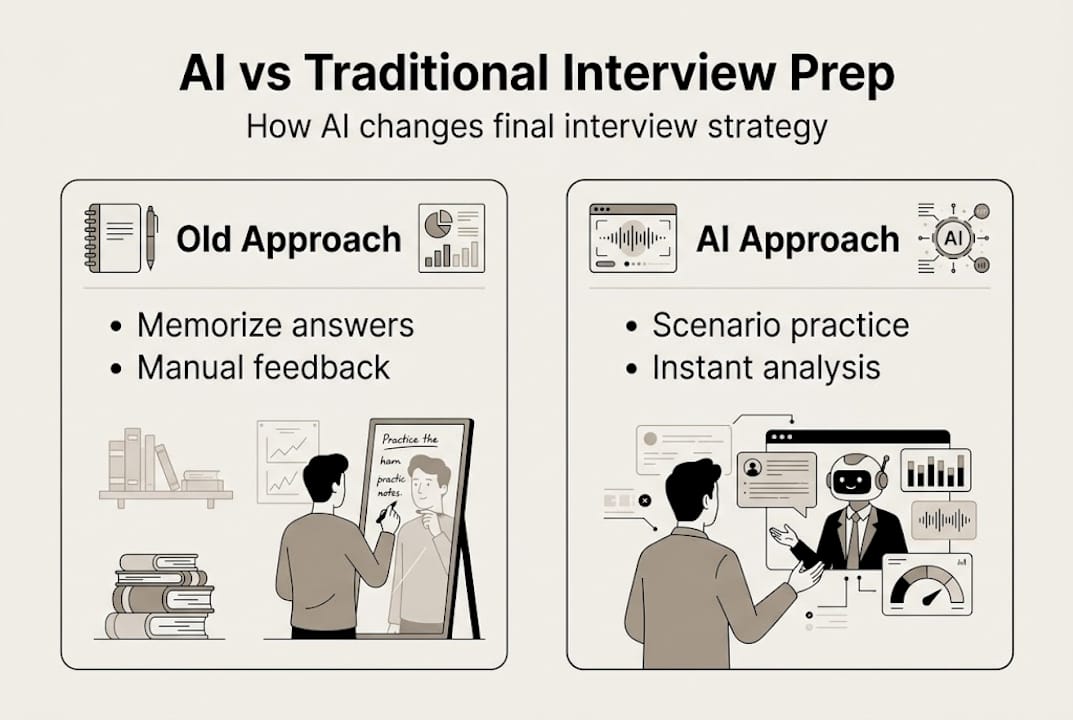
Pro Tip: Use AI-enhanced interview answers to stress-test your leadership stories for cultural alignment, not just clarity. Ask yourself: does this story show how I think, or just what I did?
Upgrade your interview prep with AI-driven support
You’ve covered the strategy. Now it’s time to put it into practice at a level that matches the stakes of your final interview.
Our AI interview prep platform is built specifically for moments like this. It listens to your responses in real time and delivers instant, targeted coaching so you can sharpen your answers before the actual conversation happens.
Whether you’re working through leadership scenarios, refining your STAR stories, or building the kind of confident presence that wins executive-level interviews, the platform gives you the feedback loop you need. You don’t just practice. You improve with every session, without needing a human coach on call. Give it a try before your next final round.
Frequently asked questions
What is the STAR method and why should I use it in a final interview?
The STAR method structures your behavioral responses using Situation, Task, Action, and Result, making your answers clear and preventing you from rambling. It’s especially effective in final rounds where interviewers are evaluating the quality of your thinking, not just the outcome.
How do AI-powered platforms improve final interview preparation?
AI prep tools let you simulate executive-level scenarios and receive detailed feedback on your narrative structure, helping you build real confidence through repetition. Unlike solo rehearsal, they surface patterns in your delivery that you wouldn’t catch on your own.
What are some mistakes to avoid in the final interview?
Common mistakes include vague answers without supporting metrics, lack of company research, poor body language, and discussing salary before an offer is made. Lack of enthusiasm and any hint of dishonesty are the fastest ways to lose an offer at this stage.
How should I approach compensation questions in the final interview?
The smartest move is to defer salary discussions until after an offer is extended, keeping the focus on fit and value throughout the interview. Bringing up numbers too early shifts the conversation from potential to negotiation, which rarely works in your favor.