
Avoid These Top Interview Mistakes to Land Your Next Job

TL;DR:Negative attitude and criticizing past employers are major reasons candidates get rejected.Mechanical errors like rambling, poor structure, and overusing AI can harm interview chances.Soft skills, nonverbal cues, punctuality, and follow-up significantly influence hiring decisions.
Losing a job offer over something completely preventable is more common than most candidates realize. 70% of hiring managers disqualify candidates for poor attitude, 45% for wrong attire, and 58% for poor grammar. These aren’t obscure deal-breakers. They’re everyday missteps that talented people make because no one told them what hiring managers actually notice. This guide breaks down the five most costly interview mistakes, explains exactly why each one damages your chances, and gives you practical tools to fix them before your next interview.
Table of Contents
- 1. Poor attitude, negativity, and badmouthing past employers
- 2. Mechanical errors: Over-using AI, rambling, and poor structure
- 3. Underestimating soft skills and nonverbal cues
- 4. Technical mistakes: Tardiness, attire, and grammar errors
- 5. Lack of preparation and follow-up: Research, practice, and thank-you notes
- How to turn these mistakes into growth opportunities
- Take your interview skills further with ParakeetAI
- Frequently asked questions
Key Takeaways
| Point | Details |
|---|---|
| Attitude matters most | Most candidates are rejected for a negative or unprofessional attitude. |
| Master interview mechanics | Stay concise, use the STAR method, and balance AI with genuine enthusiasm. |
| Soft skills over hard skills | Hiring managers rate communication and body language as more important than technical knowledge. |
| Preparation is a differentiator | Company research and genuine follow-up can set you apart from most applicants. |
| Mistakes are learning opportunities | Analyzing and learning from errors strengthens your chances in future interviews. |
1. Poor attitude, negativity, and badmouthing past employers
This is the fastest way to end an interview before it really begins. Hiring managers are trained to read emotional cues, and negativity registers immediately. It doesn’t matter how polished your resume is or how technically qualified you are. The moment you speak poorly about a former boss or company, you signal that you might do the same thing here.
The numbers are stark. Negative comments about past employers disqualify candidates at a 64% rate, and 70% of hiring managers cite poor attitude as their top reason for rejecting an otherwise qualified applicant. That’s not a minor risk. That’s a majority of interviewers ready to pass on you the moment your tone shifts.
Why does this happen so often? Because candidates feel the interview is a safe space to be honest. You had a terrible manager. The company culture was toxic. You were passed over for a promotion unfairly. These feelings are valid. But the interview room is not the place to process them.
Here’s what hiring managers are actually listening for when they ask about your previous role:
- Whether you take ownership of challenges or externalize blame
- How you speak about people who aren’t in the room
- Whether you can frame difficult situations with professionalism
- What your emotional baseline looks like under mild pressure
“Every candidate has a story about a bad job. The ones who get hired are the ones who tell it without making the interviewer uncomfortable.”
If you’re asked about a difficult work situation, redirect with a growth frame. Instead of “My manager was micromanaging and didn’t trust anyone,” try “I learned a lot about how I prefer to work and what kind of leadership environment helps me do my best.” It’s honest. It’s professional. And it answers the real question behind the question.
Knowing which questions to avoid in interviews can help you sidestep conversational traps before they become a problem.
2. Mechanical errors: Over-using AI, rambling, and poor structure
Emotional perception is critical, but mechanics can trip up even well-intentioned candidates. You can have a great attitude and still lose the offer because your answers are disorganized, too long, or sound like they were written by a chatbot.
Over-reliance on AI, rambling answers without structure, vagueness, and lack of enthusiasm are among the most commonly flagged mechanical mistakes recruiters identify. The irony is that candidates often use AI prep tools to sound more polished, but without adding their own voice and energy, they end up sounding less human.
The STAR method (Situation, Task, Action, Result) is the single most effective framework for structured answers. Here’s how it compares to unstructured responses:
| Answer type | Interviewer experience | Outcome |
|---|---|---|
| Rambling, no structure | Confused, disengaged | Candidate forgotten quickly |
| STAR-structured answer | Clear, easy to follow | Candidate remembered positively |
| AI-scripted, no personalization | Feels rehearsed, robotic | Candidate seems inauthentic |
| STAR with personal energy | Engaging and credible | Strong hiring signal |
Here’s a simple four-step process to structure any behavioral answer:
- Set the scene briefly. One or two sentences on the context.
- State your specific role. What were you responsible for?
- Describe your actions. What did you actually do, step by step?
- Share the result. Quantify it if you can.
Pro Tip: Practice your STAR answers out loud, not just in your head. The gap between thinking an answer and saying it clearly is bigger than most people expect.
When it comes to AI, the goal is to use it as a thinking partner, not a ghostwriter. Read more about using AI for job interviews and how to make it work for you rather than against you. There’s also a strong case for understanding AI in interviews as a preparation tool, not a crutch.
3. Underestimating soft skills and nonverbal cues
Beyond your answers, subtle signals can tip the scales for or against you. Most candidates prepare for what they’ll say. Very few prepare for how they’ll come across while saying it.

Here’s a surprising data point: 88% of employers prioritize soft skills over technical qualifications when making hiring decisions. That means your communication style, your ability to listen, and your presence in the room often matter more than your credentials.
Nonverbal cues are the silent layer of every interview. A limp handshake, avoiding eye contact, slouching, or checking your phone even once sends a message that your words can’t undo. Hiring managers form impressions fast, and those impressions are sticky.
Common body language mistakes to avoid:
- Crossed arms: Signals defensiveness or discomfort
- Lack of eye contact: Reads as low confidence or disengagement
- Fidgeting: Suggests nervousness that you haven’t managed
- Leaning back too far: Comes across as disinterest
- Nodding excessively: Can seem performative rather than genuine
Here’s a quick reference for what to do instead:
| Mistake | Better alternative |
|---|---|
| Looking away when answering | Maintain soft, steady eye contact |
| Slumped posture | Sit upright, lean slightly forward |
| Flat, monotone voice | Vary your pace and tone naturally |
| No facial expression | Mirror the interviewer’s energy lightly |
Pro Tip: Record yourself doing a mock interview on your phone. Most people are shocked by how different they look compared to how they feel. One viewing session can fix more problems than hours of mental prep.
Learning to avoid interview pitfalls related to body language takes practice, but it’s one of the highest-return investments you can make before a big interview.
4. Technical mistakes: Tardiness, attire, and grammar errors
With core skills and behaviors covered, surface-level errors can still hurt your chances. These are the mistakes that happen before you answer a single question, and they’re entirely within your control.
The data is direct: 41% of hiring managers disqualify candidates for tardiness, 45% for wrong attire, and 58% for poor grammar. Together, these three factors can eliminate more than half your competition, or eliminate you, before the real conversation starts.
Punctuality is a proxy for reliability. Arriving late signals poor planning, disrespect for the interviewer’s time, and low stakes investment in the opportunity. Aim to arrive 10 to 15 minutes early. Scout the location the day before if it’s unfamiliar. For virtual interviews, log in five minutes ahead and test your tech.
Attire matters more than candidates think. The rule isn’t just “dress professionally.” It’s “dress one level above what you think the company culture is.” When in doubt, go more formal. A slightly overdressed candidate reads as serious. An underdressed one reads as careless.
Grammar and language use apply to both spoken and written communication. This includes:
- Your thank-you email after the interview
- Any written responses in pre-interview assessments
- How you speak during the interview itself
- Your LinkedIn profile and resume, which may be reviewed in the room
Filler words like “um,” “like,” and “you know” erode your credibility over time. Slowing down your speech naturally reduces them. Preparation reduces them further.
5. Lack of preparation and follow-up: Research, practice, and thank-you notes
Once you’ve avoided on-the-spot missteps, preparation and post-interview behavior are next. These are the bookend mistakes that frame everything in between.
Candidates who don’t research the company before an interview receive 20% lower job offers on average. That’s a measurable financial penalty for skipping a step that takes 30 minutes. Hiring managers notice immediately when a candidate doesn’t know what the company does, who their competitors are, or what challenges the industry is facing.
Practicing with real feedback is equally important. “Winging it” might feel natural, but it produces rambling, unfocused answers. Simulations, mock interviews, or even recording yourself forces you to confront weak spots before they surface in the real thing.
Then there’s follow-up. Only 25 to 29% of candidates send a thank-you email after their interview. That means doing something as simple as following up puts you ahead of roughly three-quarters of your competition.
Here’s how to write a thank-you note that actually works:
- Send it within 24 hours of the interview.
- Reference a specific topic or moment from the conversation.
- Restate your enthusiasm for the role in one sentence.
- Add one brief point that reinforces your fit.
- Keep the total length under 150 words.
Pro Tip: Don’t send a generic thank-you. Mention something specific from the interview, like a challenge the team discussed or a project the interviewer mentioned. It proves you were listening and makes you memorable.
How to turn these mistakes into growth opportunities
Here’s the contrarian take: making interview mistakes isn’t the problem. Failing to learn from them is.
Every candidate, even the most prepared ones, has had an interview where something went wrong. A question caught them off guard. Nerves took over. An answer landed flat. The difference between candidates who grow and those who stagnate is what they do in the 48 hours after.
Hiring managers recognize the difference between nervousness and poor preparation, but structured behavioral questions are specifically designed to separate the two. Experts also note that unstructured interviews introduce similarity bias, where interviewers favor candidates who remind them of themselves, which means a “bad” interview might have had nothing to do with your performance.
That reframe matters. When you treat each interview as a data point rather than a verdict, you start asking better questions afterward. What did I say that landed well? Where did I lose the thread? What would I answer differently?
Candidates who use AI interviews and recovery tools to review and iterate on their performance close the gap faster than those who rely on memory alone. The uncomfortable interview moments are often the most instructive ones.
Take your interview skills further with ParakeetAI
Ready to put these lessons into practice and avoid these costly interview mistakes?
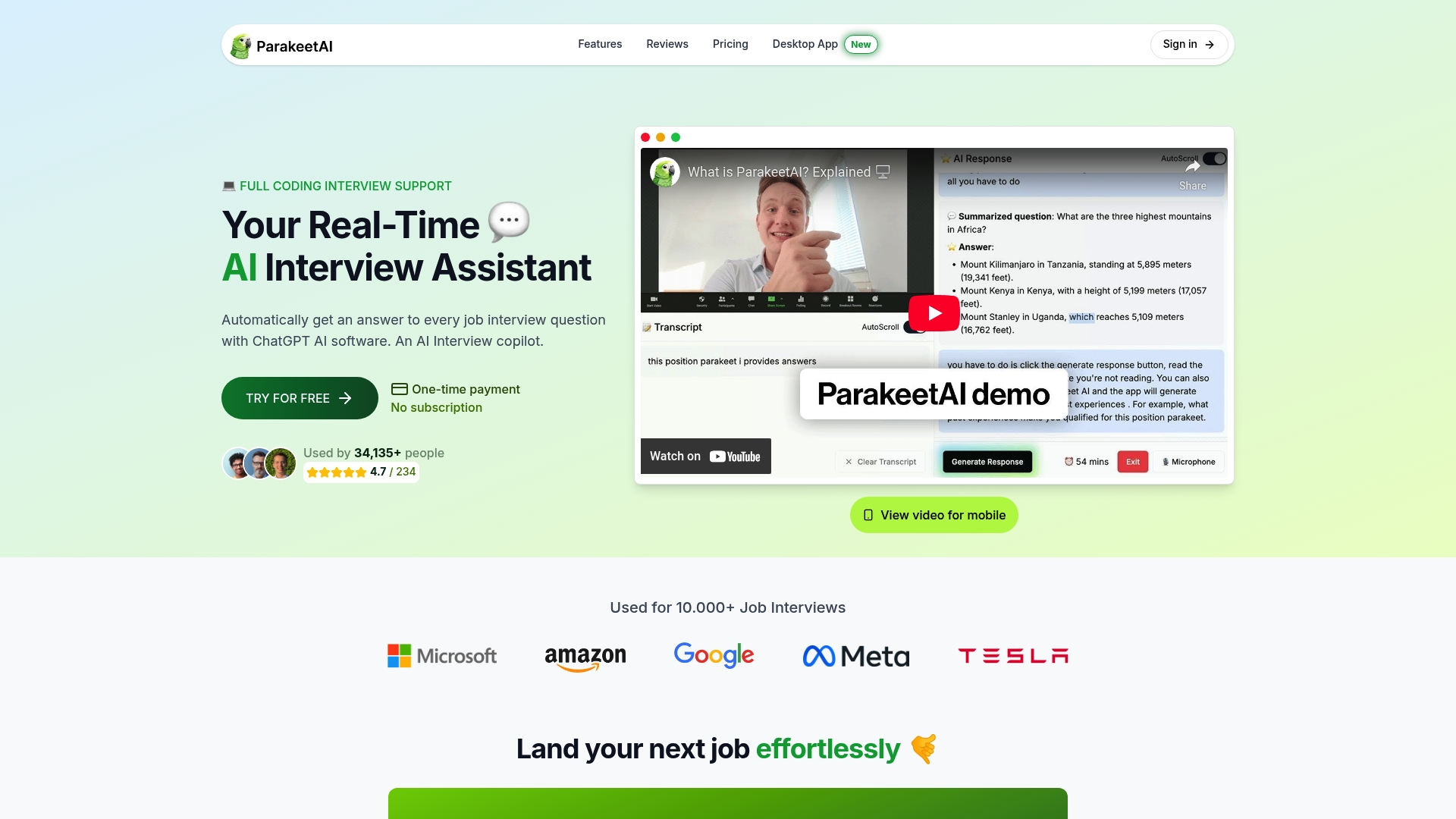
ParakeetAI is a real-time AI interview assistant that listens to your interview and automatically surfaces answers to every question as it happens. Beyond live support, it helps you practice with realistic question simulations, analyze your responses, and get personalized feedback on exactly the kinds of mistakes covered in this article. Whether you’re preparing for your first interview or your fiftieth, the ParakeetAI platform gives you a competitive edge that most candidates simply don’t have. Sign up and start practicing today.
Frequently asked questions
What is the number one interview mistake candidates make?
Negative attitude and criticizing past employers is the single biggest disqualifier, with 64% of candidates losing offers due to negativity toward previous employers.
Does using AI for interview prep hurt your chances?
Over-reliance on AI can make responses sound robotic and generic, so always layer in your own voice, specific examples, and genuine energy.
How important is a thank-you email after the interview?
Following up within 24 hours significantly boosts your chances, yet only 25 to 29% of candidates actually send a thank-you note after their interview.
Which soft skills do employers value most in interviews?
Employers prioritize communication, adaptability, and teamwork, and 88% of employers rank soft skills above technical qualifications when making their final hiring decision.
Can being nervous in an interview cost you the job?
Nervousness is sometimes mistaken for poor preparation, but using structured answers and staying self-aware can clearly demonstrate your true capabilities to the interviewer.