
Understand and Overcome Bias in AI Interview Systems

TL;DR:AI interview systems can unintentionally reinforce biases based on training data and design choices.Candidates from minority groups, with accents, neurodiverse traits, or non-traditional backgrounds are most affected by AI bias.Preparedness, transparency, and legal rights empower job seekers to challenge and improve AI-driven hiring fairness.
AI-powered interview tools promise objectivity, yet AI interview systems can unintentionally favor certain candidate types based on gender, accent, or background. If you’ve ever wondered why a perfectly strong interview still resulted in rejection, bias hidden inside the algorithm could be part of the story. This article breaks down exactly how bias enters these systems, who bears the heaviest cost, and what you can do right now to protect yourself and push for fairer hiring practices. You deserve to walk into every interview, AI-powered or not, knowing what’s working for or against you.
Table of Contents
- How bias enters AI interview systems
- Real-world impacts: Evidence from studies and edge cases
- AI vs. human interview bias: Comparing outcomes
- How job seekers can protect themselves and advocate for fairness
- Why job seekers must challenge AI biases proactively
- Empower your interview journey with trusted AI
- Frequently asked questions
Key Takeaways
| Point | Details |
|---|---|
| Bias has multiple sources | AI interview tools may reflect historical, data-driven, and design-driven biases if not carefully built. |
| Certain groups face greater risks | Edge cases like disabilities, accents, and non-traditional backgrounds can increase bias exposure. |
| AI can improve fairness | Regular audits, structured assessments, and hybrid approaches help AI outperform inconsistent human interviews. |
| Know your rights | Job seekers can leverage new transparency and appeal protections to ensure fair AI-based hiring. |
| Advocate for change | Candidate feedback and activism drive companies to improve AI fairness and transparency. |
How bias enters AI interview systems
Bias in AI interview tools doesn’t appear out of nowhere. It’s built in, often accidentally, through a series of design and data choices that nobody stopped to question. Understanding the pipeline helps you see where the cracks form.
The most common entry point is training data. If a company trained its AI on decades of past hiring decisions, and those decisions favored one demographic over another, the AI learns to replicate that pattern. It doesn’t know it’s being unfair. It just optimizes for what “good” looked like historically.
Here are the main ways bias is introduced through training data, algorithmic choices, and features tied to demographics:
- Historical hiring data reflects the biases of human recruiters from previous eras, encoding preferences for certain schools, names, or communication styles.
- Algorithmic design choices assign weights to features (like speaking pace or word choice) without always testing whether those features are actually tied to job performance.
- Facial recognition and voice analysis can correlate with race, gender, or disability status, creating proxies for protected characteristics even when no one intended that outcome.
- Scoring thresholds are often set without demographic testing, meaning a cutoff score might disproportionately screen out minority candidates.
Researchers studying AI recruitment bias have found that these systems often treat surface-level signals, like eye contact or vocal energy, as proxies for intelligence or leadership, even when the evidence connecting those signals to job success is thin.
Once a biased model is deployed, it’s hard to detect because the outputs look like legitimate scores, not discrimination. Companies using these tools often don’t audit them regularly, which means the bias compounds over thousands of decisions. Exploring AI interview fairness resources can help you understand what a rigorous, unbiased system actually looks like.
“AI systems can amplify historical biases if not carefully designed.”
That quote isn’t just a warning for HR teams. It’s a reminder that every candidate facing an AI screen deserves to ask hard questions about how the system was built.
Real-world impacts: Evidence from studies and edge cases
Understanding the sources of bias, let’s examine how this plays out in real hiring scenarios and who is most impacted.
The data here is sobering. Studies show gender and positional bias in AI interview systems, with edge cases hitting candidates who are neurodiverse, speak with an accent, or have career gaps particularly hard.
| Bias type | Observed impact | Groups most affected |
|---|---|---|
| Gender bias | Female candidates scored lower in male-dominated fields | Women in STEM, finance |
| Positional bias | First or last responses in a list ranked higher | All candidates, unpredictably |
| Accent and speech pattern bias | Non-standard accents penalized by voice AI | Non-native English speakers |
| Neurodiversity bias | Eye contact and pace norms penalized atypical communication | Autistic, ADHD candidates |
| Prestige bias | Graduates from non-flagship schools scored lower | First-generation college students |
An AI interview study examining automated video interviews found that voice analysis tools flag hesitation patterns common in candidates with anxiety or ADHD as signs of low confidence, even when responses were substantively strong.
These aren’t edge cases affecting a small population. They represent a large and growing share of the workforce. The role of voice AI in interviews deserves scrutiny because voice-based scoring is now common, and its failure modes are real.
Groups disproportionately affected by AI interview bias include:
- Disabled candidates whose communication style differs from neurotypical norms
- Accented or multilingual speakers penalized by speech recognition errors
- Candidates with career gaps flagged as higher risk by predictive models
- Graduates from non-prestige institutions scored against benchmarks tied to elite alumni data
Pro Tip: Check whether the company you’re interviewing with uses facial analysis in scoring. HireVue dropped facial analysis after widespread critique about its predictive value and bias risk. Other companies haven’t followed yet, so it’s fair to ask.
Knowing why you might want to use AI job interviews as part of your own preparation helps level the playing field when systems like these aren’t fully equitable.
AI vs. human interview bias: Comparing outcomes
With real-world impact clear, it’s important to consider whether AI can actually improve fairness compared to traditional human interviewers.
Human interviewers carry their own biases, and research confirms that snap judgments in unstructured interviews are notoriously inaccurate. A well-designed AI system, built on structured assessments and regularly audited, can actually outperform a biased human panel. The key phrase is “well-designed.”
| Factor | AI interview | Human interview |
|---|---|---|
| Consistency | Applies same criteria every time | Varies by interviewer mood and context |
| Transparency | Can generate audit trails | Rarely documented formally |
| Bias risk | Encodes historical bias if untested | Susceptible to halo effect, affinity bias |
| Explainability | Often a black box without audits | Can be questioned directly |
| Fairness potential | High, with proper design and oversight | Moderate, depends on interviewer training |
Research on structured AI assessments shows that AI can outperform biased humans when the system uses validated, structured question formats and undergoes regular fairness audits. A recent study also confirmed that hybrid models, combining AI scoring with human review, produce more equitable outcomes than either method alone.
Situations where AI reduces bias and where it creates new risks:
- AI reduces bias when replacing unstructured “gut feel” interviews with scored, criteria-based assessments
- AI reduces bias when trained on diverse, representative datasets with demographic testing
- AI introduces new bias when facial or voice features are weighted without validation
- AI introduces new bias when audit cycles are skipped or results are never reviewed by humans
If you want to understand what fair AI-driven hiring actually looks like, the interview fairness guide offers a practical breakdown. Understanding AI for faster hiring also explains how speed and fairness don’t have to be in conflict when systems are built right. Digging into why AI is critical for modern interviews gives you the fuller picture on its legitimate advantages.
How job seekers can protect themselves and advocate for fairness
Knowing the strengths and limits of AI, here’s what you can do to protect yourself and help ensure fair treatment during AI-powered interviews.
You have more leverage than you think. New regulations are expanding your rights, and smart preparation helps you perform within AI scoring criteria while pushing back against systems that aren’t fair.
- Research the company’s AI tools before the interview. Ask the recruiter which platform they use, and look up whether it has faced bias complaints or regulatory scrutiny.
- Respond with structure in every answer. Competency-based frameworks like STAR (Situation, Task, Action, Result) play directly into how AI systems score responses, rewarding clear, organized thinking.
- Prepare for technical failures by ensuring good lighting, a neutral background, and a stable internet connection. Poor technical conditions can skew AI scoring unrelated to your actual answers.
- Ask about AI disclosure directly. In states covered by laws like the Illinois AI Video Interview Act, employers must tell you when AI is used in screening and explain how it works.
- Know your appeal rights. Regulations in growing jurisdictions now mandate audits and transparency, giving you legal grounds to request an explanation if AI played a role in a rejection.
According to reporting by Harvard Business Review, a growing share of job seekers now have access to appeal mechanisms under AI hiring laws, though awareness of those rights remains low. Reading up on AI interview compliance helps you understand exactly what employers are required to disclose in your region.
Pro Tip: Focus on substance over style when preparing for AI interviews. A clear, specific answer demonstrating real experience will score higher than a polished but vague one. AI systems reward content depth, not charisma.
Why job seekers must challenge AI biases proactively
Here’s something most career advice skips: the idea that technology is neutral is a myth, and believing it puts you at a disadvantage.
AI interview systems are built by humans, trained on human decisions, and deployed without enough scrutiny. Every time a candidate accepts a biased outcome without question, they quietly validate a flawed system. But when job seekers ask about AI tools, request transparency, and use their legal rights, companies feel pressure to actually audit what they’ve built.
The hybrid human-AI approaches with clear explainability outperform both pure-AI and pure-human methods, but most companies won’t invest in that unless candidates and regulators push them to. Your questions during a hiring process aren’t just good for you. They make the system better for everyone who interviews after you.
Look at AI interview consistency as the standard you should expect, not a feature you should feel grateful for.
“Fairness in hiring isn’t accidental. It’s made by people who demand it.”
That’s the mindset shift worth making. You’re not just a candidate trying to pass a screen. You’re a participant in shaping how AI-powered hiring evolves.
Empower your interview journey with trusted AI
The bias problem in AI interviews is real, but it doesn’t mean you’re powerless. Preparation, awareness, and the right tools can meaningfully change your outcomes.
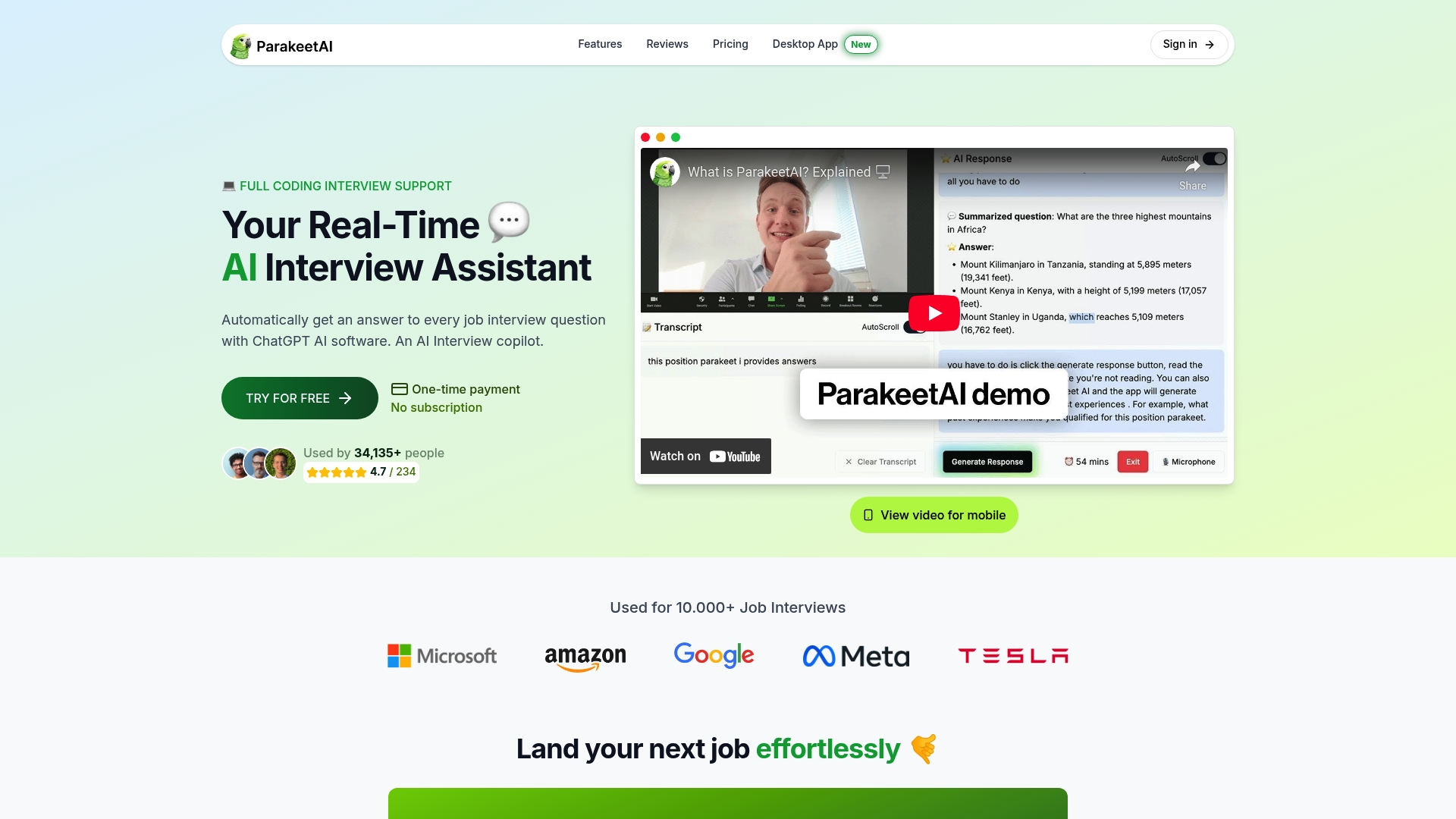
ParakeetAI is a real-time AI interview assistant that listens during your interview and delivers accurate, relevant answers to every question as it happens. Unlike tools that simply evaluate you, ParakeetAI works for you, helping you respond with clarity and confidence regardless of which platform the employer is using. If fairness matters to you, starting your preparation with a tool built around your success is the smartest first step you can take.
Frequently asked questions
How do AI interview systems become biased?
Bias enters AI systems through historical training data, algorithmic design decisions, and features that correlate with demographic characteristics like race, gender, or disability status.
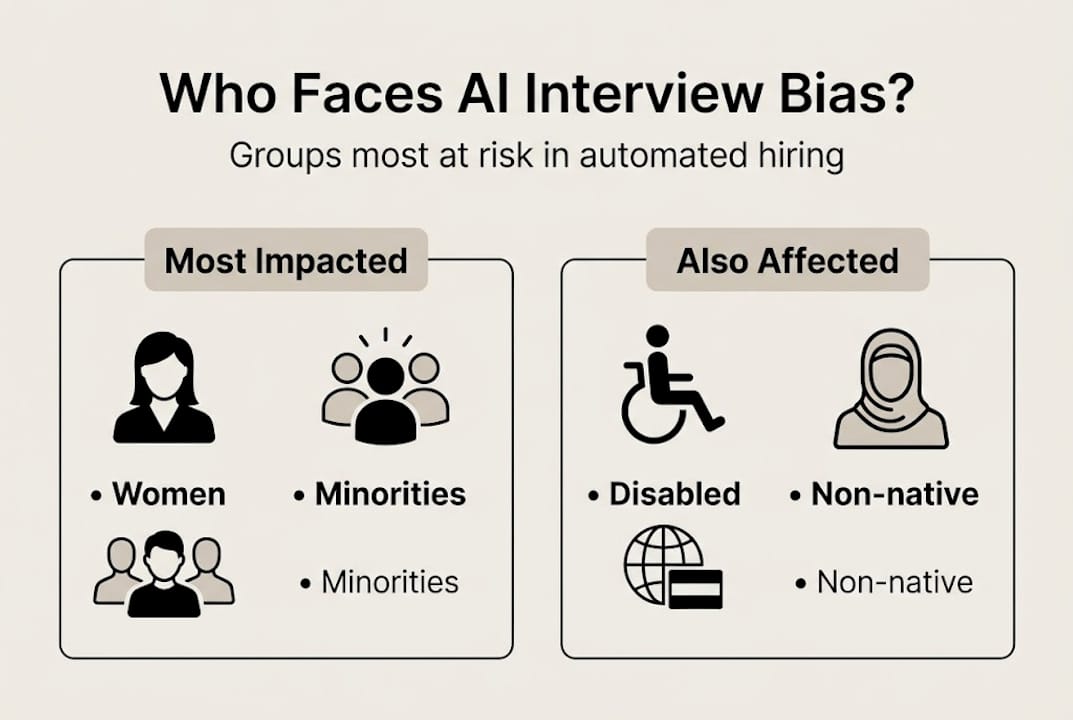
Which groups are most affected by AI interview bias?
Bias disproportionately affects women, minorities, disabled applicants, non-native English speakers, and candidates with non-traditional backgrounds, including those with autism, ADHD, or career gaps.
Can AI interview systems be fairer than humans?
Well-audited AI can reduce inconsistencies and human bias, but the system’s design, training data, and ongoing oversight are what determine whether it actually delivers fairer outcomes.
What legal protections do job seekers have against AI interview bias?
New laws, including the Illinois AI Video Interview Act, require employers to disclose AI use and allow candidates to request explanations. Regulations mandate audits and transparency, giving you the right to appeal AI-driven hiring decisions in covered jurisdictions.