
How AI Is Transforming Career Counseling for Job Seekers

TL;DR:AI utilizes machine learning, natural language processing, and recommendation systems to enhance career guidance.Hybrid models combining AI analytics with human empathy deliver the most effective career support.AI is best used as a tool for analysis and recommendation, supplemented by human mentorship.
Most job seekers assume career advice requires a human on the other side of the desk. Someone who has lived through layoffs, industry shifts, and the awkward silence after a bad interview answer. But AI is quietly dismantling that assumption. Today’s career counseling platforms use machine learning, natural language processing, and behavioral analysis to deliver guidance that is faster, more consistent, and increasingly personalized. This article separates real capability from marketing hype and shows you exactly where AI adds value, where it falls short, and how to use it strategically in your job search.
Table of Contents
- The AI technologies reshaping career counseling
- How effective is AI in providing career guidance?
- The pros and cons of AI-driven career counseling
- Real-world applications: How to leverage AI for job search and interview success
- Our perspective: Why hybrid human-AI guidance gives job seekers the edge
- How ParakeetAI accelerates your career journey
- Frequently asked questions
Key Takeaways
| Point | Details |
|---|---|
| AI foundations | AI career counseling platforms use machine learning and NLP for personalized job matching and advice. |
| Effectiveness benchmark | Current AI models provide accurate career advice about 77 percent of the time, but expert review remains necessary. |
| Hybrid approach | The most successful career guidance pairs AI analytics with empathetic human coaching for nuanced results. |
| Practical use | Job seekers should combine AI tools with professional feedback for the best job search outcomes. |
The AI technologies reshaping career counseling
Before you can use AI effectively in your career search, you need to understand what it is actually doing behind the scenes. Three core technologies drive most modern career counseling platforms.
Machine learning (ML) identifies patterns in massive datasets. It learns from thousands of successful career paths and maps your profile against those patterns to suggest roles, industries, or skill upgrades.
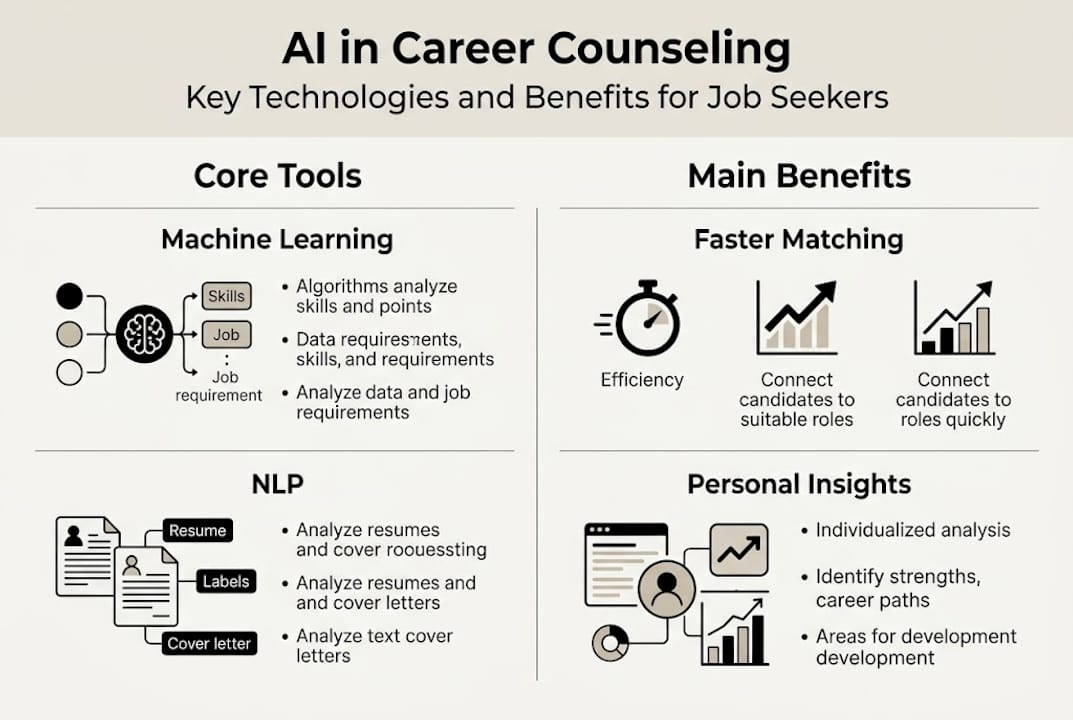
Natural language processing (NLP) reads and interprets text. It scans your resume for keywords, evaluates sentence structure, and even analyzes tone in interview simulations.
Recommendation systems are the same engines that power Netflix and Spotify. In career counseling, they match your skills and preferences to job openings, learning programs, or networking opportunities.
Here is how these technologies map to specific functions:
| AI Technology | Function in career counseling |
|---|---|
| Natural language processing | Resume analysis, interview feedback, job description matching |
| Machine learning | Personalized advice, skill gap analysis, salary benchmarking |
| Recommendation systems | Job matching, course suggestions, career path forecasting |
| Computer vision | Video interview analysis, body language scoring |
| Predictive analytics | Market trend forecasting, hiring demand signals |
Practical applications already in use include:
- Skill gap analysis: AI compares your current skills to those required in your target roles and flags what is missing
- Interview simulation: Real-time feedback on your answers, pacing, and word choice
- Market trend forecasting: Identifying which industries are growing and which are contracting
- Transferable skill discovery: Surfacing strengths you may not have thought to highlight
As AI in job matching platforms evolve, the depth of personalization keeps improving. Research confirms that AI-powered career coaching uses machine learning, NLP, and recommendation algorithms to analyze user profiles and generate tailored recommendations at a scale no human counselor could match.
“AI’s greatest advantage in career guidance is not replacing human judgment but scaling personalized support to millions of users simultaneously.” — New America, AI scalability and personalization
How effective is AI in providing career guidance?
Knowing the technology exists is one thing. Knowing whether it actually works is another. Recent benchmarks give us a clearer picture.
Studies show that large language models provide complete and correct career advice roughly 77% of the time. That means about 23 to 30% of responses miss important nuance, context, or accuracy. Benchmarks like CareerNet were specifically designed to test these gaps and confirm that room for improvement remains.

Here is a side-by-side look at how AI, human counselors, and hybrid models compare:
| Criteria | AI only | Human only | Hybrid model |
|---|---|---|---|
| Accuracy | High for data-driven tasks | High for nuanced situations | Highest overall |
| Empathy | Low | High | High |
| Personalization | High at scale | High but limited capacity | High |
| Bias risk | Moderate (algorithmic) | Moderate (human) | Lower with oversight |
| Availability | 24/7 | Limited hours | Flexible |
Breaking it down further:
- What AI does well: Rapid resume analysis, consistent scoring, pattern recognition across thousands of job listings, and instant feedback on interview responses
- Where it falls short: Emotional support, understanding unique personal circumstances, navigating office politics, and handling career situations outside its training data
- How to maximize its strengths: Use AI for the analytical heavy lifting, then bring a mentor or coach into the conversation to interpret results and add context
Trust levels also vary by user background. Postgraduate students tend to place more confidence in AI guidance than undergraduates, though both groups find value in AI recommendations. This suggests that experience with complex information helps users calibrate how much weight to give AI output.
For fairness considerations, it is worth reviewing AI interview ethics and understanding interview fairness with AI before relying on any single platform.
The pros and cons of AI-driven career counseling
AI in career counseling is not a simple upgrade over traditional methods. It comes with real trade-offs you need to understand before building your strategy around it.
Benefits:
- Personalization at scale: AI can tailor advice to your specific background without the cost of a private career coach
- Transferable skill discovery: Algorithms surface skills you have that apply to new industries, which is especially valuable for career changers
- Market insights: Real-time data on hiring trends, salary ranges, and in-demand skills
- Consistency: AI applies the same criteria to every user, reducing the variability you might get from different human counselors
- Availability: Guidance at 2 a.m. before a big interview is genuinely useful
Drawbacks:
- Algorithmic bias: AI trained on historical data can reinforce existing inequalities
- Lack of empathy: AI cannot recognize when you are discouraged and need encouragement, not just data
- Procedural justice concerns: Users often feel the process is unfair even when outcomes are reasonable
- Overreliance risk: Treating AI output as final truth rather than a starting point
- Edge-case failures: Unusual career paths, niche industries, or unconventional backgrounds often confuse AI systems
The fairness issue deserves special attention. Research shows that asynchronous AI interviews deter more than 50% of applicants, with women being disproportionately affected. Interestingly, AI scoring systems sometimes rate women and minorities higher than human reviewers do, but perceived fairness remains a real barrier to adoption.
For job seekers, this means the platform you choose matters. Look for tools that offer smart, fair resume reviews and maintain AI interview compliance standards.
Pro Tip: Use AI as an enhancer, not a replacement. Run your resume through an AI tool, then ask a mentor to review the suggestions before acting on them. The combination is far more powerful than either alone.
“The optimal path forward is not AI replacing career counselors but AI handling the analytical load while humans provide the empathy, nuance, and encouragement that machines cannot replicate.” — Hybrid human-AI models, New America
Real-world applications: How to leverage AI for job search and interview success
Theory is useful. Action is better. Here is a step-by-step approach to putting AI to work in your actual job search.
- Optimize your profile: Feed your resume and LinkedIn profile into an AI tool. Let it identify gaps, suggest stronger keywords, and flag inconsistencies before a recruiter sees them.
- Run simulated interviews: Use AI interview simulators to practice answering common and role-specific questions. Review the feedback on your language, pacing, and structure.
- Discover transferable skills: If you are changing careers, AI tools can map your existing experience to requirements in your target field. Research confirms that AI identifies transferable skills and forecasts market trends, though low-tech industries and edge cases still benefit from human insight.
- Track your applications: AI-powered application trackers monitor deadlines, follow-up timing, and response rates so nothing falls through the cracks.
- Research industry fit: Use AI to analyze which sectors are actively hiring in your target location and skill set.
Confidence in AI guidance is not uniform. Postgrads score higher confidence in AI career advice (M=4.53) compared to undergrads (M=4.29), but both groups trust AI for recommendations. If you are newer to the workforce, pairing AI output with human mentorship helps close that confidence gap.
Pro Tip: AI tools perform best in tech, finance, healthcare, and other data-rich industries. If you are targeting a niche or relationship-driven field, supplement AI insights with direct outreach and human networking. Explore how AI in corporate hiring is shaping recruitment in your target sector.
Our perspective: Why hybrid human-AI guidance gives job seekers the edge
Here is the uncomfortable truth most AI career tools will not tell you: AI is a powerful filter, not a final judge. It excels at pattern recognition, consistency, and scale. It struggles with context, encouragement, and the kind of nuanced conversation that actually changes how a person thinks about their career.
We have seen job seekers over-index on AI feedback and walk into interviews sounding polished but robotic. The resume scores were perfect. The answers were optimized. The human connection was missing.
The best results come from treating AI as your analytical co-pilot and a real person as your sounding board. Expert career coaching combined with AI analytics consistently outperforms either approach alone. Research backs this up: hybrid human-AI models are optimal because AI handles the data while humans provide the empathy and nuance that no algorithm has mastered yet.
The future of career guidance is not either-or. It is about knowing when to trust the machine and when to call a person.
How ParakeetAI accelerates your career journey
If you are ready to move from reading about AI to actually using it in your next interview, ParakeetAI is built for exactly that moment.
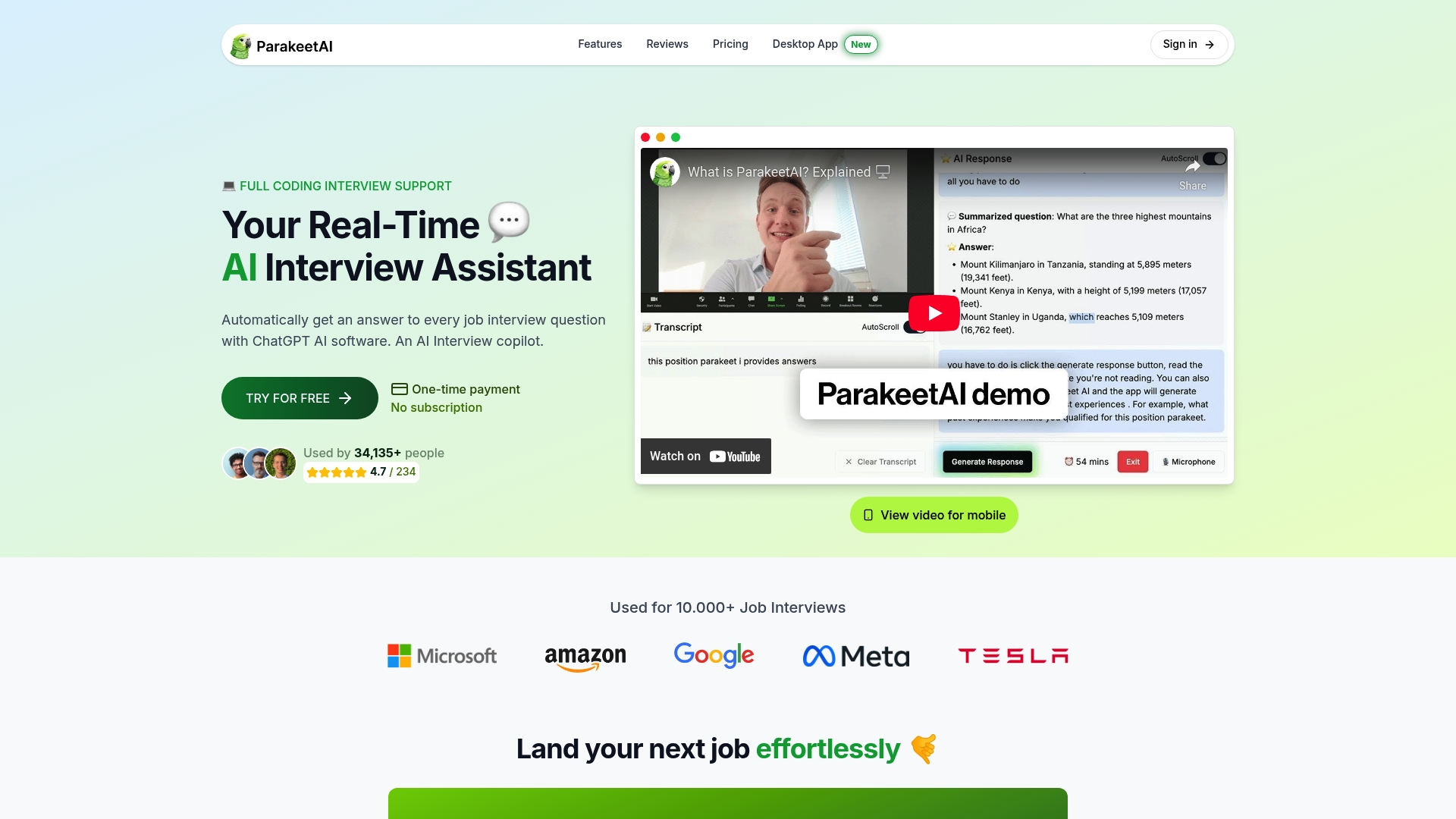
ParakeetAI is a real-time AI interview assistant that listens to your interview as it happens and automatically surfaces answers to every question using AI. No more blanking on behavioral questions or losing your train of thought under pressure. You get instant, context-aware support exactly when you need it. Visit the ParakeetAI platform to explore the tools, run a simulated interview, and see how AI-driven guidance feels in practice. The next interview does not have to feel like a test you are taking alone.
Frequently asked questions
How does AI personalize career advice?
AI analyzes your skills, interests, and experience using ML and NLP algorithms to generate career suggestions tailored specifically to your profile rather than generic advice.
Can AI interviews be biased?
AI interviews can reduce certain human biases but may introduce new fairness concerns, particularly since asynchronous AI interviews deter more than 50% of applicants, especially women.
What are the main risks of relying solely on AI for career guidance?
Overreliance on AI can result in missing important context or empathy, and algorithmic bias risks mean AI works best when paired with human support rather than used as a standalone solution.
Are certain people more confident in AI-driven career guidance?
Yes. Studies show postgrads score higher confidence in AI guidance (M=4.53) than undergrads (M=4.29), though both groups find AI recommendations valuable for career decisions.