Phone Interviews: 10 Proven Tips to Get Hired

TL;DR:Treat phone interviews as serious assessments because they are crucial screening steps that determine if you progress. Preparation, clear communication, and confident delivery significantly influence interview success; overlooking these aspects can cost you the job opportunity.
Most candidates treat phone interviews as a warm-up. That is exactly why they lose the job. A telephone interview is a genuine screening round where hiring managers decide in roughly 30 minutes whether you move forward or disappear from the pile. No eye contact, no firm handshake, no body language to save you. Just your voice, your words, and how well you prepared. The good news: that is entirely controllable, and this guide walks you through every step.
Table of Contents
- Key Takeaways
- 1. Confirm all logistics before your phone interview
- 2. Research the company and role thoroughly
- 3. Build a one-page quick-reference card
- 4. Use the STAR method to answer behavioral questions
- 5. Master your vocal delivery
- 6. Handle note-checking without breaking the flow
- 7. Prepare smart questions to ask the interviewer
- 8. Set up a distraction-free environment
- 9. Handle salary and availability questions confidently
- 10. Send a thank-you email within 24 hours
- Comparing strategies by impact
- My honest take on phone interviews
- Let Parakeet-ai give you an edge in your next interview
- FAQ
Key Takeaways
| Point | Details |
|---|---|
| Preparation beats improvisation | Researching the role and building a one-page reference card dramatically increases your calm and clarity during the call. |
| Voice carries your whole presence | Without visual cues, pacing, tone, and pausing do the work that body language would normally do for you. |
| Structured answers win | Using the STAR method for behavioral questions makes your answers specific, memorable, and easier for interviewers to score. |
| Logistics matter as much as answers | A quiet space, charged device, and solid phone connection prevent avoidable problems that can derail a strong performance. |
| Follow-up separates serious candidates | A thank-you email within 24 hours reinforces your interest and keeps your name fresh in the interviewer’s mind. |
1. Confirm all logistics before your phone interview
The fastest way to start on the wrong foot is showing up confused about the basics. Before your call, confirm the scheduled date and time (including the time zone), the interviewer’s name and title, and whether they are calling you or you are calling them. These details sound minor until you dial in 10 minutes late because you forgot the time zone difference.
Confirm the scheduled details and also look up the interviewer on LinkedIn. Knowing whether you are speaking with a recruiter, a hiring manager, or a department head changes how you pitch yourself. A recruiter wants to know whether you clear the basic requirements. A hiring manager wants to know whether you can actually do the job.
Pro Tip: Add the interview to your calendar with a 15-minute reminder, include the dial-in number, and note the interviewer’s full name so you can greet them confidently the moment they pick up.
2. Research the company and role thoroughly
Generic answers get generic results. Before you pick up the phone, spend at least an hour understanding the company’s mission, recent news, key products or services, and the specific requirements of the role. Read the job description closely and underline every skill or requirement that matches your background.
This research does two things. First, it gives you concrete talking points. Instead of saying “I’m a good communicator,” you can say “I noticed your team is scaling customer support across three markets. In my last role, I built a support process that cut response time by 40%.” Second, it signals genuine interest. Interviewers can tell when a candidate has done the homework.
Pro Tip: Check the company’s LinkedIn page, recent press releases, and Glassdoor reviews the night before. You will pick up context that most candidates miss entirely.
3. Build a one-page quick-reference card
You are allowed to have notes during a telephone interview. Use that advantage. Practitioners consistently recommend a one-page reference card over a full written script because a script makes you sound flat and rehearsed. A reference card gives you structure without taking over your voice.

Your card should include three things: your top five accomplishments mapped to the job description, two or three bullet points for each likely question area, and the questions you plan to ask the interviewer. Print it out or put it on a second screen so your eyes do not wander to find it mid-sentence.
Check out this phone screening checklist for a complete breakdown of what to include before, during, and after the call.
4. Use the STAR method to answer behavioral questions
Common telephone interview questions cover your background, motivation, strengths and weaknesses, and behavioral situations. The behavioral ones trip up the most candidates. Questions like “Tell me about a time you handled a difficult coworker” or “Describe a project where you had to meet a tight deadline” require specific stories, not vague generalizations.
The STAR method (Situation, Task, Action, Result) keeps your answer focused and factual. Describe the context briefly, explain what you needed to do, walk through exactly what you did, and state the outcome with a number if you have one. A 90-second STAR answer is almost always better than a 3-minute rambling one.
Structured interviews have a validity coefficient around 0.51 compared to 0.38 for unstructured ones. That means your ability to give consistent, organized answers genuinely predicts success at a measurable level.
5. Master your vocal delivery
Your voice is your entire first impression on a phone call. No visual cues exist to compensate for a weak or nervous tone. Voice must convey presence through pacing, warmth, and clarity since none of your body language comes through.
Speak at a deliberate pace, slightly slower than you would in casual conversation. Pause after finishing a key point. That pause signals confidence and gives the interviewer space to follow up. Avoid filler words like “um,” “like,” and “you know” because on a phone call, those sounds are amplified without anything visual to distract from them.
Stand up while you talk if it helps. Many candidates find their voice becomes more energetic and authoritative when they are on their feet. Smile, too. You cannot see it, but the interviewer can hear it in your tone.
6. Handle note-checking without breaking the flow
Taking notes during the call is smart. Going silent for 10 seconds while you rummage through them is not. The fix is simple: narrate when you check your notes. Say something like “Let me pull up a specific example for that one.” This keeps the conversation alive instead of creating an awkward silence that sounds like a tech issue.
Do not read directly from your notes. Use them as a cue, not a script. If the interviewer asks about your experience with data analysis and your note says “Salesforce project, 2023, reduced churn by 12%,” that is enough to anchor a full, natural answer without reciting text.
7. Prepare smart questions to ask the interviewer
The moment an interviewer asks “Do you have any questions for us?” is not the end of the call. It is a second interview. Candidates who ask nothing signal low interest. Candidates who ask sharp questions signal genuine engagement.
Prepare at least three questions in advance. Good ones go beyond salary and benefits: ask about the team’s biggest challenge this year, how success is measured in the first 90 days, or what the interviewer finds most rewarding about working there. These questions to ask interviewers show you are thinking about how you fit, not just whether you get an offer.
Avoid questions that are easily answered by the company website. It signals you did not do your research.
8. Set up a distraction-free environment
A barking dog, a noisy coffee shop, or a call that keeps cutting out can undo solid preparation. Choose a quiet indoor location with a strong phone signal or a reliable Wi-Fi connection. Close windows if there is street noise. Put other devices on silent. Tell anyone in your home that you are not available for the next hour.
Test your phone connection the night before. If you use a headset, test that too. Wired headsets typically provide better audio quality than wireless ones, and they eliminate the risk of a Bluetooth dropout mid-sentence.
Recording phone interviews without consent can be unlawful, so if the interviewer mentions the call is being recorded, that is normal. But if you want to record your own practice calls to review your delivery, confirm the rules in your location first.
Pro Tip: Do a mock call with a friend the day before. Ask them to rate your clarity, pacing, and energy. You will catch habits you never noticed.
9. Handle salary and availability questions confidently
Two questions derail candidates who have not rehearsed them: “What are your salary expectations?” and “When could you start?” Neither needs to be a trap.
For salary, research the market range before the call using sources like the Bureau of Labor Statistics or industry salary reports. Then give a range anchored at the top of what you would accept. If pressed for a single number, give it confidently. Hesitation here reads as uncertainty about your own value.
For availability, be honest but flexible. If you are currently employed and need to give two weeks notice, say that directly. Employers respect honesty. What they do not respect is vague answers that slow down their hiring decision. Preparing standard answers to predictable questions is one of the highest-leverage things you can do before any telephone interview.
10. Send a thank-you email within 24 hours
Most candidates do not send one. That is your opportunity. A thank-you email within 24 hours with relevant follow-up details shows professionalism and reinforces your candidacy at exactly the moment the interviewer is forming their impression.
Keep it short: three to four sentences. Thank them for their time, reference one specific thing you discussed that excited you about the role, and restate your interest. If you forgot to mention something important during the call, this is the place to add it briefly.
Do not just send “Thanks for the call, I look forward to hearing from you.” That is forgettable. Make yours specific.
Comparing strategies by impact
Not every tip delivers the same return. Here is how the core strategies stack up:
| Strategy | Must-Do or Nice-to-Do | Impact Level | Works Best For |
|---|---|---|---|
| Confirm logistics | Must-Do | High | Every candidate |
| Company and role research | Must-Do | Very High | Every candidate |
| One-page reference card | Must-Do | High | Every candidate |
| STAR method answers | Must-Do | Very High | Behavioral questions |
| Vocal delivery practice | Must-Do | High | First-time phone interviewees |
| Distraction-free setup | Must-Do | High | Remote or home-based candidates |
| Smart questions to ask | Must-Do | Medium-High | Competitive roles |
| Salary prep | Nice-to-Do | High | When salary is discussed early |
| Mock call with a friend | Nice-to-Do | Medium | Nervous or inexperienced candidates |
| Thank-you email | Must-Do | High | Every candidate |
The must-do column covers the basics that protect you from disqualifying yourself. The nice-to-do items push a solid candidate into standout territory. If you are short on time, prioritize the must-do column without exception.
My honest take on phone interviews
I have reviewed hundreds of candidate experiences across all kinds of roles, and one pattern stands out clearly. The people who struggle with phone interviews almost always underestimate them. They assume the real interview comes later, in person, so they wing the first call. That first call is where most people are eliminated.
What actually works is treating the telephone interview with the same seriousness as a final-round conversation. I have seen candidates with weaker resumes outperform stronger ones purely on the strength of preparation. They knew the company. They had stories ready. They asked sharp questions.
The other thing I have noticed is that most candidates focus entirely on what they will say, not how they will say it. On a phone call, the “how” is everything. A confident, measured voice signals competence even before the content of your answer lands. Pausing when you need a moment reads as thoughtfulness, not hesitation, when you have been practicing it.
Own your story with specifics. Every answer becomes stronger with a real number, a real outcome, or a real name. Generic answers with no evidence behind them do not move hiring managers. Yours should.
— Jure
Let Parakeet-ai give you an edge in your next interview
Preparing for a telephone interview takes real effort. Knowing whether your answers are landing, which questions trip you up, and where your delivery weakens is harder to figure out on your own.
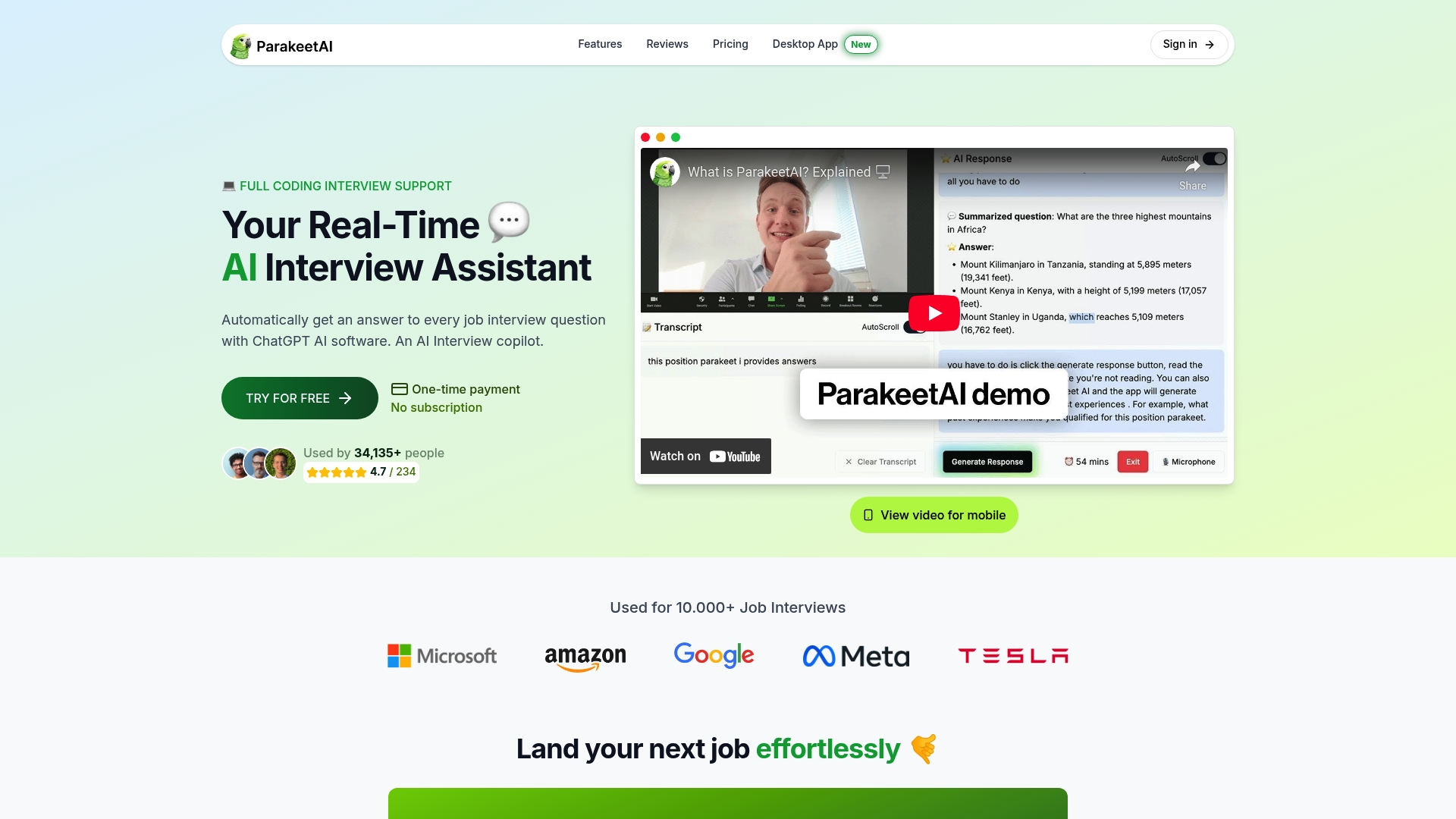
Parakeet-ai is a real-time AI interview assistant that listens during your interview and automatically provides answers to every question as it happens. Whether you are preparing for phone interviews or walking into a high-stakes final round, Parakeet-ai gives you the structure and confidence to perform at your best. Visit Parakeet-ai to see how it works and start your next interview prepared instead of guessing. You can also explore phone interview tips to keep building your strategy.
FAQ
How long do phone interviews typically last?
Phone interviews usually run about 30 minutes and function as an early screening step to determine whether a candidate moves to the next round.
What questions should I expect in a telephone interview?
Typical telephone interview questions cover your background, motivation for applying, key strengths and weaknesses, and behavioral situations answered with the STAR method.
Can I use notes during a phone interview?
Yes. Keep a one-page reference card nearby and narrate briefly if you check it, so the interviewer does not hear an unexplained silence.
Should I send a thank-you email after a phone interview?
Absolutely. Send a brief, specific thank-you email within 24 hours to reinforce your interest and stand out from candidates who skip this step.
How do I handle nervousness on a phone call?
Practice out loud with a friend or record yourself the day before. Slowing your pace, pausing deliberately, and smiling while you speak all reduce the sound of nerves without requiring you to feel calm first.