
What Is Interview Response Mapping? a Job Seeker's Guide

TL;DR:Response mapping is a strategic approach to preparing interview answers by creating flexible frameworks aligned with job competencies. It helps candidates communicate their thought process clearly within 60 to 90 seconds, demonstrating competence beyond memorized scripts. Building and practicing these maps enhances confidence, organization, and the ability to adapt under pressure during interviews.
Most candidates walk into interviews with rehearsed scripts and hope for the best. That approach fails more often than it should, because interviewers can spot a memorized answer from across the table. Interview response mapping is a different approach entirely. It’s a strategic framework for planning, organizing, and delivering answers that align with what the interviewer actually needs to hear. This guide explains what response mapping is, why it works, and how you can build your own maps before your next interview.
Table of Contents
- Key takeaways
- What interview response mapping actually is
- Why response mapping improves your actual results
- How to build your own response map
- Common interview mapping techniques compared
- Applying your response map to real interview scenarios
- My take on what response mapping really teaches you
- Take your interview prep further with Parakeet-ai
- FAQ
Key takeaways
| Point | Details |
|---|---|
| Response mapping is strategic, not scripted | Build flexible answer frameworks tied to job competencies, not word-for-word memorization. |
| 60 to 90 seconds is your target answer window | Answers shorter than 30 seconds or longer than 4 minutes hurt your chances. |
| Interviewers prioritize how you think | Mapping your thought process can demonstrate competence even without direct experience. |
| STAR is a building block, not the whole system | Use STAR as one tool within a broader response map that includes context and relevance. |
| Pauses are part of the strategy | A 5 to 10 second pause before a difficult answer signals maturity, not hesitation. |
What interview response mapping actually is
Interview response mapping is the process of systematically planning and structuring your interview answers so they align with the job’s requirements and the interviewer’s expectations. Think of it as pre-building the architecture of your responses before you ever walk into the room.
Where most candidates either memorize exact scripts or wing it entirely, response mapping sits in the middle. You create a flexible blueprint for each major question type, drawing connections between your experiences and the competencies the role demands. The goal is not to recite a prepared speech. The goal is to have a clear mental path to follow under pressure.
The core components of a response map typically look like this:
- Situation: The context or background of the story you’re telling
- Task: Your specific responsibility in that situation
- Action: The exact steps you took, and why you chose them
- Result: The measurable or observable outcome of your actions
- Relevance: How this story connects directly to the role you’re applying for
- Thought process: The logic behind your decisions, which matters more than most candidates realize
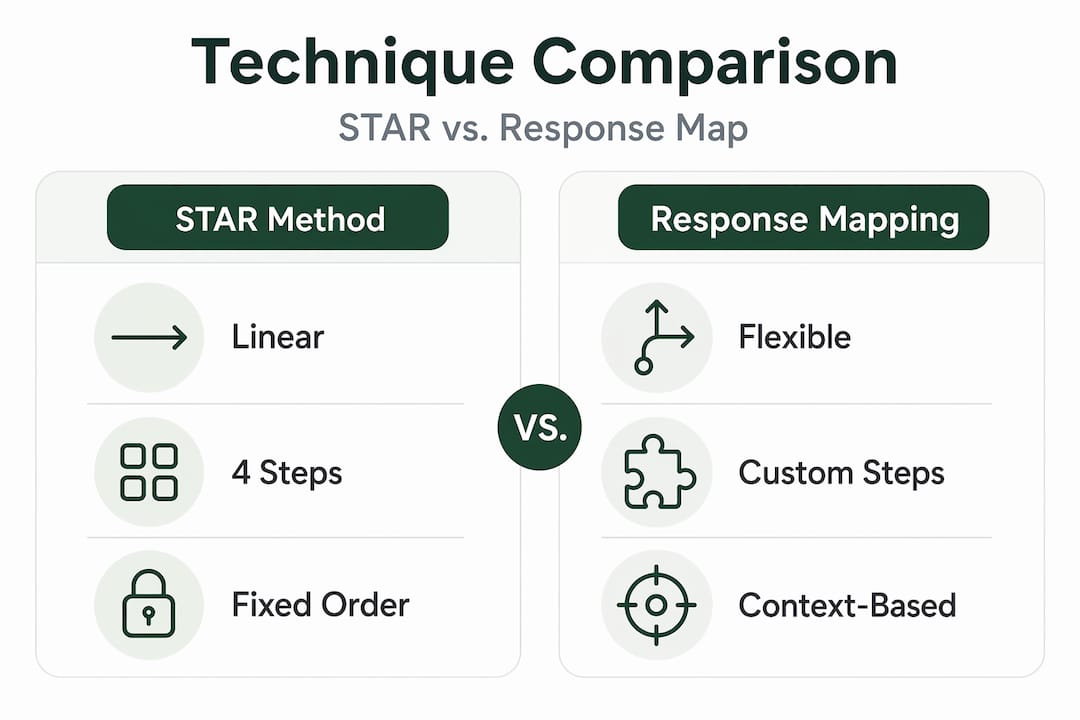
Response mapping shares DNA with the STAR technique, but it extends beyond four boxes. STAR tells you what categories to hit. Response mapping adds the layer of why those categories matter for this specific job, this specific interviewer, and this specific question.
A quick comparison helps clarify how these approaches differ:
| Technique | Focus | Flexibility | Best used for |
|---|---|---|---|
| STAR method | Story structure | Low to medium | Behavioral questions |
| Mind mapping | Visual idea connection | High | Brainstorming answer paths |
| Response mapping | Strategic alignment + structure | High | All question types |
| Script memorization | Word-for-word recall | Very low | Rarely recommended |
Response mapping works because it gives your brain a reliable path to follow when nerves kick in. Instead of searching for the right words in real time, you’re navigating a structure you’ve already built.
Why response mapping improves your actual results
The case for mapping your responses is practical, not theoretical. Optimal answer length sits between 60 and 90 seconds for most questions, with behavioral stories stretching up to 2 minutes. Answers under 30 seconds suggest you haven’t prepared. Answers over 4 minutes suggest you can’t communicate. Response mapping keeps you in the right range by giving you a structure that naturally contains your answer.

Candidates who skip mapping tend to make predictable mistakes. They ramble because they don’t have a clear endpoint. They forget to include results because they got lost in the situation. They under-explain their actions because they assumed the interviewer would fill in the gaps. A response map eliminates all three problems at once.
There’s another benefit that most candidates overlook. Interviewers prioritize how you think over whether you have exact experience. When you map your thought process into your answer, you show cognitive competence. You show a hiring manager how you approach problems. That matters enormously in roles where some skills will need to be learned on the job.
“The best candidates I’ve interviewed didn’t always have every skill listed in the job description. But they could always articulate their thinking clearly and connect their past decisions to the outcomes that followed.”
Pro Tip: Before your interview, write one sentence summarizing the core result of each story in your response map. If you can’t summarize it in one sentence, the story isn’t ready yet.
Strategic pauses also become part of the system. A 5 to 10 second pause before answering a difficult question signals maturity and prevents disorganized responses. Most candidates feel compelled to start talking immediately. Mapping teaches you to pause, locate your framework, and then begin. That small habit changes how interviewers perceive your confidence.
How to build your own response map
Building a response map is not complicated. It takes time and deliberate effort, but the process is straightforward. Here is how to do it.
- Analyze the job description deeply. Don’t skim it for keywords. Read it to identify the three to five core competencies the role requires. These are the themes your entire map will organize around. A project manager role might center on stakeholder communication, scope management, and cross-team coordination. Write those down.
- Build your story inventory. For each competency, identify two or three real examples from your past. Effective interview preparation involves reviewing your history and crafting adaptable stories aligned to the competencies you’ve identified. These don’t need to be perfect experiences. They need to be honest, specific, and outcome-oriented.
- Map each story to the STAR structure plus relevance. For every story, note the situation in one or two sentences. Write the task in one sentence. Describe the actions you took, including the reasoning behind them. Record the result with a concrete detail whenever possible. Then add a final “relevance” note that explains why this story matters for the specific role. Successful answers include quantified results and clear lessons, not just vague narratives.
- Apply the Present, Past, Future structure for opening questions. “Tell me about yourself” is one of the most misused opportunities in any interview. It’s not a life story request. It’s a strategic mapping exercise to align your current work with the job and explain why the interviewer should care. Map your answer as: what you do now (Present), what led you here (Past), and what draws you to this role (Future).
- Practice timing out loud, not in your head. You will almost always think your answer is shorter than it actually is. Record yourself once for each major story and check the time. Adjust until you hit the 60 to 90 second window for standard questions.
Pro Tip: Add a “bridging statement” at the start of each mapped answer. A phrase like “That’s a great area for me, let me share an example from when I…” buys you two seconds to locate your map and starts the answer with confidence.
Reviewing your situational question strategies alongside your maps helps you test whether your stories hold up across different question formats.
Common interview mapping techniques compared
Several techniques fall under the broader category of interview mapping. Understanding how they differ helps you pick the right tool for each situation.
STAR method is the most widely known. It provides a clean four-part structure for behavioral questions. Its strength is simplicity. Its limitation is that it doesn’t explicitly guide you to connect your answer to the job’s competencies or show how you think. Use STAR as the backbone of your behavioral stories, but add a relevance layer on top.
Mind mapping works differently. Instead of building a linear story, you draw connections between a central topic, such as “leadership,” and multiple related experiences, skills, and examples. This visual approach helps candidates who struggle to see how their background connects to a new role. It’s especially useful early in your preparation, before you start writing structured story maps.
The career stories matrix takes a grid approach. You list your key competencies across the top and your major experiences down the side. Then you check which experiences support which competencies. This prevents the common problem of over-relying on one or two stories for every question.
When comparing these techniques, consider what you’re preparing for:
- Behavioral interviews benefit most from STAR-based maps with strong relevance notes
- Case or situational interviews benefit from thought-process maps that show your problem-solving logic
- Conversational or culture-fit interviews benefit from mind mapping and the Present/Past/Future framework
- Technical interviews call for a different kind of structure, which resources like tech interview best practices cover in detail
The best candidates don’t pick one technique. They combine them. Mind map first to see what you have. STAR-structure the strongest stories. Layer relevance and thought-process notes on top.
Applying your response map to real interview scenarios
Knowing how to map interview responses in theory is one thing. Applying that knowledge to the actual questions you’ll face is where the work pays off.
For “Tell me about yourself,” your map should follow Present, Past, Future and land in about 60 seconds. The mistake most candidates make is starting too far back and losing the interviewer before they get to the relevant part.
For weakness questions, the map is simple but specific: name the weakness honestly, describe how you identified it, explain what you’ve done to address it, and close with a current state update. The common pitfall is giving a strength disguised as a weakness. Interviewers have heard “I’m a perfectionist” a thousand times.
For behavioral questions like “Tell me about a time you failed,” your STAR-plus-relevance map keeps you from either over-explaining the failure or glossing over what you learned. The result section matters most here. Concrete lessons learned carry more weight than polished storytelling.
When you face a question you didn’t map for, the response mapping mindset still helps. Ask yourself: what competency is this question testing? Which of my existing stories comes closest? How do I frame the thought process clearly even if the experience isn’t perfect? Interviewers look at thought processes above all else, which means a well-reasoned answer using adjacent experience beats a blank stare every time.
Close every interview by mapping two or three questions to ask. Researched, specific questions about the role or team signal that you did your homework and treated this as a conversation, not an interrogation.
My take on what response mapping really teaches you
I’ve seen more candidates lose strong opportunities because they talked themselves out of a job than because they lacked the skills. The pattern is almost always the same. They walked in without a map, panicked at the first unexpected question, and filled silence with words that went nowhere.
What response mapping actually teaches you is how to respect the interviewer’s time. When you build a map, you’re forced to think about what the interviewer needs to hear, not just what you want to say. That shift in perspective is the real value. The map is just the output of that thinking.
The biggest misconception I hear is that mapping is just sophisticated memorization. It isn’t. Memorization locks you into exact words. Mapping gives you a structure you can enter from any door. If the question comes at you sideways, you still know where you’re going.
Seasoned interviewers are not grading your stories. They’re watching how you organize your thoughts, how you connect your past to the present problem, and whether you can stay clear under pressure. A well-built response map makes all of that visible. A memorized script hides it.
Build flexible maps. Practice the structure, not the sentences. And treat the whole thing as a tool for thinking more clearly, not performing more convincingly.
— Jure
Take your interview prep further with Parakeet-ai
Building your response maps is the right first step. Practicing them under real conditions is where most candidates fall short. That’s exactly where Parakeet-ai comes in.

Parakeet-ai is a real-time AI interview assistant that listens to your interview and automatically generates answers to every question as they’re asked. It’s like having a response map that updates itself in real time based on what the interviewer actually says. Whether you’re working through your maps in practice mode or want backup during the real thing, Parakeet-ai keeps your preparation active and your answers sharp. Visit Parakeet-ai to see how AI-assisted interview practice can turn your response maps into second nature before your next big opportunity.
FAQ
What is interview response mapping in simple terms?
Interview response mapping is the practice of pre-planning your interview answers by connecting your experiences to the specific competencies a job requires. It gives you a flexible mental structure to follow rather than a script to recite.
How is response mapping different from the STAR method?
The STAR method structures behavioral stories into four parts: Situation, Task, Action, and Result. Response mapping uses STAR as one tool but adds layers including relevance to the role, thought-process explanation, and strategic alignment across all question types.
How long should a mapped interview answer be?
Most interview answers should run 60 to 90 seconds, with behavioral stories up to 2 minutes. Answers under 30 seconds suggest underpreparation, while answers over 4 minutes suggest poor communication skills.
Can response mapping help when I lack direct experience?
Yes. When you map your thought process into an answer, you demonstrate how you approach problems, which interviewers value highly. How candidates think matters more than whether they have exact experience.
How many response maps should I prepare before an interview?
Aim to build maps for the five core competencies in the job description, plus standard questions like “Tell me about yourself” and one or two weakness or failure questions. That gives you roughly eight to ten mapped stories that can flex across most question types you’ll encounter.