
Interview Behavioral Questions and Answers: 2026 Guide

TL;DR:Candidates should focus on preparing structured, adaptable STAR responses that highlight specific, measurable results from real experiences. Tailoring stories to industry-specific competencies and avoiding vague, rehearsed answers enhances credibility and confidence during behavioral interviews. Using numbers to quantify achievements and practicing delivery with AI tools can significantly improve interview performance.
Most job seekers spend hours polishing their resume but only minutes thinking about interview behavioral questions and answers. That’s a problem, because behavioral questions are where most hiring decisions actually get made. These questions dig into how you’ve acted in real situations, not how you’d theoretically behave. Employers use prompts like “Tell me about a time when…” to assess key competencies such as problem-solving, communication, and leadership. If you walk in without a system, you’ll ramble. If you walk in prepared, you’ll stand out.
Table of Contents
- Key takeaways
- Interview behavioral questions and answers: your prep foundation
- How to build strong answers using the STAR method
- Organizing answers by question category
- Tailoring answers to your industry and role
- Common mistakes that undercut your answers
- My honest take on behavioral interview prep
- Level up your interview prep with Parakeet-ai
- FAQ
Key takeaways
| Point | Details |
|---|---|
| Behavioral questions test real experience | Interviewers want proof of past behavior, not hypothetical answers. |
| STAR method structures strong answers | Use Situation, Task, Action, and Result to deliver focused, compelling responses. |
| Story modules increase flexibility | One experience can answer multiple questions when you adjust the emphasis. |
| Quantifying results separates candidates | Specific numbers and measurable outcomes make your answers memorable and credible. |
| Preparation by category beats memorization | Organizing your stories by competency theme helps you adapt on the spot. |
Interview behavioral questions and answers: your prep foundation
Before you write a single practice answer, you need to do a short audit. Pull up the job description and read it like a list of clues. Every phrase like “cross-functional collaboration,” “works under pressure,” or “data-driven decision making” signals a competency they will test. The most common behavioral interview questions map directly to those signals.
Next, gather your raw material. Think through the past three to five years of your professional life and identify five to eight experiences that involved a real challenge, decision, or result. These become your story inventory.
Here’s what to capture for each story:
- The situation or problem you faced
- Your specific role and responsibility in it
- The actions you personally took (not your team, you)
- The measurable outcome or lesson learned
Finally, get familiar with the STAR method framework. It structures your answers into Situation, Task, Action, and Result. Think of each story as a module you can adapt rather than a script you memorize. This is the difference between a candidate who sounds rehearsed and one who sounds confident.
Pro Tip: Label each story with two or three competencies it demonstrates. A story about fixing a broken process might work for “problem-solving,” “leadership,” and “adaptability.” This lets you mentally pull the right story fast under pressure.
How to build strong answers using the STAR method
This is the mechanics section. Knowing STAR exists is not enough. Most candidates apply it loosely and their answers fall apart. Here’s how to do it precisely.
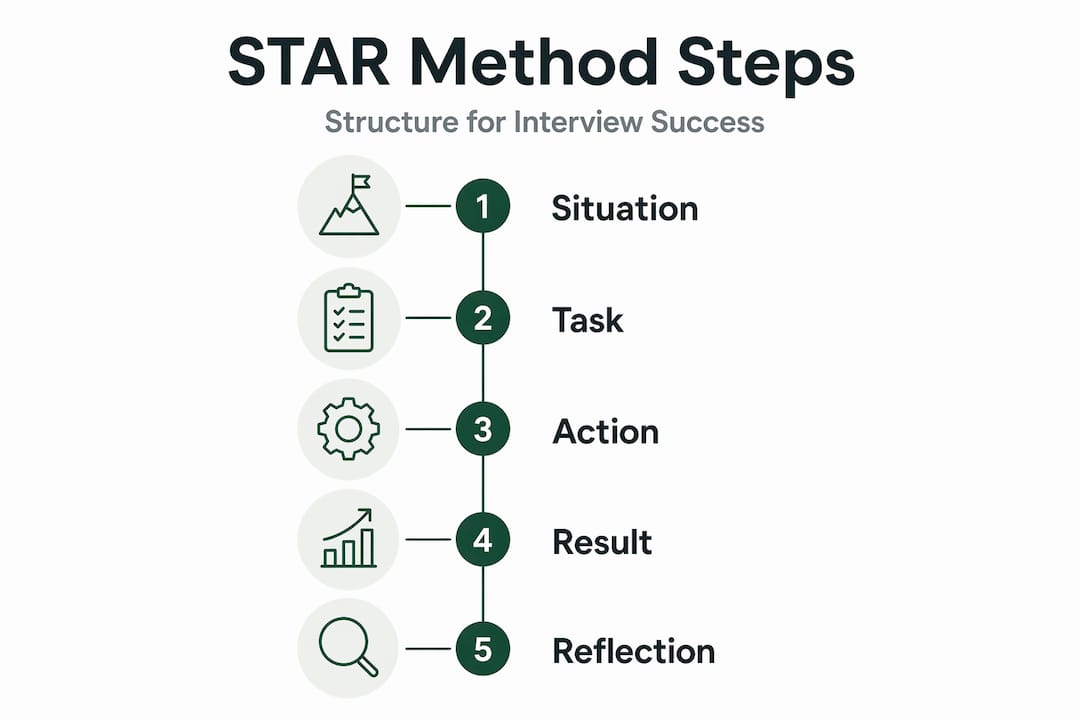
1. Situation: Set the context in two to three sentences. Avoid over-explaining. Your interviewer needs just enough background to understand why the challenge mattered. Bad: “I was working at a company.” Good: “Our team was three weeks from a product launch when our lead developer quit unexpectedly.”
2. Task: State your specific responsibility. This is not the team’s job. It is yours. Distinguish between what the situation called for and what you personally owned.
3. Action: This is the most important component. Spend 60% of your answer here. Walk through what you decided, why you decided it, and what you actually did. Use “I” statements, not “we.” Interviewers are evaluating you, not your team.
4. Result: End with what happened. Quantify the outcome whenever possible. “We launched on time” is weak. “We launched on schedule, which protected $200K in contracted revenue” is strong.
5. Reflection (optional but powerful): Add one sentence about what you learned or what you’d do differently. This signals maturity and self-awareness, two traits interviewers value highly.
Here’s a quick STAR example for the question “Tell me about a time you had to manage a project under a tight deadline.”
| STAR Component | Sample Answer |
|---|---|
| Situation | Our marketing team lost a vendor three weeks before a major product campaign launch. |
| Task | I was responsible for finding a replacement and keeping the timeline intact. |
| Action | I shortlisted three vendors in 48 hours, negotiated an expedited contract, and rebuilt the content calendar with the new partner. |
| Result | We launched on schedule. Campaign drove 18% higher click-through than the previous quarter. |
Pro Tip: Record yourself answering one STAR question out loud. Most people discover they either rush through the Result or skip the Action detail entirely. Hearing your own answer is faster feedback than any checklist.
Candidates who translate resume bullet points into specific actions and results consistently outperform those who give vague, general claims. Your STAR answer is your resume point, brought to life.

Organizing answers by question category
The top 10 behavioral interview questions rarely surprise you. They come from five or six recurring categories. When you understand the categories, you can prepare a small bank of flexible stories instead of memorizing dozens of separate answers. Stories can be adjusted on the spot for variations within the same competency area.
Here are the core categories and what interviewers are actually looking for in each:
Teamwork and collaboration: Questions like “Tell me about a time you disagreed with a teammate.” Interviewers want to see that you can resolve friction without damaging relationships.
Conflict resolution: Questions like “Describe a situation where you had to manage a difficult stakeholder.” This tests emotional control and persuasion skills.
Leadership: Questions like “Tell me about a time you took initiative.” For non-managers, this is your chance to show ownership. For managers, they want to see how you develop others.
Adaptability: Questions like “Describe a time when priorities changed suddenly.” Hiring managers want proof that you don’t freeze under uncertainty.
Time management: Questions like “How have you handled competing deadlines?” This shows prioritization skills and self-direction.
Problem-solving: Questions like “Walk me through a complex problem you solved.” Interviewers want your logic, not just your outcome.
Here’s how one story can cover multiple categories:
| Story Theme | Teamwork Question | Leadership Question | Adaptability Question |
|---|---|---|---|
| Rebuilt a broken project mid-sprint | Emphasize how you rallied the team | Emphasize the decision you made to restart | Emphasize how you pivoted the plan quickly |
| Handled a major client complaint | Emphasize cross-team coordination | Emphasize how you took ownership | Emphasize how you responded to an unexpected problem |
Preparing two to three strong stories per category gives you enough coverage to handle almost any list of behavioral interview questions. The goal is not a perfect answer for every question. It’s a flexible toolkit you can pull from quickly.
Tailoring answers to your industry and role
Generic answers hurt you in specialized roles. A behavioral job interview question about “driving results” means something different for a data analyst than it does for a sales manager. You need to tailor the emphasis of your stories to match what your role actually values.
Here’s how to think about that by context:
- Data and analytics roles: Interviewers want to hear how your analysis connected to business decisions. Don’t just describe what you built. Explain what decision it influenced and what the measurable outcome was. For a deeper look at this, the data analyst interview strategies guide breaks this down specifically.
- Technology and software engineering roles: Expect technical behavioral interview questions that blend process with interpersonal skills. “Tell me about a time you dealt with technical debt” requires both a technical explanation and a story about stakeholder communication. The software engineering interview questions overview covers the most common types.
- Managerial roles: Leadership emphasis is non-negotiable. Your stories should center on how you influenced others, made hard calls, or developed your team. Specific STAR frameworks for managers can sharpen this angle.
- Follow-up questions: In any role, expect the interviewer to probe with “What would you do differently?” or “How did that impact your team?” These are not traps. They’re opportunities to show reflection and depth.
Structured interviews with behavioral questions are specifically designed to validate resume claims through real-world application. The more specifically you connect your answer to the role’s actual demands, the more credible you sound.
Common mistakes that undercut your answers
Even well-prepared candidates make these errors. Recognizing them before your interview is the fastest way to sharpen your delivery.
- Rambling without landing: You tell a long story and forget to state the result. Interviewers stop listening. Know your ending before you start talking.
- Skipping the numbers: “We improved the process” tells them nothing. “We cut processing time by 40%” tells them everything. Numbers are proof.
- Using “we” instead of “I”: Teams do great things together. But the interviewer is evaluating you. Own your specific contribution explicitly.
- Over-polishing into vagueness: Trying to sound impressive can push you toward abstract language. “I leveraged synergies to drive outcomes” is meaningless. Concrete beats polished.
- No story for an area you’ve listed as a skill: If your resume says “strong communicator,” be ready with a specific story that proves it.
What about situations where you genuinely lack experience? Don’t fabricate. Use a close analogy from school, volunteering, or a side project, and frame it honestly. Interviewers respect candor. They do not respect invented stories that fall apart under follow-up questions.
Pro Tip: After practicing an answer, ask yourself: “Would this answer mean anything to someone who doesn’t know my company?” If the answer requires insider knowledge to make sense, simplify it.
For more structured preparation tactics, the behavioral interview tips resource covers frameworks and delivery habits worth building before your next interview.
My honest take on behavioral interview prep
I’ve reviewed hundreds of mock interview answers, and the single biggest mistake I see is over-relying on memorized scripts. Candidates lock into a version of their story and panic the moment the question is phrased differently. Flexible story modules beat memorized scripts every time.
What I’ve found actually works is preparing around competencies, not questions. When you know your “conflict resolution” story cold, you can answer 12 different question phrasings from that single story. You adjust which part you emphasize, not the whole story. That’s the mental agility interviewers notice.
The other thing I’d push back on is the idea that being “authentic” means being unprepared. Preparation is what makes you sound natural. Unrehearsed answers are not authentic. They’re just scattered. Real confidence comes from knowing your material so well that you can adapt it, not recite it.
Quantifying your results is the most underused tool in behavioral preparation. I’ve seen candidates with genuinely impressive experiences lose out because they never learned to attach a number to what they accomplished. If your work affected revenue, time, quality, or scale, find the number. Interviewers remember numbers.
— Jure
Level up your interview prep with Parakeet-ai
Preparing strong stories is one part of the equation. Delivering them well under real interview pressure is another.
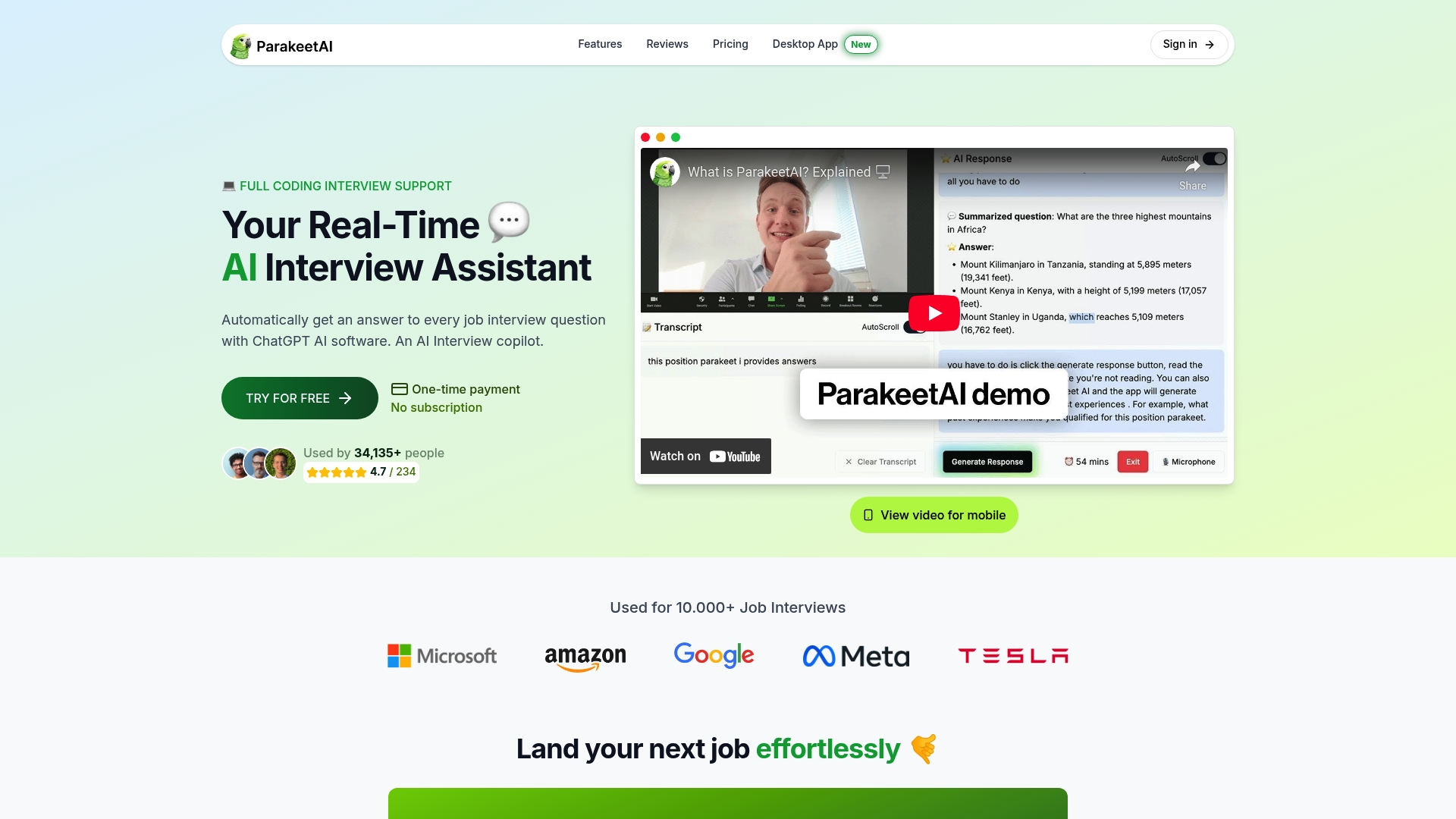
Parakeet-ai is a real-time AI interview assistant that listens to your interview as it happens and automatically surfaces answers to every question, including common and technical behavioral interview questions. You get suggested responses tailored to your role, not generic advice. Whether you’re practicing in advance or walking into a live interview, Parakeet-ai helps you stay sharp, structured, and confident when it counts most. Visit parakeet-ai.com to start practicing with AI-powered coaching built specifically for job seekers who want to stop guessing and start performing.
FAQ
What are behavioral interview questions?
Behavioral interview questions use prompts like “Tell me about a time when…” to evaluate how you’ve acted in real, job-relevant situations. Employers use them to assess competencies like problem-solving, communication, and leadership.
What is the STAR method for behavioral answers?
STAR stands for Situation, Task, Action, and Result. It structures your answer into a clear narrative that demonstrates your skills through a real example rather than a vague claim.
How many stories should I prepare for behavioral interviews?
Prepare five to eight core stories organized by competency category. Each story can be adapted to answer multiple question variations by shifting the emphasis of the Action or Result component.
How do I answer behavioral questions when I lack direct experience?
Use a close analogy from school, volunteering, freelance work, or a personal project. Frame it honestly and apply the same STAR structure. Interviewers value candor and clear thinking over a perfect job title match.
What makes a behavioral interview answer stand out?
Strong answers include a specific, quantified result. Saying you improved a process by 30% or saved the company two weeks of work is far more persuasive than a general claim about being effective or efficient.