
Unlock interview question logic to sharpen your responses

TL;DR:Understanding the logic behind interview questions improves responses and reduces reliance on memorized answers.Structured behavioral interviews and problem-solving frameworks predict job success more accurately than puzzles or brainteasers.Practicing out loud and developing process clarity are crucial for demonstrating reasoning skills under pressure.
Most candidates walk into interviews thinking success means having the right answer ready. That assumption costs people jobs. Interview question logic refers to the structured reasoning behind how questions are designed to reveal your thinking process, not just your knowledge. Interviewers aren’t grading you like a quiz. They’re watching how you break down a problem, handle uncertainty, and communicate under pressure. Once you understand the logic behind the questions, you stop guessing and start responding with real clarity. This guide covers what interview question logic is, how it works, and how to use it to your advantage.
Table of Contents
- What is interview question logic?
- Core types and mechanics of logic-based questions
- Edge cases, expert tips, and nuanced success signals
- Evidence: What actually predicts success?
- How to practice and apply interview question logic
- What most candidates (and interviewers) miss about interview logic
- Sharpen your interview logic with ParakeetAI
- Frequently asked questions
Key Takeaways
| Point | Details |
|---|---|
| Logic over memorization | Interviews test your reasoning and process more than your ability to recall facts. |
| Frameworks win | Using structured frameworks like STAR improves both your answers and hiring outcomes. |
| Preparation strategy | Practicing with new scenarios and verbalizing your thinking is more valuable than memorizing puzzles. |
| Evidence matters | Research shows structured interviews are the most reliable predictors of success. |
What is interview question logic?
At its core, interview question logic is the structured reasoning and methodology behind designing questions to measure how candidates think, reason, and fit a role. It’s not about whether you know a specific fact. It’s about whether you can organize your thoughts, identify the right variables, and communicate a path forward.
This matters because memorized answers break down fast. The moment an interviewer shifts the scenario slightly, a candidate relying on rehearsed scripts falls apart. But someone who understands the underlying logic can adapt on the fly.
Here’s a quick look at the most common types of logic-based interview questions and what each one is actually testing:
| Question type | What it tests | Example |
|---|---|---|
| Behavioral | Past behavior predicting future performance | “Tell me about a time you resolved a conflict” |
| Logic puzzle | Abstract reasoning and structured thinking | “How many golf balls fit in a school bus?” |
| Situational | Decision-making under hypothetical pressure | “What would you do if a deadline moved up by two days?” |
| Technical problem-solving | Applied reasoning in domain-specific contexts | “Debug this function” or “Design this system” |
| Case study | Analytical thinking and business judgment | “How would you grow revenue in this market?” |
For best answers to interview questions, the format matters less than your ability to show structured thinking within whatever format you’re given.
“The goal isn’t to find candidates who know the answer. It’s to find candidates who know how to find the answer.”
This is why interviewers often care more about your reasoning out loud than your final conclusion. A wrong answer with clear logic often beats a correct answer with no explanation. That’s the shift in mindset this entire guide is built around.
Core types and mechanics of logic-based questions
Once you know why logic questions exist, it helps to understand exactly how they’re built. The mechanics include behavioral questions using the STAR method, logic puzzles and brainteasers, and structured problem-solving questions evaluated with rubrics like the 5/3/1 scoring system.
Let’s break each one down:
- Behavioral questions using STAR. The STAR interview method stands for Situation, Task, Action, Result. You describe a real past experience, explain what you needed to do, walk through the steps you took, and share the outcome. This format forces structure and gives interviewers a consistent way to compare candidates.
- Logic puzzles and brainteasers. These aren’t about getting the right number. They test whether you can organize an ambiguous problem into solvable steps. The classic “how many piano tuners are in Chicago?” question rewards candidates who break the estimate into layers, not those who guess confidently.
- Structured problem-solving with rubrics. Many companies use structured interview rubrics to score responses on a scale. A 5/3/1 rubric, for example, awards a 5 for fully articulated reasoning with trade-offs considered, a 3 for partial structure, and a 1 for vague or reactive answers.
- Scenario-based questions. These drop you into a hypothetical situation and watch how you prioritize. They’re especially common in product, operations, and management roles.
- Technical deep-dives. These combine domain knowledge with live problem-solving. The logic layer is about how you approach the unknown, not just what you already know.
Pro Tip: When answering logic questions, narrate your thinking out loud at every step. Silence makes it impossible for the interviewer to score your reasoning, even if you’re thinking clearly.
Edge cases, expert tips, and nuanced success signals
Most candidates prepare for the obvious questions. What separates strong performers is how they handle the unexpected ones. Edge cases in logic questions test boundary conditions, and expert-level responses involve quickly spotting patterns, articulating trade-offs, and avoiding brute-force thinking.

Consider a classic edge case: “A man climbs a mountain starting at 6am and reaches the top at 6pm. The next day he descends the same path, again starting at 6am and arriving at the bottom at 6pm. Prove there’s a point on the path he passes at the same time both days.” Most people try to calculate. The elegant answer uses a conceptual insight: imagine two people doing the trip simultaneously. They must cross paths.
That kind of thinking is what interviewers are hunting for. Here’s what expert candidates consistently do differently:
- Ask clarifying questions before diving in. This signals adaptability and prevents wasted effort on the wrong problem.
- Name your assumptions out loud. Saying “I’m assuming X because Y” shows structured thinking and gives the interviewer something to redirect if needed.
- Identify trade-offs, not just solutions. Strong candidates explain what they’re giving up with each approach, not just what they’re gaining.
- Connect answers to job relevance. Tying your reasoning to the actual role shows you understand context, not just logic in the abstract.
- Avoid rushing to a conclusion. Speed is not a success signal. Clarity is.
For more on technical interview tips and strategies for situational questions, the pattern is the same: show your work, not just your answer.
Pro Tip: Before answering any logic question, spend 10 to 15 seconds asking one clarifying question. It resets the dynamic from “candidate being tested” to “professional solving a real problem.”
You can also study reasoning pattern tips to build fluency with common logic structures before your next interview.
Evidence: What actually predicts success?
Feelings and intuition about what makes a good interview question don’t hold up well under scrutiny. The data tells a more specific story. Structured interviews predict job performance at a validity coefficient of r=0.51, compared to r=0.38 for unstructured interviews and as low as r=0.20 in some studies. Brainteasers, famously, show zero predictive correlation according to Google’s own internal research.
Key stat: Structured behavioral interviews are nearly 3x more predictive than casual, unstructured conversations.
Here’s how the main formats compare:
| Interview format | Predictive validity | Notes |
|---|---|---|
| Structured behavioral (STAR) | r=0.51 | Highest evidence-based validity |
| Work sample tests | r=0.54 | Strong but harder to administer |
| Unstructured interviews | r=0.20 to 0.38 | Highly variable, bias-prone |
| Brainteasers/puzzles | ~0.00 | No correlation with performance |
| Situational judgment tests | r=0.34 | Moderate, context-dependent |
The practical takeaway here is direct: stop over-preparing for brainteasers and invest that time in strong interview answers built on behavioral frameworks. You’ll also want to avoid interview pitfalls like spending too much time on low-validity formats.
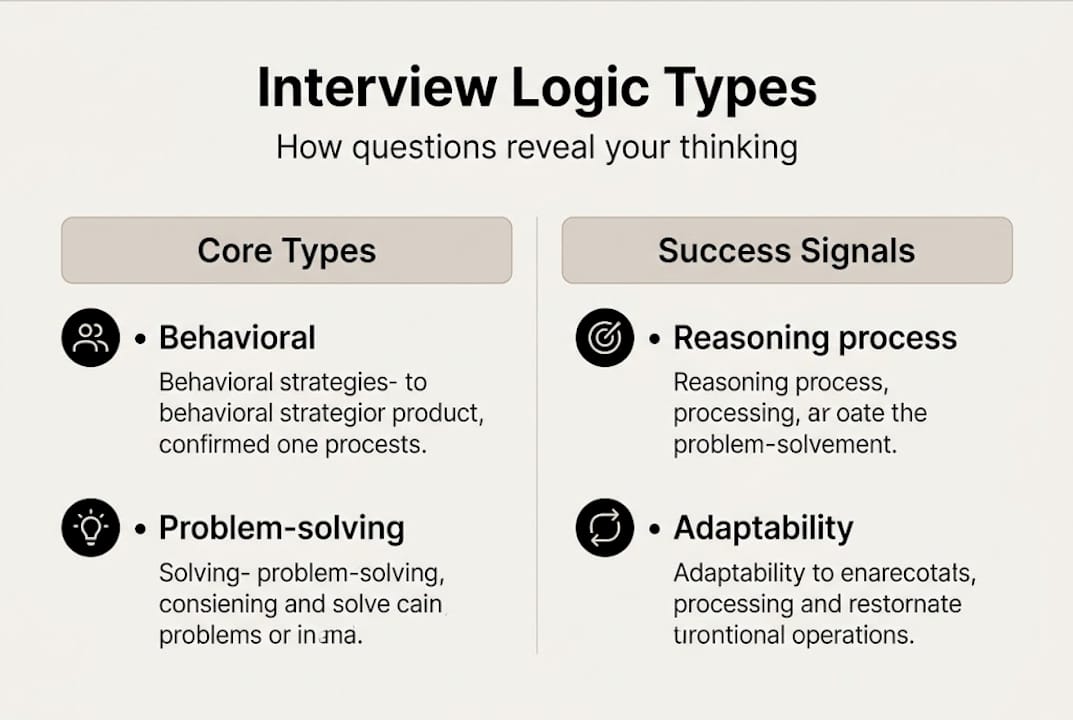
For deeper reading, problem-solving questions research shows that rubric-scored responses consistently outperform free-form evaluations in predicting long-term job success. The evidence points clearly toward structured, process-visible answers as the highest-return preparation strategy.
How to practice and apply interview question logic
Knowing the theory is step one. Building the skill takes deliberate practice. To improve responses, job seekers should verbalize their thought process, use frameworks like STAR, focus on edge cases, and practice with rubrics to self-evaluate.
Here’s a practical step-by-step plan:
- Pick one question type per session. Don’t try to practice behavioral and logic puzzles in the same sitting. Focus builds faster when you isolate formats.
- Answer out loud, not in your head. Silent practice creates a false sense of readiness. You need to hear yourself reason through a problem to catch gaps.
- Record yourself. Playback reveals filler words, vague transitions, and moments where your logic jumps without explanation.
- Score your own answers using a rubric. Use a simple 5/3/1 scale. Did you state the situation clearly? Did you explain your reasoning? Did you name a result or trade-off?
- Practice with novel scenarios. Don’t memorize common puzzles. Use AI tools to generate unfamiliar scenarios so you build adaptability, not pattern recognition.
- Tie every answer back to the role. After each practice response, ask yourself: “Would someone hiring for this specific job find this answer relevant?” If not, revise.
AI-assisted practice is particularly useful here. Tools that give real-time feedback on structure and completeness can accelerate your progress faster than solo repetition. For technical interview tips and technical interview prep resources, the same principles apply: practice the process, not the answers.
Building adaptability beats memorizing answers every time. The goal is a mental framework you can apply to any question, not a library of rehearsed responses.
What most candidates (and interviewers) miss about interview logic
Here’s the uncomfortable truth: most candidates prepare for the wrong thing. They spend hours memorizing clever answers to common puzzles, then freeze when the question shifts even slightly. Rigid preparation creates brittle performance.
But here’s what’s equally surprising: interviewers fall into the same trap. Many still use brainteasers because they feel smart, even though the evidence is clear that they predict nothing. The “clever puzzle” format gives interviewers a false sense of rigor without the actual validity.
The real signal interviewers are looking for is process clarity. Can you take a messy problem and make it legible? Can you communicate your thinking in real time without losing the thread? Those skills transfer directly to every job. A correct answer with no visible reasoning is actually a red flag in structured hiring.
“Success hinges on showing your thinking, not just arriving at answers.”
The candidates who consistently perform well aren’t the ones with the most answers memorized. They’re the ones who’ve practiced making their reasoning visible, staying calm when a question doesn’t fit their prep, and connecting every response back to what the role actually needs.
Sharpen your interview logic with ParakeetAI
Understanding interview question logic is one thing. Practicing it under realistic pressure is where real improvement happens. That gap between knowing and doing is exactly what ParakeetAI is built to close.
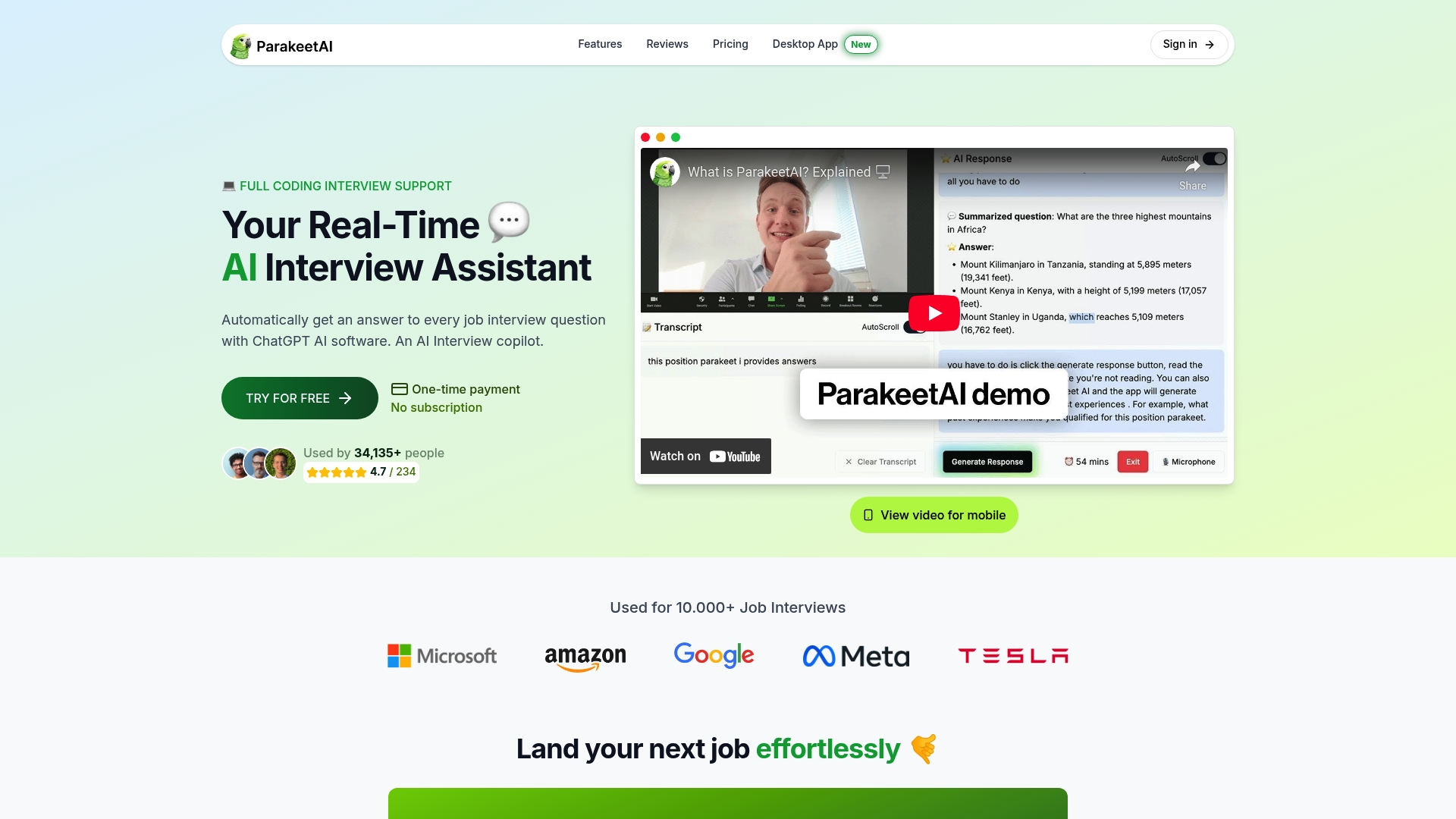
ParakeetAI is a real-time AI interview assistant that listens during your interview and automatically surfaces structured answers to every question as it happens. It’s not just a prep tool. It’s live support that helps you apply logic frameworks in the moment. For hands-on practice with crafting top interview answers, ParakeetAI gives you the feedback loop that solo practice can’t replicate. If you want to stop guessing and start responding with genuine clarity, this is where to start.
Frequently asked questions
What does interview question logic actually test?
It evaluates how you reason, structure answers, and apply logic in real time. Interviewers design questions to reveal your thinking style, not just whether you arrive at a correct answer.
How can I prepare for logic-based interview questions?
Practice talking through your process out loud, use the STAR framework for behavioral questions, and work through unfamiliar scenarios. Novel scenario practice with rubric self-evaluation builds the adaptability that rote memorization never will.
Are brainteasers reliable predictors of job performance?
No. Brainteasers show zero correlation with job performance according to Google’s internal data, because they test pattern recognition rather than genuine reasoning under realistic conditions.
Which interview question format best predicts success?
Structured behavioral questions using the STAR method have the strongest predictive validity. STAR and 5/3/1 rubrics consistently outperform unstructured formats and puzzle-based assessments in predicting real job performance.