
How to research companies for interviews: boost confidence

TL;DR:Thorough company research boosts confidence and helps tailor responses during interviews.Use diverse sources like websites, news, reviews, and social media for comprehensive insights.Deep preparation enables meaningful questions and demonstrates genuine interest to interviewers.
You walk into the interview room, shake hands, and settle into your seat. Then the interviewer asks: “So, what do you know about us?” Your mind goes blank. It’s one of the most common and avoidable interview disasters, and it happens because most job seekers underestimate how much preparation actually matters. Employers frequently ask candidates what they know about the company, and your answer sets the tone for everything that follows. This guide walks you through exactly how to research a company before your interview so you walk in with confidence, not guesswork.
Table of Contents
- Why researching the company is critical
- Essential tools and resources for company research
- Step-by-step: How to research a company before your interview
- Common mistakes and advanced research tips
- Why real research sets you apart: what most job seekers miss
- Take your interview prep to the next level
- Frequently asked questions
Key Takeaways
| Point | Details |
|---|---|
| Research is essential | Thorough company research makes you a stronger and more confident interview candidate. |
| Use multiple sources | Don’t rely solely on the company website—expand your research to news, social media, and employee reviews. |
| Personalize your approach | Tailor your interview answers using specific company details for a memorable impression. |
| Avoid common mistakes | Go beyond surface-level research and prepare thoughtful questions and insights. |
Why researching the company is critical
Think about what an interviewer is really trying to figure out. They want to know if you genuinely want this job at this company, or if you’re just applying everywhere and hoping something sticks. When you demonstrate real knowledge about the organization, you immediately separate yourself from candidates who show up unprepared.
The benefits of company research go well beyond impressing the hiring manager. Research helps you tailor every answer to match what the company actually values. It lets you ask smart, specific questions that show you’ve thought deeply about the role. It also reduces anxiety because you’re walking into a familiar situation rather than an unknown one.
Here’s what strong company research gives you:
- Personalized answers that connect your experience to the company’s specific goals
- Smarter questions that signal genuine curiosity and strategic thinking
- Increased confidence because you’ve already done the mental work
- Better culture fit signals that resonate with the interviewer
- Stronger negotiation footing when you understand the company’s market position
“The candidate who knows our recent product launch and mentions how their skills apply to it? That person stands out immediately.” This is the kind of feedback hiring managers share constantly, and it reflects a simple truth: knowledge is leverage.
Lack of research creates awkward silences, generic answers, and missed opportunities to connect. When you give a vague answer about why you want to work somewhere, you’re essentially telling the interviewer you didn’t care enough to find out. That’s a hard impression to recover from.
Pro Tip: Before any interview, write down three specific things you admire about the company. Weave at least one of them naturally into your answers. It signals preparation without sounding rehearsed.
Using expert company research tips and pairing them with best interview answers gives you a complete preparation system, not just surface-level talking points.
After understanding why research matters, let’s gather what you’ll need before diving into the process.
Essential tools and resources for company research
Knowing where to look is half the battle. Candidates can find critical company info on websites, news, reviews, and social platforms, but not all sources are equally useful. Here’s how to use each one strategically.

| Source | What you’ll find | Best for |
|---|---|---|
| Company website | Mission, values, products, leadership | Foundational knowledge |
| Team structure, recent updates, employee backgrounds | Culture and growth signals | |
| Glassdoor | Employee reviews, interview experiences, salary data | Culture and red flags |
| Google News | Recent press, funding rounds, controversies | Current context |
| Industry blogs | Competitor landscape, market trends | Strategic positioning |
Start with the company’s About page and read it carefully. Most candidates skim it. You should be taking notes. Look for language around values and mission that you can mirror in your answers. Then move to the Press Releases section, which reveals what the company considers worth celebrating.
Here’s a quick research toolkit checklist:
- Company website: About, Team, Blog, and Careers pages
- LinkedIn company page and key employees’ profiles
- Glassdoor reviews from current and former employees
- Google News search: “[Company name] 2026”
- Crunchbase or PitchBook for funding and growth history
- Reddit threads and industry forums for candid opinions
Pro Tip: Search Google for “[Company name] site:linkedin.com” and “[Company name] filetype:pdf” to uncover annual reports, whitepapers, and executive presentations that most candidates never find. This is where the real differentiation happens.
The company research guide from The Muse also offers a solid framework for organizing everything you find into actionable notes before the interview.
Now that you’ve got your toolkit and sources, it’s time to start the research process step by step.
Step-by-step: How to research a company before your interview
Having great sources means nothing if you don’t have a clear process. Follow these steps in order and you’ll build a complete picture of any company in about two focused hours.
- Start with the basics. Look up the company’s size, founding history, headquarters, core products or services, and revenue if it’s public. This gives you the skeleton of your knowledge.
- Study the mission and values. Read the About page word for word. Companies embed their culture into this language, and interviewers often ask questions that directly test whether your values align.
- Scan recent news. Search Google News for the company name and filter to the past six months. Look for funding announcements, product launches, leadership changes, or any controversies.
- Explore employee reviews. Glassdoor and LinkedIn reviews reveal what it’s actually like to work there. Look for patterns in the feedback, not just individual opinions.
- Analyze the competitive landscape. Knowing who the company competes with and how it positions itself shows strategic awareness. This is rare and impressive in an interview.
Here’s a quick comparison of research depth levels:
| Research level | Time invested | Outcome |
|---|---|---|
| Surface (website only) | 20 minutes | Generic answers, weak questions |
| Moderate (website + LinkedIn) | 45 minutes | Decent answers, some personalization |
| Deep (all sources + news) | 2+ hours | Tailored answers, insightful questions |
Preparation helps answer company-specific interview questions more confidently, and the data backs this up: candidates who research thoroughly are significantly more likely to receive follow-up interviews. Use answering company-specific questions as your guide for turning research into actual responses.
The company research steps from CareerOneStop also provide a government-backed framework that’s especially useful for structured industries.
As you proceed through your research, it’s vital to avoid common mistakes and understand how to go beyond basic info.
Common mistakes and advanced research tips
Even motivated candidates make research errors that undercut their preparation. Knowing what to avoid is just as important as knowing what to do.
The biggest mistake is relying only on the company website. It’s a starting point, not the finish line. Companies control their own websites, which means you’re only seeing the version of themselves they want you to see. You need outside perspectives to get the full picture.
Here are the most common research mistakes to avoid:
- Only reading the homepage without exploring the blog, press, or careers sections
- Ignoring Glassdoor and missing critical culture signals
- Asking generic questions like “What does success look like here?” without tying them to specific research
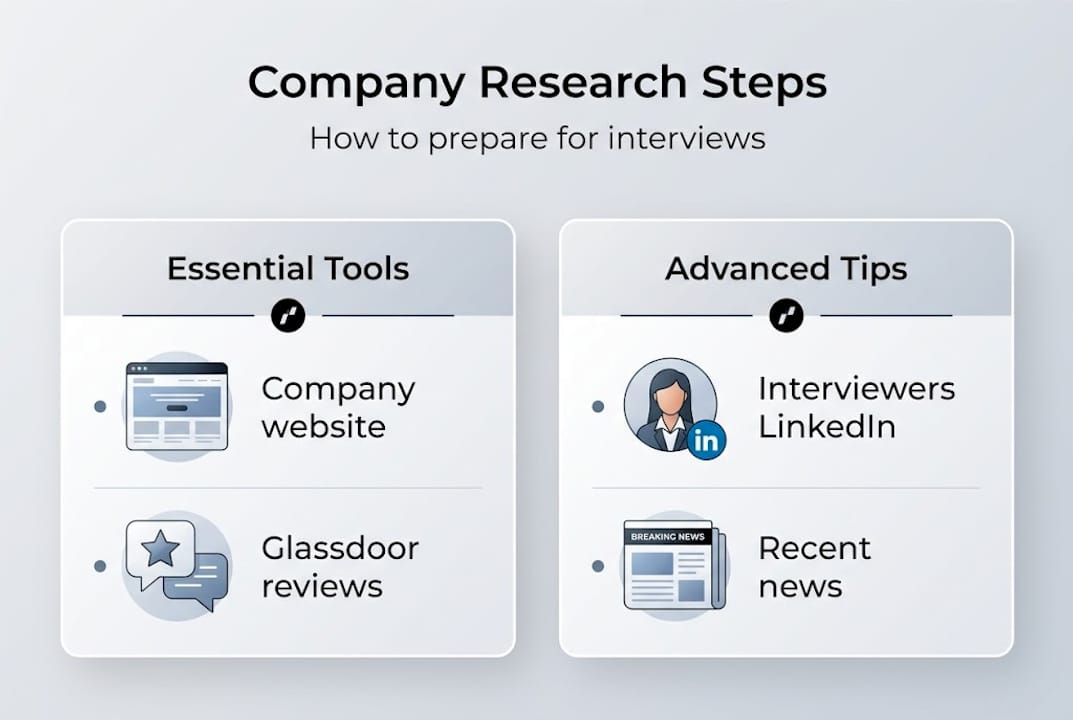
- Forgetting to research your interviewers on LinkedIn before the meeting
- Missing recent news that changes the context of the role entirely
Pro Tip: Look up your interviewers on LinkedIn before the meeting. Note their career path, any articles they’ve written, and how long they’ve been at the company. Referencing something specific about their background builds instant rapport.
Advanced researchers also use advanced interview research tips to go beyond the obvious. Try searching Twitter or X for the company name to see real-time employee and customer sentiment. Check YouTube for company culture videos or CEO talks at conferences.
You should also avoid asking interviewers questions that are easily answered on the company website. It signals you didn’t do your homework. Instead, ask questions that only someone who has done deep research would think to ask, like questions about a specific challenge mentioned in a recent earnings call or a trend affecting their industry.
For roles with a strong culture component, reviewing cultural interview questions helps you anticipate what interviewers are really probing for beneath the surface.
After learning how to avoid common pitfalls and dig deeper, let’s recap the big-picture value of investing in smart research.
Why real research sets you apart: what most job seekers miss
Here’s something most interview advice gets wrong: research isn’t just about knowing facts. It’s about using those facts to create a real conversation. The candidates who get hired aren’t always the most qualified on paper. They’re the ones who made the interviewer feel like they were talking to a future colleague, not evaluating a resume.
Superficial research is incredibly common. Most candidates spend 20 minutes on the About page and call it done. But memorable candidates use specific details to spark dialogue. They say things like, “I noticed your team expanded into the European market last quarter. How has that shifted priorities for this role?” That question doesn’t just show knowledge. It shows strategic thinking and genuine investment.
Real company research for interviews also lets you connect your own experience directly to the company’s current challenges and targets. That’s the difference between saying “I’m good at problem-solving” and “I helped reduce churn by 18% at my last company, and I see customer retention is a focus area for you right now.”
Treat every interview as a chance to show you’re thinking about the long term, not just landing an offer. That mindset, backed by real research, is what turns interviews into conversations and conversations into job offers.
Take your interview prep to the next level
Researching a company is one piece of the puzzle. Knowing how to use that research in real time, when nerves are high and questions come fast, is where most candidates struggle.
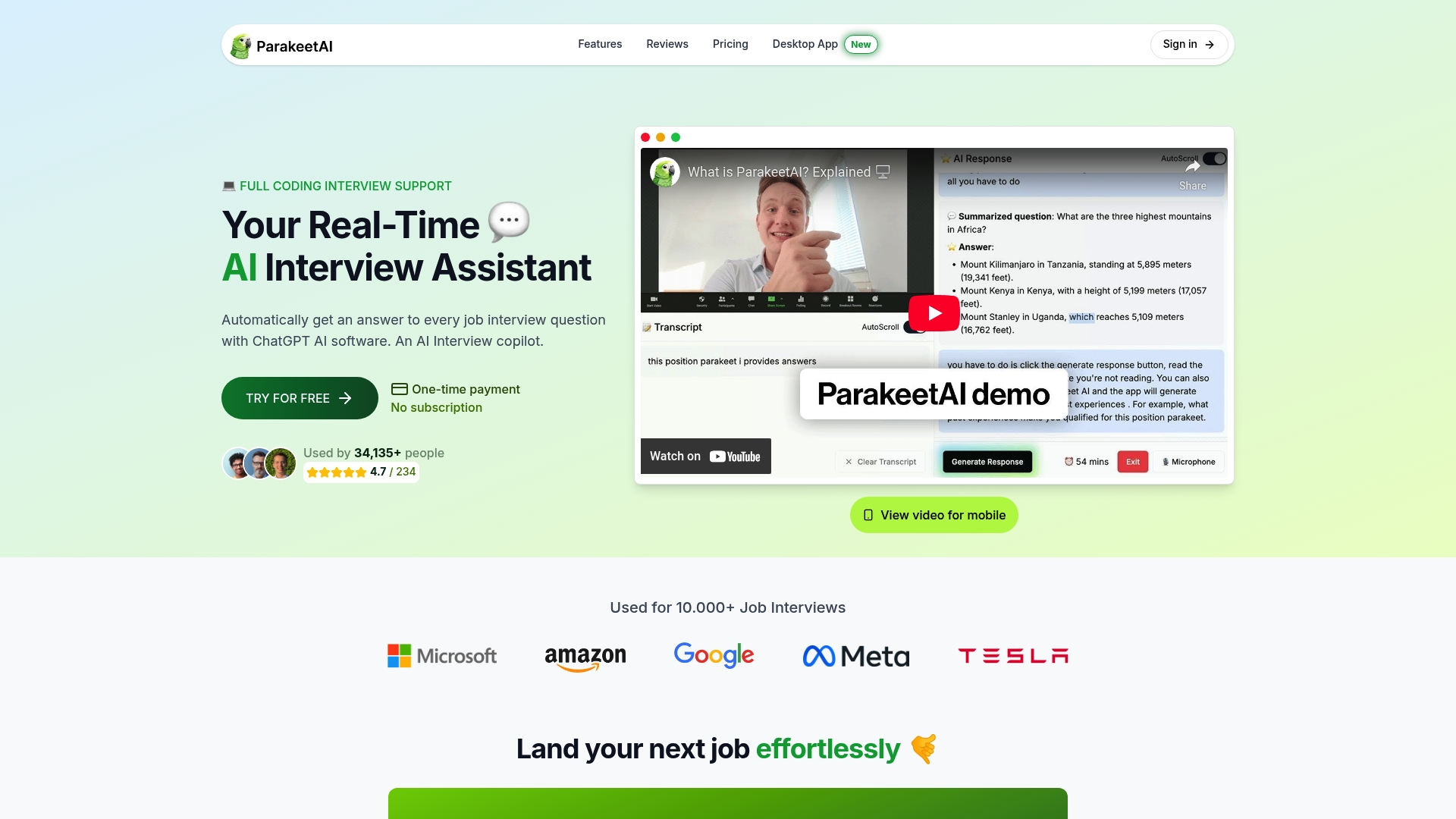
ParakeetAI interview tools are built for exactly this moment. ParakeetAI is a real-time AI interview assistant that listens to your interview and automatically surfaces the best answers to every question as it happens. You walk in prepared from your research, and ParakeetAI makes sure you stay sharp when it counts. Whether you’re prepping for your first tech interview or your tenth senior role, the platform gives you the edge that research alone can’t always deliver. Explore ParakeetAI and see how smart preparation meets real-time support.
Frequently asked questions
What are the top sources for researching a company before an interview?
Start with the company’s official website, LinkedIn page, Glassdoor reviews, and recent news articles. Critical company info is spread across multiple platforms, so using all of them gives you the most complete picture.
How much time should I spend researching a company for an interview?
Plan to spend at least one to two focused hours gathering and synthesizing information. Thorough preparation helps you answer company-specific questions with real confidence rather than guessing.
What are common mistakes people make when researching companies?
The most common errors include only scanning the company website and failing to check recent news or Glassdoor reviews. Relying on one source leaves major gaps in your understanding of the company’s culture and current priorities.
How can I use my company research in the interview?
Use specific examples from your research to tailor your answers and ask insightful, personalized questions. Preparation helps you answer company-specific questions more confidently and makes you memorable long after the interview ends.