
The Role of NLP in Job Interviews: 2026 Guide

TL;DR:NLP in hiring now assesses semantic meaning, multimodal cues, and bias detection rather than just keywords.Implementing structured rubrics, human oversight, and bias audits ensures fair, accurate, and compliant evaluation processes.
Most people assume NLP in hiring means a system scanning resumes for the right keywords. That assumption is roughly ten years out of date. The role of NLP in job interviews today covers semantic understanding of spoken answers, multimodal analysis of tone and delivery, real-time language generation, and bias detection across entire candidate pipelines. Whether you are a recruiter building fairer evaluation systems or a job seeker trying to understand what an AI is actually measuring when you speak, this guide covers what the technology does, where it fails, and how to use it well.
Table of Contents
- Key takeaways
- The role of NLP in job interviews: how the technology actually works
- Fairness, bias, and legal compliance
- Design principles for NLP-powered evaluation
- Practical applications and what is coming next
- My honest take on where NLP interviewing goes wrong
- How Parakeet-ai supports your interview preparation
- FAQ
Key takeaways
| Point | Details |
|---|---|
| NLP goes beyond keywords | Modern transformer models analyze context and meaning, not just word matches, improving candidate fit accuracy. |
| Multimodal analysis reduces bias | Combining text, audio, and video cues cuts gender and ethnic bias by over 25% compared to text-only systems. |
| Fairness requires active effort | NLP systems must be audited regularly and paired with human oversight to stay accurate and legally compliant. |
| Rubric-based scoring works better | Grounding NLP evaluation in structured rubrics and evidence prevents rewarding candidates who mirror job description language. |
| Both sides benefit from NLP | HR teams gain faster, more consistent evaluation; candidates get feedback grounded in specific evidence rather than gut feel. |
The role of NLP in job interviews: how the technology actually works
Natural language processing, or NLP, is the field of AI that enables computers to read, interpret, and generate human language. In recruitment, the term covers a spectrum of techniques that have changed dramatically over the past five years.
Early NLP systems used TF-IDF scoring, which counted how often terms appeared relative to a document corpus. That approach treated “project management” and “led cross-functional teams” as completely separate signals. It was fast but shallow. Today, transformer-based models like BERT consistently outperform those older methods on resume parsing and job qualification matching, because they understand that both phrases can signal the same underlying competency.
Here is what current NLP applications in hiring actually do during the interview process:
- Resume semantic parsing: Models map candidate experience to job requirements based on meaning, not surface wording, catching qualified candidates who use different terminology.
- Spoken answer analysis: NLP converts interview audio to text and then scores responses against structured rubrics, looking for evidence of specific skills.
- Sentiment and coherence scoring: Systems track how well a candidate structures their argument, whether their answers stay on topic, and how confidently ideas are expressed.
- Real-time question generation: Some platforms generate follow-up questions dynamically based on what a candidate just said, simulating the depth of a skilled human interviewer.
The most advanced NLP tools for interviewers now operate in multimodal frameworks. These systems don’t rely on transcripts alone. A multimodal employability system combining text, speech, and video achieved 90% top-1 accuracy and a 14% improvement in F1-score compared to text-only baselines. That level of accuracy matters when you are screening hundreds of candidates for a single role.
Pro Tip: If you are a job seeker, knowing that NLP systems analyze coherence and structure, not just content, means you should practice organizing your answers with a clear opening claim, supporting evidence, and a concise conclusion.
Fairness, bias, and legal compliance
This is where the conversation gets complicated. NLP can reduce some types of bias, but it can also introduce new ones if deployed carelessly.

One well-documented problem is transcription error bias. Speech recognition errors vary by accent, meaning a system relying solely on transcribed text will systematically disadvantage speakers whose accents the model was not trained on. That is not a minor edge case. It is a structural fairness problem built into the pipeline.
The data on hiring outcomes is stark. AI screening systems have shown that 26% of Black applicants and 15% of Asian applicants faced disproportionately high rejection rates. That is not acceptable by any standard, legal or ethical.
On the legal side, US ADA AI hiring guidance is clear: AI-based hiring systems must not screen out qualified individuals with disabilities and must offer reasonable accommodations. The EEOC applies similar scrutiny to adverse impact across protected classes. HR teams need to treat these requirements as baseline design constraints, not afterthoughts.
“Fairness improves when NLP interview systems include bias mitigation and transparency, making explainability a must-have for HR deployments.” — Multimodal Framework for Employability Assessment
Practical steps HR teams should take to stay on the right side of both ethics and the law:
- Audit transcription accuracy across demographic groups before deployment
- Use multimodal inputs, including audio embeddings, to reduce reliance on potentially biased text transcripts
- Document how scoring decisions are made and what evidence they rest on
- Offer candidates the option to flag technical issues or request alternative assessment formats
- Review outcomes data quarterly for signs of disparate impact
For a thorough breakdown of what compliance looks like in practice, the AI interview compliance resource from Parakeet-ai covers ADA and EEOC guidance in detail.
Pro Tip: HR teams: run a small-scale bias audit before full deployment. Compare pass rates across gender, race, and age using a representative sample. Catching a 10% disparity before launch is infinitely better than addressing it after a complaint.
Design principles for NLP-powered evaluation
Good NLP evaluation does not happen by default. It requires deliberate design choices at every stage.
Start with rubric-based scoring
Free-form semantic scoring has a hidden problem: it can reward candidates who mirror the language of the job description rather than demonstrating actual competence. Rubric-driven NLP scoring paired with evidence span location avoids that trap. Instead of asking “does this answer sound like a good answer?”, it asks “does this answer contain evidence of competency X as defined by the rubric?”
Here is a comparison of the two approaches:
| Approach | Strengths | Weaknesses |
|---|---|---|
| Free-form semantic scoring | Fast, flexible, requires minimal setup | Rewards mimicry, hard to audit, prone to drift |
| Rubric-based NLP scoring | Auditable, consistent, competency-focused | Requires upfront rubric design and calibration |
| Retrieval-augmented scoring | High reliability, evidence-grounded output | More complex infrastructure, needs maintenance |
The best systems combine rubric guidance with retrieval-augmented generation, pulling in relevant context to score answers against evidence rather than surface similarity. This makes output traceable and defensible.
Build human oversight into the workflow
- Require NLP systems to output structured evidence, not just scores, so reviewers know what the model responded to.
- Give recruiters a clear interface for overriding scores with written justification.
- Log every override to build a calibration dataset for future model improvement.
- Set review thresholds: any candidate within a defined score band should get a human second look.
- Run quarterly audits comparing human and AI scoring on matched samples.
Human-in-the-loop systems that give recruiters the ability to review and override AI scoring based on visible evidence are not just better ethically. They produce more defensible hiring decisions when challenged.
Pro Tip: Do not treat NLP drift as a one-time fix. NLP models require periodic retraining to stay accurate as recruiting language and candidate populations shift. Schedule a formal recalibration at least twice a year.
Practical applications and what is coming next
NLP in recruitment is no longer experimental. Commercial platforms already offer capabilities that would have seemed impractical three years ago.
One example is the AI interviewer category, where tools now support 22-plus languages and compress multi-round evaluations into a single 20 to 25 minute session covering both technical and soft skill dimensions. For global hiring at scale, that is a meaningful operational shift.
For job seekers, understanding how NLP tools work creates real preparation advantages. Here is what the technology is currently able to detect and score:
- Answer structure and logical coherence
- Keyword and concept coverage relative to the role
- Sentiment and confidence patterns across the session
- Pause frequency and verbal filler density
- Evidence specificity: vague claims versus concrete examples
For HR professionals, the emerging opportunity is not just efficiency. NLP-driven insights can help identify patterns in candidate responses that predict performance more reliably than unstructured interviewer notes.
Here is where each group gets the most value today:
| Audience | Primary NLP benefit | Key watch-out |
|---|---|---|
| HR teams | Faster screening, consistent rubric application | Bias in transcription and scoring if unaudited |
| Job seekers | Structured preparation targets, feedback specificity | Risk of over-optimizing for AI rather than human connection |
| Compliance officers | Audit trails, evidence-grounded decisions | Legal exposure if system lacks explainability documentation |
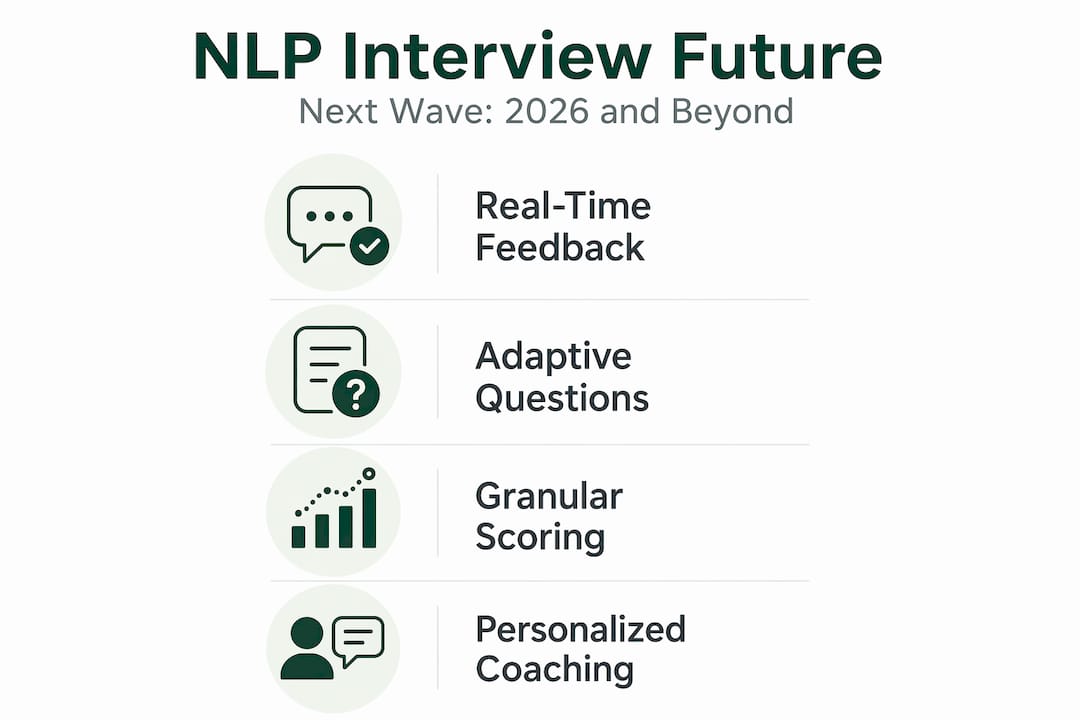
The next wave of NLP applications in hiring will focus on real-time coaching, adaptive questioning, and more granular fairness controls. The direction is toward systems that are not just accurate but explainable at every step, which matters as regulation tightens around AI job interview ethics.
My honest take on where NLP interviewing goes wrong
I have spent years watching organizations deploy AI evaluation tools with enormous confidence and then quietly walk back the results when the numbers did not hold up. The pattern is consistent. A team sees impressive accuracy metrics in a controlled study and assumes the system is objective. Then the audit comes back showing a 20% disparity in outcomes across demographic groups, and no one knows why because the scoring was a black box.
The uncomfortable truth is that NLP scoring is not objectivity. It is the encoding of whoever designed the rubric, chose the training data, and decided what “good” looks like. That does not make it useless. It makes it a tool that requires governance, not faith.
What I have seen work: organizations that treat NLP outputs as one input in a structured review process, not the final word. They invest in explainability from day one, build override mechanisms for recruiters, and run bias audits before expanding deployment. The organizations that get into trouble treat the model’s score as settled truth and stop asking questions.
My practical advice for HR professionals is to require vendors to show you bias testing data on populations similar to your candidate pool, not just aggregate accuracy numbers. For job seekers, the best preparation is not to game the AI. It is to give structured, evidence-rich answers that would also impress a skilled human interviewer. The systems that matter are designed to reward exactly that.
— Jure
How Parakeet-ai supports your interview preparation
Understanding how NLP evaluates interviews is one thing. Using that knowledge in real time during an actual interview is another challenge entirely.
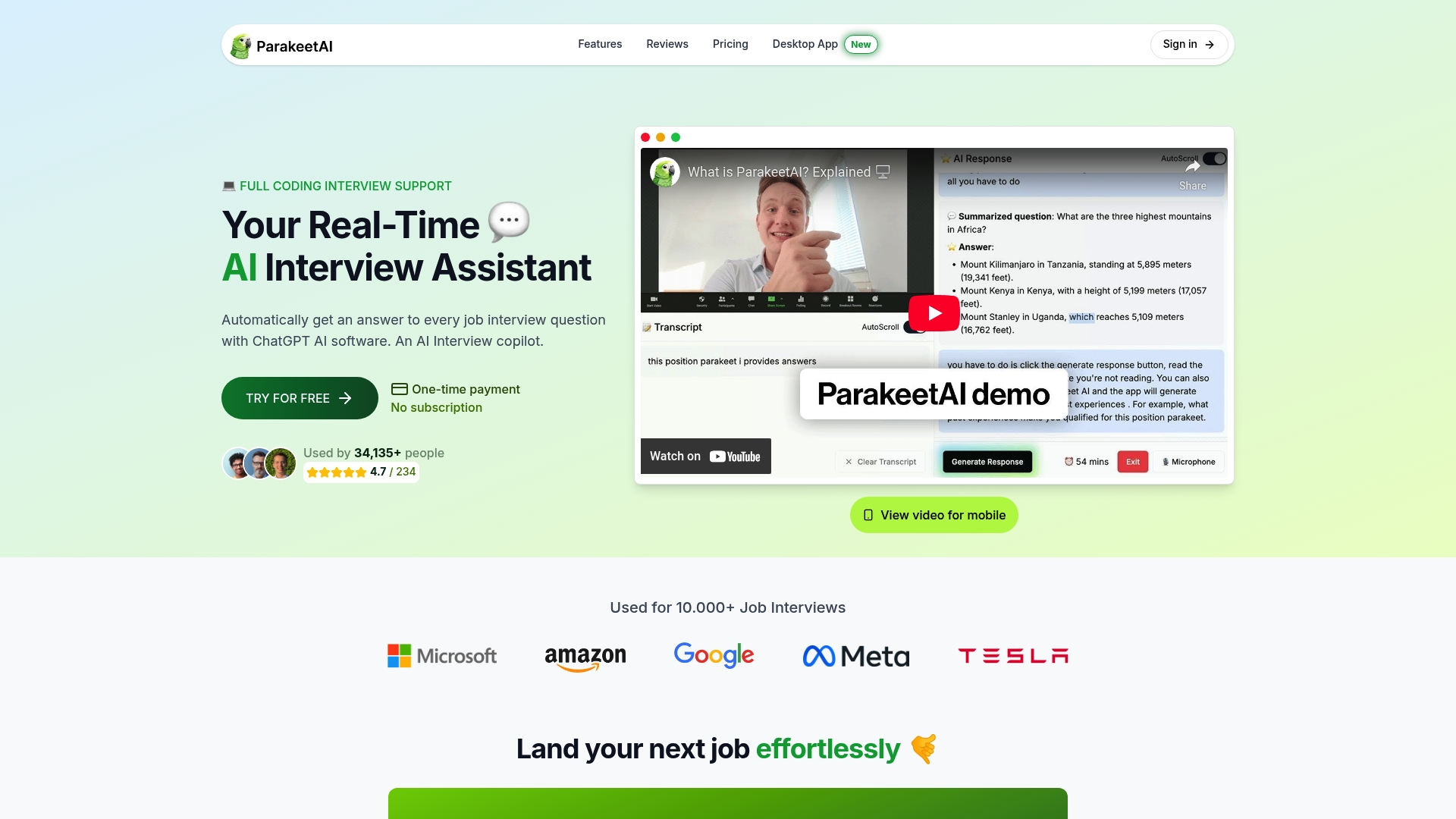
Parakeet-ai is a real-time AI interview assistant that listens to your interview and automatically surfaces answers to every question as it happens. It does not just prep you before the session. It works alongside you during the interview, so you spend less mental energy on recall and more on communicating clearly and confidently. For job seekers who want to perform at their best in NLP-evaluated interviews, where structure and evidence specificity directly affect your score, having real-time support changes the outcome. Explore how Parakeet-ai works and see whether it fits your next interview.
FAQ
What is the role of NLP in job interviews?
NLP analyzes candidate language during interviews, from resume parsing to spoken answer scoring, to evaluate skills and fit more consistently than unstructured human review. Modern systems use transformer models and multimodal inputs for greater accuracy.
Can NLP interviewing tools introduce bias?
Yes. AI screening algorithms have shown measurable disparities against Black and Asian applicants, and transcription errors tied to accent can compound the problem. Bias audits and multimodal inputs are the standard mitigation approaches.
How can job seekers prepare for NLP-evaluated interviews?
Structure your answers clearly, use specific examples to support every claim, and avoid vague generalizations. NLP systems score evidence specificity and coherence, so the same preparation that works for strong human interviewers also works here.
Do companies have legal obligations when using NLP hiring tools?
Yes. US law requires AI hiring systems to assess only job-relevant competencies and to provide reasonable accommodations for candidates with disabilities. HR teams should review ADA AI hiring guidance and document their evaluation criteria carefully.
What is a human-in-the-loop NLP system?
It is a setup where NLP scoring outputs are presented with supporting evidence to human reviewers, who can override the AI assessment. This approach improves defensibility, catches model errors, and is considered best practice for fair recruitment.