
What Is Interview Response Prediction? A 2026 Guide

TL;DR:Interview response prediction uses AI to score answers across multiple competencies and generates adaptive follow-up questions to identify specific gaps. It offers precise, personalized feedback and dynamic practice tailored to individual strengths and weaknesses. Candidates should focus on structured, quantified responses and interpret feedback to improve before high-stakes interviews.
Interview response prediction is the AI-powered process of anticipating and evaluating candidate answers to improve interview readiness before the real conversation happens. Unlike static flashcard prep or generic question banks, modern systems like Friday, PrepWise, and Interviewing.io use machine learning to score your responses, identify gaps, and generate targeted follow-up questions in real time. The result is a practice environment that adapts to you, not a one-size-fits-all script. If you want to understand how this technology works and how to use it to your advantage, this guide covers everything you need to know.
What is interview response prediction and how does it work?
Interview response prediction is the technical term for a class of AI systems that analyze candidate answers against structured scoring rubrics and use that analysis to forecast interview outcomes. The process has two distinct layers that candidates often confuse: predicting which questions might appear, and predicting how well your answers will perform. The second layer is where the real value lives.
Here is how a modern system processes your responses:
- Input collection. You submit your resume, a job description, or both. The system extracts themes, required competencies, and likely question categories.
- Dynamic question generation. An AI agent generates an opening question tailored to your profile. Platforms like PrepWise use large language models to build questions that map to specific rubric dimensions such as technical skill, communication, and problem-solving.
- Answer scoring. A scoring module evaluates your response on a scale, typically 1 to 5. The Friday system’s internal Grader scores each answer and flags weak areas before passing control to the next agent.
- Adaptive follow-up. A Clarifier agent reads the score and generates a probing follow-up question targeting the exact gap the Grader identified. If you scored low on specificity, the follow-up will push you for concrete examples.
- Outcome prediction. Some platforms go further. Interviewing.io built a predictive model from anonymized profiles and historical interview results to forecast whether a candidate is likely to pass a real interview, not just complete a practice session.
The feedback loop is the mechanism that separates interview response prediction from a simple Q&A drill. Each round of scoring and follow-up narrows the gap between where your answers are and where they need to be.
Pro Tip: Before your first AI mock session, write down three specific examples from your work history with quantified outcomes. Systems that score for specificity will reward you immediately, and you will get more useful follow-up questions as a result.
What benefits does AI-driven response prediction offer over traditional practice?
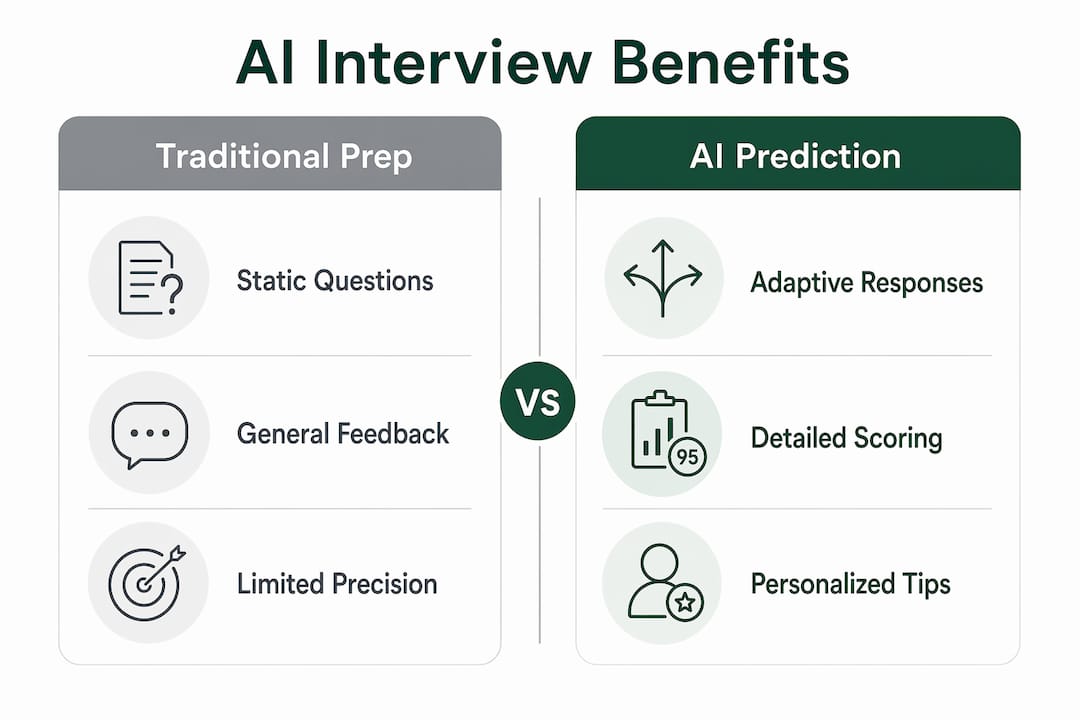
Traditional interview prep relies on memorizing answers to common questions from a static list. Interview response prediction replaces that with a system that reacts to what you actually say.

The most concrete advantage is precision. Rather than a friend telling you “that answer was pretty good,” an AI scoring system tells you exactly which competency dimension fell short. AI scoring evaluates tone, confidence, and content relevance as separate factors, which means you can fix one without disrupting the others. That level of granularity is not possible in a casual mock interview.
A second advantage is adaptivity. Static question banks give you the same 50 behavioral questions regardless of whether you aced the first 10 or stumbled on every one. Adaptive systems condition their next question on your last score. This mirrors how real interviewers actually behave. A strong answer to “Tell me about a time you led a team” often prompts a harder follow-up about conflict or failure. Weak answers prompt clarifying questions. AI replicates that dynamic.
The third advantage is objectivity. Human mock interviewers, even well-intentioned ones, soften negative feedback. AI does not. Rubric-based evaluations covering credibility and differentiation push candidates away from rehearsed, generic answers toward responses that actually stand out.
“The greatest gains from interview response prediction come when candidates use AI as a rubric-feedback tool identifying specific answer strengths and weaknesses instead of blindly trusting predicted questions.” — Friday AI mock interview simulator
For candidates preparing for technical roles, adaptive interview preparation has shown particular value because the gap between a passable answer and a strong one is often a single missing technical detail that only targeted follow-ups will surface.
Are there limitations or common misconceptions about interview answer prediction?
The biggest misconception is that these tools predict the exact questions you will face. They do not. What they predict is the category and quality threshold your answers need to meet. Interviewing.io’s research confirms that interview performance is a practical proxy for hiring quality, but no model can tell you whether your interviewer will ask about a time you failed or a time you led under pressure.
A second limitation is data dependency. The quality of predictions depends entirely on the quality of the training data and rubric design behind the system. A platform built on a shallow question bank with a single scoring dimension will produce shallow feedback. Before committing to any tool, check whether it scores across multiple competencies or just flags answer length.
The most dangerous pitfall is over-reliance on predicted question categories. Some systems warn explicitly that candidates who rehearse predicted questions without integrating personal evidence and real metrics end up with polished but unconvincing answers. Credibility comes from specificity, not from having the “right” answer to a predicted question.
Finally, AI feedback is only useful if you act on it. A score of 2 out of 5 on problem-solving tells you something is wrong. It does not automatically tell you how to fix it. You still need to interpret the feedback, revise your answer, and re-practice.
Pro Tip: After each AI mock session, write one sentence summarizing the single biggest gap the system identified. Then practice only that gap in your next session. Focused iteration beats broad repetition every time.
How can candidates effectively use interview response prediction tools?
Getting real value from these tools requires a structured approach, not just logging in and answering questions.
- Start with the job description. Paste the full job description into your prep tool before your first session. Systems like PrepWise extract required competencies directly from job postings, which means your practice questions will reflect the actual role rather than generic interview categories.
- Run a baseline session without preparation. Answer the first five questions cold, without reviewing your resume or rehearsing. The scores you receive represent your true starting point, and the gaps the system flags are the ones worth prioritizing.
- Use STAR structure for every behavioral answer. Structured answers with quantified outcomes help AI parsing systems assess your responses accurately and trigger the most useful follow-up questions. An answer that says “I reduced onboarding time by 30% by redesigning the training checklist” gives the scoring model far more to work with than “I improved the process.”
- Treat follow-up questions as the real test. The adaptive follow-ups generated after a low score are the most valuable part of the session. They reveal exactly what your answer failed to demonstrate. Answering them well is more important than nailing the opening question.
- Track your scores across sessions. Most platforms store session history. Review your scores by competency dimension after three or four sessions. A consistent low score on communication signals a structural problem in how you frame answers, not just a content gap.
| Practice method | What it measures | Best for |
|---|---|---|
| Static question banks | Question familiarity | Building baseline vocabulary |
| AI response prediction | Answer quality by competency | Identifying and closing specific gaps |
| Human mock interviews | Interpersonal dynamics | Practicing tone and presence |
| Recorded self-practice | Delivery and pacing | Reducing filler words and hesitation |
For candidates preparing for final rounds, combining AI scoring with AI strategies for final interviews produces the most complete preparation. The AI handles rubric feedback; human practice handles the interpersonal layer.
Key takeaways
Interview response prediction works best as a rubric-feedback system that scores answer quality across multiple competencies and generates adaptive follow-ups to close specific gaps.
| Point | Details |
|---|---|
| Core definition | Interview response prediction scores answer quality and predicts outcomes, not exact questions. |
| Adaptive feedback loop | Systems like Friday score each answer and generate targeted follow-ups based on identified weaknesses. |
| Multi-dimension scoring | AI evaluates tone, confidence, and content relevance as separate factors for precise improvement. |
| Structured answers perform better | STAR-format answers with quantified outcomes produce more accurate AI scores and better follow-ups. |
| Avoid over-reliance on predicted questions | Rehearsing categories without personal evidence produces polished but unconvincing answers. |
Why I think most candidates are using these tools wrong
I have watched candidates spend hours drilling predicted questions and walk into interviews sounding rehearsed but unconvincing. The problem is not the tool. It is the mindset. Most people treat interview response prediction as a cheat sheet. They want the system to tell them what questions to expect so they can memorize answers. That approach misses the entire point.
The real value is in the scoring feedback, specifically the follow-up questions generated after a low score. Those follow-ups are a direct signal of what your answer failed to prove. When a system asks “Can you give a specific example of how you measured that outcome?” after your answer, it is telling you that your response lacked evidence. That is the insight worth acting on.
I also think candidates underestimate how much rubric design matters. A platform that scores only on content length or keyword presence will give you misleading confidence. Before you commit to any tool, ask what dimensions it scores on. If the answer is vague, the feedback will be too.
The candidates who get the most out of AI-powered interview technology are the ones who treat each session as a diagnostic, not a rehearsal. They are not trying to predict the interview. They are trying to understand what their answers currently demonstrate and close the gap before it matters.
— Jure
Practice smarter with Parakeet-ai
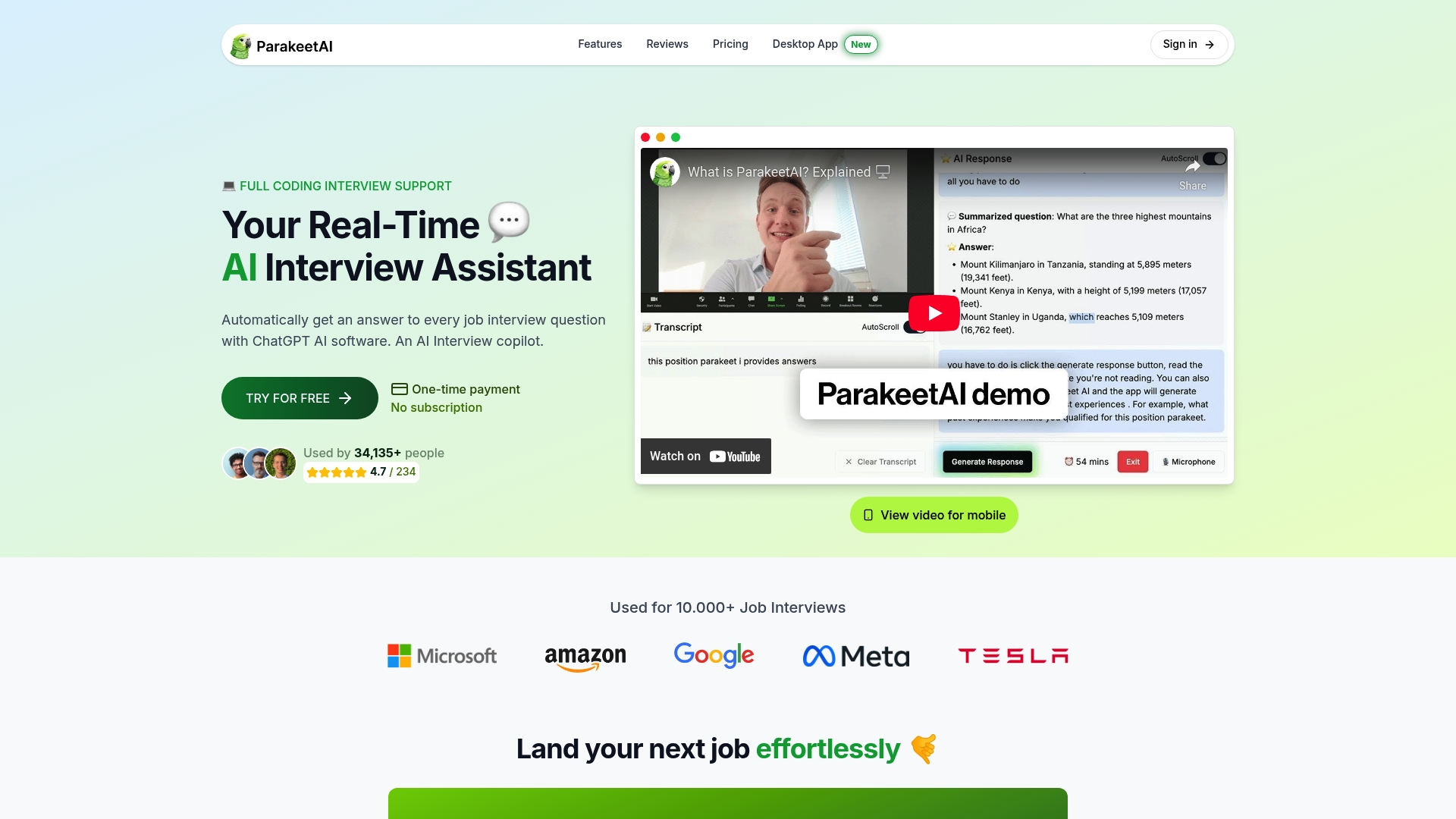
Parakeet-ai is a real-time AI interview assistant that listens to your interview as it happens and automatically provides answers to every question using AI. You do not need to memorize predicted questions or hope your prep covered the right topics. Parakeet-ai works live, in the moment, giving you the response support you need exactly when you need it. For candidates who want to combine pre-interview practice with real-time assistance, Parakeet-ai offers a preparation approach that goes beyond any static mock interview tool. Visit the platform to see how real-time AI support changes the interview experience entirely.
FAQ
What is interview response prediction in simple terms?
Interview response prediction is an AI process that evaluates the quality of your interview answers against a scoring rubric and uses that evaluation to forecast your likely interview performance. It focuses on how well your answers demonstrate required competencies, not on guessing exact questions.
How accurate are AI tools at predicting interview outcomes?
Accuracy depends on the quality of training data and rubric design. Interviewing.io’s model, built from anonymized LinkedIn profiles and historical interview results, outperformed both human recruiters and large language models at predicting candidate success, which shows that outcome prediction is achievable with sufficient data.
Does interview response prediction replace traditional mock interviews?
No. AI scoring covers rubric dimensions like content relevance, tone, and problem-solving, but human mock interviews capture interpersonal dynamics and presence that AI cannot fully replicate. The two methods work best in combination.
What answer format works best with AI scoring systems?
STAR-format answers that include specific, quantified outcomes perform best. AI parsing systems condition follow-up questions on score thresholds, and structured answers with measurable results give the scoring model more data to work with, producing more precise feedback.
Can these tools help with technical interviews as well as behavioral ones?
Yes. Platforms like PrepWise generate questions from job descriptions and score answers across technical skill, communication, and problem-solving dimensions simultaneously, making them applicable to both behavioral and technical interview formats.