
Why Unbiased Interview Practices Matter for Better Hiring

TL;DR:Unbiased interview practices use structured, consistent evaluation methods to eliminate personal bias and assess candidates fairly.Implementing these practices improves hiring accuracy, legal defensibility, and business outcomes such as higher revenue and lower turnover.
Unbiased interview practices are defined as structured evaluation methods that assess candidates solely on job-relevant criteria, removing personal, cultural, or demographic factors from hiring decisions. The importance of unbiased interviews extends far beyond ethics. Organizations using structured, fair hiring methods see 28% higher revenue and 40% lower turnover compared to those relying on gut-feel assessments. Google, Accenture, and SHRM have each documented that bias in hiring is not a minor administrative problem. It is a direct threat to performance, legal standing, and team quality. This article breaks down why unbiased interview practices work, what the research proves, and how you can implement them starting today.
Why unbiased interview practices are critical for fair hiring

Structured interviewing is the industry term for what most HR professionals mean when they discuss unbiased interview practices. The two concepts are deeply linked. Structured interviews use predetermined, job-relevant questions asked in the same order to every candidate, scored against consistent rubrics. Unbiased practices layer on top of that foundation by addressing the psychological and procedural factors that distort evaluation.
Bias in interviews is rarely intentional. Confirmation bias, identified by Google’s hiring research team as a primary source of interview error, causes interviewers to seek evidence that confirms their first impression of a candidate rather than objectively evaluating responses. That snap judgment forms within seconds of meeting someone and then shapes every subsequent question and score. The result is a hiring decision that reflects the interviewer’s comfort zone, not the candidate’s actual capability.
The legal exposure is real and growing. Legal experts warn that organizations without structured evaluation criteria face significant liability in discrimination claims, because they cannot demonstrate that decisions were made on job-related grounds. Title VII of the Civil Rights Act and EEOC guidelines require that hiring criteria be demonstrably job-relevant. Unstructured interviews, by definition, cannot meet that standard consistently.
Common bias types that derail fair evaluation include:
- Affinity bias: Favoring candidates who share the interviewer’s background, alma mater, or hobbies
- Halo/horn effect: Letting one strong or weak answer color the entire evaluation
- Attribution bias: Crediting a candidate’s success to luck rather than skill based on their demographic profile
- Beauty bias: Unconsciously rating more conventionally attractive candidates higher on unrelated competencies
- Recency bias: Weighting the last candidate interviewed more favorably simply because they are freshest in memory
Pro Tip: Before each interview panel, run a five-minute calibration session where evaluators align on what a strong, average, and weak answer looks like for each question. This single step reduces scoring variance significantly.
How do structured interviews reduce bias and improve hiring accuracy?
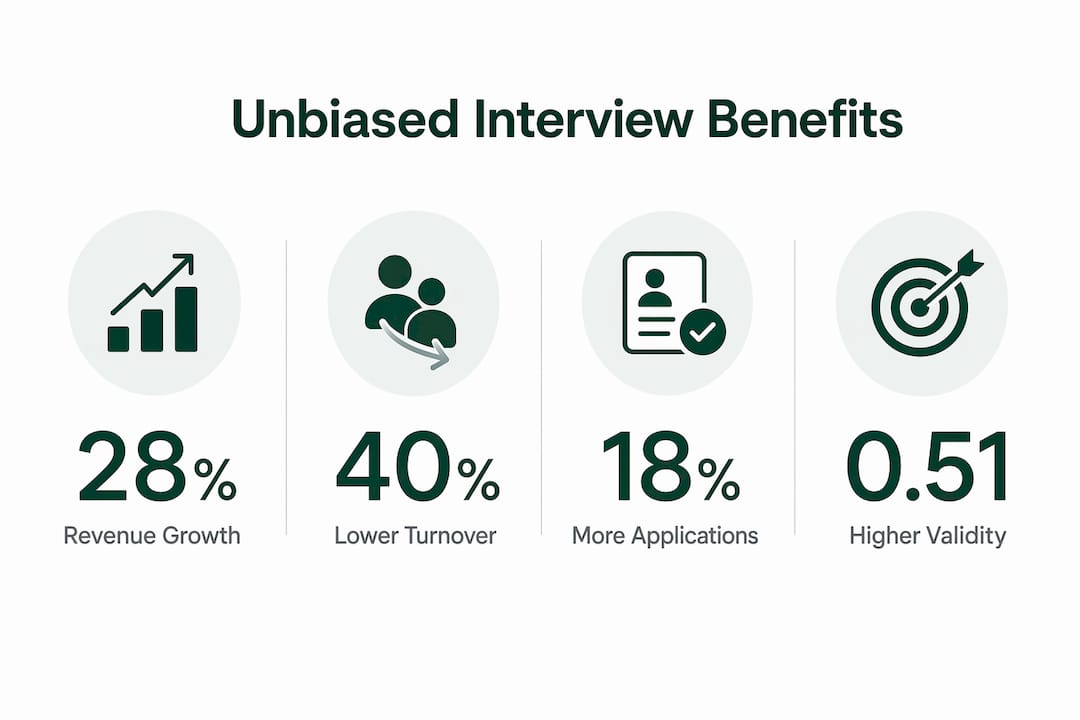
Structured interviews improve predictive validity by about 30% compared to unstructured conversations, with validity coefficients of 0.51 versus 0.38 respectively. That gap translates directly into better hiring decisions and fewer costly mis-hires. Unstructured interviews feel natural and conversational, but they are unreliable predictors of job performance precisely because they vary so much between candidates.
The core components of a structured interview are not complicated, but they require deliberate design:
- Job-relevant question bank: Every question maps to a specific competency required for the role, developed before the first interview begins.
- Consistent delivery: Every candidate receives the same questions in the same order, eliminating the advantage some candidates gain from more talkative or generous interviewers.
- Behaviorally anchored rating scales (BARS): Scoring rubrics define exactly what a 1, 3, and 5 response looks like for each question, so two evaluators watching the same answer reach similar scores.
- Independent scoring: Each evaluator scores candidates before the debrief discussion, preventing groupthink and social pressure from distorting individual assessments.
- Calibrated debrief: The panel compares scores after independent evaluation, discussing only evidence-based observations tied to the rubric.
Here is how structured and unstructured interviews compare across the dimensions that matter most to hiring teams:
| Dimension | Structured interviews | Unstructured interviews |
|---|---|---|
| Predictive validity | 0.51 | 0.38 |
| Legal defensibility | High | Low |
| Evaluator consistency | High | Low |
| Candidate experience | Neutral to positive | Variable |
| Setup time required | 4 to 6 hours per role | Minimal |
A common objection is that structured interviews feel robotic and hurt candidate experience. The research does not support this. Candidates cannot differentiate between structured and unstructured interviews when the interviewer delivers questions with warmth and genuine engagement. The rigidity is felt by the interviewer, not the candidate.
Pro Tip: Build your question bank collaboratively with the hiring manager and a current high performer in the role. Their input ensures questions reflect real job demands, not idealized job descriptions.
What business benefits result from unbiased interview practices?
The business case for fair hiring is no longer theoretical. The data from 2026 is direct: inclusive and unbiased hiring correlates with 28% higher revenue and up to 40% lower employee turnover. Both figures reflect the compounding effect of better hiring decisions made consistently over time. Lower turnover alone reduces replacement costs, which typically run 50% to 200% of annual salary for a given role.
The benefits extend beyond the numbers on a spreadsheet. Consider second chance hiring, where organizations consider candidates with justice involvement. 85% of HR professionals report that second chance hires perform as well or better than the general workforce. This finding directly challenges the assumption that excluding nontraditional candidates protects quality. It does the opposite.
| Business outcome | Impact |
|---|---|
| Revenue growth | 28% higher for inclusive hiring organizations |
| Employee turnover | Up to 40% lower with unbiased practices |
| Second chance hire performance | 85% perform equal to or better than average |
| Underrepresented group applications | 18% increase when unnecessary credentials are removed |
| Employer brand | Stronger candidate trust and wider talent pool |
Removing unnecessary credential requirements raises applications from underrepresented groups by 18% and improves overall hire quality. This is not about lowering standards. Inclusive hiring is a performance strategy built on measuring what actually predicts job success, not what signals social similarity to the hiring team.
Organizations like Accenture and Unilever have publicly documented the performance gains from structured, skills-based hiring. Unilever replaced early-stage interviews with structured video assessments and AI-scored work samples, cutting time-to-hire by 75% while increasing diversity. The lesson is clear: fairness and efficiency are not in conflict.
How can organizations implement effective unbiased interview strategies?
Building unbiased recruitment strategies requires investment upfront. Structured interviews take 4 to 6 hours of preparation per role to develop properly, a time commitment most teams skip. That shortcut is expensive. Teams that skip the prep work default to unstructured conversations that produce less valid, less defensible hiring decisions.
Here is a practical framework for implementation:
- Audit your current process: Map every stage of your hiring funnel and identify where candidates from underrepresented groups drop off. Tracking funnel drop-off rates at each stage reveals hidden exclusion points that aggregate diversity metrics miss entirely.
- Build role-specific question banks: Work with hiring managers to identify the three to five competencies that actually predict success in the role. Write two to three behavioral questions per competency.
- Develop BARS rubrics before interviews begin: Define what excellent, acceptable, and poor responses look like for each question. Share these with all evaluators before the first interview.
- Train interviewers on bias mechanics: A one-hour training on confirmation bias, affinity bias, and the halo effect changes how evaluators approach scoring. Awareness alone reduces error.
- Standardize the debrief process: Require independent scoring before any group discussion. Use a shared scoring sheet that forces evaluators to cite specific candidate statements as evidence.
- Use technology to support consistency: AI-driven tools can standardize question delivery, flag scoring inconsistencies, and surface patterns across evaluators that human reviewers miss.
- Delay background checks: Over 37 states and 150 localities have enacted Ban the Box laws following EEOC guidance, requiring background checks only after conditional offers. Adopting this practice proactively expands your talent pool and reduces automatic disqualification bias.
Pro Tip: Assign one panel member as the “bias observer” during each debrief. Their sole job is to flag when the discussion drifts from rubric-based evidence to personal impressions. Rotate this role across the team.
One implementation pitfall deserves direct attention. Experienced interviewers’ informal cues and gut feelings are not worthless, but they must not drive the final decision. Bring those observations into the debrief as supplementary context. The structured score must carry the primary weight.
Key takeaways
Unbiased interview practices require structured questions, calibrated rubrics, and consistent scoring to deliver measurably better hiring outcomes and legal defensibility.
| Point | Details |
|---|---|
| Structured interviews outperform unstructured | Predictive validity of 0.51 vs. 0.38 means fewer costly mis-hires over time. |
| Business impact is quantifiable | Fair hiring links to 28% higher revenue and 40% lower turnover in 2026 data. |
| Bias is psychological, not just procedural | Confirmation bias and snap judgments require deliberate structural countermeasures. |
| Implementation requires upfront investment | Budget 4 to 6 hours per role for question development and rubric creation. |
| Technology accelerates fairness at scale | AI tools standardize scoring and surface evaluator inconsistencies human review misses. |
The uncomfortable truth about hiring teams and structure
I have worked with dozens of hiring teams across industries, and the resistance to structured interviews follows a predictable pattern. Senior interviewers, often the most experienced people in the room, push back hardest. They believe their instincts are calibrated by years of practice. Some of them are right. But the research is unambiguous: even skilled interviewers produce more valid decisions when working within a structured framework than when operating on intuition alone.
The real problem is not skepticism about structure. It is the upfront cost. Building a proper question bank and rubric set for a single role takes real time, and most hiring teams are already stretched. So they skip it, run a few friendly conversations, and call it an interview process. Then they wonder why their new hires underperform or leave within a year.
What I have found actually works is treating the first structured interview build as a template investment. Spend the six hours once. Refine it after the first hiring cycle. By the third use, the process runs faster than an unstructured interview and produces decisions the whole team can defend. The teams that commit to this approach stop debating whether a candidate “felt right” and start discussing whether the evidence supports the hire. That shift in language alone signals a more mature, more effective hiring culture.
Fairness in interviews is not a constraint on good hiring. It is the mechanism that makes good hiring possible at scale.
— Jure
How Parakeet-ai supports structured, fair interviewing
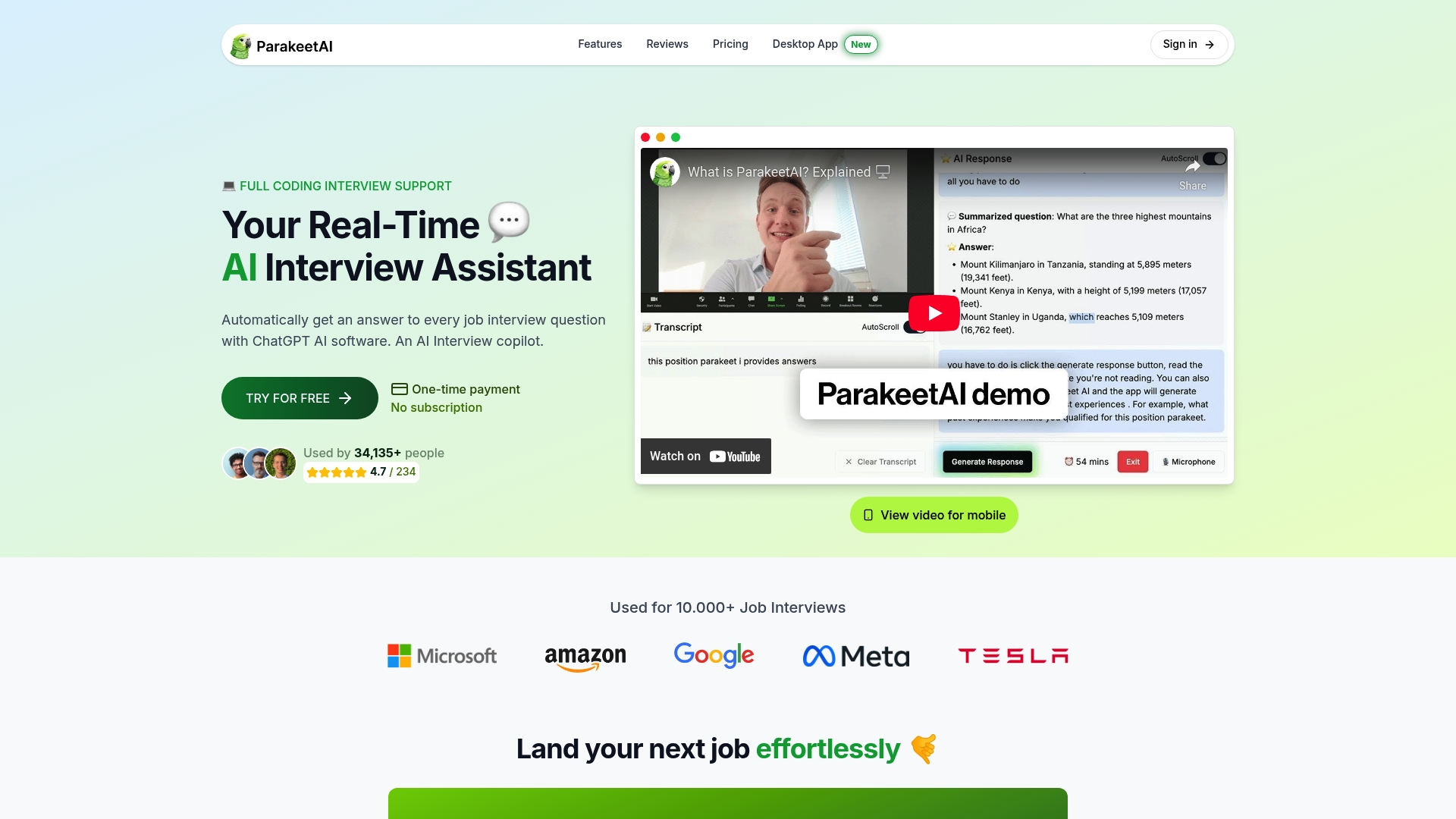
Parakeet-ai is a real-time AI interview assistant that listens to your interviews and automatically provides structured, job-relevant responses to every question as it happens. For hiring teams building unbiased interview processes, Parakeet-ai supports consistency by standardizing how questions are framed and how responses are captured, reducing the evaluator variance that undermines fair scoring. The platform draws on AI-driven fairness principles to minimize human bias in real time. If your team is ready to move beyond gut-feel hiring and build a process that produces defensible, high-quality decisions, visit parakeet-ai.com to see how it works.
FAQ
What are unbiased interview practices?
Unbiased interview practices are structured evaluation methods that assess every candidate on the same job-relevant criteria, using consistent questions, scoring rubrics, and independent evaluator scoring to remove personal bias from hiring decisions.
Why does fairness in interviews matter for business outcomes?
Unbiased hiring correlates with 28% higher revenue and 40% lower employee turnover, according to 2026 data, because better evaluation methods produce better hires who stay longer and perform at a higher level.
How do you conduct an unbiased interview?
Develop a job-relevant question bank, use behaviorally anchored rating scales for scoring, have evaluators score independently before debriefing, and train interviewers to recognize confirmation bias and affinity bias before they enter the room.
Do structured interviews hurt the candidate experience?
Research shows candidates cannot tell the difference between structured and unstructured interviews when the interviewer delivers questions with genuine engagement, meaning structure does not come at the cost of a positive candidate experience.
What is the biggest barrier to implementing unbiased recruitment strategies?
The primary barrier is the upfront time investment. Building a proper structured interview takes 4 to 6 hours per role, a cost most teams underestimate, but one that pays back through lower turnover and stronger hiring decisions over every subsequent use.