
What Is Interactive Interview Guidance for Job Seekers

TL;DR:Interactive interview guidance combines AI assistance with real candidate responses for adaptive, structured interview support. It offers real-time feedback, reduces bias, and enhances authenticity, unlike traditional static prep methods. Using AI tools alongside genuine storytelling and company research builds interview fluency and confidence.
Interactive interview guidance is a technology-powered method that combines AI assistance with real interview data to improve how candidates prepare for and perform in job interviews. Unlike static prep materials or one-time coaching sessions, this approach adapts in real time, giving both candidates and recruiters structured, consistent support throughout the interview process. Platforms like Glider AI and USC Interactive Interviews have made this method increasingly accessible, and tools like Parakeet-ai have extended it directly to candidates preparing on their own. Understanding how it works gives you a concrete edge over candidates still relying on memorized scripts.
What is interactive interview guidance, exactly?
Interactive interview guidance is an AI-supported interview method that uses real candidate responses and adaptive questioning to create more authentic, structured interview experiences. The term “interactive interview guidance” is a descriptive phrase that covers what the industry more formally calls AI-guided interviewing or AI-assisted interview coaching. Both terms refer to the same core concept: technology that participates actively in the interview process rather than sitting on the sidelines.

The defining feature is authenticity. USC Interactive Interviews, for example, operates on the principle that every answer is authentic, meaning responses come from the actual words of the interview subject rather than from generative AI fabrication. This matters because it preserves the integrity of the candidate’s voice while still delivering structured, scalable interview experiences.
On the recruiter side, platforms like Glider AI function as a recruiter co-pilot, adapting follow-up questions in real time, capturing structured notes, and applying consistent scoring to reduce evaluator bias. For candidates, interactive guidance shows up as AI mock interviews, real-time feedback tools, and personalized coaching platforms that simulate live interview conditions.
How does interactive guidance differ from traditional interview prep?
Traditional interview preparation is front-loaded. You research the company, memorize a set of STAR stories, and rehearse answers until they feel natural. Candidates typically spend 1 to 2 hours researching, prepare 6 to 8 STAR stories, and run through 30-minute mock sessions. That approach works, but it has a ceiling. Memorized answers break down the moment an interviewer takes the conversation in an unexpected direction.
Interactive interview guidance removes that ceiling by making the preparation dynamic rather than static. Here is how the two approaches compare:
| Feature | Traditional prep | Interactive guidance |
|---|---|---|
| Feedback timing | After the session, from a coach | Real time, during practice or live interview |
| Adaptability | Fixed scripts and rehearsed answers | AI adapts follow-up questions based on responses |
| Consistency | Varies by coach or mock partner | Standardized scoring applied across all candidates |
| Authenticity | Depends on candidate’s memorization | Built from actual interview responses and story banks |
| Accessibility | Requires scheduling a coach or partner | Available on demand, any time |
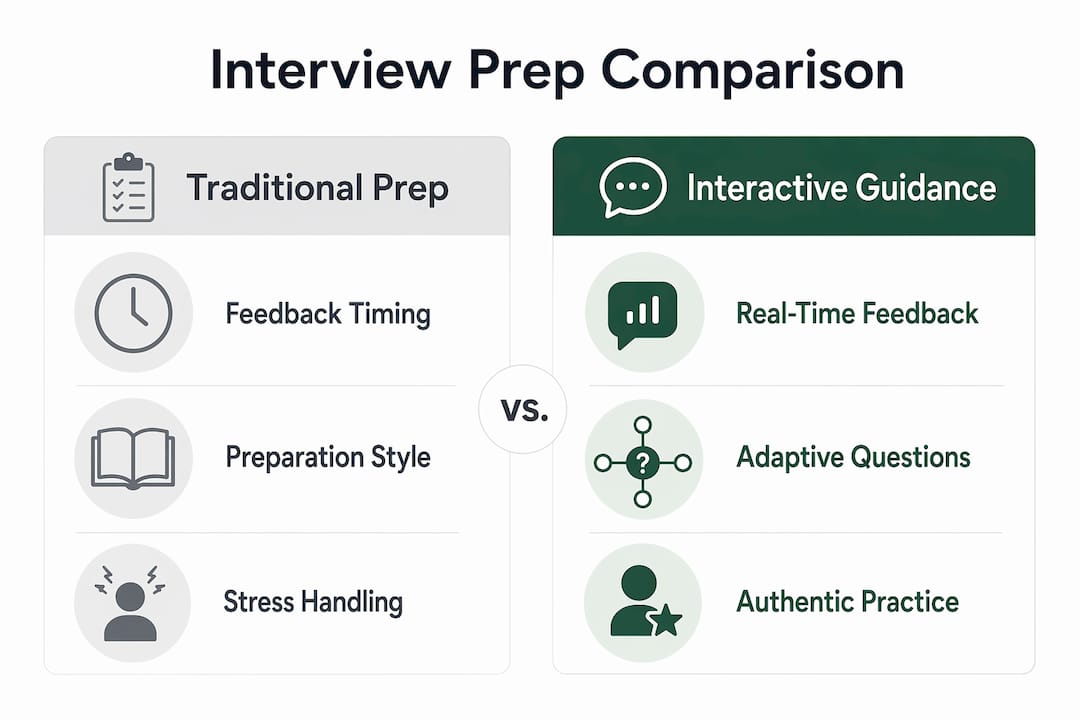
The practical difference shows up most clearly under pressure. A candidate who has only memorized answers will freeze when asked a follow-up they did not anticipate. A candidate who has trained with adaptive AI tools has practiced handling exactly that kind of pivot. Interactive guidance also addresses a structural problem in traditional prep: evaluator inconsistency. AI ensures role-specific questions and structured scoring, which removes the variability that comes from different interviewers applying different standards.
Pro Tip: Do not abandon traditional prep entirely. Use STAR story development as your foundation, then layer interactive AI practice on top to stress-test those stories under realistic, adaptive conditions.
What technologies power interactive interview guidance?
The technology behind interactive interview guidance combines natural language processing, structured data capture, and adaptive questioning logic. Recruiters lead the conversation while AI captures notes and suggests follow-up questions in real time. This co-pilot model means the human element stays intact while the AI handles the cognitive load of tracking responses, scoring consistency, and flagging gaps in candidate answers.
Key capabilities that define modern interactive interview platforms include:
- Real-time adaptive questioning: The system analyzes a candidate’s answer and generates contextually relevant follow-ups, pushing for depth rather than accepting surface-level responses.
- Structured scoring: Every response is evaluated against predefined criteria, removing the subjectivity that typically creeps into live interviews.
- Multilingual support: Enterprise platforms support multiple languages, making structured interviews accessible across global hiring pipelines.
- Applicant tracking system integration: Platforms connect directly to tools like Greenhouse, Workday, and Lever, so interview data flows automatically into existing hiring workflows.
- Instant reporting: Hiring managers receive structured summaries immediately after interviews, cutting the time between interview and decision.
For candidates, the technology manifests differently. AI mock interview tools use speech recognition and language analysis to evaluate your answers for clarity, specificity, and structure. AI practice sessions offer unlimited repetitions with immediate feedback, which career coaches consistently identify as one of the fastest ways to improve answer quality before a live interview.
Pro Tip: When using an AI mock interview tool, record your sessions and review them. The gap between how you think you sound and how you actually sound is where most improvement happens.
You can find specific guidance on AI interview best practices that covers how to get the most out of these tools without letting them replace genuine preparation.
How can you use interactive guidance to prepare effectively?
The most effective candidates treat interactive interview guidance as a training system, not a shortcut. The goal is to build a mental story bank, a personal library of specific experiences that you can draw from and adapt to almost any question. Candidates with internalized stories answer confidently even when conversations diverge from the expected script, because they are working from real experience rather than rehearsed lines.
Here is a practical preparation sequence that combines interactive tools with foundational work:
- Build your story bank first. Identify 8 to 10 specific professional experiences that demonstrate problem-solving, leadership, conflict resolution, and results. Write them out in STAR format: Situation, Task, Action, Result.
- Run AI mock interviews. Use a platform like Parakeet-ai to simulate live interview conditions. Focus on behavioral questions first, since those are where most candidates lose points through vague, generic answers.
- Review AI feedback on specificity. The most common weakness in interview answers is lack of concrete detail. If your AI feedback flags vague language, go back to your story bank and add numbers, names, and outcomes.
- Practice divergent follow-ups. Ask the AI to challenge your answers with follow-up questions you did not prepare for. This trains you to think on your feet rather than recite from memory.
- Combine tech with company research. Authenticity, storytelling, and role understanding cannot be automated. Spend equal time understanding the company’s priorities, culture, and the specific problems the role is meant to solve.
- Simulate the full interview format. If you are preparing for a technical role, use technical interview tips to practice the specific formats you will face, including whiteboard problems, case studies, or system design questions.
The sequence works because it builds from the inside out. You develop the raw material first, then use AI tools to refine how you deliver it. Candidates who skip step one and go straight to AI practice end up with polished delivery of empty content.
What are the benefits and limitations of interactive interview guidance?
Interactive interview guidance delivers measurable advantages for both candidates and organizations, but it is not a complete solution on its own.
Benefits:
- Fairness and consistency: AI applies the same evaluation criteria to every candidate, which democratizes structured, fair preparation and gives recruiters confidence without requiring subject matter experts in the room.
- Reduced bias: Structured scoring reduces the influence of irrelevant factors like appearance, accent, or interviewer mood.
- Candidate readiness: Unlimited practice with immediate feedback accelerates skill development faster than periodic sessions with a human coach.
- Real-time support: For live AI-guided interviews, candidates receive prompts and structure that help them stay focused and thorough.
- Scalability: Organizations can run hundreds of structured interviews simultaneously without sacrificing evaluation quality.
Limitations:
- Over-reliance on AI feedback can produce candidates who are technically polished but emotionally flat. Human interviewers notice when someone sounds rehearsed rather than genuine.
- Interactive tools cannot replicate the social dynamics of a real interview. Rapport, reading the room, and adjusting your energy to match an interviewer’s style are skills that only develop through real human interaction.
- Not all platforms are equal. Some AI mock interview tools provide generic feedback that does not account for industry-specific norms or role-level expectations.
“Despite AI advances, authenticity and storytelling remain paramount to interview success. Technology supports preparation, but the candidate’s genuine voice is what closes the offer.”
The right mindset is to treat interactive guidance as a force multiplier for preparation you have already done, not a replacement for it. Candidates who combine AI practice with deep personal reflection and company research consistently outperform those who rely on either approach alone. For a broader view of why AI matters in interviews, the structural shift toward AI-assisted evaluation is accelerating, which makes familiarity with these tools a practical necessity in 2026.
Key takeaways
Interactive interview guidance works best when AI-powered practice is layered on top of authentic storytelling and deep role research, not used as a substitute for either.
| Point | Details |
|---|---|
| Core definition | Interactive interview guidance combines AI assistance with real candidate responses for structured, adaptive interview support. |
| Advantage over traditional prep | AI adapts follow-up questions in real time, exposing gaps that memorized answers cannot cover. |
| Technology foundation | Platforms use NLP, structured scoring, and ATS integration to deliver consistent, bias-reduced evaluations. |
| Candidate preparation strategy | Build a story bank first, then use AI mock interviews to stress-test and refine delivery. |
| Key limitation | AI cannot replace authentic human connection; over-reliance produces polished but hollow interview performance. |
Why interactive guidance changed how I think about interview prep
I spent years watching candidates walk into interviews with meticulously prepared answers and walk out confused about why they did not get the offer. The problem was almost never knowledge. It was delivery, specificity, and the inability to adapt when the conversation went somewhere unexpected.
What interactive interview guidance gets right is that it forces you to practice under realistic pressure, not ideal conditions. The first time an AI follow-up question catches you mid-answer with no prepared response, you realize how much of your preparation was actually just comfort with a script. That discomfort is the point.
What I think most people miss is the democratization angle. A candidate at a well-funded university with access to career coaches and alumni networks has always had a structural advantage in interview preparation. Interactive guidance tools compress that gap significantly. A first-generation job seeker with a good AI practice tool and a disciplined preparation process can now build the same interview fluency that used to require expensive coaching or insider access.
The risk I watch for is the opposite extreme: candidates who run 50 AI mock interviews and start to sound like they are reciting a script written by a language model. Interviewers pick up on that immediately. The goal is to use AI to sharpen your own voice, not to replace it with a synthetic one. Pair your AI practice with a long-term job search strategy, like the frameworks outlined for IT professionals navigating competitive markets, and you will be building something that compounds over time rather than just prepping for a single interview.
— Jure
How Parakeet-ai supports your interview preparation
Parakeet-ai is a real-time AI interview assistant that listens to your live interview and automatically provides answers to every question as it happens. For candidates who want to experience interactive interview guidance in its most direct form, Parakeet-ai removes the gap between preparation and performance.
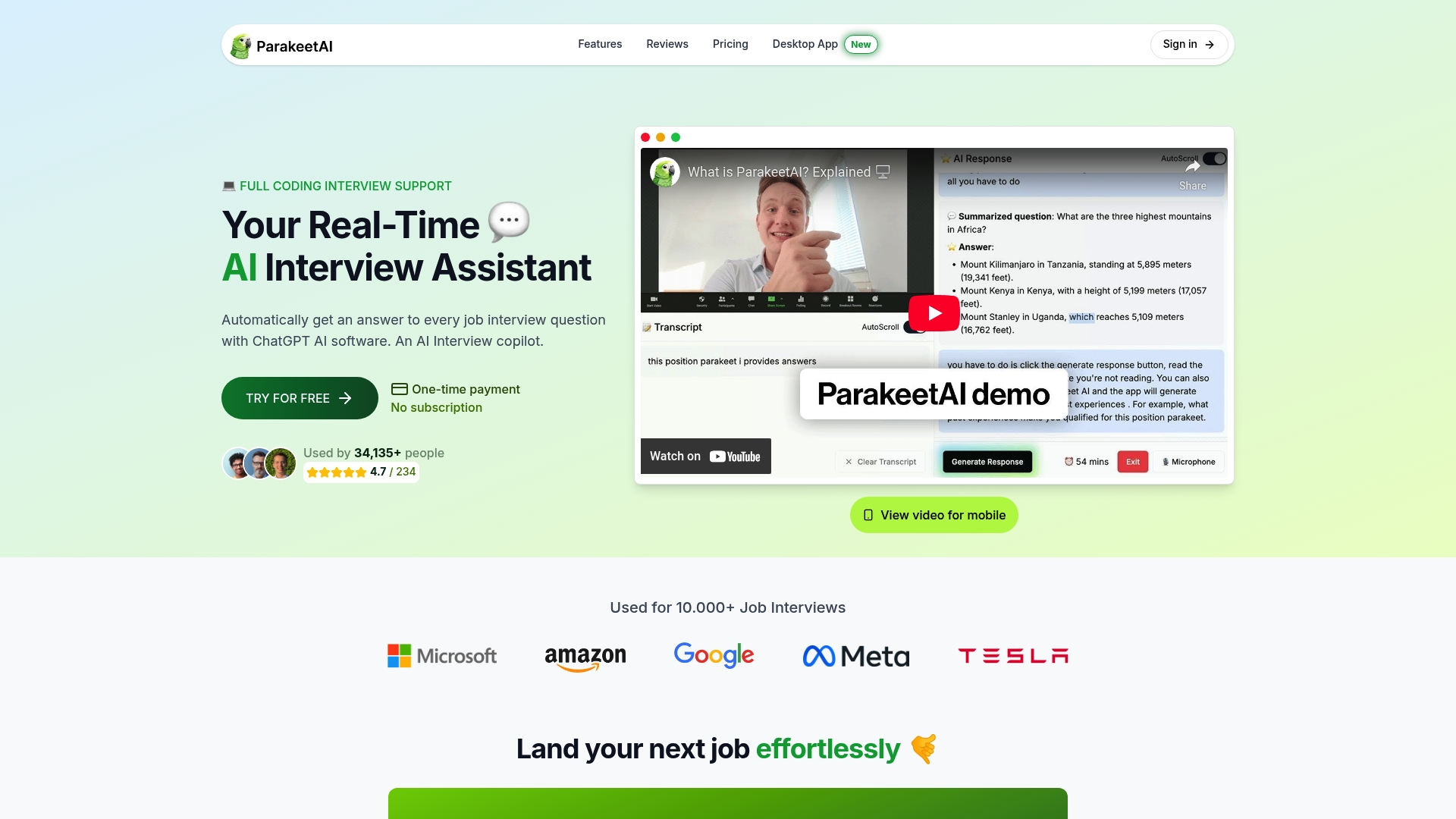
Beyond live assistance, Parakeet-ai gives you access to AI-powered practice sessions, structured feedback on your answers, and preparation resources built specifically for the formats you will face. Whether you are preparing for a behavioral interview, a technical screen, or a panel format, the platform adapts to your specific situation. Visit parakeet-ai.com to see how real-time AI guidance works in practice and start preparing with tools that match the actual conditions of modern interviews.
FAQ
What is interactive interview guidance in simple terms?
Interactive interview guidance is an AI-supported method that provides real-time prompts, adaptive follow-up questions, and structured feedback during interview practice or live interviews. It differs from static prep by responding dynamically to what you actually say.
How does interactive guidance reduce interviewer bias?
AI applies consistent scoring criteria to every candidate response, removing the variability that comes from different interviewers applying different standards. Platforms like Glider AI use role-specific questions and structured evaluation to produce fairer, more comparable assessments.
Can interactive interview guidance replace a human coach?
No. AI tools accelerate skill development through unlimited practice and immediate feedback, but they cannot replicate the social dynamics, rapport-building, and nuanced feedback that experienced human coaches provide. The most effective preparation combines both.
What is the STAR method and how does it work with AI practice?
STAR stands for Situation, Task, Action, Result. It is a framework for structuring behavioral interview answers. AI mock interview tools use STAR-aligned evaluation criteria to score your responses and flag answers that lack specificity or clear outcomes.
How do I know if I am over-relying on AI interview tools?
If your answers sound rehearsed rather than genuine, or if you struggle to adapt when an interviewer asks something unexpected, you have likely optimized for AI feedback rather than real conversation. Balance AI practice with live mock interviews and genuine reflection on your own professional experiences.