
How to prepare interview stories that impress hiring managers

Behavioral interview questions trip up even the most qualified candidates. You walk in with a strong resume, real experience, and genuine skills, but the moment someone asks “Tell me about a time you handled conflict,” your mind goes blank. The problem isn’t your experience. It’s that you haven’t shaped that experience into stories. Candidates who prepare compelling personal stories are far more memorable, more credible, and more likely to get the offer. This guide walks you through exactly how to build, structure, and deliver interview stories that make hiring managers lean forward.
Table of Contents
- Understand why interview stories matter
- Choose your core stories: Skills every employer seeks
- Structure your stories for maximum impact
- Practice and refine: Making your stories unforgettable
- Expert perspective: Why most job seekers get interview stories wrong
- Strengthen your interview stories with Parakeet AI
- Frequently asked questions
Key Takeaways
| Point | Details |
|---|---|
| Behavioral stories matter | Most employers use behavioral interviews, so well-prepared stories set you apart. |
| Use proven frameworks | Structure each story with the STAR, SOAR, or CAR method for maximum clarity and impact. |
| Prepare a core bank | Build 5-7 versatile stories covering leadership, teamwork, problem-solving, and more. |
| Practice for authenticity | Rehearse your stories out loud and title them for easy recall while keeping responses conversational, not scripted. |
| Quantify your results | Add metrics or tangible outcomes to every story to show measurable contribution. |
Understand why interview stories matter
Stories aren’t just a nice touch in interviews. They’re the primary currency of the modern hiring process. Most interviewers aren’t just checking boxes. They’re trying to predict how you’ll behave on the job, and the best predictor of future behavior is past behavior.
That’s why behavioral questions dominate today’s interviews. Behavioral questions are used by 73% of employers, and 70-80% of recruiters say storytelling significantly influences their hiring decisions. Those numbers aren’t small. They tell you that your ability to narrate your own experience is nearly as important as the experience itself.
When you tell a real story, something shifts in the room. You stop sounding like every other candidate reciting job duties and start sounding like a person with actual impact. Stories demonstrate competencies in a way that abstract claims simply can’t. Saying “I’m a great communicator” means nothing. Describing how you de-escalated a tense client situation and saved a $200,000 contract says everything.
Stories also build trust. Hiring managers hear hundreds of generic answers. A specific, well-told story with real details and honest reflection stands out immediately. It signals that you’re self-aware, prepared, and credible.
Here’s what strong interview stories accomplish:
- Prove your skills with concrete evidence instead of vague claims
- Differentiate you from candidates with similar qualifications on paper
- Build rapport by making you relatable and human
- Demonstrate self-awareness through reflection and lessons learned
- Answer follow-up questions more easily because you know the full context
If you want to explore how top candidates craft behavioral interview answers or handle cultural interview questions, those skills build directly on the storytelling foundation you’re developing here. The STAR interview method is widely recognized as the gold standard for structuring these stories, and we’ll get into that shortly.
Now that we’ve set the stage for why stories are crucial, let’s dive into what makes an effective interview story.
Choose your core stories: Skills every employer seeks
Understanding the importance is step one. Now let’s clarify which stories you should focus on.
Not all experiences are equally useful in interviews. You want stories that are versatile, meaning they can answer multiple types of questions depending on how you frame them. Prepare 5-10 versatile stories covering key competencies like leadership, teamwork, problem-solving, failure, and conflict resolution. That range gives you enough material without overwhelming you.

Start by mapping your stories to the competencies employers care about most:
| Competency | Story example to draw from |
|---|---|
| Leadership | Led a cross-functional project or mentored a junior team member |
| Teamwork | Collaborated under pressure to meet a tight deadline |
| Problem-solving | Diagnosed and fixed a recurring process failure |
| Conflict resolution | Navigated disagreement between team members or stakeholders |
| Learning from failure | Missed a target, analyzed why, and changed your approach |
| Initiative | Identified a gap and took action without being asked |
To find your best stories, revisit your resume bullet points, past performance reviews, and any moments where you felt proud, challenged, or stretched. Those emotional peaks tend to make the most compelling narratives.
Once you have your list, look for overlap. A single story about leading a product launch under budget could cover leadership, problem-solving, and initiative. That kind of flexibility is exactly what you want.
- Pull stories from different roles and time periods
- Include at least one failure story with a clear lesson
- Choose stories where you personally drove the outcome, not just your team
- Avoid stories that require long backstory to make sense
Pro Tip: Label each story with a short title like “The Late Launch” or “The Difficult Client.” These mental tags help you retrieve the right story quickly when you’re under pressure in the interview room.
For a deeper look at the types of questions these stories will answer, check out common interview questions and situational interview strategies to see how your stories map to real interview scenarios.
Structure your stories for maximum impact
With your main stories identified, the next step is to give them a clear and powerful structure.
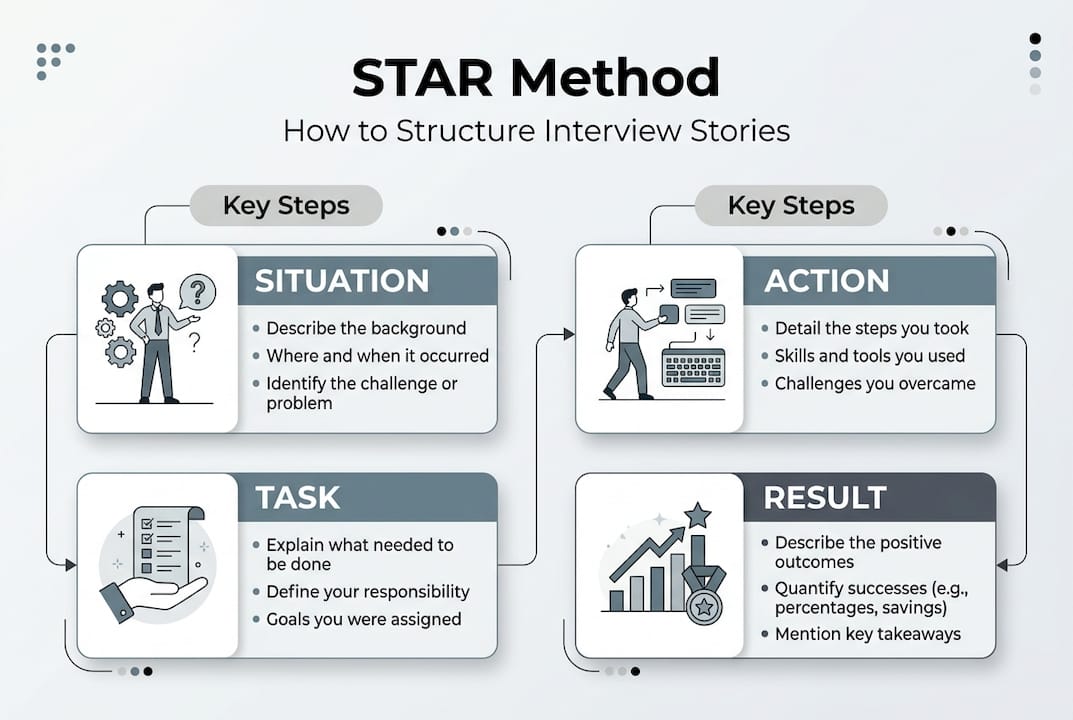
The most widely used framework is STAR, which stands for Situation, Task, Action, and Result. The STAR method is the primary framework for structuring behavioral interview stories, and alternatives like SOAR and CAR exist for different contexts. Understanding all three gives you flexibility.
| Framework | Best used for | Structure |
|---|---|---|
| STAR | General behavioral questions | Situation, Task, Action, Result |
| SOAR | Senior roles, problem-solving focus | Situation, Obstacle, Action, Result |
| CAR | Concise answers, early-career | Challenge, Action, Result |
For most interviews, STAR is your default. Here’s how to use it well:
- Situation: Set the scene briefly. One or two sentences. Give just enough context for the interviewer to understand the environment.
- Task: Clarify your specific role or responsibility. What were you expected to do?
- Action: This is the heart of your story. Spend about 60% of your time here. Be specific about what you did, not what the team did.
- Result: Quantify whenever possible. “Reduced onboarding time by 30%” is far stronger than “improved the process.”
Timing matters. Each story should run 90 seconds to 2.5 minutes. Shorter and you seem unprepared. Longer and you risk losing the interviewer’s attention.
Always use first-person language. “I identified,” “I proposed,” “I led.” This isn’t about taking credit from your team. It’s about showing your individual contribution clearly. Interviewers are hiring you, not your former colleagues.
Pro Tip: After you draft a story, check the Result section. If you can’t attach a number, a timeline, or a concrete outcome, dig deeper. Even “reduced customer complaints by roughly half over three months” is more powerful than “improved customer satisfaction.”
For managers and senior candidates, STAR stories for managers offers more advanced guidance on framing leadership-level narratives. The STAR format guide from Harvard Business Review also breaks down common mistakes candidates make when applying this framework.
Practice and refine: Making your stories unforgettable
A strong structure is essential, but practicing your delivery is what makes your stories truly memorable.
The biggest mistake candidates make is memorizing their stories word for word. When you script every sentence, you sound robotic. Worse, if you lose your place, you panic. Instead,
title your stories for quick recall, map one story to multiple questions, and avoid scripting so you sound natural.
Practice out loud, not just in your head. Your brain processes speech differently than silent reading. What sounds smooth in your mind can stumble badly when spoken. Record yourself on your phone and listen back. It’s uncomfortable, but it’s one of the fastest ways to catch filler words, vague language, and pacing issues.
“The goal isn’t to memorize a script. It’s to know your story so well that you can tell it naturally, in any order, under any pressure.”
Here are the most common pitfalls to avoid:
- Overusing “we”: Interviewers want to know what you did. Replace “we decided” with “I recommended” or “I led.”
- Being too vague: “I helped improve the process” tells the interviewer almost nothing. Be specific about your actions.
- Skipping the result: A story without a clear outcome feels unfinished. Always land the plane.
- Choosing outdated stories: If your best example is from ten years ago, look harder. Recent stories feel more relevant and credible.
- Ignoring emotional honesty: Stories that include a moment of doubt, a mistake, or a hard decision feel real. Perfect stories feel rehearsed.
Once you have your core stories down, map each one to at least three different question types. A story about navigating a difficult client could answer questions about conflict resolution, communication, customer focus, or resilience. That flexibility reduces how many stories you need to memorize while expanding your coverage.
For more on building strong habits before your interview, explore interview best practices and learn how to avoid interview pitfalls that trip up even experienced candidates.
Expert perspective: Why most job seekers get interview stories wrong
After learning the practice techniques, it’s crucial to understand the common pitfalls and how to deliver stories that stand out.
Here’s the uncomfortable truth: most candidates over-prepare the wrong way. They script every word, rehearse until the story sounds polished, and then walk into the interview sounding like they’re reading from a teleprompter. Hiring managers notice this immediately. It doesn’t signal preparation. It signals that you can’t think on your feet.
The second mistake is effort without outcome. Candidates describe everything they did, how hard they worked, how many obstacles they faced, but never land on a business result. Interviewers don’t just want to hear that you tried hard. They want to know what changed because of you. A percentage, a dollar figure, a timeline. Something measurable.
Failure stories are where most people leave real points on the table. Candidates either avoid them entirely or apologize through the whole story. The strongest failure stories follow a simple arc: here’s what happened, here’s what I got wrong, here’s what I changed, and here’s the result after. That arc shows maturity, accountability, and growth. Those are exactly the qualities that separate good hires from great ones.
If you’re serious about avoiding the mistakes that quietly sink candidates, common interview pitfalls is worth reading before your next interview.
Strengthen your interview stories with Parakeet AI
You now have a clear framework for building and delivering interview stories that actually land. The next step is practice, and that’s where Parakeet AI gives you a real edge.
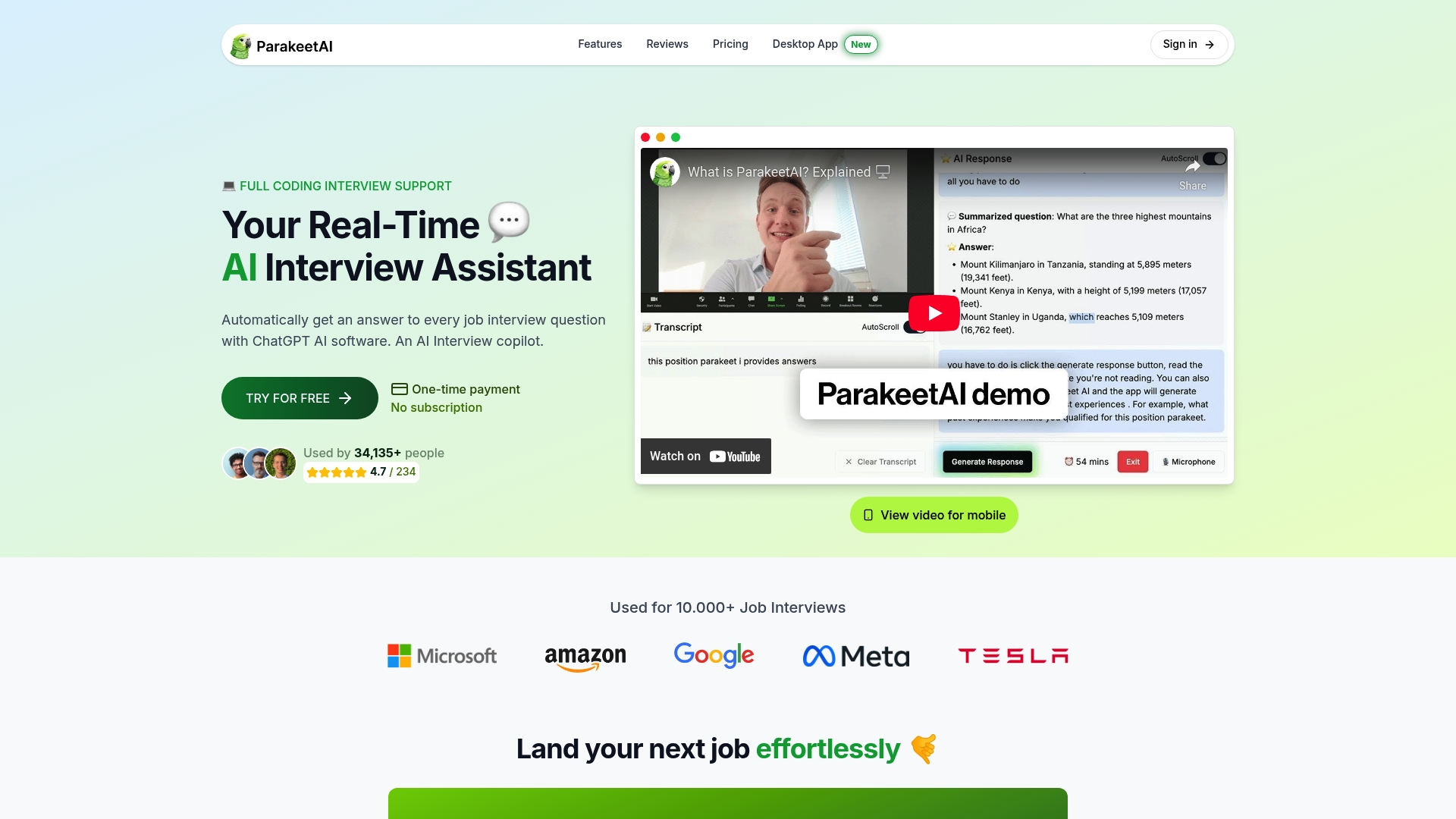
Parakeet AI is a real-time interview assistant that listens during your interview and automatically provides answers to every question using AI. You can rehearse your stories in realistic interview scenarios, get instant feedback on structure and delivery, and refine your answers before the pressure is real. It’s like having a personal interview coach available any time you need one. Stop guessing whether your stories are strong enough. Practice with Parakeet AI and walk into every interview knowing your stories are ready.
Frequently asked questions
How many interview stories should I prepare?
Aim for 5-7 core stories that can be adapted to multiple competencies and questions. Versatile stories covering key competencies give you enough range without overwhelming your preparation.
What is the STAR method in interviews?
The STAR method stands for Situation, Task, Action, and Result. It’s the primary framework for structuring behavioral interview stories in a clear and compelling way.
How long should each interview story be?
Keep each story to 90 seconds to 2.5 minutes, focusing most of your time on your actions and results. Recommended story timing ensures you’re thorough without losing the interviewer’s attention.
Can I reuse the same story for different questions?
Yes, a well-chosen story can be adapted to address multiple competencies and questions. The key is shifting which part of the story you emphasize based on what the question is asking.
What if I don’t have metrics or big results to share?
Focus on your specific actions, what you learned, or how you grew. Even describing how you overcame a difficult obstacle or improved a small process shows initiative and self-awareness, which hiring managers value highly.