
Master achievement storytelling: boost interview success

Only about 3% of applicants are invited to interview, and just 27% of those receive offers. These numbers reveal how competitive landing a job truly is. To stand out, you need more than qualifications on paper. You must effectively communicate your achievements to demonstrate real value. This guide will teach you how to define, frame, and deliver powerful achievement stories that impress employers and significantly boost your chances of securing the role you want.
Table of Contents
- Understanding The Role Of Achievements In Job Interviews
- Common Misconceptions About Discussing Achievements
- Frameworks And Techniques To Structure Achievement Stories
- Leveraging AI Tools To Enhance Real-Time Achievement Communication
- Practical Steps To Prepare And Deliver Achievement-Based Answers
- Bringing It All Together: Real-World Examples And Success Stories
- Discover AI-Powered Tools To Boost Your Interview Success
- Frequently Asked Questions About Achievement Storytelling In Job Interviews
Key takeaways
| Point | Details | |-------|---------|| | Achievements prove your skills and boost hiring chances | Concrete examples of past successes provide evidence that you can deliver results for employers. | | Avoid confusing responsibilities with achievements | Listing duties weakens your credibility, while measurable outcomes demonstrate real impact. | | Use STAR framework to structure clear stories | Situation, Task, Action, Result creates organized, compelling achievement narratives. | | AI tools enhance preparation and real-time performance | Modern technology helps tailor responses, build confidence, and improve delivery during interviews. | | Tailor achievement stories to company needs | Aligning your examples with organizational goals maximizes relevance and impact. |
Understanding the role of achievements in job interviews
Interview invitation and job offer rates remain remarkably low, making differentiation critical for success. With 63% of hiring decisions made within the first 5 minutes, you have limited time to make a strong impression. Employers actively look for concrete examples of achievements as evidence of your skills and potential impact on their organization.
Communicating achievements effectively boosts your credibility and perceived fit for the role. When you share specific stories about problems you solved or goals you exceeded, you demonstrate practical capabilities rather than theoretical knowledge. These narratives reveal your problem-solving approach, work ethic, and cultural alignment with the company.
Employers value quantifiable results because they provide objective proof of your contributions. A candidate who says “increased sales” is far less compelling than one who states “grew regional sales by 34% in six months.” The specificity creates confidence in your abilities. Understanding job interview statistics helps you recognize why achievement storytelling matters so much in competitive hiring environments.
Your achievement stories also showcase transferable skills that apply across roles and industries. Whether you streamlined a process, led a successful project, or resolved a customer crisis, these examples illustrate competencies like leadership, communication, and adaptability. First impressions hinge on your ability to articulate value quickly and memorably.

Common misconceptions about discussing achievements
Many candidates mistakenly believe listing responsibilities equals showcasing achievements. Describing what you were supposed to do tells employers nothing about how well you performed. For example, “managed a team of five” simply states a duty, while “coached five team members to exceed quarterly targets by 22%” demonstrates measurable impact.
Vague skill listing weakens your credibility with hiring managers. Saying you have “strong communication skills” or are a “team player” without supporting evidence sounds hollow. Employers prioritize quantifiable results over generic claims because numbers provide concrete validation of your contributions.
Poor preparation remains a leading cause of interview failure. Research shows 48% of interviews fail due to lack of preparation, particularly insufficient practice in conveying specific achievements. Candidates who wing their responses often ramble, forget key details, or fail to connect their experiences to job requirements.
Common errors include overloading answers with industry jargon that obscures your actual accomplishments. Technical terms may sound impressive but can confuse interviewers from different backgrounds. Another mistake is relying solely on AI-generated text without personalizing it, which creates robotic, inauthentic responses that fail to engage.
Pro Tip: Keep a running achievement journal throughout your career. Document projects, metrics, challenges overcome, and positive feedback as they happen. This makes interview preparation much easier and ensures you never forget important accomplishments.
To improve your responses systematically, focus on improving interview answers through targeted practice. Stay updated on job interview trends to understand evolving employer expectations and adjust your approach accordingly.
Frameworks and techniques to structure achievement stories
Behavioral interview questions focusing on past achievements are increasingly common. Studies indicate behavioral questions are rated 89% effective by HR managers for assessing candidate capabilities. These questions typically begin with “Tell me about a time when…” or “Give me an example of…”
The STAR framework provides a clear structure for organizing your achievement stories:
- Situation: Briefly describe the context or challenge you faced in a specific scenario.
- Task: Explain your responsibility or goal within that situation.
- Action: Detail the specific steps you took to address the challenge or achieve the goal.
- Result: Share the measurable outcome and impact of your actions, including numbers whenever possible.
Using structured approaches like STAR significantly improves interview performance. Research shows structured interviews increase predictive validity by over 30% compared to unstructured conversations. This benefits both candidates and employers by reducing bias and focusing on objective evidence of capabilities.
| Approach | Clarity | Credibility | Memorability |
|---|---|---|---|
| Unstructured rambling | Low | Weak | Forgettable |
| STAR framework | High | Strong | Impactful |
The comparison reveals why structured storytelling matters. Organized responses help interviewers follow your logic and remember your key accomplishments. They also demonstrate your ability to communicate complex information clearly, a valuable skill in any role.
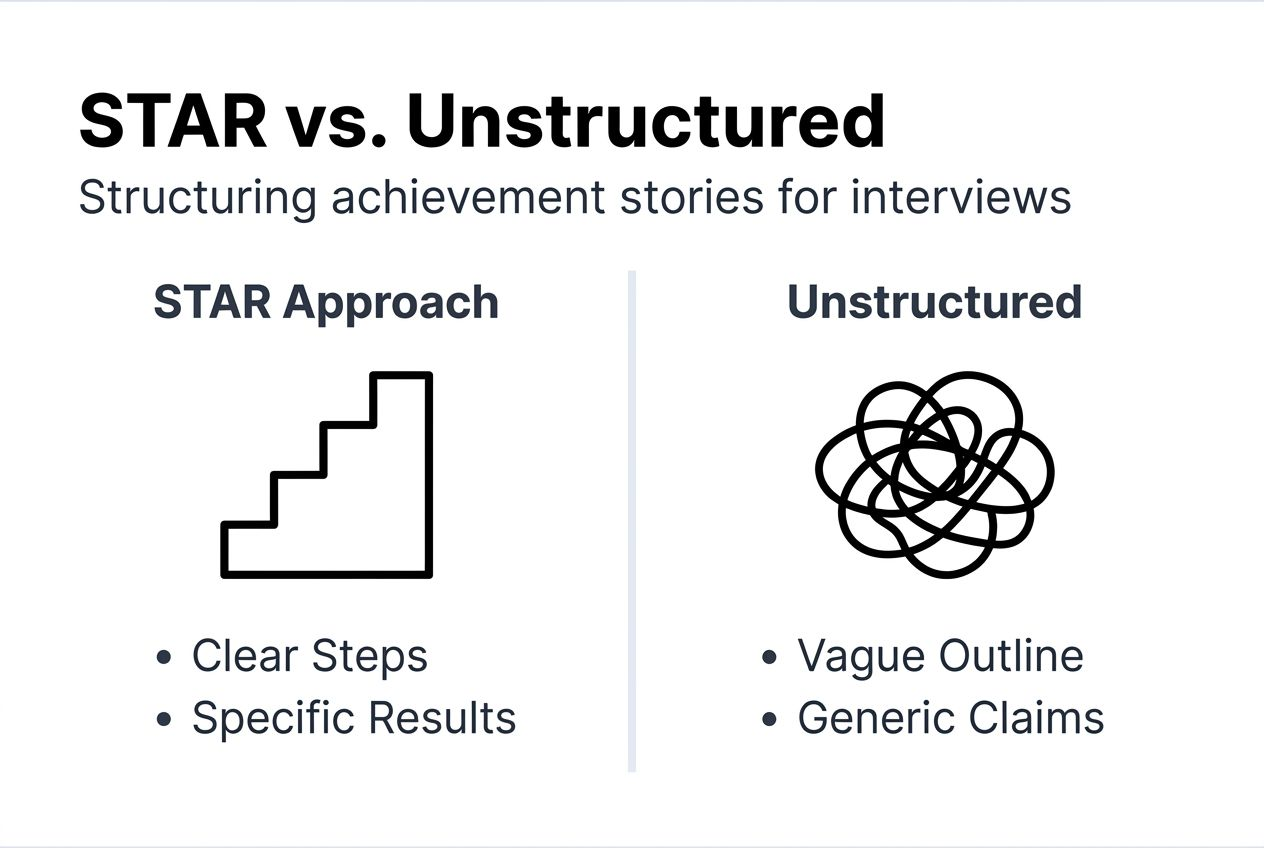
Pro Tip: Prepare five to seven STAR stories covering different competencies like leadership, problem solving, teamwork, and innovation. This ensures you have relevant examples ready for various question types without over-rehearsing any single story.
Learn how organizations benefit from structured approaches by exploring AI in interviewer training guide. Understanding the effectiveness of behavioral interviews and structured interview benefits helps you align your preparation with what employers value most.
Leveraging AI tools to enhance real-time achievement communication
AI-driven tools now provide real-time prompts and suggestions to help you articulate achievements more effectively during interviews. These technologies analyze questions as they’re asked and offer tailored talking points based on your background and the role requirements. This support helps you stay focused and confident even under pressure.
The adoption of AI in hiring continues to accelerate. Currently, 72% of organizations use AI-driven tools in recruiting and talent management. As employers embrace these technologies, candidates benefit from using similar tools during preparation and even live interviews to level the playing field.
AI assistance offers several advantages for achievement communication:
- Helps identify which accomplishments best match specific job requirements
- Suggests quantifiable metrics you may have overlooked in your experience
- Provides structure and phrasing improvements for clearer storytelling
- Reduces anxiety by offering backup support during challenging questions
- Enables rapid customization of examples for different interview contexts
It’s important to understand that AI cannot replace authentic storytelling. Technology should complement your preparation and delivery, not substitute for genuine reflection on your experiences. The most effective approach combines AI insights with your personal voice and unique perspective.
Pro Tip: Use AI tools to generate initial drafts of achievement stories, then personalize them with specific details, emotions, and lessons learned. This creates responses that feel natural while benefiting from AI’s organizational and optimization capabilities.
Explore solutions like real-time AI interview answers and interview answer generator tools to enhance your preparation. Understanding the advantages of AI interview tools helps you make informed decisions about incorporating technology into your job search strategy. Research AI usage in recruiting to stay current on industry trends.
Practical steps to prepare and deliver achievement-based answers
Effective achievement communication requires systematic preparation. Follow these steps to maximize your interview performance:
- Research the company and role thoroughly. Understand organizational goals, challenges, and culture to identify which achievements will resonate most. Review the job description carefully to spot required competencies.
- Select achievements with clear, quantifiable results. Choose examples that demonstrate skills directly relevant to the position. Prioritize stories with measurable outcomes like percentages, dollar amounts, or time savings.
- Structure each story using the STAR framework. Write out your examples following Situation, Task, Action, Result format. Keep each component concise to maintain interviewer attention.
- Practice delivery with AI-based mock interviews. Use technology to simulate realistic interview conditions and receive feedback on pacing, clarity, and impact. Record yourself to identify areas for improvement.
- Prepare follow-up questions and closing statements. Think about how to reference your achievements when asking about team dynamics, company direction, or role expectations. Craft a memorable closing that reinforces your key accomplishments.
Pro Tip: Create a one-page achievement cheat sheet with bullet points for each STAR story. Review this document right before your interview to refresh your memory and boost confidence.
Post-interview follow-up matters significantly. Research indicates follow-up communication referencing specific achievements improves hiring chances by 75%. Send a personalized thank-you message within 24 hours that mentions achievements you discussed and reinforces your fit for the role.
Continuously work on improving your interview answers through practice and feedback. Understand the importance of interview follow-up as part of your overall strategy for landing offers.
Bringing it all together: real-world examples and success stories
Achievement storytelling works across all career levels and industries. Consider these diverse examples:
- Entry-level marketing coordinator: Used STAR to explain how she organized a social media campaign that increased engagement by 47% and generated 120 qualified leads, demonstrating initiative and analytical skills.
- Mid-career software engineer: Shared a story about refactoring legacy code that reduced system crashes by 68% and improved load times by 3.2 seconds, showcasing technical expertise and user focus.
- Senior operations manager: Described leading a process improvement initiative that cut production costs by $340,000 annually while maintaining quality standards, highlighting leadership and strategic thinking.
- Career changer from teaching to HR: Explained how she designed a training program that improved new hire retention by 29%, illustrating transferable skills in curriculum development and people management.
Candidates who combine STAR structure with quantified results consistently show improved interviewer engagement. Hiring managers remember specific numbers and outcomes far better than vague descriptions. This memorability directly influences callback rates and job offers.
Data supports the power of high-quality achievement articulation. Research shows candidates with strong achievement storytelling experience 32% higher job offer rates compared to those who rely on generic responses. The difference comes from demonstrating concrete value rather than making abstract claims.
Pro Tip: Adapt your achievement stories based on interviewer reactions. If someone seems particularly interested in a metric or outcome, offer additional context or related examples. This responsiveness shows emotional intelligence and communication flexibility.
These success stories demonstrate that achievement storytelling techniques apply regardless of your industry, role level, or career path. The key is selecting relevant examples, structuring them clearly, and delivering them with confidence and authenticity. Learn more about achievement impact on job offers to understand the competitive advantage this skill provides.
Discover AI-powered tools to boost your interview success
Mastering achievement storytelling takes practice, and modern technology can accelerate your progress significantly. Parakeet AI offers a real-time interview answer generation and coaching platform designed specifically for job seekers like you. Our tool listens to interview questions and provides instant, tailored responses that highlight your achievements effectively.
The platform combines proven frameworks like STAR with AI customization to help you craft and practice achievement-focused responses for your target roles. You’ll gain confidence in articulating your value, improve your adaptability during unexpected questions, and present yourself as the ideal candidate. Start improving your interview skills today and gain a competitive edge with our intuitive AI interview preparation platform. Transform your achievement stories into job offers.
Frequently asked questions about achievement storytelling in job interviews
How do I quantify achievements if my role is non-numeric?
Focus on qualitative improvements you can describe objectively. For example, “reduced customer complaint escalations” or “shortened project timelines from three months to six weeks” provide measurable context. You can also reference recognition received, such as awards, promotions, or positive feedback from stakeholders.
Can I use personal achievements in professional interviews?
Yes, when they demonstrate transferable skills relevant to the job. Organizing a community fundraiser that raised $15,000 shows project management, communication, and goal orientation. Just ensure you clearly connect personal examples to professional competencies the employer values.
What if I have few achievements to discuss?
Reframe everyday responsibilities as achievements by focusing on how you exceeded expectations or improved processes. Did you find a more efficient way to complete tasks? Help a colleague solve a problem? Contribute ideas that were implemented? These count as achievements when you add context and outcomes.
How do I avoid sounding rehearsed when using frameworks?
Practice your stories enough to remember key points, but not word-for-word scripts. Focus on conversational delivery and maintain eye contact. Vary your phrasing slightly each time you practice. The goal is confident fluency, not robotic recitation. Resources for improve interview answers can help you strike this balance.
Are AI interview tools safe and reliable to use?
Reputable AI interview assistants prioritize data security and provide accurate, relevant suggestions based on your input. Choose platforms with clear privacy policies and positive user reviews. These tools are designed to enhance your natural abilities, not replace them, making them valuable aids when used appropriately.