
How Interview Answer Library AI Boosts Job Success

TL;DR:Interview Answer Library AI provides real-time, structured answer suggestions during live interviews, enhancing candidate confidence. It interprets questions, retrieves relevant responses, and delivers adaptable formats like STAR or bullet points, supporting natural communication. Proper use emphasizes personalization and moderation to avoid sounding canned, helping candidates respond authentically under pressure.
Most job seekers treat interview preparation as something that ends the moment the video call starts. You memorize answers, practice your delivery, maybe run through a few mock questions, and then you’re on your own. But that assumption is no longer accurate. Real-time AI answer libraries are now active during live interviews, pulling up structured, context-aware suggestions while you speak. This article breaks down exactly what Interview Answer Library AI is, how the technology works, its real benefits and limitations, and the practical steps you can take to use it confidently in your next job search.
Table of Contents
- What is Interview Answer Library AI?
- How does Interview Answer Library AI work?
- Benefits and common concerns: Does real-time help or hinder?
- Getting the most from Interview Answer Library AI: Practical tips
- A balanced perspective: What most guides won’t tell you about interview answer AI
- Want smarter interview answers? Try Interview Answer Library AI
- Frequently asked questions
Key Takeaways
| Point | Details |
|---|---|
| Real-time support | Interview Answer Library AI provides live, context-aware responses during interviews to help you perform better. |
| Flexible answer formats | You get access to STAR answers, concise bullet points, and suggested questions for every interview situation. |
| Balance is key | Use AI as a safety net but adapt answers in your own voice for authentic connections. |
| Practical preparation | Test and personalize your answer library before interviews for maximum benefit. |
What is Interview Answer Library AI?
Now that you know support can extend into the live interview, let’s break down what Interview Answer Library AI actually is and how it changes the game.
Interview Answer Library AI is a category of AI-powered tools that provides on-demand, context-aware answer suggestions during live job interviews. Unlike static flashcards or pre-written scripts, these platforms actively listen to the conversation and surface relevant responses in real time. Think of it like having a knowledgeable coach whispering well-structured guidance in your ear, except it’s instant, searchable, and tailored to the exact question being asked.
Traditional preparation methods put all the pressure on memory. You rehearse thirty possible questions, hope your interviewer asks them, and try not to blank when they don’t. Interview Answer Library AI removes that bottleneck by building a dynamic database of proven answers that can be retrieved on the fly. According to AI interview technology explained, modern AI systems go far beyond static Q&A by interpreting the intent behind a question and matching it to the best possible answer format.
Here’s what these tools typically offer:
- STAR format answers: Structured responses covering Situation, Task, Action, and Result, ideal for behavioral questions
- Concise bullet suggestions: Quick, scannable points for competency-based or technical questions
- Follow-up question prompts: Smart suggestions for questions you can ask the interviewer to show engagement
- Adaptive phrasing: Tailored language based on your role, industry, or level of experience
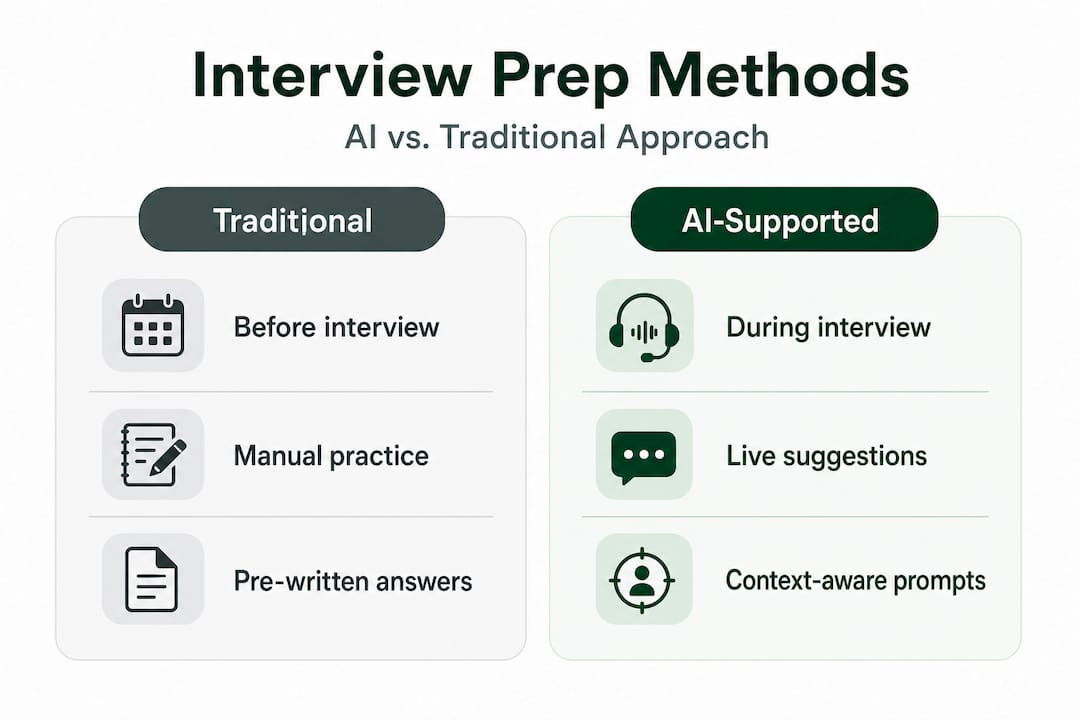
The difference between traditional prep and live AI support becomes very clear when you compare them side by side:
| Feature | Traditional prep | Interview Answer Library AI |
|---|---|---|
| When it works | Before the interview | During the live interview |
| Adaptability | Fixed, memorized answers | Dynamic, context-aware suggestions |
| Answer format options | One format you practiced | STAR, bullet, or concise on demand |
| Recovery from unexpected questions | Depends on your memory | AI surfaces a relevant answer instantly |
| Time investment | Hours of rehearsal | Setup once, use live |
| Personalization | Manual, static notes | Continuously updated library |
As reported in this real-time AI announcement, AI can assist in real time by suggesting STAR answers, concise bullet points, and smart questions for candidates to ask. This is a meaningful leap from anything that existed just a few years ago.
How does Interview Answer Library AI work?
With the basics covered, let’s explore step-by-step how Interview Answer Library AI fits into a live interview and powers up your responses.
The process is more straightforward than most people expect. Here’s what typically happens from start to finish:
- Set up and connect: You install or launch the AI tool and connect it to your interview platform, whether that’s Zoom, Microsoft Teams, or Google Meet.
- Audio capture begins: The tool listens to the live audio of your interview session, including both the interviewer’s questions and the conversation context.
- Question detection: The AI interprets the intent behind each question. “Tell me about a time you dealt with conflict” gets classified differently than “What’s your experience with project management tools?”
- Library query: The system searches its curated answer database for the most relevant, proven response options tied to that question type.
- Suggestion delivery: Answers appear on your screen in your preferred format, STAR, bullet points, or concise one-liners, within seconds.
- You adapt and respond: You take the suggestion as a starting point and deliver it in your own voice, adding personal context and real examples.
One of the most practical aspects of these tools is their platform compatibility. Real-time AI listens during live interviews on platforms like Zoom, Teams, and Meet, generating tailored suggestions without disrupting the natural flow of conversation. You can review the real-time AI answers job interview process in more detail to understand exactly how the audio interpretation pipeline works.
Here’s a simplified model of what happens under the hood:
| Stage | What the AI receives | What it produces |
|---|---|---|
| Input | Live audio from interviewer | Transcribed question text |
| Processing | NLP intent classification | Matched answer type and topic |
| Output | Answer format selected by user | STAR, bullet, or concise response |
| Delivery | On-screen prompt in real time | Suggested answer within 2 to 4 seconds |

Pro Tip: Run a full practice session with the tool before your real interview. Ask yourself behavioral, technical, and situational questions aloud and observe how the AI responds. Familiarity with the tool’s speed and layout reduces cognitive load during the actual interview so you can focus on delivering, not navigating.
Benefits and common concerns: Does real-time help or hinder?
Knowing how these tools operate raises another crucial question: does real-time AI assistance actually help, or can it backfire during high-pressure interviews?
The honest answer is: it depends entirely on how you use it. Let’s look at both sides clearly.
Key advantages include:
- Increased confidence: Knowing a backup exists reduces anxiety, especially for candidates prone to blanking under pressure
- Adaptable answer formats: You can switch between STAR, bullet, or concise formats based on how the conversation is flowing
- Reduced prep time: Instead of memorizing fifty responses, you build familiarity with the tool and trust its library
- Access to model answers: Exposure to well-structured responses during the interview also teaches you better answer patterns over time
- Recovery from curveball questions: When an unexpected question lands, the AI gives you a relevant anchor to work from instead of silence
Legitimate concerns also exist:
- Over-reliance risk: If you read the AI’s suggestion word for word, your answer sounds canned and impersonal
- Possible distraction: Switching attention between the interviewer and your screen can break eye contact and conversational flow
- Added pressure for some: Contrary to reducing stress, some users find the visual presence of live prompts creates an additional cognitive load
The community has weighed in on this honestly. As noted across candidate discussions, real-time assistants can add stress for some candidates, and the best approach is to treat these tools as a safety net rather than a script.
“The candidates who benefit most from AI answer libraries are the ones who use suggestions to get oriented, then close the screen and speak naturally. The tool gives them a direction. Their voice gives it life.”
The real-time AI interview assistants benefits are most visible when the candidate treats the suggestions as prompts, not scripts. Think of it like GPS navigation: you still drive the car, but the system tells you the best route so you don’t have to think about it from scratch.
Understanding the role of AI assistants in interviews is important before you decide how heavily to rely on one. It’s a support tool, not a replacement for authentic communication.
Pro Tip: Position your AI tool’s suggestion panel on a secondary monitor or in a corner of your screen. Keep your camera feed and the interviewer’s video front and center. This way, you glance at suggestions without visibly shifting your gaze away from the conversation.
Getting the most from Interview Answer Library AI: Practical tips
If you’re ready to try Interview Answer Library AI, here’s how you can set yourself up for success and avoid the most common pitfalls.
Success with this technology isn’t accidental. It comes from deliberate setup, practice, and a clear strategy for how you’ll use suggestions during the conversation.
Follow these steps to maximize your results:
- Choose and set up your tool in advance: Don’t install a new AI assistant the night before your interview. Give yourself at least three to five days to explore the interface, configure settings, and understand how suggestions appear on screen.
- Test with practice questions: Run through at least ten common interview questions out loud while the tool is active. Notice which formats feel most natural to you, STAR, bullet points, or concise summaries.
- Personalize your answer library: Most platforms allow you to add your own content. Insert real examples from your career, specific metrics and achievements, and questions you genuinely want to ask at the end of the interview.
- Conduct at least one full mock interview: Ask a friend to interview you while the AI runs. Simulate real conditions as closely as possible, including camera, headset, and screen setup.
- Practice adapting, not reading: Train yourself to look at a suggestion, absorb the structure, and then turn away and say it in your own words. This builds the habit before you need it live.
- Review after every interview: Note which AI suggestions felt most useful, which ones you ignored, and where your own instincts led to better answers. This kind of reflection accelerates your improvement over time.
Some platforms already offer real-time coaching during live Zoom, Teams, and Meet interviews, making step-by-step guidance a built-in feature rather than an afterthought. Understanding why choose AI job assistants over solo prep can help you evaluate whether the tool is worth building into your regular job search process.
The personalization step is often skipped, and it’s the most powerful one. Generic answer libraries give you a solid base, but adding your own voice, your own results, and your own language transforms a suggestion into a genuine response.
Pro Tip: After each interview, spend five minutes reviewing the AI suggestions you used. Mark the ones that felt most natural as favorites. Over time, you’ll build a shortlist of go-to formats that work for your communication style, making the next interview even smoother.
A balanced perspective: What most guides won’t tell you about interview answer AI
Here’s the uncomfortable truth that most enthusiastic AI guides skip over. Interview Answer Library AI is genuinely transformative for job seekers, but the candidates who benefit most are the ones who treat it as a launching pad, not a lifeline.
Overuse creates a specific problem that’s hard to diagnose in the moment: generic answers. When every response sounds polished but impersonal, hiring managers pick up on it faster than you’d expect. They’ve conducted hundreds of interviews. They know what rehearsed sounds like, and a string of technically correct but emotionally flat answers raises red flags about self-awareness and genuine motivation.
Real interviews reward people who reveal something about themselves. The way you frame a failure, the specific detail you choose to include in a success story, the moment of humor or honesty that surfaces naturally, these are the things that make a candidate memorable. An AI library can give you the skeleton of a great answer. Only you can add the flesh.
The most effective candidates we see use AI suggestions to handle the structural part of the answer, the what and the how, and then inject their own personality into the delivery. They follow the STAR format from the suggestion but tell their story within it. They use the bullet point as an anchor and riff naturally from there.
There’s also something worth understanding about job interview technology trends: AI tools are evolving fast, but so is the ability of skilled interviewers to detect over-scripted responses. The gap between “AI-assisted” and “AI-controlled” is where your job offer lives. Stay on the right side of it by committing to authenticity as your primary strategy and using the AI to support it, not replace it.
Want smarter interview answers? Try Interview Answer Library AI
Ready for your next interview? Put these practical steps into action with a tool designed to help job seekers like you perform with more confidence and clarity.
Parakeet AI is a real-time AI job interview assistant that actively listens to your interview and automatically surfaces answers to every question as it’s asked. Whether you’re navigating a behavioral question on a Zoom call or tackling a technical question in a Teams meeting, Parakeet AI provides structured, personalized suggestions in formats you can actually use.
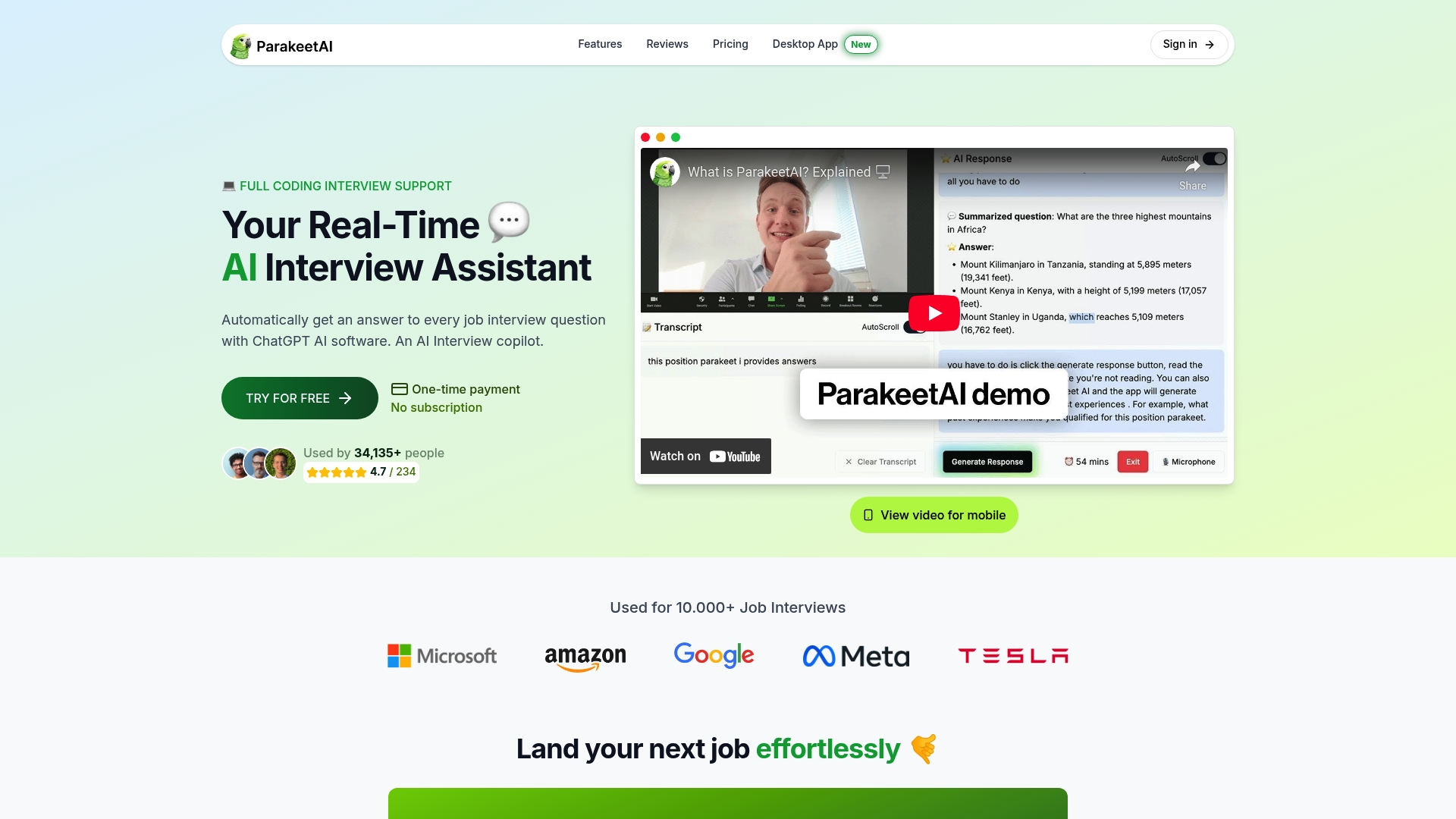
Explore Parakeet AI’s answer library, set up your personalized response collection, and run a practice session before your next interview. The difference between a good interview and a great one often comes down to being prepared for the unexpected. Parakeet AI helps make sure you always have something strong to say.
Frequently asked questions
Is using Interview Answer Library AI allowed during real interviews?
Most companies do not explicitly prohibit AI answer libraries, but you should be transparent if asked directly and always avoid reading suggestions verbatim to keep your answers authentic.
How accurate are real-time AI suggestions for interview answers?
These tools are context-aware and trained on proven answer frameworks, so STAR, bullet, and concise answers are generally highly relevant, though personalizing them with your own experience always improves accuracy.
Does using an AI answer library guarantee I’ll get the job?
No tool can guarantee an offer. Candidates who rely too heavily on suggestions risk sounding scripted, and as community feedback confirms, using AI as a safety net rather than a full script produces the best outcomes.
Can Interview Answer Library AI help with behavioral interview questions?
Yes, and this is one of its strongest use cases. These platforms deliver STAR answers and concise responses in real time, making behavioral questions much easier to structure under pressure.