
Anonymous interviewing AI: clarity, risks, and benefits

TL;DR:Most “anonymous” AI interview platforms do not guarantee complete privacy or bias elimination, often leaving identifying clues in responses.While anonymization can reduce bias and create a low-pressure environment, risks of re-identification remain through analysis of speech patterns and content.
Most job seekers assume that “anonymous” means protected. When an AI interview platform promises anonymity, candidates picture a clean, private exchange where their identity stays fully hidden and bias disappears entirely. That assumption is understandable, but it is also partially wrong. The technical reality of how anonymization works with AI-driven systems is more nuanced, and sometimes more fragile, than the marketing suggests. This guide breaks down what anonymous interviewing AI actually does, where it genuinely helps your preparation, and what risks you need to understand before trusting any platform with your career data.
Table of Contents
- What does anonymous interviewing AI actually mean?
- How anonymization works, and where it falls short
- Why use anonymous interviewing AI? Practical benefits and use cases
- Navigating the risks: Privacy, bias reduction, and smart use
- Why most job seekers misunderstand AI anonymity (and what actually matters)
- Boost your interview skills with trusted AI tools
- Frequently asked questions
Key Takeaways
| Point | Details |
|---|---|
| Anonymity is nuanced | AI interviews offer different levels of anonymity, each with unique privacy implications. |
| Not foolproof privacy | Even anonymous interview data may be deanonymized with advanced AI techniques. |
| Bias reduction advantage | Anonymous formats can lower identity-based bias and performance pressure in practice. |
| Feedback quality matters | The value for job seekers lies most in detailed, AI-powered feedback, not just privacy. |
| Smart usage is key | Understanding risks and carefully managing your responses maximizes anonymous AI interview benefits. |
What does anonymous interviewing AI actually mean?
The phrase “anonymous interviewing AI” gets used in several different ways, and that ambiguity creates real confusion for job seekers. At its core, “anonymous interviewing AI” refers to AI-enabled interview formats where the candidate, or other participants, are not identified to the interviewer during the session. But there are at least three distinct types of anonymization happening across different platforms.
The first type hides your identity from a live human interviewer during a practice or assessment session. Platforms that run blind technical interviews, for example, strip your name, photo, and resume from what the interviewer sees. The second type involves what happens to your data after the session ends. AI interviewing systems can also be described as “anonymous” when AI conducts structured interviews with participants while attempting to delink their responses from direct identifiers. The third type uses an AI intermediary to conduct the interview itself, meaning no human interviewer sees your responses at all.
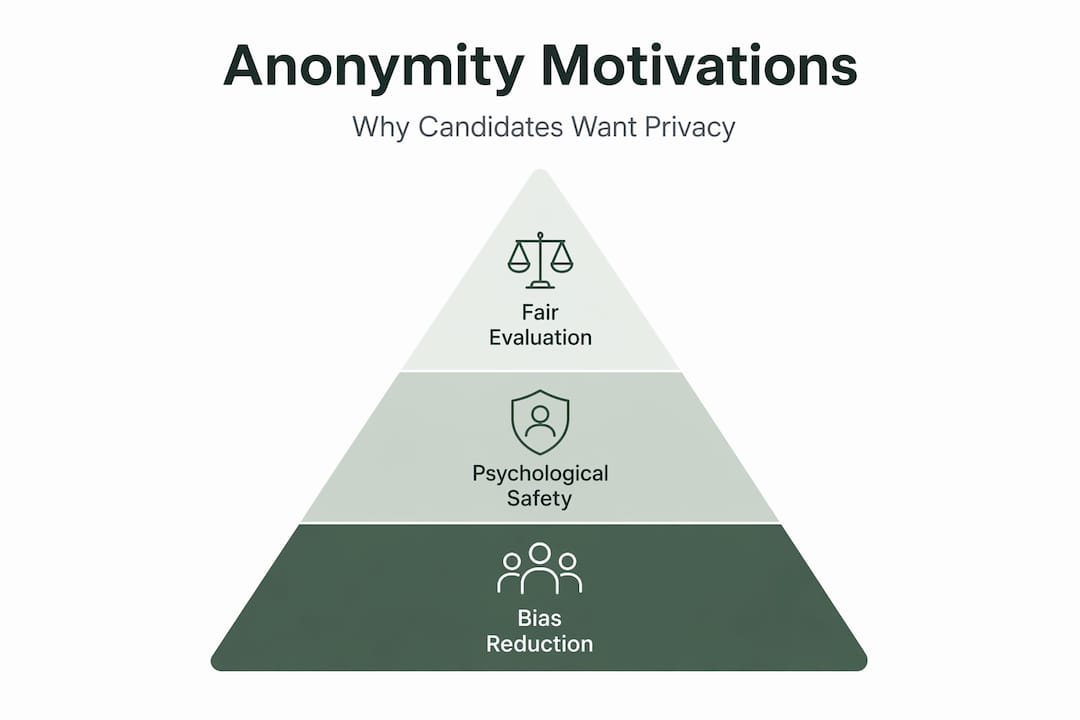
Why do candidates want anonymity in the first place? The motivations fall into three clear buckets. First, reducing bias: when an interviewer cannot see your name, photo, or background, they are less likely to make snap judgments based on race, gender, or educational pedigree. Second, creating a low-pressure practice environment where you can stumble, restart, and experiment without professional consequences. Third, protecting sensitive information if you are exploring new opportunities while still employed.
Here is a quick comparison of the main anonymization approaches and what they actually protect:
| Anonymization type | What it hides | What it does NOT hide |
|---|---|---|
| Identity-blind live session | Name, photo, resume | Voice, speech patterns, content of answers |
| Data deidentification | Name tags in transcripts | Unique stories, project names, writing style |
| AI-only interviewer | Human interviewer access | Platform’s own data processing and storage |
| Metadata scrubbing | Timestamps, device info | Behavioral patterns, answer content |
Understanding which layer a platform is applying matters enormously. Using structured interview AI for practice is valuable regardless of privacy features, but knowing what you are actually protected from helps you make smarter choices. For a broader primer on how these systems operate, exploring AI interview technology gives useful context.
Key reasons job seekers pursue anonymous AI interviews:
- Bias reduction during early screening or practice rounds
- Psychological safety to practice authentically without fear of judgment
- Performance focus where feedback centers on what you said, not who you are
- Competitive confidentiality when job searching while currently employed
- Objective benchmarking through AI-scored assessments rather than subjective human impressions
How anonymization works, and where it falls short

Most platforms approach anonymization through a combination of technical and procedural steps. On the technical side, they strip direct identifiers like your full name and email from session data, mask metadata such as IP addresses and device fingerprints, and route your responses through an AI intermediary before any human reviewer sees them.
However, anonymization is not absolute with language-model-driven or text-rich data. Researchers demonstrated real deanonymization and re-identification risks for an anonymized interview dataset, meaning that stripping your name does not guarantee your identity stays hidden. The content of what you say can be just as revealing as the label attached to it.
“Researchers were able to re-identify participants in anonymized interview datasets with up to 25% accuracy in some sample groups, using only the text of responses and AI-assisted analysis.”
This is not a theoretical risk. The same analytical power that makes AI useful for evaluating answers also makes it capable of identifying who gave those answers. Unique phrases, specific project references, unusual career histories, and distinctive communication styles all function as digital fingerprints. A dataset labeled “anonymous” can become identifiable the moment someone applies a sufficiently powerful language model to it.
Here is a clearer breakdown of common anonymization methods and their deanonymization risks:
| Method | How it works | Residual risk level |
|---|---|---|
| Name and email stripping | Removes direct labels | Low protection: content still identifies |
| Metadata removal | Deletes device and timestamp data | Moderate: behavioral patterns remain |
| AI intermediary routing | No human sees raw responses | Moderate: platform still processes data |
| Transcript summarization | Replaces verbatim text with summaries | Higher protection but loses detail |
| Full data deletion post-session | Session data not retained | Highest protection if verifiable |
Typical steps platforms claim to take, and where vulnerabilities remain:
- Collect session data through an encrypted connection. Vulnerability: data is still stored, even temporarily.
- Strip direct identifiers from the transcript. Vulnerability: the text itself remains, preserving identifying content.
- Apply access controls so only certain team members see raw data. Vulnerability: insider access and data breaches are always possible.
- Aggregate or anonymize datasets before any research or model training use. Vulnerability: aggregation does not prevent re-identification by AI.
- Delete data on request if the platform honors deletion requests. Vulnerability: backups and third-party processors may retain copies.
Pro Tip: Never reference specific company names, proprietary project titles, or unique technical implementations during practice sessions on any platform you do not fully trust. These details are the most reliable re-identification signals in anonymous text data.
Understanding AI interview ethics gives you a sharper lens for evaluating platform promises, and learning about interview recording technology helps you ask the right questions before sharing sensitive responses.
Why use anonymous interviewing AI? Practical benefits and use cases
Despite the technical limitations of anonymization, these platforms offer real, measurable value for job seekers. The key is knowing exactly what you are getting.
The most significant benefit is bias reduction during early rounds or practice. When an AI or anonymized human interviewer cannot see your demographic information, the early evaluation focuses on your actual answers. For candidates from underrepresented groups, this can create a fairer environment for demonstrating technical skill or situational judgment without the weight of stereotype threat affecting the process.
The second major benefit is psychological safety. Knowing that a practice session will not appear on any interviewer’s record, and that your stumbles stay private, allows you to attempt harder questions, experiment with different answer structures, and build confidence incrementally. This kind of low-stakes repetition is where real skill development happens.
Third, objective performance tracking through AI-generated feedback gives you data on your answers that human interviewers rarely share. You can learn whether your responses are too vague, too long, or missing the key components an interviewer is looking for. Platforms that combine realistic practice and feedback tend to be more directly useful than vague privacy claims, because anonymity primarily affects bias and pressure, not the quality of coaching.
What anonymous AI interviews cannot do is equally important to understand. They cannot guarantee your data stays private indefinitely. They cannot eliminate all forms of bias, particularly if the AI system itself was trained on biased data. They cannot predict how a specific hiring company will evaluate you. And they cannot replace the experience of actual interview conversations with real decision-makers.
Most impactful benefits for job seekers using anonymous AI interview platforms:
- Reduced identity bias in technical assessments and behavioral screens
- Honest practice in a space where mistakes carry no professional cost
- Faster feedback loops through AI analysis of your responses
- Skill gap identification before you face a real interviewer
- Confidence building through repeated realistic practice sessions
- Fairer early rounds for candidates from underrepresented backgrounds
Exploring AI for interview fairness shows you the broader landscape of how these tools address bias, and automated interview feedback explains how AI scoring works in practice.
Pro Tip: When evaluating any anonymous AI interview platform, prioritize the quality and specificity of the feedback it generates over the strength of its anonymity promises. Better coaching produces better outcomes. Privacy protection, while important, rarely determines whether you land the job.
Navigating the risks: Privacy, bias reduction, and smart use
Now that the benefits are clear, the practical question is how to use these tools without exposing yourself unnecessarily. The starting point is recognizing that “anonymous” can mean different things across platforms, and these are not equivalent threat models or privacy guarantees. A platform that hides your name from a live interviewer operates very differently from one that processes and stores your full transcript in an identifiable database.
Before using any platform, ask specific questions. Does the platform retain your session transcripts, and for how long? Is your data used to train AI models, and can you opt out? Who has access to your session content, and under what circumstances? Does the platform comply with relevant data protection laws in your region? These questions are not paranoid. They are the due diligence that any informed candidate should perform.
The second major risk area involves what you say, not just what your name is. Even a fully anonymized session becomes identifiable if you describe a project that is unique to your specific employer, reference a product launch that narrows the field to a handful of candidates, or use highly distinctive language patterns that match your public writing.
Understanding AI bias in interviews is also essential because some platforms claim to reduce bias while using AI systems that replicate the same biases present in their training data. Anonymizing the candidate does not fix a biased scoring model.
Practical tips for safe, high-value use of anonymous AI interview platforms:
- Ask the platform directly about their data retention, training use, and deletion policies before creating an account
- Avoid specific identifiers in your answers: no company names, project titles, or unique career details that narrow your identity
- Treat “anonymous” as a spectrum, not a guarantee, and calibrate your openness accordingly
- Focus your energy on feedback quality: how detailed, actionable, and accurate is the AI evaluation of your answers?
- Use these platforms for skill building, not as a substitute for understanding the specific company and role you are interviewing for
Why most job seekers misunderstand AI anonymity (and what actually matters)
Here is the uncomfortable reality: the word “anonymous” has become a marketing feature more than a technical guarantee. Platforms use it to signal safety and fairness, and candidates interpret it as a promise that their identity is protected and their evaluation is unbiased. Neither conclusion is reliably true.
The deeper problem is that job seekers are often optimizing for the wrong thing. They focus on whether a platform is anonymous when they should be asking whether it makes them measurably better at interviewing. Those are different questions with different answers. A platform with strong structured interview AI overview capabilities and detailed scoring rubrics will do more for your career outcomes than one that promises privacy but delivers vague feedback.
We have also seen that candidates from marginalized groups, who have the most to gain from truly bias-free evaluation, are sometimes the most vulnerable to data risks if they share sensitive details in sessions they believe are protected. The irony is real. The very population that benefits most from anonymized practice also faces the highest potential harm if that anonymization fails.
What actually moves the needle for candidates is consistent, realistic practice combined with honest, specific feedback. It is drilling behavioral answers until the structure becomes instinctive. It is getting scored on clarity, relevance, and concision rather than receiving generic encouragement. Anonymity supports that process by reducing performance anxiety, but it does not replace the process itself.
The most successful candidates we see treat anonymous AI practice as a training tool, not a privacy solution. They use it to build genuine skill, and they go into real interviews ready to perform, not just protected.
Boost your interview skills with trusted AI tools
Understanding the limits of anonymous AI interviews is the first step. The next step is finding a platform that actually delivers on what matters most: real-time support, quality feedback, and a practice environment that builds genuine confidence.
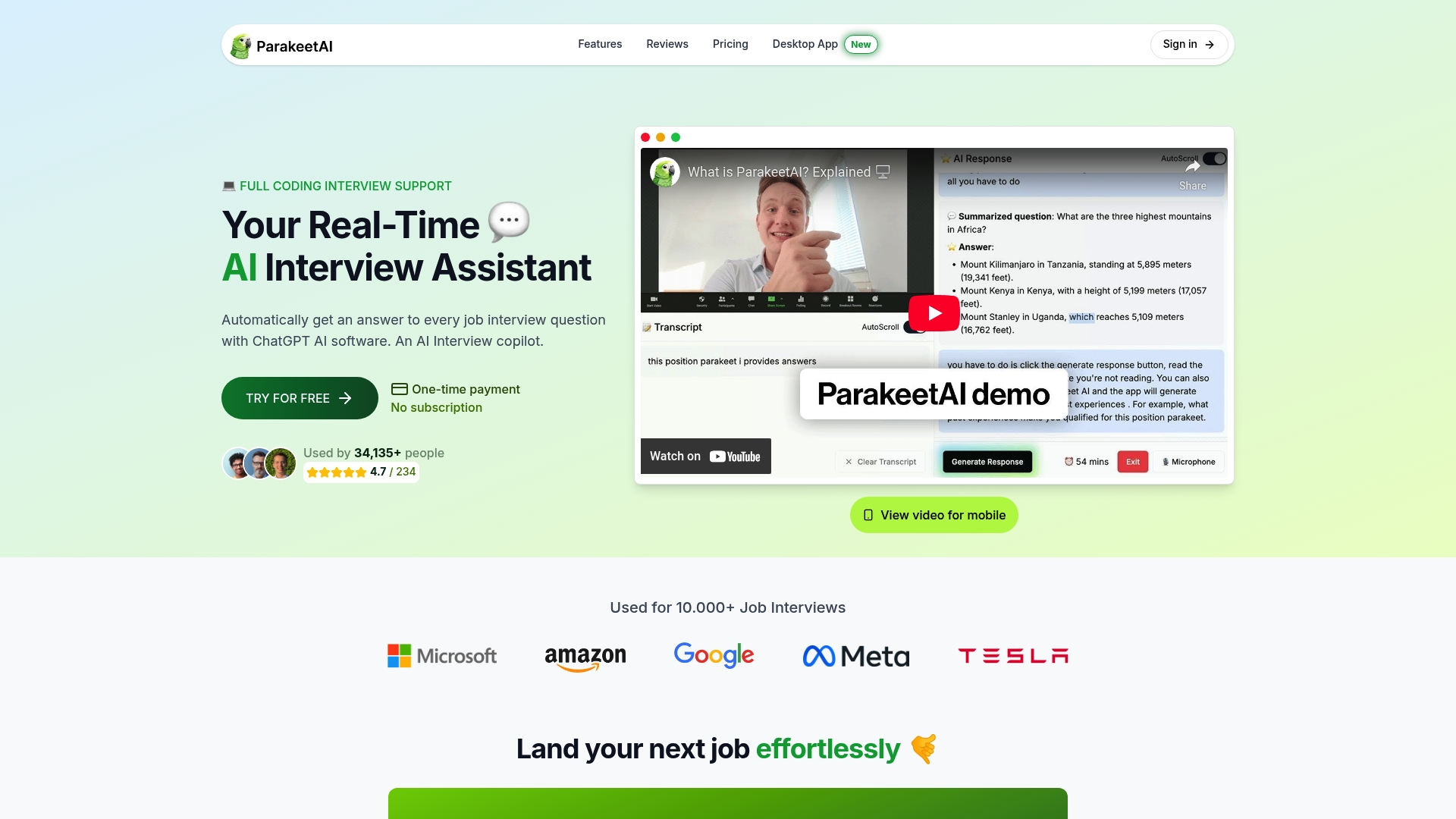
ParakeetAI is built for job seekers who want more than practice. It listens to your interview in real time and automatically provides AI-generated answers to every question as it happens, so you always have a strong response ready. Whether you are preparing for technical screens or behavioral rounds, ParakeetAI combines realistic simulation with the kind of actionable, in-the-moment support that translates directly into better performance. If you are serious about your next opportunity, explore how ParakeetAI can give you a real edge before and during your interviews.
Frequently asked questions
Can my identity still be discovered in an anonymous AI interview?
Yes. Even anonymized interview transcripts carry re-identification risks, with researchers demonstrating up to 25% accuracy in some samples using only the text content of responses.
Do anonymous AI interviews always reduce hiring bias?
They can reduce bias related to your identity during early rounds, but they do not eliminate all bias. As research confirms, anonymity primarily affects bias and pressure, not the quality or fairness of the AI’s underlying scoring model.
How does anonymous AI practice improve interview performance?
It lowers the psychological stakes so you can practice more honestly, and it provides objective feedback on your answers. Platforms combining realistic practice and specific feedback produce the most measurable improvement in candidate performance.
What’s the difference between anonymizing the interviewer and the data?
Hiding your identity from the interviewer targets bias reduction during the session, while anonymizing stored data targets your privacy after the session ends. As research on blind hiring shows, these are entirely different threat models with different protections and different failure points.