
Structured interview AI: transform your job prep in 2026

TL;DR:Structured interview AI offers real-time, specific feedback for improving interview performance.It generates role-specific questions, evaluates answers across multiple criteria, and allows repeated practice.Combining AI practice with human mocks optimizes preparation by addressing unpredictability and interpersonal skills.
Many job seekers assume AI-powered interview tools are cold, scripted, and one-size-fits-all. That assumption is costing them opportunities. Today’s structured interview AI does something traditional prep rarely achieves: it gives you immediate, specific, and repeatable feedback on exactly how you answered a question, not just whether you seemed confident. If you have ever walked out of a mock interview with vague notes like “be more concise,” you already know how frustrating generic feedback can be. This article breaks down what structured interview AI actually is, how it evaluates your performance, and how you can use it strategically to land more offers.
Table of Contents
- Understanding structured interview AI
- How structured interview AI evaluates your performance
- Adaptive responses and real-world nuances
- Maximizing your results with structured interview AI
- Our take: The real value and the real limits of structured interview AI
- Ready to empower your interview prep?
- Frequently asked questions
Key Takeaways
| Point | Details |
|---|---|
| Structure matters | Structured interview AI relies on proven frameworks like STAR, ensuring every answer is measured on clarity and relevance. |
| Feedback is instant | Modern interview AI delivers immediate, standardized feedback, making it perfect for rapid skill improvement. |
| AI is adaptable | Today’s tools can tailor follow-up questions and scoring based on your unique responses—no two sessions are the same. |
| Human prep still counts | Combining AI-driven practice with real mock interviews offers the best of both worlds for job seekers. |
Understanding structured interview AI
With this curiosity in mind, let’s clarify what structured interview AI really is and how it functions.
At its core, structured interview AI uses algorithms to simulate job interviews with consistent, role-specific questions. Unlike a friend quizzing you from a list, these tools pull questions directly from job descriptions and apply recognized behavioral frameworks. The most common is the STAR method, which stands for Situation, Task, Action, and Result. This gives every practice session a realistic, professional feel rather than a casual rehearsal.
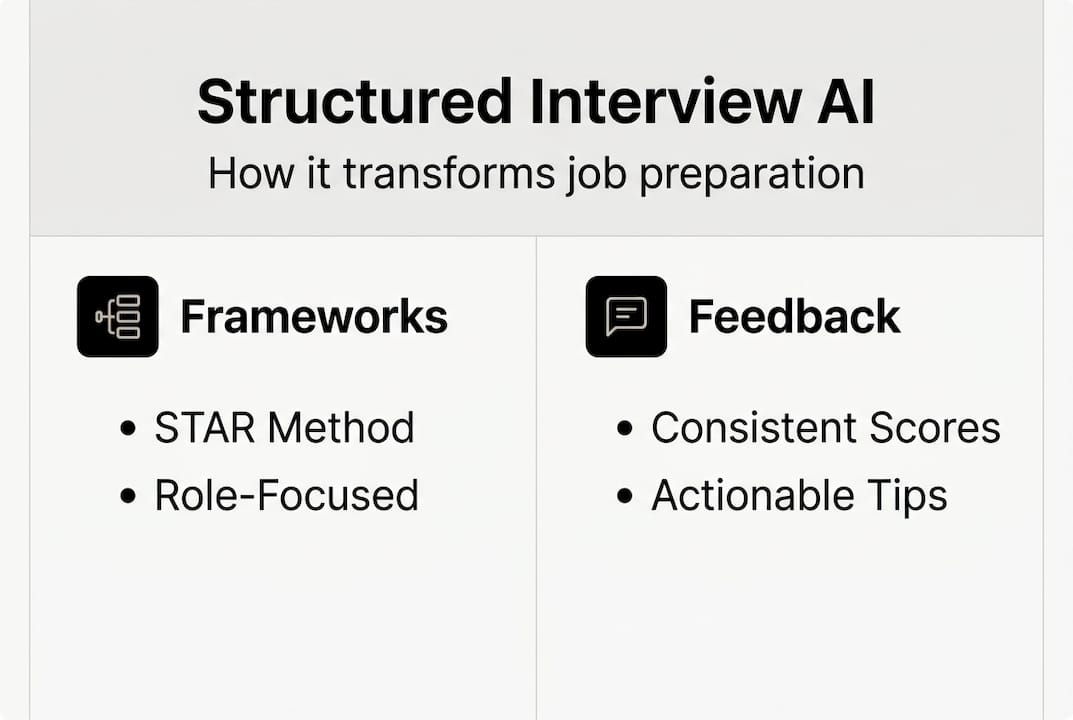
These tools simulate structured interviews by generating role-specific questions from job descriptions, often using behavioral formats like the STAR method, and deliver consistent, standardized feedback on criteria such as structure, clarity, content relevance, and delivery. That last part matters enormously. Consistency is something human mock interviewers simply cannot guarantee across multiple sessions.
Here is what a typical structured interview AI session covers:
- Question generation: Pulled from your target job description for maximum realism
- Answer recording: Voice or text input depending on the platform
- Evaluation: Scored across multiple dimensions simultaneously
- Feedback delivery: Immediate written report with specific improvement notes
- Repeat access: Practice the same question until your score improves
Contrast that with a traditional mock interview. You schedule it, wait for a friend or career coach, answer questions, and then receive feedback that is filtered through personal bias and memory. The AI version removes all of that friction.
“The best structured interview AI tools don’t just tell you that your answer was weak. They show you exactly which sentence lacked specificity, which moment your confidence dipped, and how your structure compared to a strong benchmark response.”
For job seekers exploring behavioral interview tips, this kind of granular feedback is a game changer. And if you are curious about the broader case for automation, understanding why automate job interviews helps explain why companies and candidates alike are embracing these tools at scale.
How structured interview AI evaluates your performance
After defining structured interview AI, it’s crucial to see how these tools actually assess your interview answers.
The evaluation engine behind these platforms is more nuanced than a simple pass or fail. Feedback typically covers STAR structure, specificity, quantified outcomes, and conciseness, with platforms like Huru scoring on answer structure, filler words, and confidence. Each of those dimensions gets its own score, which means you can see at a glance where you are strong and where you need work.

Here is how human feedback compares to AI feedback in practice:
| Dimension | Human feedback | AI feedback |
|---|---|---|
| Timeliness | Hours or days later | Instant |
| Consistency | Varies by reviewer | Identical every session |
| Depth of analysis | Subjective and general | Specific and data-driven |
| Emotional bias | Present | Absent |
| Availability | Scheduled only | On demand, 24/7 |
To get the most out of AI scoring, follow these steps when crafting your answers:
- Start with a clear Situation so the AI can identify your context immediately.
- State your Task in one sentence, no more.
- Describe your Actions using active verbs and specific decisions you made.
- Quantify your Result wherever possible, for example, “reduced onboarding time by 30%.”
- Review your score per dimension and revise the weakest section first.
Pro Tip: Use outcome-focused language in every answer. Instead of saying “I helped the team,” say “I led a process change that cut errors by 20%.” AI scoring systems reward specificity and measurable impact far more than general statements.
For a deeper look at how the technology behind these platforms works, the AI interview technology explained resource is worth your time. You can also compare the leading AI-powered job interview tools to find the platform that fits your prep style best.
Adaptive responses and real-world nuances
Knowing the feedback process, let’s explore how AI-driven interviews adjust dynamically and what their real-world boundaries are.
One of the biggest misconceptions about structured interview AI is that it follows a rigid script. Modern platforms do not work that way. Tools adapt follow-ups based on your answers rather than a preset list, which means if you mention a specific challenge in your response, the system may probe deeper into that challenge in the next question. That dynamic behavior makes practice sessions feel closer to a real interview.
Here is a quick comparison of adaptive versus rigid AI interview behavior:
| Feature | Adaptive AI | Rigid AI |
|---|---|---|
| Follow-up questions | Based on your answer | Fixed and preset |
| Question depth | Increases with vague answers | Static regardless |
| Feedback personalization | Tailored to your response | Generic templates |
| Realism | High | Moderate |
Beyond adaptability, there are important real-world considerations every job seeker should know:
- Transparency: Reputable platforms disclose how AI is used in evaluations and what data is stored.
- Bias mitigation: Well-designed tools include blind scoring to reduce cultural or demographic bias, though no system is perfect.
- Language support: Many platforms support multiple languages, though feedback quality may vary outside of English.
- Cultural adaptability: AI tools calibrate to professional norms, but local interview customs can differ significantly.
The honest truth is that structured interview AI is best suited for high-volume solo practice. It is not a replacement for human coaching, especially when you are preparing for senior roles or navigating culturally specific hiring processes. Exploring AI-powered interview tools and AI-driven mock interviews will help you identify which platforms handle these nuances most responsibly.
Maximizing your results with structured interview AI
Having mapped out the adaptive power and policies of AI interview tools, it’s time to put these insights into practical action.
Using structured interview AI effectively is not about logging in once and hoping for improvement. It requires a deliberate routine. Combining AI practice with human mocks consistently yields better outcomes than relying on either alone, because each fills the gaps the other leaves behind.
Here is a step-by-step plan to integrate structured interview AI into your prep:
- Upload your target job description to the AI tool so questions are role-specific from the start.
- Complete three to five AI sessions per week, focusing on one or two behavioral competencies at a time.
- Review your feedback report immediately after each session and highlight your two lowest-scoring areas.
- Rewrite and re-record those specific answers before moving to a new question.
- Schedule a human mock interview every week or two to test your improvements in a live, unpredictable setting.
- Compare feedback from both sources to identify patterns that appear repeatedly.
Pro Tip: Keep a simple log of your AI scores and your human feedback notes in one place. When the same weakness shows up in both, that is your highest-priority improvement area. Patterns do not lie.
The mindset shift that makes the biggest difference is treating AI sessions as low-stakes rehearsals, not high-stakes tests. You are not being judged. You are gathering data. That mental reframe removes the anxiety that often makes practice feel unproductive.
For practical strategies on how to leverage AI for interviews and explore AI-based coaching options, those resources offer additional frameworks that complement the approach outlined here.
Our take: The real value and the real limits of structured interview AI
With actionable advice in hand, let’s zoom out and assess both the power and the boundaries of structured interview AI from an expert’s perspective.
Structured interview AI is genuinely unbeatable in three areas: consistency, standardized feedback, and convenient high-volume practice. No human coach can give you the same quality of feedback at 11 PM on a Tuesday, session after session, without fatigue or bias. For building foundational answer structure and eliminating filler words, AI is the most efficient tool available.
But here is what most articles will not tell you. Real job interviews are unpredictable in ways that no algorithm fully captures. A hiring manager might pivot mid-conversation, challenge your answer directly, or ask something entirely off-script. The interpersonal tension of that moment, and your ability to stay composed and persuasive, is something you can only develop through practice with real people.
The AI interview technology insight available today is impressive, but it reflects professional norms rather than the full complexity of human judgment. Cultural context, relationship dynamics, and reading the room are skills that live outside the algorithm. True mastery comes from blending rapid AI feedback with personalized, interpersonal mock interviews. Candidates who rely solely on software for high-stakes job prep are leaving a significant advantage on the table.
Ready to empower your interview prep?
Wrapping up, your next step is putting structured interview AI insights into action with dedicated tools.
If you have been practicing answers in your head or relying on occasional mock interviews, you already know that approach leaves too much to chance. Structured interview AI gives you a repeatable, data-driven way to sharpen every answer before the real thing.
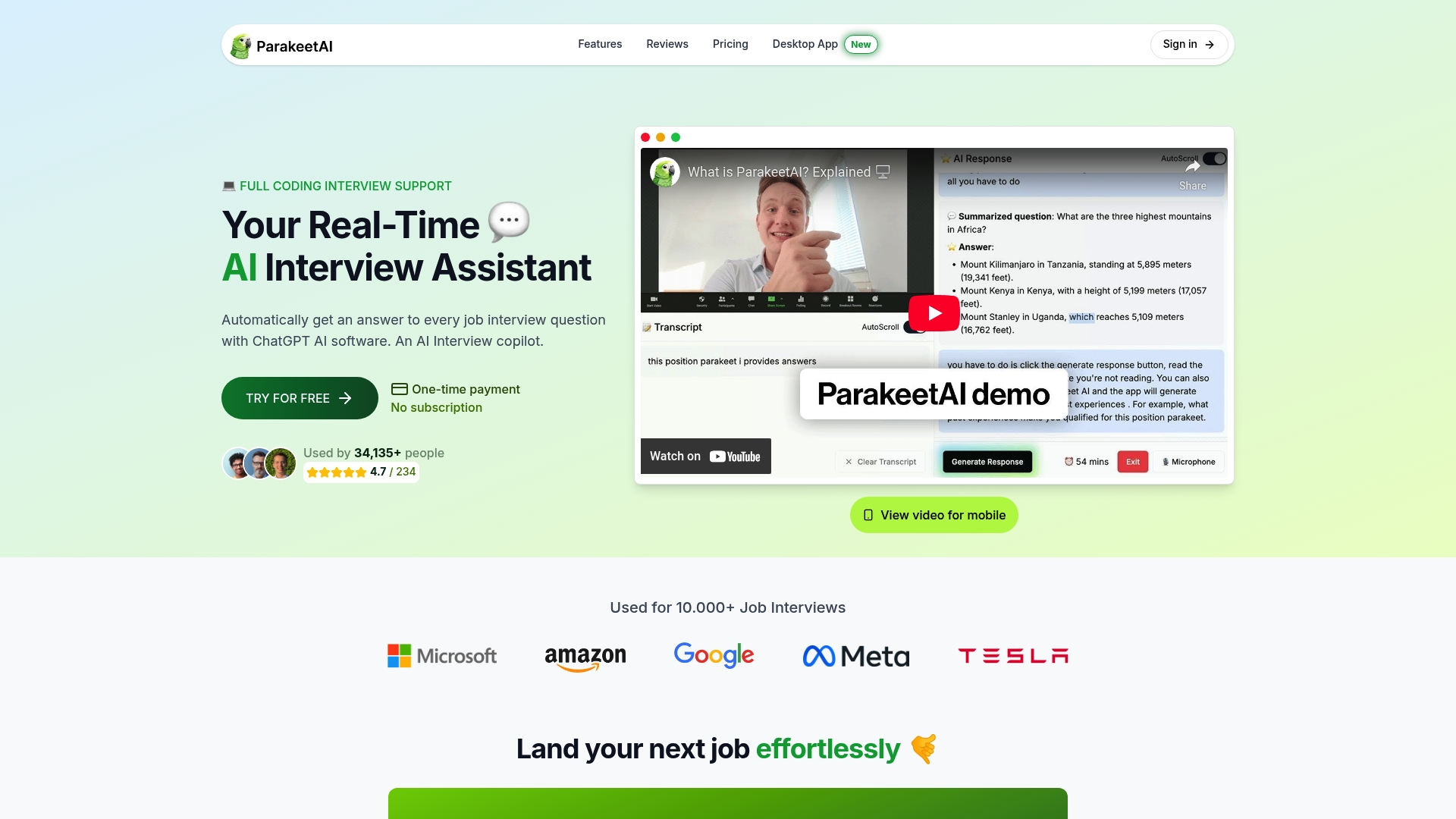
ParakeetAI takes this a step further by listening to your live interview in real time and automatically surfacing relevant, tailored answers as each question is asked. It is the kind of support that turns preparation into performance, right when it matters most. Explore the platform and see how real-time AI assistance can make your next interview your best one yet.
Frequently asked questions
What makes structured interview AI different from other AI interview tools?
Structured interview AI uses consistent, role-focused questions with behavioral frameworks like STAR and provides detailed, standardized feedback that generic AI tools typically skip. The emphasis on structure and scoring criteria sets it apart.
Can structured interview AI replace practicing with a human?
AI is excellent for high-volume practice and instant feedback, but combining it with human mocks consistently produces better results because human sessions expose you to unpredictability and interpersonal dynamics.
How does structured interview AI personalize its feedback?
It scores your answers on specific criteria like STAR structure, specificity, and confidence, then gives tailored suggestions per area so you know exactly what to fix rather than receiving broad advice.
Are there risks or downsides to using structured interview AI?
While adaptive and largely unbiased, AI feedback can miss cultural nuance or context, which is why combining AI with human practice remains the recommended approach for serious job seekers.
What features should I look for in a structured interview AI tool?
Prioritize platforms with adaptive questioning, transparent AI use policies, clear scoring on answer structure and delivery, and strong privacy protections for your recorded responses.