
What is interview question intelligence? A job seeker's guide

TL;DR:Interview question intelligence uses AI to standardize response evaluation based on predefined rubrics, not body language or tone. It makes structured, fairer interviews, improving predictive validity and reducing bias, benefiting candidates who prepare content strategically. To succeed, candidates should use clear STAR responses, understand the system’s rubrics, and practice reading transcripts to align answers with evaluation criteria.
Most job seekers imagine AI interview systems as silent judges watching their every move. The reality of what is interview question intelligence is far more interesting and far more useful to you. Rather than a machine scoring your nervous energy or the color of your shirt, interview question intelligence uses AI to standardize how responses are captured, mapped to job criteria, and evaluated against consistent rubrics. Understanding this distinction changes everything about how you prepare. This guide breaks down exactly how these systems work, what they measure, and how you can use that knowledge to walk into any AI-powered interview with real confidence.
Table of Contents
- What is interview question intelligence and how does it work?
- Why structured, AI-powered interviews improve hiring fairness and predictive power
- Types of interview intelligence tools and what job seekers should know
- How to prepare your interview answers for AI-powered scoring
- Emerging trends and nuanced realities in AI interview intelligence
- Our perspective: interview intelligence rewards preparation, not performance
- Prepare smarter with real-time AI interview support
- Frequently asked questions
Key Takeaways
| Point | Details |
|---|---|
| Interview intelligence defined | Interview intelligence uses AI to analyze and score interview answers against structured criteria for fairness. |
| Structured interviews win | AI-powered structured interviews predict job performance better and reduce interviewer bias. |
| Answer clarity matters | Clear, STAR-structured answers with measurable results score higher in AI evaluations. |
| AI tools differ | Some AI systems score candidates while others assist interviewers without scoring. |
| Transparency is key | Knowing AI’s role and disclosing AI use during interviews supports trust and compliance. |
What is interview question intelligence and how does it work?
Interview question intelligence refers to the use of AI technology to make interviews more structured, evidence-based, and consistent. Interview intelligence uses AI to capture and transcribe interview data, map responses to predefined competencies, and produce consistent, auditable outputs instead of relying on ad-hoc human impressions.
Think of it as a translation layer. Your spoken answer gets converted to text, that text is analyzed against a rubric tied to the job’s required skills, and a score reflects how well your response matched what the role actually demands.
The core components of interview question intelligence typically include:
- Real-time transcription. AI captures your spoken responses word for word during the interview.
- Competency mapping. Each answer is matched to specific skills the employer defined before the interview even began.
- Standardized rubric scoring. Every candidate’s answers are measured against the same criteria, not the interviewer’s gut feeling.
- Transcript-based evaluation. Scoring focuses on the content of what you said, not how you looked or sounded.
- Auditable records. The process creates documentation that employers can review, defend, or audit for fairness.
The most important thing to understand is that AI interview technology does not read your body language or penalize you for speaking with an accent. The system is primarily concerned with whether your answer contains the right substance. That is a meaningful shift in the interview intelligence assessment landscape, and it works in your favor when you know how to prepare.
Why structured, AI-powered interviews improve hiring fairness and predictive power
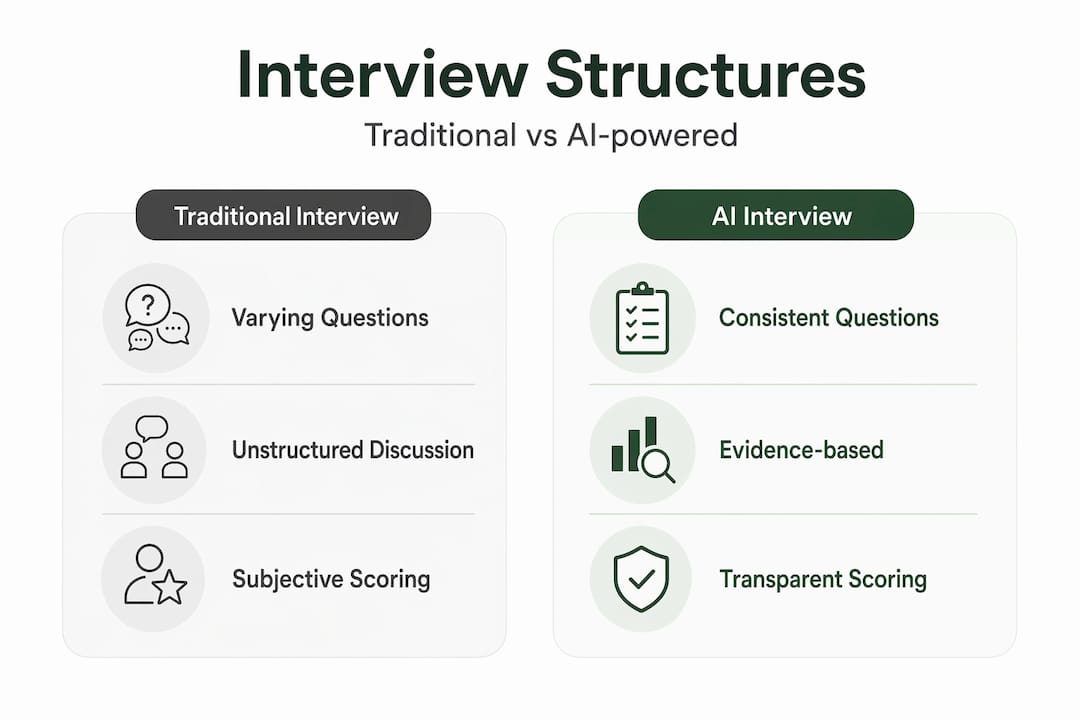
Before AI entered the picture, most interviews were unstructured. Different candidates got different questions, and interviewers scored answers based on personal impressions. That produced unreliable results for employers and unfair outcomes for candidates.
Structured interviews are substantially more predictive of job performance than unstructured ones. One meta-analysis found a validity coefficient of r = .51 for structured interviews versus r = .38 for unstructured. That gap matters enormously when you are trying to demonstrate your true ability.
“Criteria Corp’s Interview Intelligence reduces bias by basing scoring on transcripts instead of appearance or tone of voice.” — Criteria Corp
Interview intelligence automates the structured interview process. It removes the variability of having five different interviewers ask five different versions of the same question. For you as a candidate, this means:
- Your answers compete on equal footing with every other candidate’s answers.
- The interviewer’s personal preferences or unconscious biases play a smaller role.
- Your content, not your networking relationship with the hiring manager, drives your score.
Here is how structured AI interviews compare to traditional approaches:
| Factor | Traditional interview | AI-structured interview |
|---|---|---|
| Question consistency | Varies by interviewer | Identical for all candidates |
| Scoring consistency | Subjective | Rubric-based |
| Bias exposure | High | Reduced |
| Auditability | Low | High |
| Predictive validity | r = .38 | r = .51 (structured baseline) |
The structured interview AI benefits are not just theoretical. Candidates who understand the system and prepare accordingly consistently perform better because they are delivering exactly what the rubric rewards. And understanding why AI is used in modern hiring helps you stop fearing the technology and start using it strategically.
Types of interview intelligence tools and what job seekers should know
Not all AI interview tools work the same way, and knowing which type you are facing changes your preparation strategy significantly.
Some platforms, like Criteria Corp’s Interview Intelligence Quotient (IIQ) system, automatically score and rank candidate answers against rubrics. Other platforms, like Employ’s AI Interview Companion, focus entirely on interviewer assistance. They build structured interview guides, summarize responses, and coach interviewers without ever assigning a score to the candidate.
Here is a quick comparison of the two major categories:
| Tool type | What it does | Impact on you |
|---|---|---|
| Scoring and ranking systems | Automatically evaluates and ranks candidates | Your answer content directly determines your score |
| Interviewer support tools | Assists interviewers without scoring you | Human still evaluates, but questions are more consistent |
Both types reward the same preparation strategy: clear, structured, competency-aligned answers. The difference is in who or what ultimately makes the call.
Key things every job seeker should know about these tools:
- Scoring tools reward explicit content. Vague answers that sound impressive but lack specifics tend to score lower.
- Support tools still use structured questions. Even without auto-scoring, the interview follows a tighter format.
- You often cannot tell which type is in use. Default to preparing for both.
- Transcript accuracy matters. Speak clearly and avoid long, winding sentences that bury your main point.
Pro Tip: Before your interview, research the employer’s hiring technology on their careers page or job posting. Some companies openly disclose which AI tools they use. If you find one, look up how that platform scores answers. It gives you a specific edge most candidates completely miss.
Getting familiar with the broader AI hiring platform landscape helps you understand where you stand before you even enter the room.
How to prepare your interview answers for AI-powered scoring
Here is where understanding interview question intelligence pays off practically. Effective evaluation starts with predefined rubrics that define what an excellent answer looks like before the interview even begins. Your job is to match that template.

AI interview scoring rewards clearly structured answers. The STAR method (Situation, Task, Action, Result) is not just a neat framework. It maps directly to the components AI systems look for when evaluating candidate intelligence and response quality.
Follow these steps when building your answers:
- Identify the competency behind the question. “Tell me about a time you handled conflict” is testing interpersonal skills. Anchor your answer to that skill explicitly.
- Open with the situation in one or two sentences. Set context fast. AI systems do not reward long setups.
- State your specific role and responsibility. The Task portion tells the system you understand accountability.
- Describe your actions in detail. Use “I” statements, not “we.” AI scoring cares about your individual contribution.
- Close with a measurable result. Numbers, percentages, timelines, and outcomes are strong signals. “The team improved” is weak. “Customer satisfaction rose 18 percent over 60 days” is strong.
Pro Tip: Record yourself answering practice questions and read the transcript. This is exactly how AI systems see your answers. You will immediately spot where you buried your main point, used vague language, or forgot to state a measurable outcome.
Questions to assess intelligence in interviews often feel abstract, like “Walk me through how you solve a complex problem.” AI systems still analyze these for structure and evidence. The candidate who says “I analyze data, identify patterns, and test solutions” scores lower than the one who gives a specific example with a clear outcome.
The importance of leveraging AI for your interviews comes down to one insight: the system is not mysterious. It has a rubric. Your goal is to match it.
Emerging trends and nuanced realities in AI interview intelligence
Interview question intelligence is not a solved problem. The systems are powerful, but they carry real limitations that job seekers deserve to understand.
AI interview scoring objectivity depends entirely on design choices, training data, and what the system was built to measure. A rubric trained on historical hiring data can reflect the same biases that made those past decisions flawed in the first place. This is not a reason to panic. It is a reason to be informed.
Key trends shaping this space right now:
- Bias auditing is becoming standard. Responsible vendors are publishing bias reports and using diverse training data to correct inherited problems.
- Over-optimization is a real risk. Candidates who learn to “game” AI scoring with perfectly structured but hollow answers sometimes perform poorly when they face human follow-up questions.
- In-interview AI assistance is growing. Google is piloting AI assistance during coding interview rounds, signaling a major shift in how AI roles in interviews are defined.
- Transparency is becoming a competitive differentiator. Companies that clearly disclose how AI is used in their hiring process attract stronger candidate trust.
“What counts as ‘objective’ in AI scoring is itself a design choice. The inputs, the rubric weights, and the training data all shape the outcome.”
As AI technology in interviews evolves alongside broader AI automation trends, the candidates who will consistently perform best are those who understand the system well enough to work within it authentically, not just mechanically.
If AI assistance is permitted during your interview, know the rules before you use it. Disclose it if required. The line between a helpful tool and an unfair advantage depends entirely on the context the employer defines.
Our perspective: interview intelligence rewards preparation, not performance
Most advice about AI interviews focuses on anxiety reduction. Relax, be yourself, just answer clearly. That is fine but incomplete. Here is the more useful truth: interview intelligence systems are the first hiring technology in history that rewards thorough preparation more than natural charisma.
Think about what that means. The articulate, naturally charming candidate who gives vague, anecdote-heavy answers can actually score lower than the methodical candidate who studied the job description, identified the key competencies, and built STAR-structured answers aligned to each one.
This is a genuine leveling of the playing field. Introverts, non-native English speakers, and candidates who interview nervously have always been disadvantaged in purely human evaluations. Content-first AI scoring changes that dynamic in a meaningful way.
The mistake most job seekers make is treating AI-powered interviews as harder than human ones. They are actually more predictable. You know roughly what the rubric values: specific examples, measurable outcomes, direct answers, demonstrated competencies. That is more information than you get in a traditional interview, where half the battle is guessing what the interviewer personally responds to.
Prepare your content thoroughly. Practice out loud. Read your own transcripts. Those three habits will outperform any amount of “presence” coaching every single time in a system that evaluates what you actually said.
Prepare smarter with real-time AI interview support
Understanding interview question intelligence is only half the equation. The other half is walking into your actual interview ready to deliver. Parakeet is a real-time AI interview assistant that listens to your interview as it happens and instantly generates answers to every question asked. It does not practice with you beforehand and hope for the best. It is there with you, in the moment.
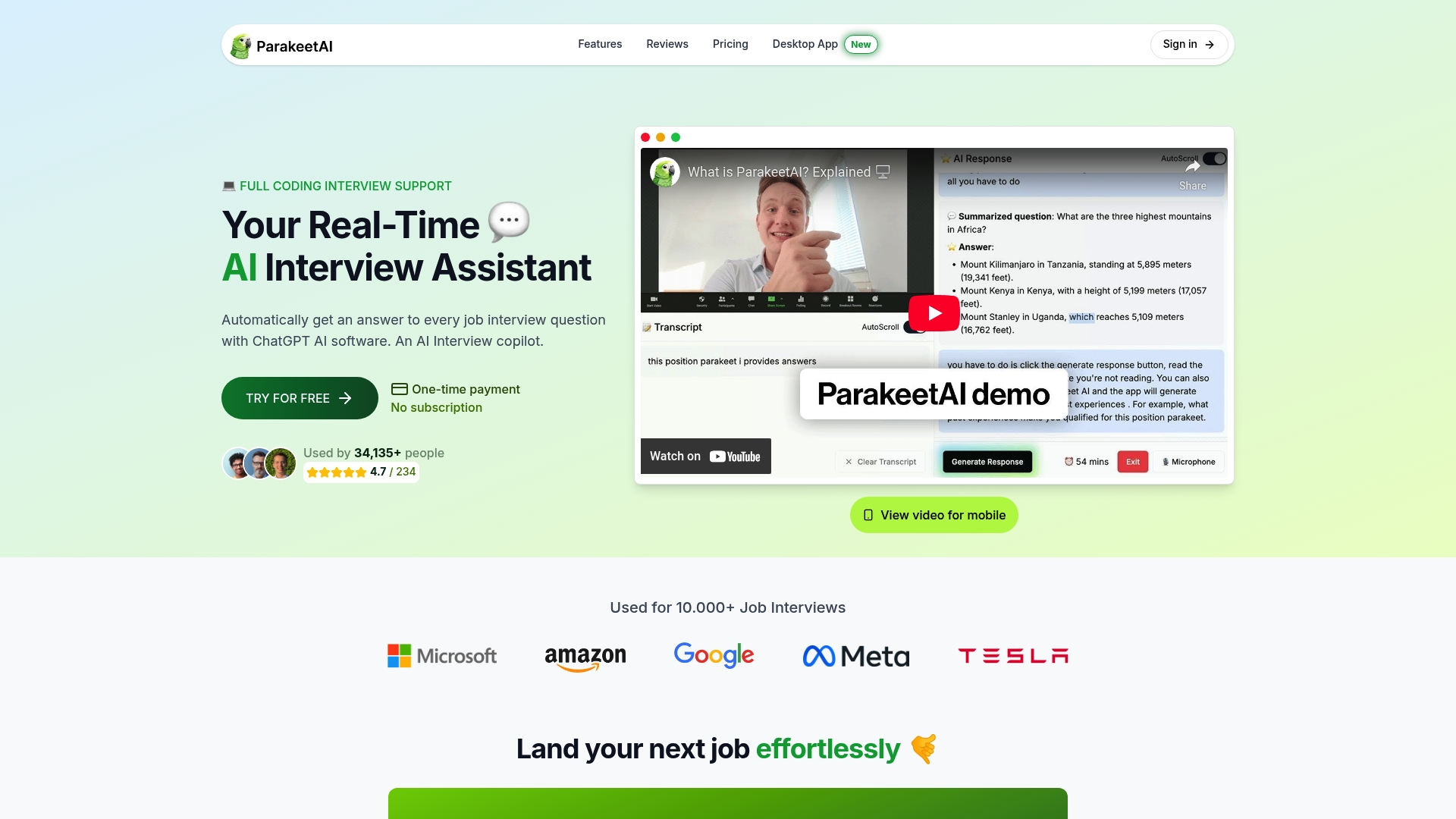
Whether you are facing a structured AI scoring system or a human interviewer with a prepared guide, having support that responds to the actual question in front of you changes the game entirely. Try Parakeet before your next interview and see what it feels like to answer every question with confidence backed by real-time AI.
Frequently asked questions
What exactly does interview question intelligence measure?
It evaluates the content quality, relevance, reasoning structure, and competency alignment of your answers using AI-based transcript analysis. Specifically, AI identifies keywords, behavioral indicators, and response patterns mapped against predefined role criteria.
Can interview intelligence systems judge me based on my appearance or voice tone?
Most advanced systems focus only on your transcripted answers to reduce bias and do not assess appearance or vocal tone. Scoring is based on interview transcripts, not on appearance or tone of voice.
How should I prepare if I know my interview uses AI scoring?
Focus on clear, structured answers using the STAR method and include measurable outcomes to optimize for transcript analysis. AI scoring rewards answers structured with Situation, Task, Action, and Result, along with explicit measurable outcomes.
Are all AI interview tools automatically scoring candidates?
No. Some AI tools assist interviewers by summarizing and structuring interviews without scoring candidates directly. Interview intelligence ranges from scoring and ranking systems to coaching and summarizing tools that never assign a candidate score.
Is it acceptable to use AI assistance during the interview itself?
It depends entirely on the employer’s rules, and job seekers should always verify and disclose usage when required. Google’s coding interview pilot shows AI assistance is entering interviews, but candidates must confirm what is allowed before using any tool.