
Amazon STAR method interview questions and answers guide

TL;DR:Mastering the STAR method is essential for organizing and conveying your behavioral interview stories effectively at Amazon. It involves clearly outlining the Situation, Task, Action, and Result to highlight your personal contributions and measurable outcomes. Successful answers align with Amazon’s leadership principles, demonstrate ownership, and include detailed reasoning and trade-offs to stand out during their rigorous evaluation process.
You’re staring at a blank page, trying to remember a “time you failed and what you learned from it,” and your mind goes completely blank. If that sounds familiar, you’re not alone — and the problem usually isn’t that you lack good experiences. It’s that you don’t have a structure for presenting them. That’s exactly what amazon star method interview questions and answers preparation fixes. Amazon’s behavioral interviews are designed to reveal how you think, act, and own outcomes. This guide walks you through the STAR method, shows you how Amazon actually scores your answers, and gives you concrete examples you can model.
Table of Contents
- Understanding the STAR method and its role in Amazon interviews
- How Amazon evaluates STAR answers: Aligning with leadership principles and scoring criteria
- Crafting strong STAR answers: Step-by-step preparation and example frameworks
- Common pitfalls in using the STAR method and how to avoid them
- Real examples of STAR answers aligned to Amazon leadership principles
- Why mastering Amazon’s STAR method differs from generic behavioral interviewing
- Prepare with Parakeet AI to master your Amazon STAR interview answers
- Frequently asked questions
Key Takeaways
| Point | Details |
|---|---|
| Structured responses | The STAR method helps organize your answers clearly and keeps them relevant to the question. |
| Amazon’s evaluation | Amazon interviewers score STAR answers on leadership principle alignment, ownership, data, depth, and trade-offs. |
| Ownership matters most | Using ‘I’ statements and showing personal responsibility is crucial to passing Amazon’s behavioral rounds. |
| Quantify results | Including measurable outcomes strengthens your STAR answers and makes impacts clear. |
| Practice with probing | Rehearsing aloud with feedback helps deepen your stories and prepare for tough follow-up questions. |
Understanding the STAR method and its role in Amazon interviews
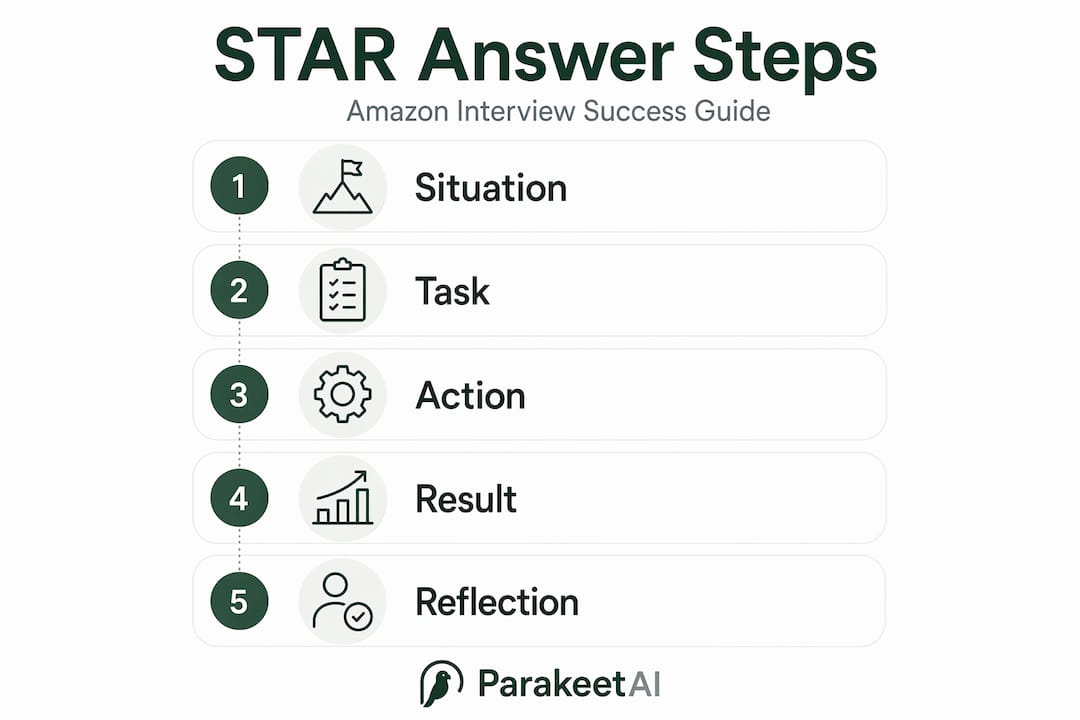
The STAR method is a four-part framework for answering behavioral interview questions. Each letter maps to a specific component of your answer: Situation (the context), Task (your responsibility), Action (what you personally did), and Result (what happened because of you). The structure exists because interviewers need a clear, linear story — not a rambling account that buries the point.
Here’s what each component does for your answer:
- Situation: Sets the scene briefly. One or two sentences max. Give the interviewer just enough context to understand the stakes.
- Task: Clarifies your specific role. What were you responsible for solving or delivering?
- Action: The heart of your answer. Describe exactly what you did, the decisions you made, and why.
- Result: The payoff. What changed because of your actions? Quantify it when possible.
This matters especially for Amazon interview prep because Amazon uses behavioral questions as the primary filter across all roles, from software engineers to product managers to operations leads. The STAR interview technique keeps your answers organized and on point, directly relevant to the question asked. Without this structure, answers tend to sprawl, skip the “so what,” or bury the interviewer’s most wanted insight: what you did.
Amazon’s interviewers use structured scorecards. They are not listening passively. They are actively checking whether your answer maps to specific leadership principles. If your story doesn’t land in a recognizable format, they may not find the data points they need to score you, even if your underlying experience is excellent.
How Amazon evaluates STAR answers: Aligning with leadership principles and scoring criteria
Here’s where most candidates get surprised. You could follow the STAR format perfectly and still score poorly at Amazon. That’s because Amazon interviewers rate answers across five specific dimensions: leadership principle alignment, ownership, data, depth, and trade-offs. Knowing this changes how you prepare entirely.
| Scoring dimension | What interviewers look for | Common failure |
|---|---|---|
| Leadership principle alignment | Clear tie to 1-2 principles | Vague or generic story |
| Ownership | “I” statements showing personal accountability | Saying “we” throughout |
| Data | Quantified results and metrics | Outcomes stated without numbers |
| Depth | Thoughtful reasoning behind decisions | Surface-level action descriptions |
| Trade-offs | Acknowledgment of competing priorities | Acting as if the decision was obvious |
Each of these deserves your direct attention during preparation. Leadership principle alignment means your story should be selected because it naturally demonstrates a principle like Customer Obsession or Bias for Action, not retrofitted to sound that way. Ownership means the interviewer is evaluating you, not your team.
Pro Tip: When you review your draft STAR answers, read them aloud and count how many times you say “we.” Every “we” is a missed opportunity to show your personal contribution. Replace it with “I” and a specific action.
Depth is the dimension that separates strong candidates from borderline ones. Interviewers will ask follow-up questions like “Why did you make that choice?” or “What would you have done differently?” Your story needs a reasoning layer beneath the actions. You should be able to explain why you chose one path over another.
Use these behavioral interview tips to build answers that don’t just describe what happened — they reveal how you think.
Crafting strong STAR answers: Step-by-step preparation and example frameworks
Preparing your STAR answers involves identifying experiences, writing outlines, and practicing until your delivery is natural and confident. Here’s a practical process that works:
- Identify 8 to 10 specific experiences. Choose moments where you had genuine personal impact. Aim for variety: a project you rescued, a conflict you resolved, a process you improved, a customer problem you owned.
- Map each story to Amazon’s leadership principles. Check which principle or principles each story most naturally demonstrates. Don’t force it.
- Write a short STAR outline for each. Keep situation and task to 2-3 sentences combined. Write 5-8 sentences for the action. End with 2-3 sentences on results.
- Quantify every result you can. “Reduced processing time” is weak. “Reduced processing time by 34%, saving the team 6 hours per week” is what interviewers remember.
- Practice out loud, not in your head. Saying an answer and thinking an answer feel very different. One reveals gaps the other hides.
- Simulate probing questions. Have someone ask “Why did you do it that way?” or “What would you change?” after you finish your story.
The action section should take up roughly 60 to 70 percent of your answer time. This is where Amazon interviewers find the scoring data they need. Thin action sections are the most common cause of low scores on best answers to interview questions evaluations.
Pro Tip: Build a “story bank” document with your 8 to 10 outlines labeled by leadership principle. Before your interview, review it twice. You want the stories accessible enough that you can adapt them to slightly different question phrasings without panicking.

Common pitfalls in using the STAR method and how to avoid them
Even candidates who understand the STAR interview technique fall into predictable traps. Candidates often give too much background, rush through actions, or forget to include results entirely. Here’s what to watch for:
- Over-explaining the situation. Interviewers don’t need your entire project history. Two sentences of context are enough. Every extra minute spent on setup is a minute stolen from your action and result.
- Team-speak instead of “I.” “We decided to…” and “The team built…” remove you from your own story. Say what you personally did, decided, or delivered.
- Vague results. “The project was successful” tells an interviewer nothing. Always ask yourself: what specifically improved, by how much, and over what timeframe?
- Mismatching stories to questions. Using a customer obsession story to answer a question about a time you disagreed with a decision signals poor listening. Tailor the example to the question asked, not just the leadership principle.
- Sounding rehearsed. There’s a version of preparation that makes you worse: over-scripted, robotic delivery. Practice for fluency, not memorization.
Pro Tip: After you finish telling a STAR story in practice, ask your practice partner to summarize back what you owned in the story. If they say “you and your team,” your ownership language needs work.
These behavioral interview pitfalls are fixable once you know to look for them. The fix is mostly in your language and your result section, not in finding better stories.
Real examples of STAR answers aligned to Amazon leadership principles
Here’s what high-scoring STAR answers look like in practice across three common Amazon leadership principles. Each one uses specific “I” actions, quantified results, and visible trade-offs.
| Leadership principle | Question prompt | Key scoring elements in the answer |
|---|---|---|
| Customer Obsession | Tell me about a time you improved the customer experience. | Specific customer pain identified by data; personal initiative to fix it; measurable satisfaction improvement |
| Ownership | Describe a time you took responsibility for a problem not in your scope. | Clear “I” actions; proactive escalation; result tied to business metric |
| Bias for Action | Tell me about a time you made a decision with incomplete information. | Explicit trade-off named; timeline pressure acknowledged; outcome measured |
Customer Obsession example: I was a product manager and noticed our support ticket volume for one feature was 18% higher than any other. I personally audited 200 tickets, identified a UI labeling issue, wrote a fix proposal, and pushed it through two sprint cycles without waiting for a roadmap slot. Post-fix, that ticket category dropped by 63% in 45 days.
Notice the story’s structure: the data came first (18% higher volume), the action was personal and specific (I audited, I wrote, I pushed), and the result was quantified (63% drop in 45 days). The trade-off was implicit: prioritizing an unlisted fix over scheduled work. A strong candidate would name that trade-off explicitly if asked.
Strong stories for Amazon software developer interview questions follow the same pattern regardless of role. The principle alignment, personal ownership, and data are what separate a 4 from a 2 on Amazon’s scoring scale.
Why mastering Amazon’s STAR method differs from generic behavioral interviewing
Most STAR method interview guides treat it as a formatting exercise. Use the template, fill in the blanks, pass the interview. Amazon treats behavioral interviews differently, and once you understand why, your whole preparation shifts.
Technical skill is just the ante; the deciding factor is how candidates present themselves and demonstrate leadership behaviors during behavioral rounds. Amazon’s Bar Raiser process is specifically designed to probe whether your STAR story is genuine and deep. These are trained interviewers whose job is to push past surface-level answers. They will ask “what specifically did you consider before making that decision?” and “what was the cost of that choice?” If you only prepared a surface narrative, you’ll run out of road fast.
The deeper issue: most candidates practice answers, not stories. An answer is something you rehearse. A story is something you know cold because you lived it and can walk around inside it from any angle. Amazon’s probing questions are designed to expose the difference.
There’s also a mindset shift required around trade-offs. In generic behavioral interviewing, you’re rewarded for showing decisiveness. At Amazon, you’re rewarded for showing thoughtful decisiveness — acknowledging what you gave up, who you considered, and what you’d do differently next time. Candidates who present every decision as obvious tend to score lower than those who name the tension they navigated.
The bottom line: Amazon interview preparation done well is closer to building a case study portfolio than memorizing scripts. Your stories need to be real, specific, and pressure-tested at the detail level.
Prepare with Parakeet AI to master your Amazon STAR interview answers
Knowing the framework and building strong stories is step one. The gap most candidates don’t close is real-time practice under pressure, where someone is probing your answer and you need to stay clear, specific, and confident.
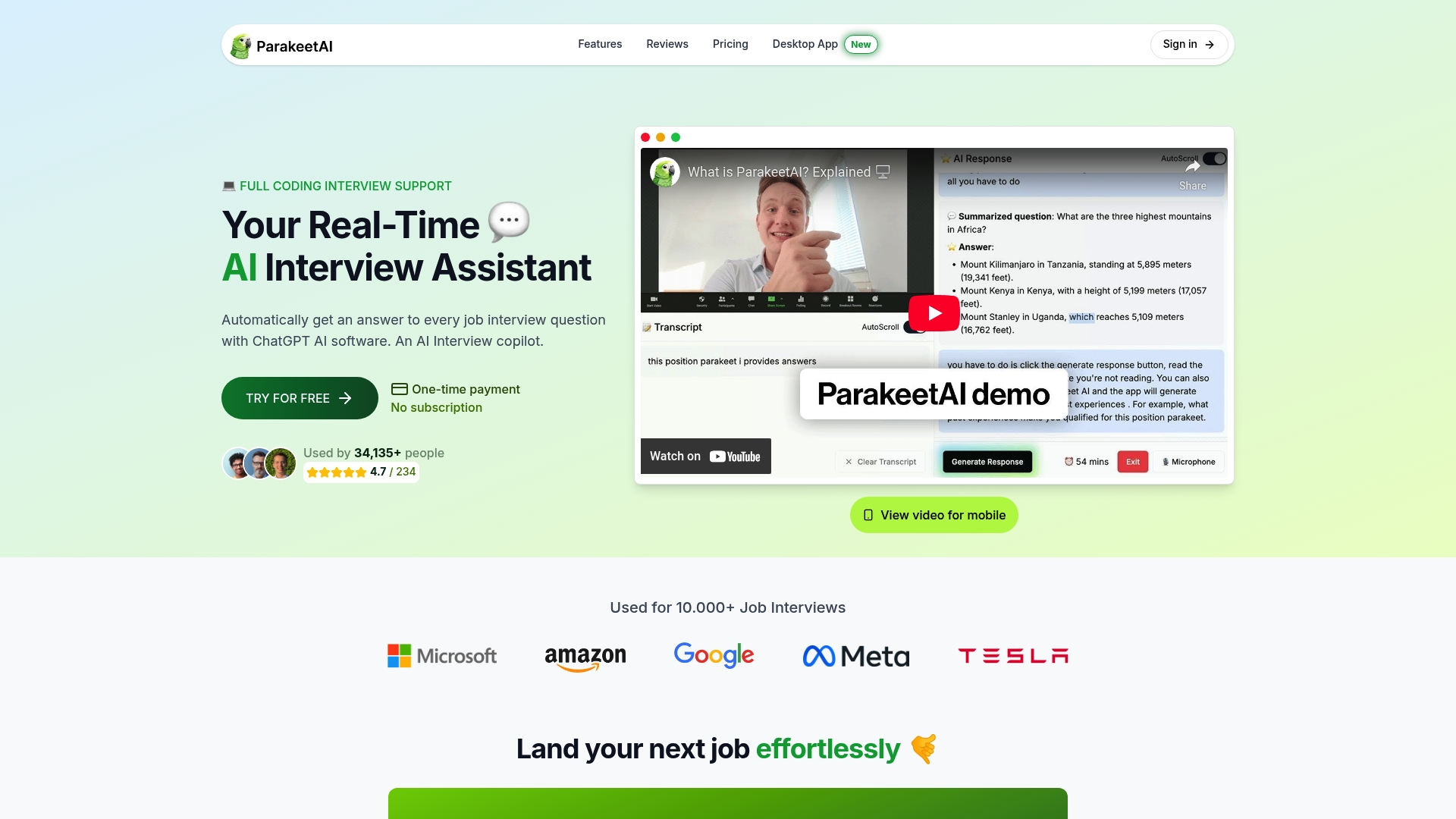
Parakeet AI is a real-time AI interview assistant that listens to your interview and automatically provides answers to every question using AI. During practice sessions, it helps you refine your ownership language, sharpen your quantified results, and align your stories to Amazon’s leadership principles before the real interview. Pair it with the Amazon interview prep guidance on the blog and the behavioral interview tips library to build a preparation system that actually prepares you for probing follow-ups — not just the first question asked.
Frequently asked questions
How long should my STAR method answers be in an Amazon interview?
Aim for one to two minutes per answer. Keep situation and task brief, spend most of your time on the action, and close with a clear, quantified result.
Can I use non-work experiences when answering STAR questions at Amazon?
Yes. School projects, practicums, and community involvement all work if they clearly demonstrate your personal actions and measurable outcomes relevant to the question.
What is the biggest mistake candidates make when using the STAR method at Amazon?
Using “we” instead of “I” is the most common error. Amazon interviewers evaluate you specifically, and team-language hides your personal contribution from their scorecard.
How can I practice telling my STAR stories effectively?
Say your answers out loud with a practice partner who asks follow-up questions in real time. Silent rehearsal doesn’t expose the gaps that live probing does.