
Why Use Instant Answer AI for Interview Success

TL;DR:Instant answer AI enhances interview preparation by restructuring responses, reducing cognitive load, and offering multiple answer variants. Its grounding through retrieval minimizes hallucinations, making responses more reliable, but human verification remains essential to ensure accuracy. Using AI as a reflective scaffold instead of a crutch helps professionals build genuine confidence and authenticity in their interview insights.
Most people assume instant answer AI is just about speed. Get a fast response, move on. But for job seekers and professionals preparing for interviews, the question of why use instant answer AI runs much deeper than that. The real value is not just in the milliseconds saved. It is in how AI restructures your preparation, sharpens your answers, and reduces the cognitive load that turns interview prep into an exhausting guessing game. This article breaks down the technology, the benefits, the real risks, and the practical steps you need to use AI effectively when your career is on the line.
Table of Contents
- Key Takeaways
- Why use instant answer AI: what the technology actually does
- Key benefits of AI answers for interview prep
- Limitations you need to know before you rely on AI
- How to build AI into your interview prep routine
- Comparing AI tools for interview prep
- My take on where instant AI fits in your career toolkit
- How Parakeet-ai helps you prepare and perform
- FAQ
Key Takeaways
| Point | Details |
|---|---|
| AI grounds answers in facts | Retrieval-Augmented Generation cuts hallucinations by 42–68%, making AI answers far more reliable. |
| Speed frees up strategic thinking | Instant AI handles repetitive prep tasks so you can focus on refining your personal stories. |
| Multiple answer variants matter | The best AI tools generate STAR, contrarian, and vulnerable story variants rather than one generic response. |
| Human verification is non-negotiable | Even grounded AI can produce citation-shaped errors, so always cross-check outputs with your own experience. |
| AI is a scaffold, not a shortcut | Use instant AI to structure and reflect on your thinking, never to replace it entirely. |
Why use instant answer AI: what the technology actually does
Before you can decide whether instant AI belongs in your interview toolkit, you need to understand what is happening under the hood. Most AI chatbots generate responses by predicting the next most likely word based on patterns learned during training. That is fast, but it can also be confidently wrong.
The more important advancement for job seekers is Retrieval-Augmented Generation, or RAG. Instead of relying solely on what the model memorized during training, RAG-based systems pull from real documents and verified sources before generating a response. RAG-based grounding reduces hallucinations by 42 to 68% by forcing the model to reference actual retrieved content rather than internal guesswork.
Think of it like the difference between a student answering an exam from memory versus an open-book exam. The grounded model has its notes in front of it. That matters enormously in interview contexts, where a fabricated statistic or a misremembered company fact can derail an otherwise strong answer.
The latest models push this further. GPT-5.5 Instant demonstrates a 52.5% reduction in hallucinated claims and a 37.3% drop in inaccurate responses compared to earlier versions. For professionals who need to walk into interviews armed with accurate, well-structured knowledge, this trajectory is significant.
- Instant AI models generate responses in real time, making them practical for live interview support
- RAG grounding ties AI outputs to retrieved documents for higher factual reliability
- Newer reasoning-capable models balance speed with accuracy better than older fast-but-shallow versions
- Guardrails add another layer of verification, checking generated answers against source documents before delivery
Pro Tip: When evaluating any AI tool for interview prep, ask whether it uses grounded retrieval or pure generative output. The difference in answer reliability is substantial.
Key benefits of AI answers for interview prep
Here is where the advantages of instant AI shift from abstract to genuinely useful. The benefits of real-time AI for interview preparation are not just about convenience. They reshape how you think about preparation itself.
The most underappreciated benefit is cognitive offloading. Interview prep at the professional level is exhausting. You are researching the company, mapping your experience to the job description, crafting STAR stories, anticipating behavioral questions, and rehearsing delivery. All at once. Instant AI handles the repetitive and research-heavy parts of that process, which frees up mental bandwidth for the strategic thinking that actually wins offers.

Another overlooked advantage is answer structure. Most candidates know what they want to say but struggle to say it clearly under pressure. AI excels at organizing scattered thoughts into coherent narratives. You feed it a rough idea of your experience, and it returns a structured response you can then personalize. That gap between “I know my stuff” and “I explained it well” is where interviews are won or lost.
The 24/7 availability factor matters more than people admit. Interview prep rarely happens at convenient times. When you remember a critical detail about the company at 11 p.m., or want to draft an answer variation before your 8 a.m. call, AI is there. No scheduling required.
Using AI for quick answers also accelerates specialized knowledge recall. If you are interviewing for a role that requires technical familiarity you have but have not used recently, AI can rapidly reconstruct frameworks, terminology, and context. That refresh takes minutes instead of hours.
Research shows that AI generates multiple answer variants including STAR format, contrarian takes, and vulnerable story angles aligned with specific hiring culture signals. This is a level of personalization that traditional interview prep books simply cannot provide.
Limitations you need to know before you rely on AI
No serious treatment of why use instant answer AI would be complete without addressing where it can go wrong. And it can go wrong in ways that feel sneaky.
The most dangerous failure mode is what researchers call citation-shaped hallucination. An AI response can sound authoritative, include what looks like a source reference, and still be factually wrong. Even grounded systems can misattribute meaning or invent details about real documents. The output looks trustworthy. It may not be.
Compounding this, hallucination detection has real ceiling limits. Even advanced detectors produce false negatives, meaning some fabricated claims slip through undetected. No single method fully eliminates AI-generated errors. The practical implication: every AI answer you plan to use in an interview needs a human sanity check against your actual resume and real experience.
There are other risks worth understanding:
- Overreliance turns AI into a crutch that prevents you from building genuine recall and confidence in your own answers
- Smaller or faster AI models tend to produce bland, generic responses that lack the nuance hiring managers notice
- Guardrail failures can still let hallucinations through, especially as retrieval context shifts between questions
- Using AI to skip reflection rather than support it leaves you unable to adapt when an interviewer goes off script
Pro Tip: Never paste an AI-generated answer directly into your memory and rehearse it as written. Use it as a first draft. Rewrite it in your own voice, then practice the rewritten version until it sounds like you.
How to build AI into your interview prep routine
Knowing the benefits and risks is only useful if you translate them into a concrete approach. Here is a practical sequence that real-time AI interview users actually find effective.
- Start with research. Use AI to rapidly summarize the company, its recent news, its stated values, and the likely competencies for the role. This takes 20 minutes instead of two hours and gives you a solid foundation without the rabbit holes.
- Draft your answer skeletons. Feed AI your rough experience notes and ask it to structure them into STAR format. Do not accept the first output. Ask for a contrarian variant and a more personal, vulnerable version to see which fits the company culture better.
- Stress-test your answers. Ask AI to challenge your answers the way a skeptical interviewer would. “What would a hiring manager push back on here?” is one of the most useful prompts you can use. It surfaces weak points before the interview does.
- Refine with your own voice. Take the AI-structured draft and rewrite each section in language that sounds natural to you. This is where authenticity returns. AI gives you the architecture. You supply the personality.
- Add human review. Share your refined answers with a mentor, coach, or trusted peer. AI cannot assess whether your delivery sounds genuine or whether your story actually lands emotionally. People can.
Pro Tip: Ask AI to generate three different openings for your “tell me about yourself” answer, each optimized for a different company culture: collaborative, high-performance, and mission-driven. Then choose the one that fits the company you are actually interviewing with.
The advantages of AI interview tools compound when you follow a structured routine rather than using AI randomly whenever you feel stuck.
Comparing AI tools for interview prep
Not all instant AI solutions are built equally, and the trade-offs are worth understanding before you commit to one for something as high-stakes as a job interview.
| Feature | Fast/lightweight models | Reasoning-capable models |
|---|---|---|
| Response speed | Under 1 second | 2 to 5 seconds |
| Answer nuance | Generic, surface-level | Contextual, story-aware |
| Best use case | Quick fact lookups | Core storytelling and strategy |
| Hallucination risk | Moderate to high | Lower with grounding |
| Culture-fit variants | Rarely | Frequently supported |
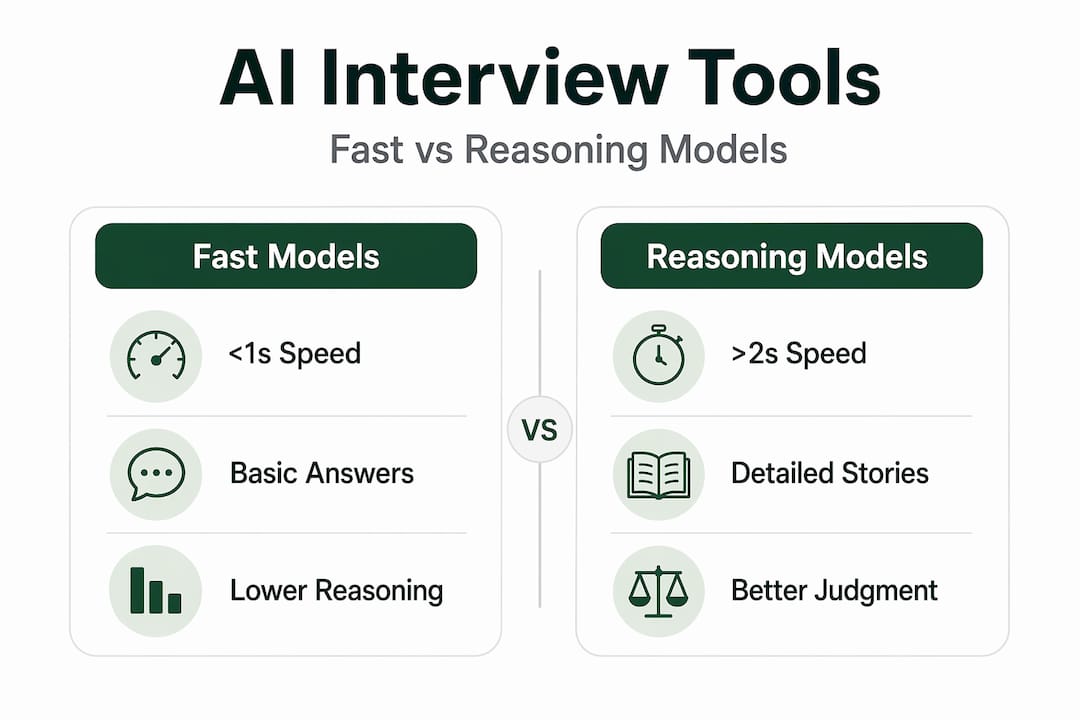
The takeaway from this comparison is practical. Reasoning-capable models are better for crafting the stories that carry interviews. Fast and lightweight models are fine for quick lookups, terminology checks, or generating a list of likely questions for a specific role. Using both intentionally, rather than defaulting to one, gives you the best of both categories.
When choosing an AI partner for interview help, prioritize tools that offer grounded retrieval, support for multiple answer variants, and some mechanism for checking outputs against real context. Speed alone is not a sufficient criterion when the stakes include your next job offer.
My take on where instant AI fits in your career toolkit
I have watched professionals at every level try to shortcut their interview prep with AI, and I have seen the same pattern play out repeatedly. The candidates who use AI as a mirror, something to reflect and organize their thinking back to them, tend to interview with far more confidence than those who use it as a vending machine for pre-packaged answers.
What I find genuinely exciting about where instant AI is heading in 2026 is the shift toward grounding and accuracy. The RAG guardrails improvement trajectory means the tools are becoming more reliable at exactly the moments when reliability matters most. That is not a small thing when you are in a live interview and relying on recalled information.
That said, I think most professionals underestimate the ethical dimension here. Using AI to help you prepare is smart. Using it to manufacture a persona that does not reflect your actual experience is a trap. Interviewers are increasingly sophisticated at detecting rehearsed-but-hollow answers. The authenticity problem is real, and no amount of AI grounding fixes a story that is not genuinely yours.
My honest advice: treat AI the way a great athlete treats a coach. The coach does not run the race. The coach helps you run it better. AI as scaffolding for your own reflection and structure is where the genuine value lives. The moment you stop thinking and just repeat what the AI gave you, you have lost the edge it was supposed to provide.
— Jure
How Parakeet-ai helps you prepare and perform
If you are serious about applying what this article covers, Parakeet-ai is built for exactly this moment. It is a real-time AI interview assistant that listens during your interview and automatically surfaces relevant answers to every question as you go.
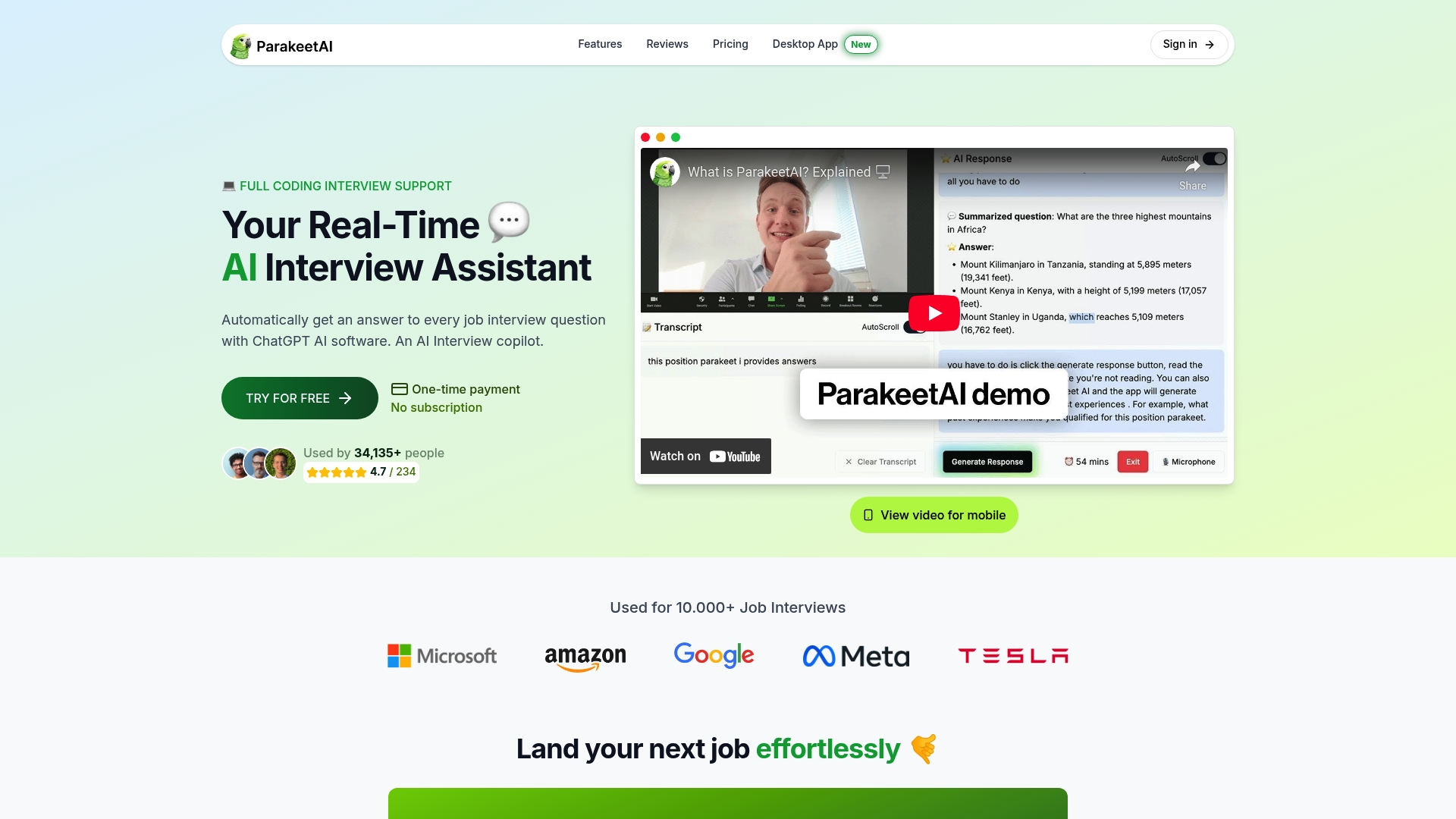
Unlike static prep tools, Parakeet-ai works in the live context of an actual interview, which means you get real-time AI support when it counts most. The platform is designed to reduce cognitive overload in the moment, not just in preparation. If you want to walk into your next interview with sharper answers, better structure, and a tool that works alongside you rather than just before you, explore Parakeet-ai and see how it fits your preparation approach.
FAQ
What is instant answer AI and how does it help in interviews?
Instant answer AI generates real-time responses to questions by drawing on trained knowledge and, in better systems, retrieved documents. For interviews, it helps candidates structure answers, recall specialized knowledge, and prepare multiple response variants quickly.
Why choose AI assistance over traditional interview coaching?
AI is available 24/7, generates personalized answer variants at scale, and processes company-specific context faster than any book or coach. It works best as a complement to human coaching, not a replacement.
How do I avoid overreliance on AI during interview prep?
Always rewrite AI-generated answers in your own voice and verify every factual claim against your actual experience. Use AI to structure your thinking, then practice the answer until it sounds natural without reading from a script.
Are instant AI solutions accurate enough to trust for interview prep?
Grounded AI systems using RAG technology reduce hallucinations by 42 to 68%, making them significantly more reliable. However, no system is error-free, so human verification of every AI-provided answer remains necessary.
What makes Parakeet-ai different from other AI interview tools?
Parakeet-ai listens to your interview in real time and automatically provides relevant answers as questions are asked, making it a live support tool rather than a pre-interview prep resource only.