
Unique Interview Questions to Ask Employer in 2026

TL;DR:Asking six strategic questions across success, role, team, and growth helps candidates stand out and gather vital information. Tailoring questions to each interviewer’s level and responding to answers with follow-ups build rapport and demonstrate preparation. Focusing on concrete, outcome-oriented inquiries ensures a deeper understanding of the role and company for better decision-making.
Unique interview questions to ask an employer are strategic inquiries that reveal critical insights about the role, team, and company while showcasing your genuine engagement. Most candidates treat the “Do you have any questions?” moment as a formality. The ones who get hired treat it as a second interview. Strategic questioning signals deep preparation and helps you stand out in hiring managers’ eyes. This guide gives you a research-backed framework of six questions across four categories, plus the exact wording that makes each one land.
Why six questions across four categories is the sweet spot
The number of questions you ask matters as much as the questions themselves. Bringing six prepared questions covering four categories is the community-sourced consensus for 2026: two about success, two about the role, one about team dynamics, and one about growth or culture. That ratio keeps the conversation substantive without making you sound like you’re reading from a script.
Over-preparing backfires. Candidates who arrive with twelve questions often rush through them, turning a dialogue into a deposition. Six questions give you enough material to stay flexible while covering every dimension that actually matters for your decision.
The four categories serve different purposes:
- Success metrics reveal how the company defines and measures your contribution
- Role realities uncover the day-to-day work that never appears in a job description
- Team dynamics show you what it actually feels like to work there
- Growth and culture confirm whether the company’s trajectory matches your career goals
Coursera recommends preparing up to 10 questions but limiting your final selection to no more than five high-impact ones to respect the interviewer’s time. The six-question framework threads that needle by giving you one backup per category.
Pro Tip: Prepare two additional questions as backups. If the interviewer answers one of your prepared questions during their own presentation, you can swap in a backup without losing momentum.
1. What would distinguish an exceptional performer from a good one in this role?
This is the single most revealing success question you can ask. It forces the interviewer to articulate the difference between meeting expectations and exceeding them. Most job descriptions describe the floor, not the ceiling. This question exposes the ceiling.

The answer tells you three things at once: what the company actually values, how clearly leadership has defined success, and whether the bar is achievable given your skills. If the interviewer struggles to answer, that is useful information too.
Compare this to the generic alternative most candidates use:
| Generic question | Unique alternative | What it reveals |
|---|---|---|
| “What does success look like here?” | “What separates exceptional from good performers?” | Specific performance standards, not platitudes |
| “What are the main responsibilities?” | “What would I work on in my first 30 days?” | Immediate priorities and onboarding reality |
| “Is there room to grow?” | “What does a typical career path look like from this role?” | Concrete advancement data, not vague promises |
The generic versions invite vague answers. The unique alternatives demand specificity, which is exactly what you need to make an informed decision.
2. How does the team measure impact for this position?
Success metrics questions work best in pairs. After asking about exceptional performance, follow up by asking how impact is actually tracked. This is one of the best questions to ask an employer during an interview because it signals that you think in outcomes, not just activities.
Ask specifically about KPIs, review cycles, and who sets the targets. Some companies measure output weekly; others do quarterly reviews with little feedback in between. Knowing this before you accept an offer prevents a painful mismatch later.
A strong follow-up to this question: “How often does the team revisit those metrics?” That one sentence shows you understand that good measurement systems evolve, and it positions you as someone who thinks about continuous improvement.
3. What projects would I likely work on in the first month?
This is the first of your two role-reality questions, and it is one of the most underused good questions to ask a potential employer. Job descriptions describe responsibilities in abstract terms. This question forces the interviewer to get concrete.
The answer immediately tells you whether the role matches what was advertised. If the interviewer describes work that sounds nothing like the job posting, you have learned something critical before signing an offer letter. If the answer aligns perfectly, your confidence in the role increases.
Pro Tip: Weave this question in naturally when the interviewer describes the team’s current projects. Saying “That’s interesting, what would my first month look like in that context?” feels like a conversation, not an interrogation.
Pay attention to how specific the answer is. A hiring manager who can describe your first month in detail has thought carefully about onboarding. One who gives a vague answer may not have a clear plan for your success.
4. Are there responsibilities not listed in the job description?
Every role has invisible work. Administrative tasks, cross-functional meetings, ad hoc requests from leadership, and informal mentoring duties rarely appear in job postings. Asking questions that uncover daily realities helps you evaluate collaboration and leadership before you commit.
This question does something most candidates never do: it signals that you are realistic about how work actually happens. Interviewers respect candidates who acknowledge that job descriptions are simplified summaries, not complete pictures.
The answers you get here often determine whether you will feel set up for success or blindsided in your first 90 days. One candidate I know accepted a “marketing manager” role only to discover that 40% of the job was internal reporting. A single question like this one would have surfaced that reality.
5. How does the team handle disagreements or conflicting opinions?
This is your team dynamics question, and it is one of the most revealing good interview questions for employers you can ask. Conflict resolution style is a direct window into team culture. A team that avoids conflict entirely is fragile. A team that handles it openly and respectfully is healthy.
Listen carefully to the framing of the answer. Phrases like “we always align quickly” can signal either genuine cohesion or a culture where dissent is suppressed. Phrases like “we debate openly and then commit to a decision” suggest psychological safety.
Questions to avoid in this category:
- “Is the team competitive?” (sounds like you are worried about politics)
- “Do people get along?” (too vague to generate useful information)
- “How often does the team socialize?” (irrelevant to work quality and can read as unfocused)
Stick to questions about process and decision-making. Those answers are harder to spin and more predictive of your actual experience. For tech roles specifically, questions to avoid in interviews include anything that sounds like you are evaluating the team’s social calendar rather than its working style.
6. What does a typical career path look like from this role?
Growth questions are your final category, and they carry more weight than most candidates realize. Questions probing growth opportunities and career paths demonstrate commitment to long-term professional development and alignment with company culture. Hiring managers want to invest in people who plan to stay and grow.
The best version of this question asks for specifics: “Can you give me an example of someone who started in this role and where they are now?” That follow-up transforms a vague answer into a concrete data point.
Pair it with one of these:
- “Are there mentorship or training programs available for this level?”
- “How would you describe the company’s culture in three words?”
- “How does the company support employees who want to develop new skills?”
The culture question in particular is deceptively simple. Three words force the interviewer to prioritize, and the words they choose (or avoid) tell you a great deal. Cultural interview questions like this one reveal values that no careers page will ever publish honestly.
For candidates in tech, understanding how employers invest in development connects directly to long-term IT career growth and salary trajectory, making these questions doubly valuable.
7. How to tailor questions by interviewer type
Not every question works with every interviewer. The reverse interview strategy recommends asking 5–8 questions total and tailoring them by interviewer level: recruiters on process, hiring managers on expectations, and executives on strategy.
A recruiter cannot tell you how the team handles conflict. A CEO cannot tell you what your first month’s projects will look like. Matching your questions to the interviewer’s knowledge base shows situational awareness and makes your questions land harder.
Here is a quick mapping:
- Recruiter: Process, timeline, team size, general culture
- Hiring manager: Success metrics, role realities, team dynamics, onboarding
- Executive: Company direction, strategic priorities, how this role contributes to larger goals
Preparing one question per interviewer type, beyond your core six, gives you material for every conversation in a multi-round process without repeating yourself.
Key takeaways
The most effective approach to asking questions in an interview is to prepare six targeted questions across four categories: success, role, team, and growth.
| Point | Details |
|---|---|
| Six questions is optimal | Use the 2-2-1-1 ratio across success, role, team, and growth to stay substantive without sounding scripted. |
| Follow-ups build likability | Responding to the interviewer’s answers with a follow-up question is the strongest driver of interpersonal connection. |
| Tailor by interviewer level | Ask recruiters about process, hiring managers about expectations, and executives about strategy. |
| Role-reality questions prevent surprises | Asking about unlisted responsibilities and first-month projects surfaces information that job descriptions never include. |
| Growth questions signal commitment | Asking about career paths and mentorship shows you plan to invest in the role long-term. |
What I have learned about asking questions that actually work
The conventional advice is to “ask thoughtful questions.” That is not wrong, but it misses the most important mechanic. Follow-up questions are the single most effective type during interviews, increasing rapport and likability when candidates listen and engage thoughtfully. The prepared question gets you in the door. The follow-up is what makes the interviewer remember you.
I have watched candidates with weaker resumes outperform stronger ones on paper simply because they listened well and responded to what was actually said. They treated the interview as a conversation, not a performance. That shift in mindset changes everything about how your questions land.
The biggest mistake I see is candidates who wait for the “Do you have any questions?” prompt and then recite their list. Ask questions throughout the interview when they arise naturally. If the hiring manager mentions a recent product launch, ask about it. That moment of genuine curiosity is worth more than any prepared question.
One more thing: avoid asking questions that make you sound like you are already negotiating before you have an offer. Questions about remote work flexibility, vacation policy, and salary range belong in a later conversation. In the first interview, your questions should signal that you are focused on doing great work, not on the perks that come with it.
— Jure
Prepare smarter with Parakeet-ai
Knowing which questions to ask is only half the challenge. Delivering them confidently in a live interview is the other half.
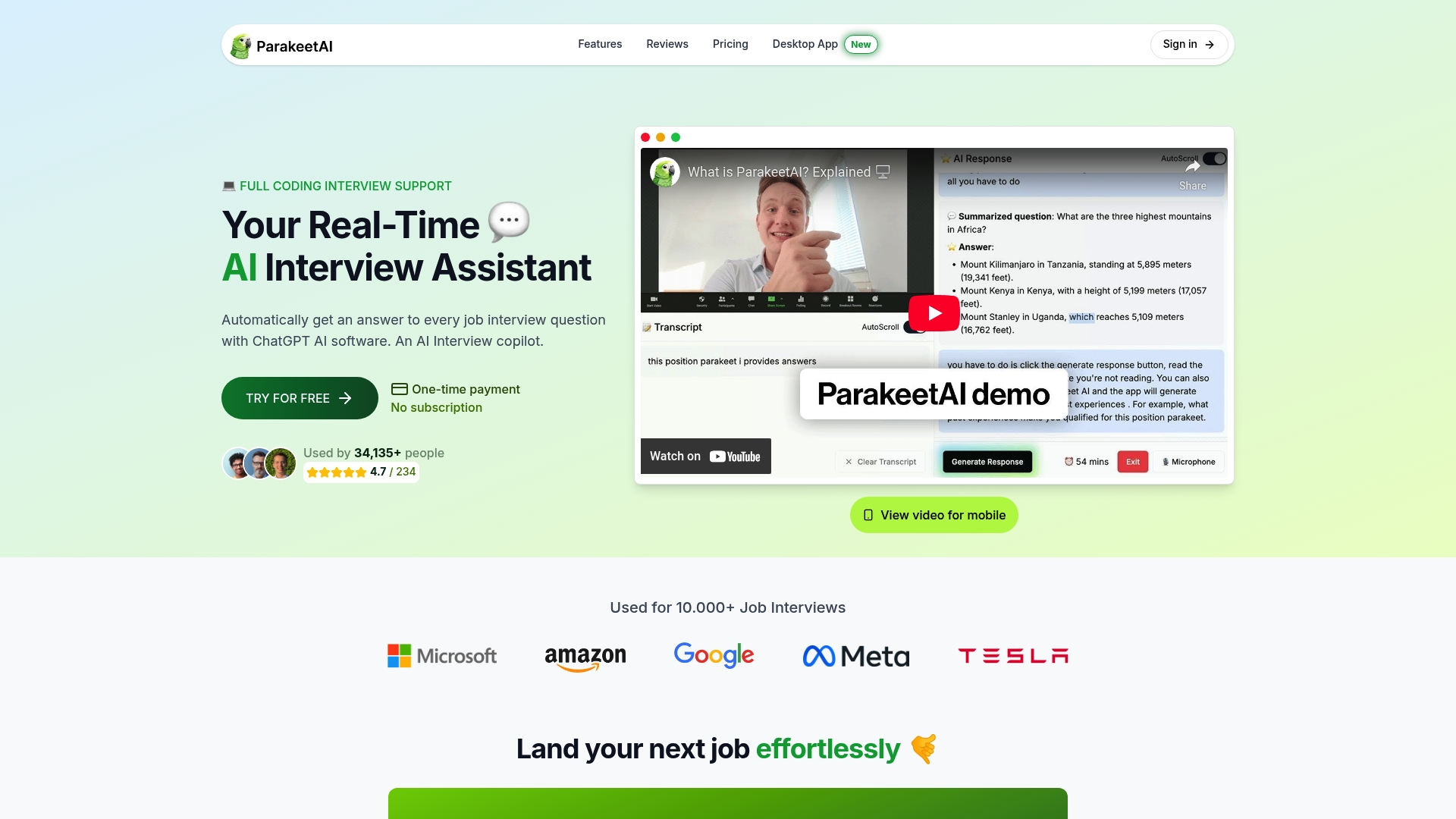
Parakeet-ai is a real-time AI interview assistant that listens to your interview and automatically provides answers to every question using AI. It helps you stay focused, respond clearly, and never lose your train of thought under pressure. Whether you are preparing for a first-round screening or a final executive interview, Parakeet-ai gives you the support to show up at your best. Visit parakeet-ai.com to see how it works and start your next interview with confidence.
FAQ
How many questions should I ask an employer in an interview?
Prepare six questions using the 2-2-1-1 ratio across success, role, team, and growth categories. Ask them throughout the interview rather than saving them all for the end.
What are the top 3 questions to ask in an interview?
The three highest-impact questions are: “What separates exceptional from good performers in this role?”, “What would I work on in my first month?”, and “What does a typical career path look like from here?” Each one targets a different dimension of fit.
Why do unique interview questions matter to hiring managers?
Hiring managers use candidate questions as a filter to identify deep research and critical thinking. Top candidates ask strategic questions that reflect knowledge of the company’s competitive position, not just the job description.
What questions should I avoid asking an employer?
Avoid questions about salary, vacation, and remote work in early rounds. Also avoid vague questions like “Do people get along?” that generate useless answers. Focus on questions about process, performance, and growth instead.
Should I tailor my questions to different interviewers?
Yes. Ask recruiters about process and timeline, hiring managers about role expectations and team dynamics, and executives about company strategy. Matching your questions to the interviewer’s knowledge base makes each question more effective.