Hybrid Interview Technology Explained for 2026 Hiring

TL;DR:Hybrid interview technology combines virtual and in-person stages to improve hiring efficiency and candidate assessment. It uses structured workflows, AI tools, and deliberate stage design to filter candidates gradually while enhancing accessibility and reducing costs. Success depends on intentional process planning that leverages each format’s strengths and clearly communicates expectations to candidates.
Hybrid interview technology is defined as the integration of virtual and in-person interview formats into a single, coordinated recruitment process. It gives candidates flexibility while giving recruiters a structured way to assess skills, culture fit, and communication across multiple settings. Most modern hiring pipelines now use this approach because it reduces costs, widens the candidate pool, and produces better hiring decisions than either format alone. Understanding what is hybrid interview technology means understanding how AI, video platforms, and structured assessment combine to replace the old one-size-fits-all interview.
How does hybrid interview technology work?
Hybrid interview technology works by chaining multiple interview modalities in a deliberate sequence, each designed to filter and assess candidates at a different level. Professional recruitment processes typically chain 3–5 interview modalities, combining automated screening, competency-based interviews, technical assessments, and panel evaluations. Each stage filters roughly 30–50% of candidates. That progressive structure is what makes hybrid recruiting efficient rather than exhausting.
A typical hybrid workflow looks like this:
- AI-assisted asynchronous video screening. Candidates record answers to structured questions on their own schedule. AI tools transcribe and score responses, allowing recruiters to review only the top performers rather than watching every submission.
- Structured virtual interview. A live video call with a recruiter or hiring manager follows. This stage uses a scoring rubric to keep assessments consistent across candidates.
- In-person panel or culture interview. The finalist stage brings candidates on-site. This is where group dynamics, physical presence, and informal rapport get evaluated. These qualities lose effectiveness in virtual settings and are best assessed face to face.
- Technical or skills assessment. Depending on the role, this can happen virtually or in person, often layered with AI analysis to validate genuine understanding rather than memorized answers.
The federal government has formalized a version of this structure. Federal hybrid interviews typically include 30 minutes of structured, rubric-scored questions followed by 15 minutes of unstructured conversation for rapport building. That split is a useful model for any organization designing its own hybrid process.
Pro Tip: Map your hybrid process before you post the job. Candidates who know exactly which stages are virtual and which are in-person are far less likely to drop out mid-process.

What are the benefits of hybrid interviews?
Hybrid interviewing is now the norm, adopted for accessibility and cost reduction across industries. The benefits split cleanly between what candidates gain and what recruiters gain.
For candidates:
- Geographic access. Virtual screening stages remove the need to travel for early-round interviews, opening roles to candidates who live outside commuting distance.
- Scheduling flexibility. Asynchronous video tools let candidates record responses at a time that works for them, reducing the friction of coordinating live calls across time zones.
- Clearer expectations. Hybrid processes that communicate their structure upfront give candidates a better experience. 26% of job seekers reject offers due to unclear communication about recruitment processes. Transparency about which stages are in-person directly reduces that dropout rate.
- Fairer assessment. Modern AI video tools analyze transcript content rather than facial expressions, which reduces unconscious bias in early screening rounds.
For recruiters and HR teams:
- Dramatic time savings. AI-assisted video interviewing can reduce recruiter screening time significantly. For large applicant pools, AI filters top candidates with over 95% transcription accuracy, cutting the hours spent on manual review.
- Better use of in-person time. When virtual stages handle initial screening, in-person meetings focus on cultural fit and relationship building. That is the highest-value use of a hiring manager’s time.
- Reduced bias in early rounds. Structured rubrics and AI scoring create a consistent baseline that purely conversational interviews cannot match.
- Lower cost per hire. Fewer in-person rounds mean lower travel reimbursement, less scheduling overhead, and faster time to offer.
The combination of these advantages explains why hybrid recruitment strategies have become standard practice in sectors ranging from tech to healthcare to government hiring.
Hybrid vs. fully virtual vs. fully in-person interviews
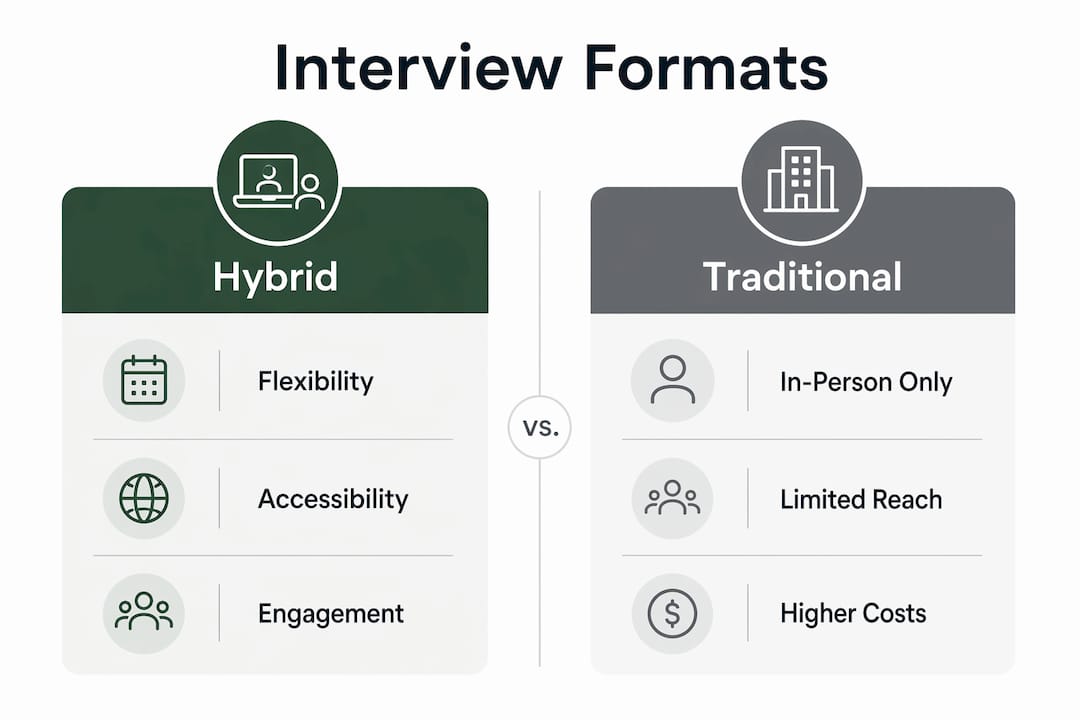
Each interview format has a specific context where it performs best. Hybrid does not automatically win. The right choice depends on the role, the candidate pool, and what you are actually trying to measure.
| Format | Cost | Accessibility | Candidate Engagement | Assessment Quality |
|---|---|---|---|---|
| Fully virtual | Low | High | Moderate | Strong for skills, weak for culture |
| Fully in-person | High | Low | High | Strong for culture, slower to scale |
| Hybrid | Moderate | High | High | Strong across both dimensions |
Fully virtual interviews work well for high-volume screening and roles where remote work is permanent. The limitation is that group dynamics and assessment centers lose effectiveness when moved online. You cannot accurately read how a candidate interacts with a team through a video grid.
Fully in-person interviews remain the gold standard for senior leadership roles where cultural alignment is the primary hiring criterion. The cost and logistical complexity make them impractical for early-stage screening at scale.
Hybrid formats solve both problems. In-person time used for culture assessment and relationship building improves the onboarding experience without requiring every stage to happen on-site. Virtual stages handle volume efficiently. The in-person stage handles depth.
Hybrid is the preferred format for high-volume roles, technical positions requiring multi-stage assessment, and government hiring where structured rubrics are mandatory. It is also the best fit when your candidate pool spans multiple cities or time zones.
Pro Tip: Reserve your in-person stage for the final two or three candidates. Use it to assess culture fit and informal rapport, not to repeat questions you already covered virtually.
How to succeed in a hybrid interview as a job seeker
Hybrid interviews require two distinct skill sets. Performing well virtually and performing well in person are not the same thing. Candidates who treat both stages identically tend to underperform in at least one of them.
Here is how to prepare for each component:
- Adjust your communication style for each setting. Virtual interviews reward expressiveness. You need to project energy through a screen, which means slightly more deliberate eye contact with the camera, clearer vocal pacing, and more explicit verbal signaling. In-person interviews reward warmth and physical presence. Candidates must modulate expressiveness differently for each setting to avoid appearing flat or disconnected.
- Set up your virtual environment properly. Test your camera, microphone, and internet connection at least 24 hours before the interview. Use a neutral background, position your camera at eye level, and make sure your face is well lit from the front. These details signal professionalism before you say a word.
- Prepare for both structured and unstructured segments. Structured stages use rubric-scored questions with specific competencies in mind. Prepare STAR-format answers (Situation, Task, Action, Result) for these. Unstructured segments are conversational. Prepare two or three genuine questions about the team and the role that show you have done your research.
- Clarify the format before the interview. Email the recruiter and ask which stages are virtual, which are in-person, and how long each segment runs. This is not a sign of anxiety. It is a sign of preparation. Knowing the structure lets you allocate your energy correctly.
- Use AI tools to sharpen your answers. Real-time AI interview assistants like Parakeet-ai listen to interview questions as they are asked and surface relevant answers instantly. This is especially useful for the structured virtual stage, where questions follow predictable competency frameworks.
The candidates who perform best in hybrid processes are the ones who treat each stage as its own challenge rather than a repetition of the same conversation in a different setting.
Key takeaways
Hybrid interview technology succeeds because it combines the scale of virtual screening with the depth of in-person assessment, giving both candidates and recruiters a better process than either format alone.
| Point | Details |
|---|---|
| Hybrid interview definition | Hybrid interviews combine virtual and in-person stages into one coordinated recruitment process. |
| AI accelerates screening | AI video tools achieve over 95% transcription accuracy, cutting manual recruiter review time significantly. |
| Transparency reduces dropout | 26% of candidates reject offers due to unclear process communication; clear hybrid policies reduce attrition. |
| In-person time has a specific job | Reserve on-site stages for culture fit and rapport, not for repeating questions covered virtually. |
| Candidates need two skill sets | Virtual stages reward expressiveness; in-person stages reward warmth and physical presence. |
Why intentional design separates good hybrid processes from bad ones
Most hybrid interview failures I have seen come from one mistake: treating the format as a logistical compromise rather than a deliberate design choice. Organizations add a virtual screening round because it is convenient, then bring everyone on-site for a panel that asks the exact same questions. That is not a hybrid process. That is a redundant one.
The hybrid processes that actually work use each stage for what it does best. Virtual stages handle volume, consistency, and skills verification. In-person stages handle the things technology genuinely cannot replicate: reading a room, sensing team chemistry, and building the kind of trust that makes a candidate say yes to an offer. AI-enhanced hybrid approaches reduce false positives by ensuring candidates demonstrate genuine knowledge rather than rehearsed answers. That is a real advantage, but only if the in-person stage then adds something the AI stage could not.
The other thing I would push back on is the assumption that more stages equal better hiring. Three well-designed stages beat five poorly sequenced ones every time. The goal is progressive filtering, not exhaustion. Candidates who make it to your final round should feel like the process respected their time. If they do not, your best candidates will drop out before you make an offer. The AI-driven remote interview tools available in 2026 make it easier than ever to run tight, efficient early rounds. Use that efficiency to protect the in-person stage, not to add more virtual ones.
— Jure
How Parakeet-ai helps you perform in hybrid interviews
Hybrid interviews move fast, and the structured virtual stage is where most candidates lose ground. Parakeet-ai is a real-time AI interview assistant that listens to your interview as it happens and automatically surfaces answers to every question using AI. You stay focused on the conversation while Parakeet-ai handles the recall work in the background.
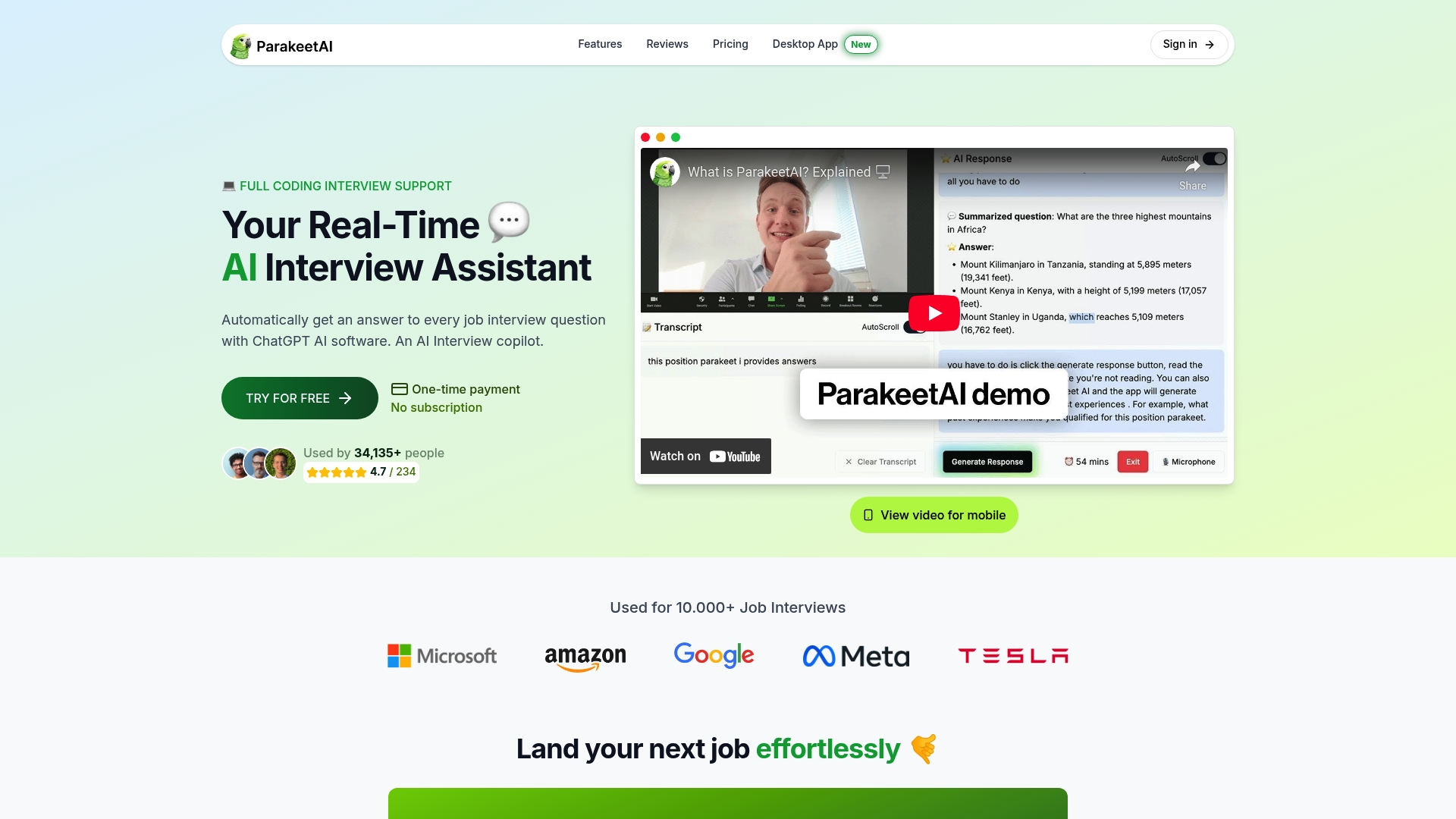
For job seekers navigating the virtual screening stages of hybrid processes, Parakeet-ai gives you the confidence to answer competency-based questions accurately and completely. For HR professionals, understanding how tools like Parakeet-ai fit into AI interview technology helps you design processes that are fair and efficient. Try Parakeet-ai at parakeet-ai.com and see how real-time AI support changes the way you interview.
FAQ
What is hybrid interview technology?
Hybrid interview technology is the combination of virtual and in-person interview formats within a single recruitment process. It typically uses AI-assisted video screening for early rounds and in-person meetings for final assessment stages.
How does a hybrid interview work step by step?
A hybrid interview usually starts with an AI-scored asynchronous video screening, moves to a live structured virtual interview, and ends with an in-person panel or culture conversation. Each stage filters candidates progressively before passing them to the next round.
What are the main benefits of hybrid interviews?
Hybrid interviews increase geographic accessibility for candidates, reduce recruiter screening time through AI tools, and improve assessment quality by reserving in-person time for culture and rapport evaluation. They also lower cost per hire compared to fully in-person processes.
How should i prepare differently for virtual vs. in-person stages?
Virtual stages require more deliberate expressiveness and strong technical setup, including camera, lighting, and audio. In-person stages reward physical warmth and conversational depth, so prepare genuine questions and focus on building rapport rather than repeating rehearsed answers.
Why do candidates drop out of hybrid recruitment processes?
26% of job seekers reject offers due to unclear communication about recruitment processes. Ambiguity about which stages are in-person and how many rounds exist is the primary driver of candidate dropout in hybrid hiring.