What Is Interview Answer Calibration? A 2026 Guide

TL;DR:Interview answer calibration aligns interviewers on shared standards, ensuring consistent candidate evaluation.Understanding this process helps candidates tailor their responses, improving clarity, relevance, and scoring chances.
Interview answer calibration is defined as the process of aligning interviewers on shared scoring standards so every candidate gets evaluated against the same behavioral benchmarks. This practice sits at the heart of fair, consistent hiring. For you as a job seeker, understanding what is interview answer calibration gives you a real edge: you can anticipate how interviewers interpret your answers, adjust your communication style in real time, and match the quality bar the panel has already agreed on. Concepts like inter-rater reliability, behavioral anchors, and structured rubrics all feed into this process, and each one shapes how your responses land.

What is interview answer calibration and why does it matter?
Interview answer calibration is the structured practice of aligning hiring teams so all interviewers score candidate responses according to the same standards and behavioral definitions. Without it, two interviewers watching the same answer can reach opposite conclusions, and that inconsistency hurts both the company and the candidate.
The numbers make this concrete. Agreement rates fall below 50% on borderline candidates when panels skip shared calibration exercises, even when a detailed rubric exists. That means a coin flip decides your fate more often than your actual performance. Proper calibration changes that by converting a rubric on paper into a real measurement tool.
The mechanism behind this improvement is inter-rater reliability, which measures how consistently different evaluators score the same response. Calibration raises inter-rater reliability from roughly 0.45 to 0.75 within 6–8 weeks of consistent practice. A score of 0.75 represents strong agreement across evaluators, meaning your answers get judged on merit rather than on which interviewer happened to be in the room.
One distinction worth knowing: calibration is not the same as an interview debrief. Calibration aligns scoring standards upstream, before candidates are evaluated, while debriefs happen downstream to decide on a hire or no-hire. Calibration makes debriefs faster and less contentious because the team already agrees on what a strong answer looks like.
Pro Tip: If you ever get a chance to ask your recruiter about the interview format, ask whether the panel uses a structured scorecard. That single question tells you the team has likely calibrated their standards, and you should prepare specific, behavioral examples rather than general talking points.
How do calibration sessions actually work?
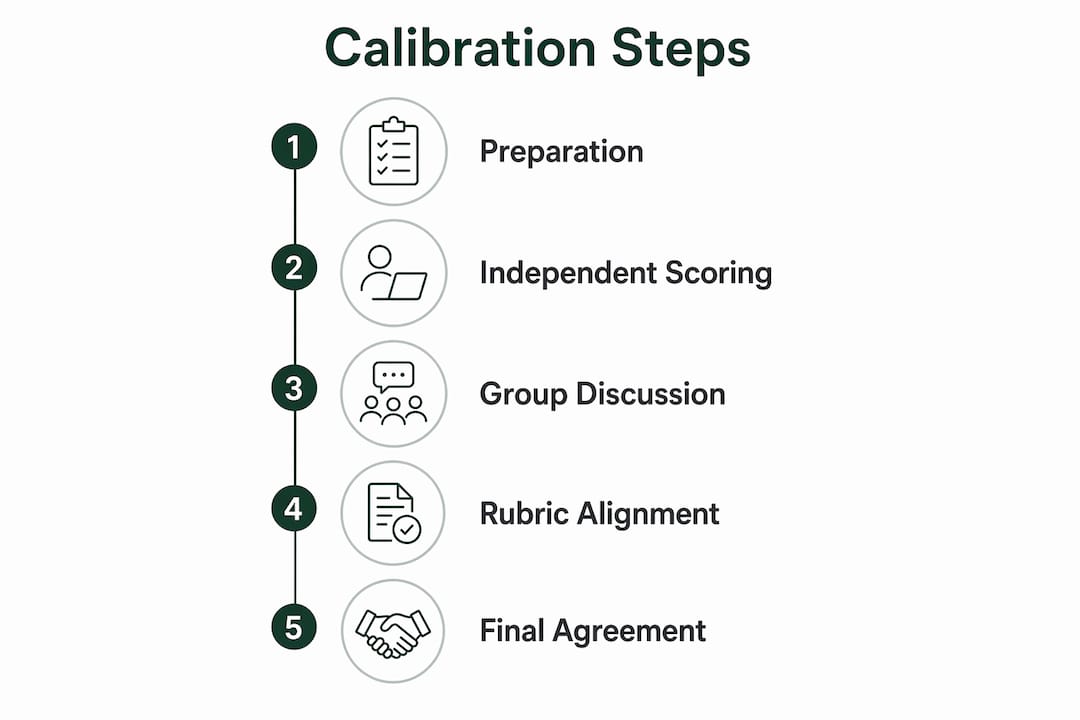
Calibration sessions follow a defined structure that most candidates never see. Knowing the process helps you understand the evaluation bar you are being measured against.
Hiring teams typically run quarterly sessions lasting 60–90 minutes where interviewers re-score exemplar candidates and discuss disagreements. These sessions exist to counteract scoring drift, the natural tendency for evaluators to loosen or tighten their standards over time without realizing it.
A typical session moves through four steps:
- Independent scoring. Each interviewer scores the same exemplar candidate response on their own, without discussing it first.
- Simultaneous score reveal. All scores are shared at the same moment. Revealing scores simultaneously prevents anchoring bias, where the first score heard pulls everyone else toward it.
- Outlier discussion. The team focuses on the biggest disagreements and traces them back to ambiguous rubric language.
- Rubric anchor updates. Behavioral descriptions tied to each score level get rewritten to reflect the team’s shared understanding.
One critical point: calibration targets rubric clarity, not interviewer personality. The goal is never to make a lenient interviewer harsher or a strict one softer. The goal is to make the rubric itself precise enough that leniency and strictness become irrelevant.
| Session Element | Purpose |
|---|---|
| Independent scoring | Removes social influence before discussion |
| Simultaneous reveal | Prevents anchoring bias from the first score heard |
| Outlier discussion | Identifies where rubric language is ambiguous |
| Anchor updates | Sharpens behavioral definitions for future scoring |
Frame-of-reference training is another tool teams use alongside sessions. It teaches interviewers to recognize specific behaviors as strong, average, or weak by walking through concrete examples. This shared frame is what makes behavioral anchors so powerful: instead of “good communication,” a rubric might say “candidate explained a technical concept to a non-technical stakeholder without jargon in under two minutes.”
Pro Tip: Calibration on borderline candidates yields the most learning for a hiring team. Candidates near the hiring threshold reveal exactly where the rubric needs sharpening. As a candidate, this means your toughest competition is not the obviously strong hire. It is the person who, like you, sits right at the decision line. Prepare your examples to be unambiguously strong, not just adequate.
How does calibration reduce bias in interview scoring?
Calibration is one of the most effective tools for reducing the biases that distort interview scores. The halo effect is the most common offender. It occurs when a strong first impression, like a confident handshake or a prestigious employer on a resume, inflates scores across unrelated competencies. Calibration counters the halo effect by directing evaluator attention toward observable, specific behaviors rather than general impressions.
Here is what uncalibrated scoring looks like in practice:
- An interviewer scores a candidate’s problem-solving answer as a 4 out of 5 partly because the candidate went to MIT, not because the answer itself demonstrated strong reasoning.
- A second interviewer scores the same answer as a 2 out of 5 because the candidate seemed nervous, even though the content was solid.
- Neither score reflects the actual quality of the answer.
Calibration fixes this by anchoring scores to evidence. The rubric defines what a “4” looks like in behavioral terms, and interviewers are trained to match the answer to the description, not to their gut feeling.
Calibration removes the question of whether you liked the candidate and replaces it with a simpler question: did the answer match the behavioral description for this score level?
Scoring drift is a second bias calibration addresses. Over months of interviewing, evaluators unconsciously shift their standards. A “strong hire” in January may only qualify as a “hire” by June if no recalibration happens. Periodic sessions reset the baseline and keep the bar consistent across hiring cycles. This matters to you because it means the standard you are evaluated against today should match the standard applied to every other candidate in that cycle.
How can you use calibration knowledge to improve your answers?
Understanding how interviewers calibrate their scoring gives you a practical framework for adjusting your own answers in real time. This is sometimes called candidate-driven calibration: reading the room and adapting your response depth, structure, and language to match what the interviewer is actually looking for.
Adapting answer depth to interviewer expectations signals professional judgment and stakeholder awareness. These are exactly the behaviors that score well on most structured rubrics. Here is how to put it into practice:
- Ask a clarifying question before diving in. Try: “Would you prefer a high-level overview or a detailed walkthrough of my process?” This one question shows self-awareness and prevents you from over-explaining to a time-pressed interviewer or under-delivering to one who wants depth.
- Watch for verbal and non-verbal cues. If the interviewer starts writing quickly, they are capturing detail. If they lean back and nod, they may want you to move on. Adjust your pace accordingly.
- Match your vocabulary to the interviewer’s role. A technical interviewer wants specifics: tools, methods, outcomes. A behavioral interviewer wants context, actions, and results. Calibrate your language to the audience in front of you.
- Confirm alignment mid-answer. For complex questions, pause and check: “Does that level of detail work, or would you like me to go deeper on any part?” This mirrors what calibrated interviewers do in their own sessions.
The goal is to demonstrate that you can read a room and adjust. That skill shows up directly in competencies like communication, stakeholder management, and executive presence. Interviewers who use structured interview scorecards are specifically looking for evidence of these behaviors, and candidate-driven calibration delivers exactly that evidence.
Pro Tip: Before your interview, research whether the company uses structured interviews. LinkedIn, Glassdoor, and recruiter conversations often reveal this. If they do, prepare your examples using the STAR format (Situation, Task, Action, Result) and make the Result measurable. Calibrated rubrics almost always reward specificity over storytelling.
Key takeaways
Interview answer calibration is the single most important process separating fair, consistent hiring from subjective, bias-prone evaluation, and understanding it gives candidates a concrete advantage.
| Point | Details |
|---|---|
| Calibration defines scoring standards | Interviewers align on behavioral anchors before evaluating candidates, not after. |
| Inter-rater reliability improves sharply | Proper calibration raises scoring agreement from 0.45 to 0.75 within 6–8 weeks. |
| Bias reduction is structural | Calibration targets the rubric, not the interviewer, making halo effect and drift less likely. |
| Candidates can self-calibrate | Asking clarifying questions and reading interviewer cues signals strong communication competency. |
| Borderline cases matter most | Preparing unambiguously strong examples puts you above the decision threshold where calibration has the most impact. |
Why calibration knowledge is the candidate’s secret weapon
Most candidates walk into interviews thinking the game is about impressing one person. The reality is that your answer gets scored against a shared standard that the panel agreed on before you walked in the room. That changes everything about how you should prepare.
I have seen candidates with genuinely strong experience score poorly because their answers were pitched at the wrong level. They gave a 10-minute technical deep dive to a hiring manager who wanted a 90-second business summary. The content was excellent. The calibration was off. The score reflected that.
The common misconception is that more detail always signals more competence. Calibrated rubrics do not reward volume. They reward fit between the answer and the behavioral anchor for that score level. A concise, specific answer that matches the rubric’s “strong” description will outscore a rambling answer every time.
My practical advice: treat every interview as a two-way calibration exercise. You are not just answering questions. You are reading what the interviewer values, adjusting your depth and language in real time, and confirming alignment when the stakes are high. Candidates who do this consistently do not just perform better. They get remembered as unusually self-aware, which is a competency almost every calibrated rubric rewards.
Build the habit before the interview. Practice answering the same question at three different depths: a 30-second version, a 2-minute version, and a 5-minute version. Then practice choosing the right one based on a cue. That skill is candidate-driven calibration, and it is one of the most transferable professional skills you can develop.
— Jure
How Parakeet-ai helps you prepare calibrated answers
Understanding calibration theory is one thing. Practicing it under pressure is another. Parakeet-ai is a real-time AI interview assistant that listens to your interview and automatically provides answers to every question as it happens.
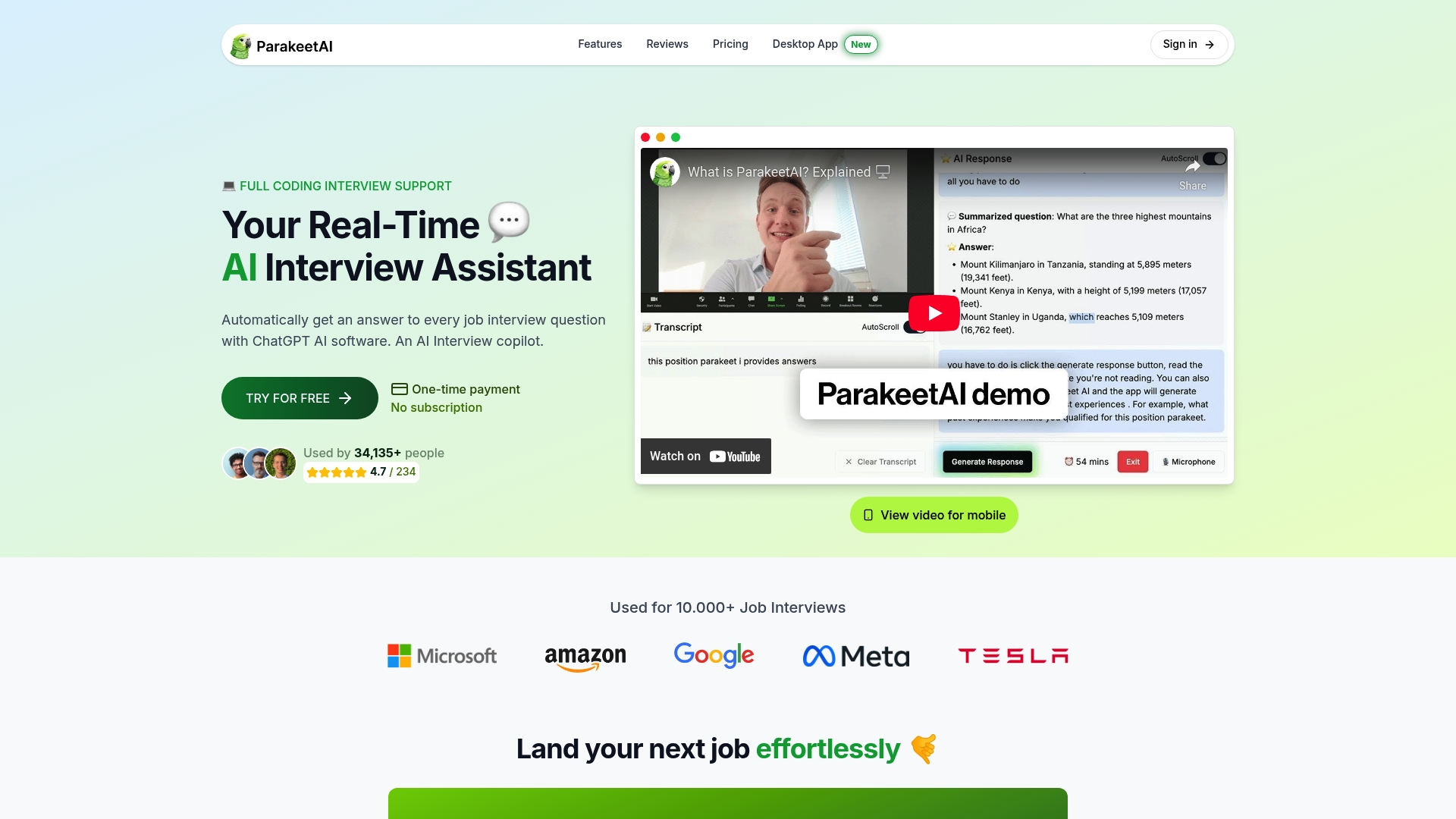
Parakeet-ai analyzes your responses against the standards interviewers actually use, helping you identify where your answers are too vague, too detailed, or missing the behavioral evidence that structured rubrics reward. Think of it as having a calibration session for your own answers before the real interview begins. You can improve your interview answers with feedback that mirrors what a calibrated hiring panel looks for, and practice adjusting your depth and language in real time. Visit Parakeet-ai to start preparing with the same standards top hiring teams use.
FAQ
What is interview answer calibration in simple terms?
Interview answer calibration is the process where interviewers agree on what a strong, average, or weak answer looks like before scoring candidates. It ensures every candidate is evaluated against the same behavioral standard.
How does calibration affect my interview score?
Calibration raises inter-rater reliability from roughly 0.45 to 0.75, meaning your score depends far more on your actual answer quality than on which interviewer evaluates you.
What is the difference between calibration and an interview debrief?
Calibration happens before interviews to align scoring standards, while debriefs happen after to decide on a hire or no-hire. Calibration makes debriefs faster by eliminating scoring disputes upfront.
How can i calibrate my own interview answers?
Ask clarifying questions about answer depth, watch for interviewer cues, and match your vocabulary to the interviewer’s role. This candidate-driven calibration signals strong communication competency on structured rubrics.
Why do borderline candidates matter most in calibration?
Candidates near the hiring threshold reveal where rubric anchors are ambiguous, which is why calibration sessions focus on these cases. Preparing specific, measurable examples puts your answers clearly above that threshold.