
NLP in Interviews: Real-Time AI Tips for Candidates

TL;DR:Natural language processing is used in interviews to transcribe answers, analyze sentiment, and score responses in real time. Employers rely on NLP outputs like coherence, semantic similarity, and paracoustic signals for automated evaluation and candidate filtering. Candidates should understand these systems, practice with AI tools ethically, and ensure privacy disclosures before engaging in AI-assisted interviews.
Natural language processing (NLP) in interviews is the set of AI techniques — speech-to-text transcription, sentiment analysis, and semantic similarity scoring — that tools like Parakeet-ai and 2026 hiring research use to transcribe, evaluate, and score your answers in real time. The short version: every word you say is being parsed, not just heard.
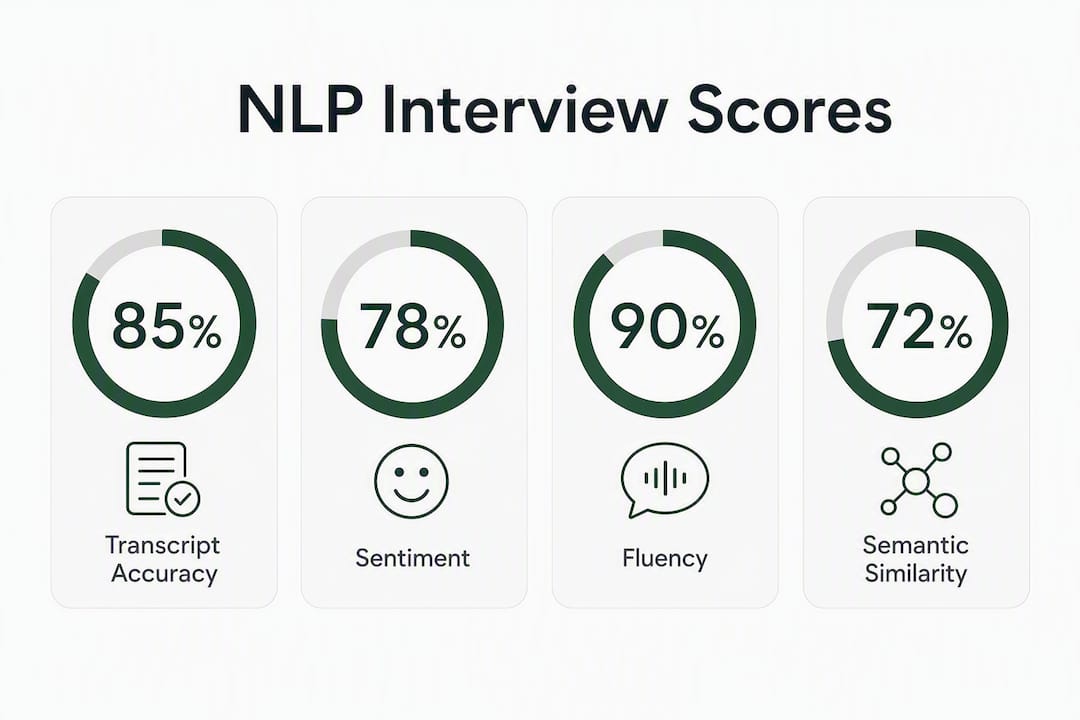
Here is what NLP typically outputs during an interview:
- Transcript: A word-for-word text of your spoken answer
- Sentiment/tone score: Whether your language reads as confident, neutral, or negative
- Fluency and coherence score: How logically your answer flows
- Semantic-similarity score: How closely your answer matches an ideal “golden” response
- Paracoustic signals: Pitch, speech rate, and pause patterns layered on top of the text
Pro Tip: Open every answer with a one-sentence summary of your point before you elaborate. NLP parsers weight early tokens heavily, so front-loading your main claim improves both coherence scores and human comprehension.
Table of Contents
- How employers actually use NLP to evaluate you
- What NLP gets wrong — and why that matters for you
- How to use real-time AI assistance ethically and effectively
- Practice exercises, STAR templates, and prompts to use live
- What tools are available to US candidates right now
- Privacy and legal checks every candidate should make
- Key Takeaways
- The gap between what NLP promises and what it actually delivers
- Parakeet-ai gives you a real-time edge when it counts most
- Useful sources and further reading
How employers actually use NLP to evaluate you
Hiring teams rarely read every transcript themselves. Instead, NLP-based evaluation runs in the background, converting your spoken answers into structured scores across multiple dimensions. The goal is consistency at scale: one model, same rubric, every candidate.
Common employer-side applications include:
- Automated structured-interview scoring: Competency labels and numeric scores generated from your answers without a human reviewer in the loop
- Initial screening: Resume-to-answer keyword matching that filters candidates before a live interview
- Multimodal fusion: Text features combined with paracoustic data (pitch, pauses, rate) to produce a single engagement score
- Interviewer-assist tools: Real-time flags that prompt a human interviewer when an answer is off-topic or unusually short
The AI in HR adoption trend matters here because it shapes what signals get weighted. Semantic-similarity scoring, for example, compares your answer against a model response using cosine similarity over word vectors. A coherent STAR answer scores higher than a list of keywords because coherence raises the similarity score directly.
| Employer use case | What NLP measures | Candidate impact |
|---|---|---|
| Automated screening | Keyword match, sentiment | Answers lacking relevant terms may be filtered out |
| Structured scoring | Semantic similarity, fluency | Rambling or keyword-stuffed answers score lower |
| Multimodal evaluation | Text + pitch + pauses | Flat or overly measured delivery can flag low engagement |
| Interviewer assist | Topic relevance, length | Very short answers trigger follow-up prompts |
What NLP gets wrong — and why that matters for you
NLP models are probabilistic, not perceptive. Britannica’s definition makes this plain: these systems combine computational linguistics and machine learning to process language, but they do not understand context the way a person does. They make statistically likely predictions.
Key failure modes to know:
- Accent and ASR errors: Automatic speech recognition accuracy varies by accent, which means transcription errors can cascade into scoring errors before a human ever reviews your answer
- Sarcasm and idioms: Heavy regional slang or irony is routinely mis-parsed; the model reads the literal tokens, not your intent
- Paracoustic misreads: Speaking too slowly or too deliberately can register as low engagement, even when you are being thoughtful
- Halo effects in training data: If a model was trained on a narrow candidate pool, it may encode those patterns as “ideal,” disadvantaging candidates who communicate differently
2026 research note: A peer-reviewed framework published this year found that standardized NLP evaluation improves baseline objectivity but creates tech-dependent baselines — not objective truth. The model’s design choices become the new source of bias.
Ethics checklist — red flags in employer NLP tooling:
- No disclosure that AI is scoring your interview
- No option to request a human review
- No stated data-retention or deletion policy
- Scoring criteria that are not shared with candidates
Pro Tip: If you notice your answers are being transcribed live (look for a real-time caption feed), speak in clear, standard American English. Avoid heavy idioms or filler phrases like “you know” — they increase transcription noise and can lower your fluency score.
How to use real-time AI assistance ethically and effectively
Treat a real-time AI assistant as a live coach, not a teleprompter. The moment you start reading suggestions verbatim, your delivery flattens and paracoustic scores drop.
Ethical checklist before you use one:
- Check the employer’s policy on AI assistance during interviews
- Disclose use if the employer or platform requires it
- Have a fallback plan ready if the tool lags or fails mid-interview
- Never paste a suggestion word-for-word; paraphrase it in your own voice
Practical dos and don’ts:
- Do use the assistant to confirm you have covered the key competency the question targets
- Do monitor your own pace; if the tool flags a long pause, it is a cue to move forward
- Don’t keyword-stuff your answers; cosine similarity scoring penalizes incoherence even when individual keywords match
- Don’t rely on the assistant for emotional tone — that has to come from you
Pro Tip: When an AI suggestion appears, read it once, then close your eyes for two seconds and say it in your own words. That two-second gap is enough to convert a robotic read-back into natural speech.
Practice exercises, STAR templates, and prompts to use live

A STAR answer maps cleanly onto what NLP scoring systems reward: a clear situation sets context tokens, the task and action sections carry competency keywords, and the result closes with a measurable outcome that boosts semantic similarity to model responses.
STAR template for NLP-scored interviews:
AI-driven mock interviews that evaluate content, tone, and delivery are the fastest way to rehearse this structure before a real session.
Sample prompts to use with a real-time assistant:
- “Give me a one-sentence summary of the key competency this question is testing.”
- “Suggest three specific action verbs I can use in my answer.”
- “Paraphrase my last answer more concisely.”
- “What keywords should I include without stuffing them?”
- “Flag any part of my answer that sounds off-topic.”
- “Give me a stronger result statement with a measurable outcome.”
- “How can I restate my opening sentence more confidently?”
- “Check whether my answer covers Situation, Task, Action, and Result.”
Practice exercises:
- Timed responses: Set a 90-second timer and answer a behavioral question. Review the transcript for filler words.
- Paracoustic drill: Record yourself and listen back at 1.25x speed. If it sounds rushed, your live pace is probably fine; if it sounds slow, speed up.
- Mock-feedback loop: Run a behavioral mock interview session, review the feedback, then re-answer the same question and compare scores.
Fallback protocol: If the assistant lags or gives a clearly wrong suggestion, ignore it and answer from your prepared STAR structure. Never pause visibly to wait for a suggestion — a long silence scores worse than an imperfect answer.
Pro Tip: LLM-powered mock systems evaluate fluency and emotional tone alongside content. Run at least one full mock session the evening before your interview specifically to calibrate your pace, not your content.
What tools are available to US candidates right now
The US market has several resource types worth knowing:
- University career centers: Many now offer AI-assisted mock interview tools through platforms integrated with their career portals — check your alumni network even if you graduated years ago
- Public research demos: Academic papers on automated interview evaluation sometimes release demo interfaces; search Google Scholar for the authors’ institutional pages
- Skills-based job matching platforms like ResumeMatch show you where NLP scoring already shapes which roles you surface for, which is useful context before any interview
- Parakeet-ai: A real-time assistant that listens during your interview and surfaces answer suggestions live
Evaluation checklist before trusting any real-time tool:
- Does it disclose its privacy and data-retention policy clearly?
- What is the latency? Suggestions arriving more than three seconds late are useless live.
- Does it support multimodal feedback (tone and delivery, not just text)?
- Is there a free trial or demo session you can run before the real interview?
| Feature to check | Why it matters |
|---|---|
| Privacy policy | Your transcript is sensitive data |
| Latency | High lag makes live use impractical |
| Multimodal support | Text-only tools miss delivery signals |
| Trial availability | Test before you rely on it |
NLP and deep learning power the infrastructure behind these tools, so latency and model capability are real differentiators — not marketing copy.
Privacy and legal checks every candidate should make
Before any AI-evaluated interview, run through these checks:
- Is recording disclosed in the job posting or interview invite?
- Is AI scoring mentioned anywhere in the application process?
- Who stores your transcript, and for how long?
- Can you request deletion of your data after the process ends?
Action steps if something feels off:
- Ask the recruiter directly: “Will this interview be recorded or evaluated by AI?”
- Request a written confirmation of the data-retention policy
- Document any consent you give (screenshot the disclosure screen)
- If you believe AI scoring produced an unfair outcome, escalate to HR in writing
- For complicated situations, consult an employment attorney — EEOC guidance addresses algorithmic fairness concerns in hiring, but applying it to your specific case requires professional judgment
This article is general information, not legal advice. Confirm current rules with the EEOC or a qualified employment attorney for your own situation.
Key Takeaways
NLP in interviews converts your spoken words into scores across transcript accuracy, sentiment, fluency, and semantic similarity — and candidates who understand that system perform better in it.
| Point | Details |
|---|---|
| NLP scores more than words | Employers measure tone, pace, and coherence alongside content — not just keywords. |
| Structured answers win | Coherent STAR responses outscore keyword-stuffed replies on semantic similarity measures. |
| Outputs are probabilistic | NLP models predict, not understand — treat scores as guidance, not verdicts. |
| Privacy check is non-negotiable | Confirm recording disclosure and data-retention policy before every AI-evaluated interview. |
| Parakeet-ai for live practice | Use Parakeet-ai to run a real-time mock session and calibrate both content and delivery before interview day. |
The gap between what NLP promises and what it actually delivers
The pitch for NLP in hiring is appealing: remove human bias, standardize evaluation, give every candidate a fair shot. The reality is more complicated. Standardization does reduce certain kinds of inconsistency, but it replaces them with model-design bias — and that bias is often invisible to the candidate and sometimes to the employer.
What I find underappreciated is how much paracoustic scoring penalizes candidates who are simply being careful. Speaking deliberately, pausing to think, choosing words precisely — these are signs of intelligence in a human conversation. In a multimodal NLP system, they can register as low engagement or low fluency. That is not a minor edge case; it is a structural problem with how these systems are calibrated.
The right response is not to avoid AI tools or to game them. It is to understand the scoring logic well enough to present yourself authentically within it. Use a real-time assistant to catch gaps in your answers and monitor your delivery, but never let it flatten your voice into something that sounds coached. The candidates who do best with these systems are the ones who use them for rehearsal and self-awareness, not as a script.
Parakeet-ai gives you a real-time edge when it counts most
You now know what NLP is scoring and why structure, tone, and pace all matter. The next step is practicing with a tool that replicates those conditions before you sit in a real interview.
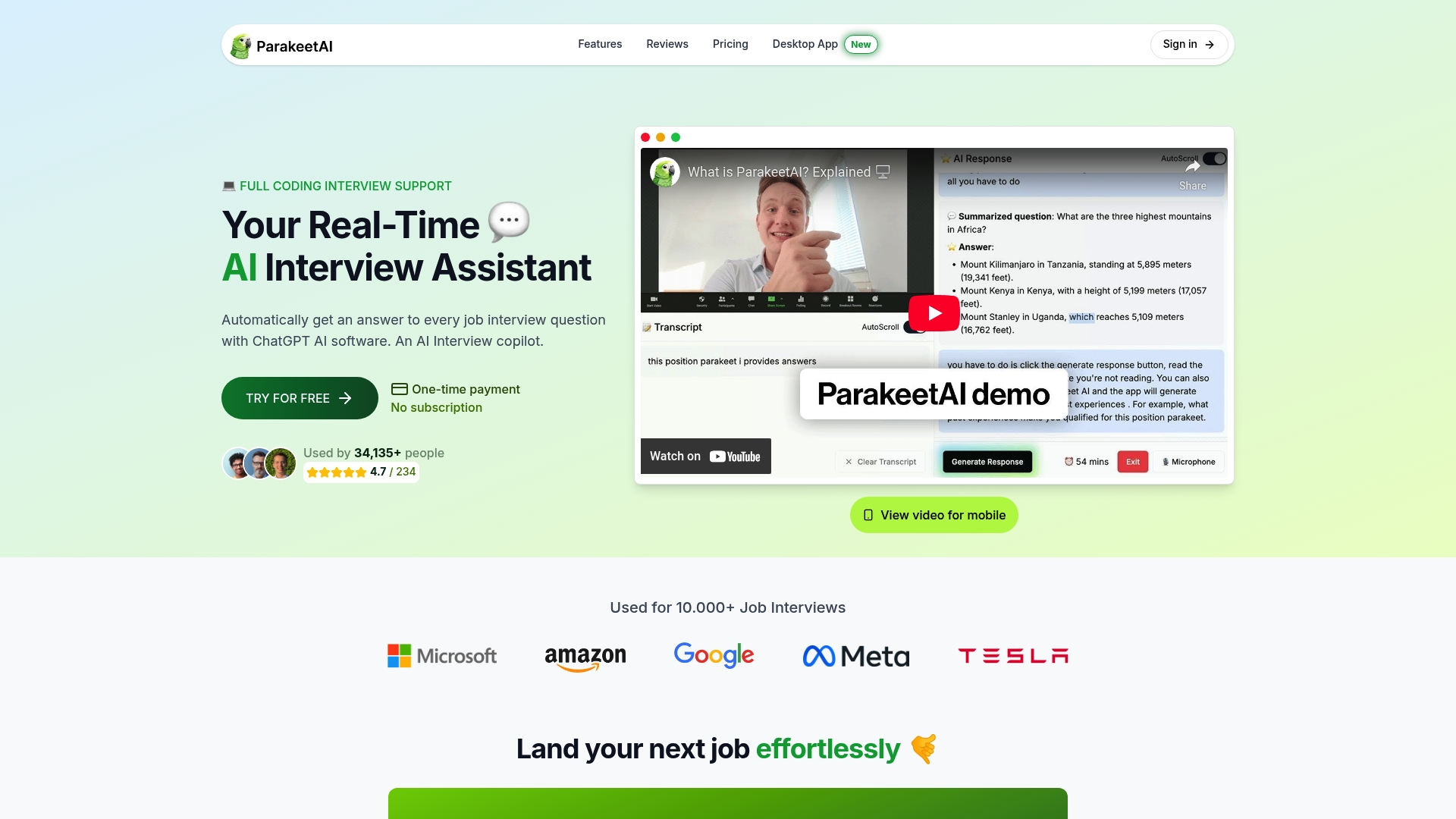
Parakeet-ai listens to your interview as it happens and surfaces answer suggestions in real time — covering the exact signals this article covered: semantic relevance, competency alignment, and delivery cues. Run a 10–15 minute mock session, test the latency, check the suggestion quality on a behavioral question, and review the feedback on your tone and pacing. That single session will show you more about your interview habits than hours of solo prep. Start your mock session at Parakeet-ai and go into your next interview knowing exactly what the system is measuring.
Useful sources and further reading
Dig deeper with these vetted resources:
- AI-Assisted Structured Interview Analysis Using NLP and Speech Feature Extraction — the 2026 peer-reviewed framework covering multimodal evaluation, paracoustic features, and standardization trade-offs
- Leveraging NLP and LLMs for Intelligent Mock Interview Systems — covers LLM-driven question generation, semantic feedback, and fluency/sentiment assessment
- AI-Based Virtual Interview Assistant — explains TF-IDF, cosine similarity, and automated scoring in practical terms
- An Automated Interview Evaluator Using NLP — a concrete implementation using Google Gemini AI and speech recognition
- Natural Language Processing — Britannica — authoritative definition and probabilistic-nature explainer
- What is NLP? — AWS — infrastructure-level overview of deep learning and real-time NLP capabilities
- What is NLP? — Coursera — accessible explainer covering core applications including sentiment analysis and speech recognition
- AI-Driven Mock Interviews Explained — Parakeet-ai blog — feature-level overview of what mock-interview platforms evaluate
- Job Interview Technology Trends — Parakeet-ai blog — 2026 employer adoption context
- Skills-Based Job Matching: A 2026 Guide — ResumeMatch — useful context on where NLP scoring shapes hiring before the interview stage
- For EEOC algorithmic fairness guidance or complicated privacy questions, consult eeoc.gov directly or speak with a qualified employment attorney