What Is Interview Response Accuracy? 2026 Guide

TL;DR:Interview response accuracy measures how well answers align with specific job criteria and scoring rubrics. Focusing on relevance, evidence, and outcome clarity improves scoring more than polished storytelling or confidence. Using structured methods like STAR and practicing concise, evidence-based responses enhances overall interview performance.
Interview response accuracy is the measure of how precisely your answers align with the job-relevant criteria and evaluation rubrics an interviewer uses to score candidates. Most job seekers focus on sounding polished or telling a compelling story. The research says that is the wrong priority. An empirical analysis of 16,940 responses found that direct relevance to core questions is the strongest predictor of answer quality, while clarity alone does not predict actual contribution. Understanding what is interview response accuracy, and how it differs from mere fluency, is the first step toward performing at a higher level in structured interviews.
What does interview response accuracy mean in practice?
Interview response accuracy is the technical term for how well your answers map to the specific competencies, criteria, and scoring rubrics an interviewer is using. It is not about grammar, confidence, or storytelling flair. It is about signal: does your answer give the evaluator the evidence they need to score you on the competency being assessed?
Three elements define an accurate interview response:
- Relevance: Your answer directly addresses the question asked, not a related question you feel more comfortable answering.
- Evidence: You provide concrete, specific examples rather than general claims about your skills.
- Outcome clarity: You include quantified or clearly described results that let the evaluator measure your impact.
Structured behavioral questions, which follow the STAR method (Situation, Task, Action, Result), are the most common format where response accuracy is formally measured. The STAR method gives both candidates and evaluators a shared framework. When you skip the Result or bury the Action under too much context, your accuracy score drops even if your story sounds good.
Pro Tip: Distribute your answer time intentionally. Optimal answer length is 90–120 seconds, split roughly 20% on Situation and Task, 60% on your Actions, and 20% on Results. Quantify your outcome in the final 15–20 seconds to maximize evaluator impact.

The distinction between accuracy and polish matters because interviewers using structured interview rubrics are trained to score specific behavioral anchors. A beautifully told story that misses the competency scores lower than a rougher answer that hits every anchor.
How are interview responses evaluated for accuracy?
Evaluators use two broad approaches to assess interview response accuracy: structured and unstructured formats. The difference in reliability between them is significant.
| Evaluation Method | Validity Coefficient | Inter-rater Agreement |
|---|---|---|
| Structured interviews | ~0.51 | 0.70–0.78 |
| Unstructured interviews | Lower | 0.28–0.35 |
Structured interviews with behavioral anchors produce a validity coefficient of approximately 0.51 and rater agreement between 0.70 and 0.78. Unstructured formats drop agreement to 0.28–0.35. That gap means your answer is far more likely to be scored consistently, and fairly, when the interview uses a defined rubric.
Inter-rater calibration is the process where interviewers align on how to apply scoring criteria before the interview begins. Panels that skip calibration have agreement rates below 50% on borderline candidates, even when they are using detailed rubrics. That inconsistency is not your fault as a candidate, but it does mean your answers need to be clear enough to score well across multiple evaluators with different interpretations.
AI scoring tools are now part of many hiring pipelines. AI evaluation tools perform comparably with a single trained human rater but score lower than a calibrated panel of human raters. AI is consistent and fast, but it lacks the nuanced consensus that a well-calibrated human panel produces.
One finding that surprises most candidates: interview format does not statistically affect the accuracy of response evaluation. Video interviews and in-person interviews produce consistent assessment scores. The rubric design matters far more than the medium.
Pro Tip: Before any interview, ask your recruiter whether the process uses a structured format with defined competencies. If it does, tailor every answer to demonstrate those competencies explicitly. That is how you align with the rubric before you walk in.
Common pitfalls that reduce interview response accuracy
Most candidates reduce their own accuracy without realizing it. These are the four patterns that consistently lower scores.
- Social desirability bias. This is the tendency to give answers you think the interviewer wants to hear rather than truthful, specific ones. Research on response bias shows that biases can account for 10–70% of variance in participant responses. That is a massive range, and it means a heavily rehearsed, people-pleasing answer can distort your score significantly.
- Polished storytelling over signal. Candidates who spend 80% of their answer on the Situation and only 10% on Actions give evaluators almost nothing to score. Experienced interviewers look for discrete competency signals, not narrative arc. Hiring evaluators value mature judgment signals in nuanced, imperfect answers more than flawless rehearsed responses.
- Contradictory evidence across interviews. If you describe yourself as a collaborative leader in one answer and a decisive solo operator in another, anchoring bias kicks in. Panel members who heard the first answer will discount the second. Consistency across your answers reduces this effect and improves how fairly you are scored.
- Exceeding recommended answer length. Answers longer than 120–180 seconds are viewed negatively by evaluators. Going long signals poor self-awareness and makes it harder for the interviewer to extract the competency evidence they need. Brevity with substance is the goal.
The biggest misconception candidates carry into interviews is that a polished answer equals a good answer. Authentic, evidence-based responses score better because they give evaluators the specific behavioral data they are trained to find.
How to improve your interview response accuracy
Improving accuracy is a skill, not a personality trait. These five strategies produce measurable results.
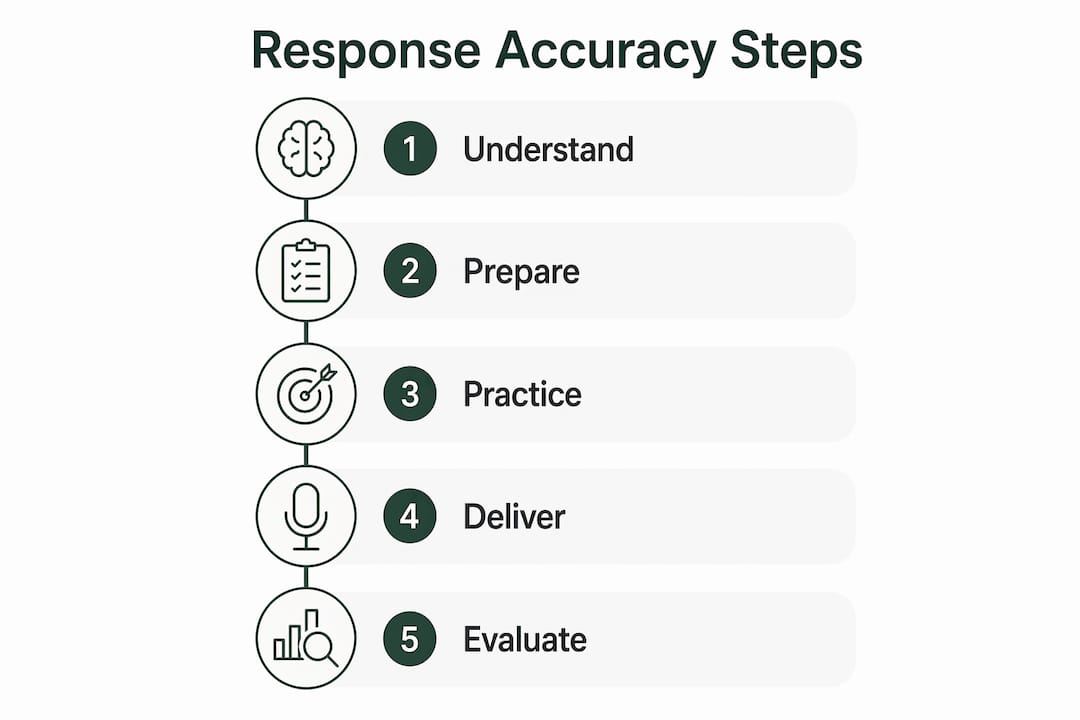
- Adopt the STAR framework as your default structure. Every behavioral question you answer should follow Situation, Task, Action, Result. This is not just a storytelling trick. It directly maps to the behavioral anchors evaluators use to score you. Review behavioral interview techniques before your next interview to understand how rubrics align with this structure.
- Lead with quantified outcomes. Vague results like “the project went well” give evaluators nothing to anchor a score to. Specific results like “we reduced onboarding time by 30% in two quarters” give them a concrete data point. Quantify wherever you can, and if you cannot use a number, describe the decision’s impact in terms of scope or stakeholder effect.
- Practice timing your answers. Record yourself answering common behavioral questions and time each response. Aim for 90–120 seconds. If you consistently run over, you are likely spending too much time on context and not enough on your actions and results. Trim the Situation section first.
- Prepare for follow-up questions. Accurate answers invite follow-up because they contain real, specific information. If you cannot answer a follow-up about your own example, the evaluator will discount the original answer. Knowing your examples deeply, including the trade-offs you made and why, is what separates a good answer from a great one. Candidates who explain trade-offs score higher than those offering polished but simplistic answers.
- Use AI tools for self-evaluation. AI interview practice tools give you immediate, consistent feedback on whether your answers address the question asked. This mirrors how AI scoring systems in real hiring pipelines evaluate your responses. Practicing with an AI tool trains you to give signal-rich answers rather than just comfortable ones. For tech roles specifically, reviewing best answers for tech interviews shows you what high-accuracy responses look like in practice.
The underlying principle across all five strategies is the same: give the evaluator what they are scoring for, not what feels natural to say. Measuring interview response quality requires you to think like the person on the other side of the table.
Key takeaways
Interview response accuracy is determined by how directly your answers address job-relevant competencies and scoring rubrics, not by how polished or confident you sound.
| Point | Details |
|---|---|
| Accuracy beats polish | Evaluators score competency signals, not storytelling quality or fluency. |
| Structure drives scores | Structured interviews with rubrics produce validity coefficients of ~0.51 and far higher rater agreement than unstructured formats. |
| Bias reduces accuracy | Social desirability bias can account for up to 70% of response variance, distorting your true score. |
| Timing matters | Keep answers to 90–120 seconds, with 60% of that time on your Actions. |
| Format is not the issue | Video and in-person interviews produce equivalent scores; rubric quality is what determines fairness. |
The part most candidates get completely backward
I have reviewed hundreds of interview preparation approaches over the years, and the same mistake shows up constantly. Candidates spend the most time on the part that matters least: making their story sound good. They rehearse the narrative arc, work on their vocal delivery, and polish the opening line. Then they walk into the interview and give a beautifully told answer that scores a three out of five because it never addressed the actual competency being assessed.
The research backs this up, but so does simple logic. An interviewer using a structured rubric is not listening for a good story. They are listening for evidence of a specific behavior. When you understand that, your entire preparation strategy shifts. You stop asking “how do I tell this better?” and start asking “does this answer prove I have the competency they are measuring?”
The other thing I have noticed is that candidates underestimate follow-up questions. A vague, polished answer gets one follow-up and then stalls. A specific, slightly rough answer generates three or four follow-ups because the evaluator has real information to probe. Those follow-up conversations are where strong candidates separate themselves. Authenticity and specificity create that opportunity. Rehearsed smoothness closes it off.
My honest advice: spend 70% of your preparation time on the content of your examples, not the delivery. Know your results, know your trade-offs, and know why you made the decisions you made. That is what accurate interview responses are built from.
— Jure
Practice smarter with Parakeet-ai
Understanding interview response accuracy is one thing. Applying it under real interview pressure is another challenge entirely.
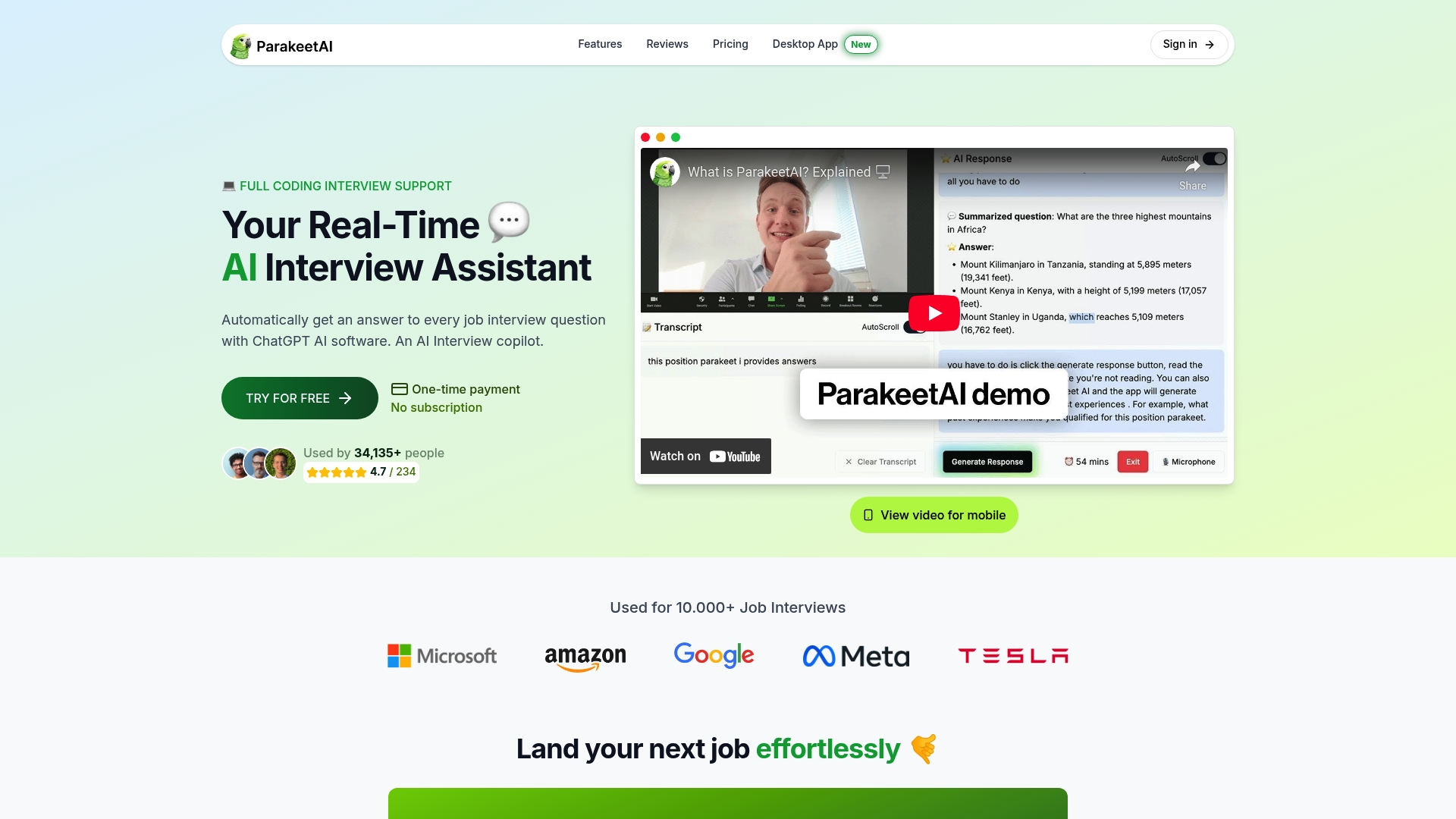
Parakeet-ai is a real-time AI interview assistant that listens to your interview as it happens and automatically generates answers to every question using AI. It gives you the structured, competency-focused responses that score well on rubrics, delivered in the moment when you need them most. Whether you are preparing for a behavioral round or a technical screen, Parakeet-ai helps you practice giving signal-rich answers and then supports you live when it counts. Visit Parakeet-ai to see how it works and start preparing for your next interview with a tool built around how evaluators actually score responses.
FAQ
What is interview response accuracy?
Interview response accuracy measures how directly a candidate’s answers align with the specific competencies and scoring rubrics used in a structured interview. It is defined by relevance and evidence, not clarity or polish.
How does the STAR method improve response accuracy?
The STAR method (Situation, Task, Action, Result) maps directly to the behavioral anchors evaluators use to score answers. Answers structured this way are easier for interviewers to score consistently and accurately.
Does a video interview affect how accurately my answers are scored?
No. Assessment scores remain consistent across video and in-person formats. Rubric design and interview structure have far greater impact on scoring accuracy than the interview medium.
What is the ideal length for an accurate interview answer?
The optimal answer length is 90–120 seconds. Answers exceeding 120–180 seconds are viewed negatively by evaluators and reduce the perceived accuracy of your response.
How does social desirability bias reduce interview accuracy?
Social desirability bias causes candidates to give answers they think interviewers want rather than truthful, specific ones. Research shows this bias can account for 10–70% of variance in responses, significantly distorting interview validity.