
How to Prepare for a Software Engineering Interview

TL;DR:Effective software engineering interview prep requires a structured 6–8 week plan covering coding, system design, and behavioral skills. Candidates improve most by demonstrating their thought process, practicing aloud, and treating each round as a unified signal, not separate tests. Consistent, reflective preparation and clear communication are key to transforming rejections into job offers.
Preparing for a software engineering interview means mastering three distinct disciplines: coding challenges, system design, and behavioral communication. Most candidates fail not because they lack technical knowledge, but because they treat each round as a separate test rather than a unified signal. The industry standard for how to prepare for a software engineering interview is a 6–8 week structured plan with roughly 11 hours of weekly practice. This guide gives you that structure, covering every round type, common mistakes, and the communication habits that actually move hiring decisions.
How to prepare for a software engineering interview: timeline and schedule
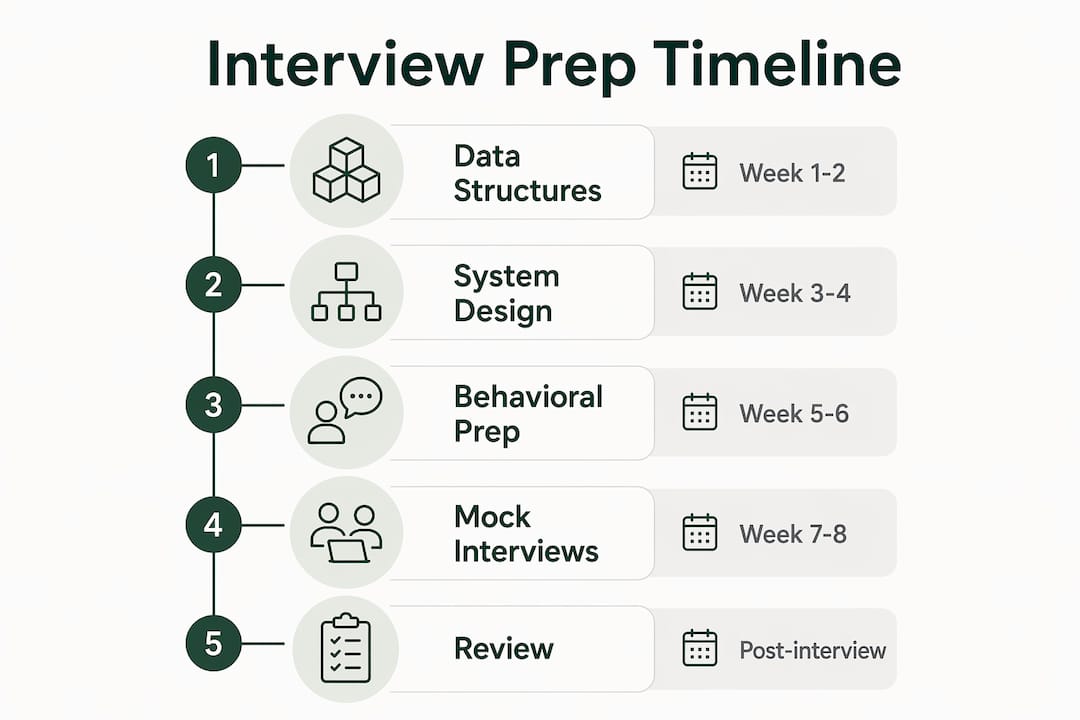
A realistic preparation timeline is the foundation of every successful technical job search. Industry data shows that 6–8 weeks at approximately 11 hours per week is the recommended commitment for most candidates. Junior engineers can target the lower end of that range; senior candidates should plan for the full eight weeks to cover system design depth.
Here is how to structure those weeks:
| Week | Focus Area | Daily Goal |
|---|---|---|
| 1–2 | Data structures and algorithms fundamentals | 2 LeetCode problems per day |
| 3–4 | Coding patterns and timed problem sets | 3 problems per day with narration |
| 5–6 | System design concepts and mock sessions | 1 full design session per day |
| 7 | Behavioral story preparation and mock interviews | 2 STAR stories refined per day |
| 8 | Full mock interviews and post-mock write-ups | 1 full mock interview per day |
Split your weekly hours roughly as follows: 50% on coding practice, 30% on system design, and 20% on behavioral preparation. Candidates who skip behavioral prep consistently underperform in the final rounds, where hiring decisions often get made.
Pro Tip: After every mock interview, write a short postmortem noting what you got wrong and why. Post-mock write-ups accelerate improvement faster than additional solo practice.
How do you master coding interview challenges?
Coding interviews test your problem-solving process, not your ability to recall solutions. Interviewers prioritize candidates who think aloud, clarify assumptions, and adapt their approach over those who silently produce a memorized answer. That distinction changes how you should practice.
The core skills to build are:
- Problem decomposition. Read the prompt twice. Identify inputs, outputs, and edge cases before writing a single line of code.
- Data structure fluency. Know arrays, hash maps, trees, graphs, stacks, queues, and heaps. Understand when each applies and why.
- Algorithm patterns. Study sliding window, two pointers, binary search, depth-first search, breadth-first search, and dynamic programming. LeetCode and HackerRank both organize problems by pattern, which is the most efficient way to study.
- Narration. Say your reasoning out loud. When you choose a hash map over an array, explain why. Interviewers score your communication, not just your output.
- Time management. Coding problems typically allow 20–25 minutes for solving, plus time for discussion and testing. Practice under that constraint from week one.
Top candidates produce a working solution first, then discuss optimizations and time complexity only if time allows. A correct brute-force answer with clear reasoning beats an incomplete optimal solution every time.
Pro Tip: Use the interview time management tips framework: spend the first 5 minutes clarifying, the next 15 coding a working solution, and the final 5 discussing complexity and edge cases.

How to prepare for system design interviews effectively
System design interviews assess your ability to think like a production engineer, not a student. The goal is not to produce a perfect architecture. The goal is to show you can reason through trade-offs under real constraints.
Follow this sequence in every system design session:
- Clarify the scope. Ask what scale the system needs to handle. One million users or one billion users require fundamentally different designs.
- State your assumptions. Write them down visibly. This shows structured thinking and prevents you from solving the wrong problem.
- Sketch a high-level architecture. Cover the major components: clients, load balancers, services, databases, and caches. Do not go deep on any single component yet.
- Discuss constraints explicitly. Proactively addressing constraints like latency, throughput, and cost is what separates senior candidates from junior ones. Name the trade-offs you are making.
- Explore failure modes. Ask yourself what breaks first under load. Discuss replication, failover, and data consistency.
- Invite feedback. Ask the interviewer if they want you to go deeper on any component. This signals collaboration, not just performance.
“Success depends on demonstrating production-grade thinking incorporating system impacts, code reliability, and stakeholder alignment.”
The candidates who struggle in system design rounds are those who jump straight to a solution without establishing scope. Treat the first five minutes of every design session as a requirements gathering conversation, not a monologue.
For deeper practice resources on architecture rounds, the system design interview content at Parakeet-ai covers scalability patterns and real-world case studies worth working through.
How do you craft strong behavioral interview stories?
Behavioral rounds are where technically strong candidates lose offers. The fix is preparation, not personality. Using the STAR method (Situation, Task, Action, Result) gives your answers a clear structure that interviewers can score consistently.
The themes you need to cover are:
- A time you resolved a technical conflict with a teammate
- A time you delivered under a tight deadline
- A time you made a mistake and corrected it
- A time you influenced a decision without direct authority
- A time you improved a process or system proactively
Prepare 4–5 STAR stories under two minutes each and practice them until they feel natural, not scripted. Two minutes is the target because longer answers lose the interviewer’s attention and signal poor communication skills.
Each story should follow this structure: set the context in one sentence, describe your specific responsibility in one sentence, explain the actions you took in three to four sentences, and close with a measurable result. Numbers matter. “Reduced deployment time by 40%” is more credible than “improved the process.”
Pro Tip: Record yourself delivering each story once. Watch it back. If you cannot follow your own reasoning in under two minutes, the interviewer cannot either. Use the behavioral story preparation guide at Parakeet-ai to refine your frameworks.
What are the most common interview mistakes to avoid?
Most interview failures are predictable. The table below maps the most common mistakes to their fixes.
| Mistake | Fix |
|---|---|
| Starting to code without clarifying | Ask at least two questions about constraints before writing anything |
| Silent problem solving | Narrate every decision, including dead ends |
| Optimizing before a working solution exists | Get a correct solution first, then discuss complexity |
| Inconsistent performance across rounds | Treat every round with the same preparation and energy |
| Vague behavioral answers | Use STAR structure with a specific, measurable result |
Asking clarifying questions before coding is the single most common failure pattern interviewers report. Candidates assume they understand the problem and code toward the wrong solution. Two targeted questions at the start prevent that entirely.
The other mistake worth calling out is treating rounds as independent events. Hiring decisions rely on consistent signals across coding, system design, and behavioral rounds. One exceptional coding round does not offset a weak behavioral round. Prepare all three with equal seriousness.
When you get stuck during a problem, say so directly. Tell the interviewer where your thinking stopped and ask if a hint is available. That transparency reads as maturity, not weakness. Silence reads as disengagement.
Key takeaways
Consistent, structured preparation across all three interview formats is the most reliable path to a software engineering offer.
| Point | Details |
|---|---|
| Follow a 6–8 week plan | Commit roughly 11 hours per week split across coding, system design, and behavioral prep. |
| Narrate your reasoning | Interviewers score your thought process, not just your final answer. |
| Produce working solutions first | Deliver a correct brute-force answer before discussing optimizations. |
| Prepare 4–5 STAR stories | Keep each behavioral story under two minutes with a measurable result. |
| Clarify before you code | Ask at least two constraint questions before writing any solution. |
What actually separates candidates in these interviews
I have reviewed a lot of interview feedback over the years, and the pattern is consistent. The candidates who get offers are rarely the ones who solved every problem perfectly. They are the ones who made their thinking visible throughout every round.
The biggest shift I see in candidates who go from rejections to offers is learning to treat the interview as a conversation, not a performance. When you hit a dead end in a coding problem and say “I think a greedy approach might not work here because of this edge case, let me try a different structure,” you are showing exactly what a senior engineer does in production. That is what interviewers are actually measuring.
The other thing I would push back on is the instinct to over-index on LeetCode grinding. Solving 300 problems in isolation without narrating your reasoning or writing post-mortems is far less effective than solving 100 problems with full verbal explanation and a written review after each session. Volume without reflection does not transfer to interview performance.
Finally, the behavioral round deserves the same preparation rigor as the technical rounds. I have seen candidates with genuinely impressive technical skills lose offers because their behavioral answers were vague and unmemorable. A specific story with a real number lands every time. A general answer about “working well with teams” lands nowhere.
— Jure
How Parakeet-ai can support your interview prep
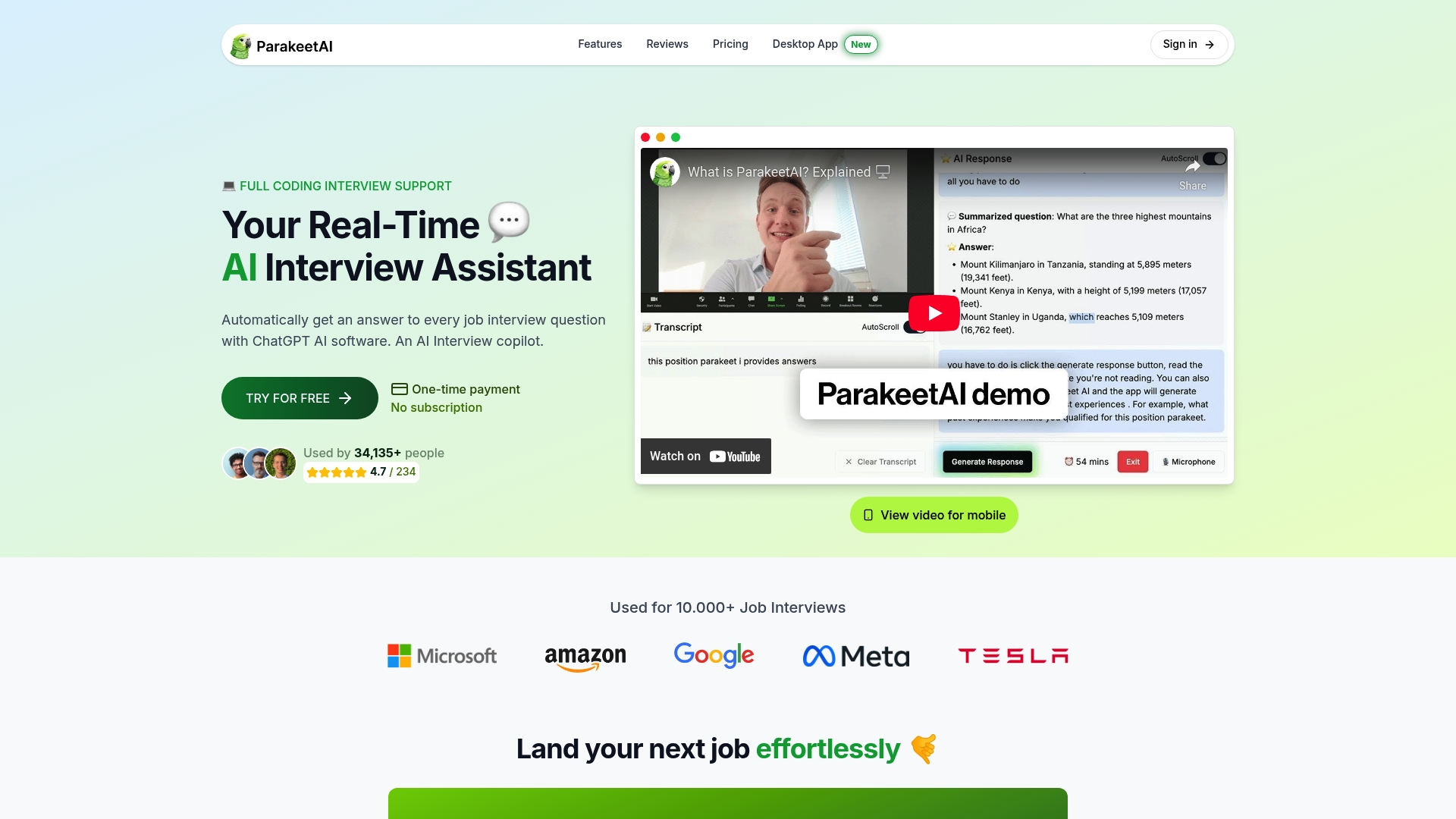
Parakeet-ai is built specifically for candidates who want real-time support during technical interviews. The platform listens to your interview as it happens and provides instant, contextual answers to every question you face.
Beyond the live assistant, the Parakeet-ai blog covers the full software engineering interview checklist: coding patterns, system design frameworks, and behavioral story guides updated for 2026 hiring standards. If you want to understand how AI coaching benefits candidates preparing for technical roles, that resource is worth reading before your next mock session. Start with the software engineering interview questions breakdown to identify your weakest areas first.
FAQ
How long does it take to prepare for a software engineering interview?
Most candidates need 6–8 weeks of preparation at roughly 11 hours per week. Junior roles may require less time; senior roles with system design rounds typically need the full eight weeks.
What topics should i study for a coding interview?
Focus on data structures (arrays, hash maps, trees, graphs), algorithm patterns (binary search, sliding window, dynamic programming), and time complexity analysis. LeetCode and HackerRank organize problems by pattern, which is the most efficient study method.
What is the STAR method for behavioral interviews?
STAR stands for Situation, Task, Action, and Result. It structures behavioral answers into a clear narrative that interviewers can score. Each story should run under two minutes and close with a measurable outcome.
Should i optimize my solution during a coding interview?
Produce a working solution first, then discuss optimizations if time allows. A correct brute-force answer with clear reasoning is scored higher than an incomplete optimal solution.
How do i handle getting stuck during a technical interview?
Say out loud where your thinking stopped and ask the interviewer if a hint is available. Transparent communication about your reasoning process reads as engineering maturity, not weakness.