
Live Language Translation in Interviews: 2026 Guide

TL;DR:Live language translation converts spoken words in real-time during interviews, breaking down language barriers. AI tools like Maestra support many languages and provide rapid, automatic interpretation, making multilingual hiring faster and more inclusive. Proper interview design, such as using short sentences and confirmation loops, enhances translation accuracy and interview effectiveness.
Live language translation in interviews is the real-time conversion of spoken words from one language to another, allowing candidates and employers to communicate clearly regardless of their native languages. This technology covers what is live language translation in interviews at its core: AI tools like Maestra, Discuss, and Team Stream now handle this conversion automatically, with latency as low as 0.5 seconds. The result is a hiring process that no longer treats language as a barrier. For global teams and remote hiring in 2026, understanding how this technology works is no longer optional.
What is live language translation in interviews?
Live language translation in interviews is the process of converting spoken language in real time during a hiring conversation. The industry term for this is live interpretation, which distinguishes it from written translation. Translation handles text. Interpretation handles live speech. Both terms appear in this space, but interpretation is the precise word for what happens during an interview.
AI tools now power most of this process automatically. A platform captures the speaker’s voice, runs it through automatic speech recognition, converts the text, translates it, and delivers the output as audio or captions. AI-powered tools like Maestra support 125 or more languages, and many offer same-day setup. That speed and scale would have been impossible with human interpreters alone five years ago.
The technology matters because language barriers cost real hiring opportunities. A qualified candidate who speaks Spanish, Mandarin, or Arabic may struggle to express their full competence in English. Live interpretation removes that friction and lets the actual skills show through.
What are the primary modes of live language translation in interviews?
Live translation operates through two distinct modes: simultaneous interpretation and consecutive interpretation. Each has a different structure, latency, and best use case.
Simultaneous interpretation converts speech in real time as the speaker talks. Professional human interpreters maintain a 2–6 second ear-voice span. AI interpreters cut that down to roughly 0.5 seconds. This mode works best in large group interviews, panel settings, or any situation where stopping the conversation would break the flow. The listener hears the translated version almost instantly through an earpiece or caption feed.
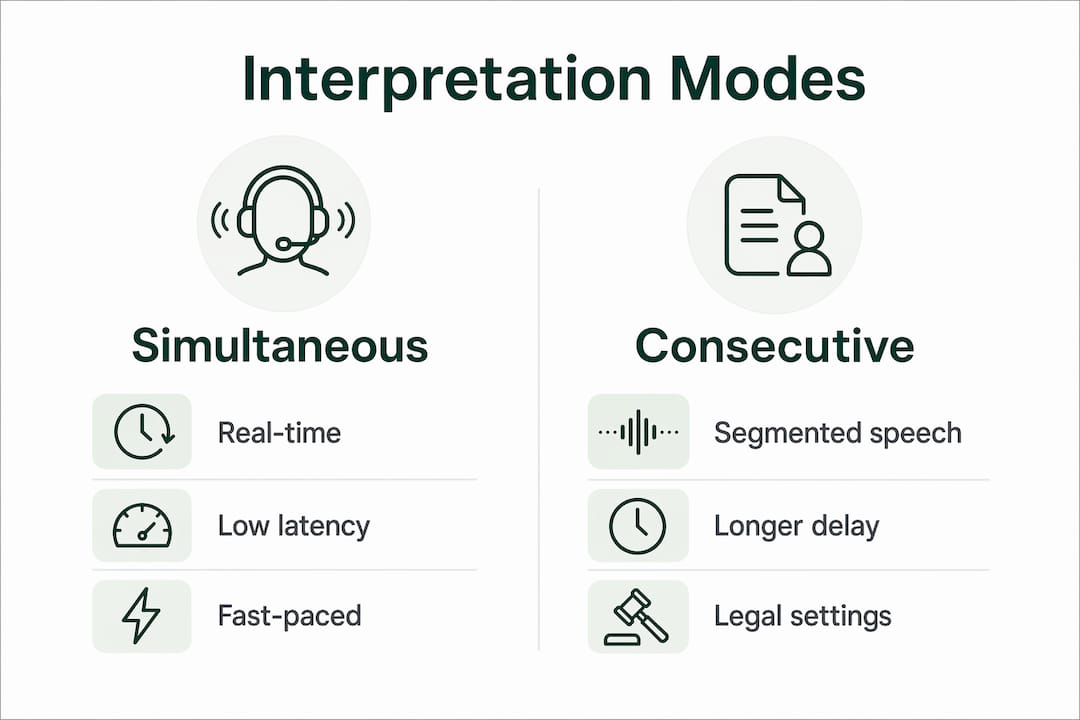
Consecutive interpretation works differently. The speaker talks for 2–3 sentences, then pauses. The interpreter, human or AI, delivers the translation during that pause. This adds time to the conversation but allows for more careful, accurate output. Legal interviews, HR compliance discussions, and sensitive onboarding conversations benefit most from this mode.
| Feature | Simultaneous | Consecutive |
|---|---|---|
| Latency | 0.5 sec (AI), 2–6 sec (human) | Longer, includes speaker pauses |
| Best for | Panel interviews, large groups | Legal, HR, compliance settings |
| Accuracy risk | Higher at speed | Lower due to pauses |
| Conversation flow | Uninterrupted | Structured, slower |
| Cost | Higher for human interpreters | More manageable |
Pro Tip: Choose simultaneous mode for fast-paced screening calls and consecutive mode for final-round or legally sensitive interviews where accuracy outweighs speed.
How do AI-powered live translation tools work in interviews?
AI live translation tools combine three processes: automatic speech recognition, machine translation, and speech synthesis. The system listens to the speaker, converts audio to text, translates that text, and delivers the result as captions or synthesized audio. Each step happens in milliseconds.

The language support across platforms has grown significantly. Platforms like Maestra cover 125 or more languages, while the broader market ranges from 80 to 137 or more supported languages depending on the provider. That range covers the vast majority of global hiring scenarios.
Key capabilities of current AI live translation tools include:
- Automatic speech recognition that converts spoken words to text with high accuracy in quiet, structured environments
- Machine translation engines trained on professional and business vocabulary
- Speech synthesis that delivers translated audio in a natural voice
- Caption overlays integrated directly into video conferencing platforms like Zoom and Microsoft Teams
- Multi-participant support so all parties in a panel interview receive translated output simultaneously
Accuracy drops in noisy environments, with heavy accents, or when speakers use idioms and slang. Structured interview settings with clear audio and prepared questions produce the best results. The embed-first trend in 2026 puts translation directly inside hiring platforms, removing the need for third-party tools.
Pro Tip: Before selecting a live translation platform, list the top five languages your candidate pool speaks and confirm the tool’s accuracy benchmarks for those specific languages, not just its total language count.
What are the benefits of live language translation for candidates and employers?
Live interpretation services deliver concrete advantages for both sides of the hiring table. The benefits go beyond convenience. They affect hiring quality, cost, and inclusion.
AI live translation in HR onboarding improves immediate comprehension and prevents misunderstandings that would otherwise cause productivity delays weeks later. That same principle applies during the interview itself. A candidate who fully understands each question gives a more accurate, complete answer.
Key benefits of live language translation in interviews:
- Wider candidate pools. Employers access talent from any country without requiring fluency in the interview language.
- Reduced miscommunication. Real-time translation catches language gaps before they become hiring mistakes.
- Lower interpreter costs. Traditional live interpretation costs $200–$440 per hour. AI-embedded tools cut that expense substantially.
- Faster hiring decisions. Multilingual interviews no longer require scheduling a human interpreter days in advance.
- Stronger inclusion. Non-native speakers compete on skill, not language proficiency.
- Continuous HR support. Translation extends beyond the interview into onboarding, training, and team communication.
The real-time interview benefits compound over time. Companies that adopt live translation early build more diverse teams and reduce turnover caused by early miscommunication during onboarding.
What challenges and best practices exist for live translation in interviews?
AI live translation is not perfect. Knowing where it fails helps you design interviews that get the most out of it.
The biggest challenge is the performance trap. Speakers, especially nervous candidates, try to sound impressive by using long, complex sentences. AI translators struggle with those constructions. The output becomes garbled or loses meaning. Short, direct sentences produce far more accurate translations.
AI also struggles with idioms, cultural references, and domain-specific jargon. A phrase like “hit the ground running” may translate literally and confuse the listener entirely. The fix is simple: plain language throughout.
Best practices for live translation in interviews:
- Use structured interview formats. Structured interviews with prepared questions reduce AI cognitive load and improve translation accuracy compared to open-ended, improvised conversations.
- Speak in short chunks. One idea per sentence. Pause after each point. This gives the AI time to process and deliver an accurate output.
- Avoid idioms and slang. Replace figurative language with literal descriptions. “We move fast” beats “we hit the ground running.”
- Use a confirm-first loop. After key questions or answers, the interviewer rephrases the main point and asks the candidate to confirm understanding. This catches AI drift before it becomes a problem.
- Combine AI with human review for critical decisions. Professional linguists recommend hybrid human-AI approaches for high-stakes environments. Use AI for speed, and a human reviewer for final-round decisions.
Pro Tip: Send candidates a one-page guide before the interview explaining that live translation is in use and asking them to speak in short, clear sentences. This single step dramatically improves output quality.
How can employers and job seekers implement live translation effectively?
Effective implementation starts before the interview begins. Platform selection, preparation, and follow-up all shape the outcome.
For employers, the first step is choosing a platform that matches the languages your candidates speak. Confirm that the tool integrates with your existing video conferencing setup. Platforms that embed translation directly into the interview interface reduce technical friction on the day of the call.
Practical steps for both sides:
- Train interviewers on the tool before using it with candidates. A 15-minute walkthrough prevents technical delays during the actual interview.
- Structure every question in advance. Written, pre-translated questions give candidates time to prepare and give the AI a predictable input to work with.
- Use AI for interviews to include multilingual stakeholders in panel interviews without requiring everyone to share a common language.
- Send a translated written summary after the interview. This confirms what was discussed and catches any translation errors that slipped through.
- Test audio quality before the session. AI translation accuracy drops sharply with background noise or poor microphone quality.
Job seekers using live translation should practice speaking slowly and clearly. Reviewing the structured interview approach before the call helps candidates anticipate question formats and prepare concise, translation-friendly answers.
Key takeaways
Live language translation in interviews works best when both parties use structured formats, short sentences, and a confirm-first loop to catch AI errors before they affect hiring decisions.
| Point | Details |
|---|---|
| Two core modes | Simultaneous interpretation suits fast interviews; consecutive suits legal or HR-sensitive settings. |
| AI language range | Tools like Maestra support 125 or more languages with near-instant latency. |
| Cost advantage | AI translation cuts traditional interpreter costs of $200–$440 per hour substantially. |
| Accuracy best practice | Structured questions and short sentences produce the most reliable AI translation output. |
| Hybrid approach | Combine AI speed with human review for final-round or high-stakes interview decisions. |
The part of live translation most people overlook
I have watched organizations adopt live translation tools and immediately declare the language problem solved. It is not. The tool is only as good as the interview design around it.
The confirm-first loop is the single most underused practice in this space. Interviewers rush through questions, assume the translation landed correctly, and move on. Then they wonder why a candidate’s answers seem off. The answer is almost always a translation error that a two-second pause and a rephrased question would have caught.
The cost argument for AI translation is real. Cutting $200–$440 per hour in interpreter fees adds up fast across a global hiring pipeline. But the savings disappear if a bad hire results from a miscommunication that nobody caught. The technology is a tool, not a replacement for careful interview design.
The trend I find most promising is embedded translation inside hiring platforms. When the translation is built into the platform rather than bolted on as a third-party add-on, the experience becomes natural for both sides. That is where the market is heading, and it is the right direction.
— Jure
How Parakeet-ai can support your multilingual interview process
Parakeet-ai is a real-time AI interview assistant that listens to your interview and automatically provides answers to every question using AI. For job seekers navigating interviews in a second language, that kind of real-time support changes the dynamic entirely.
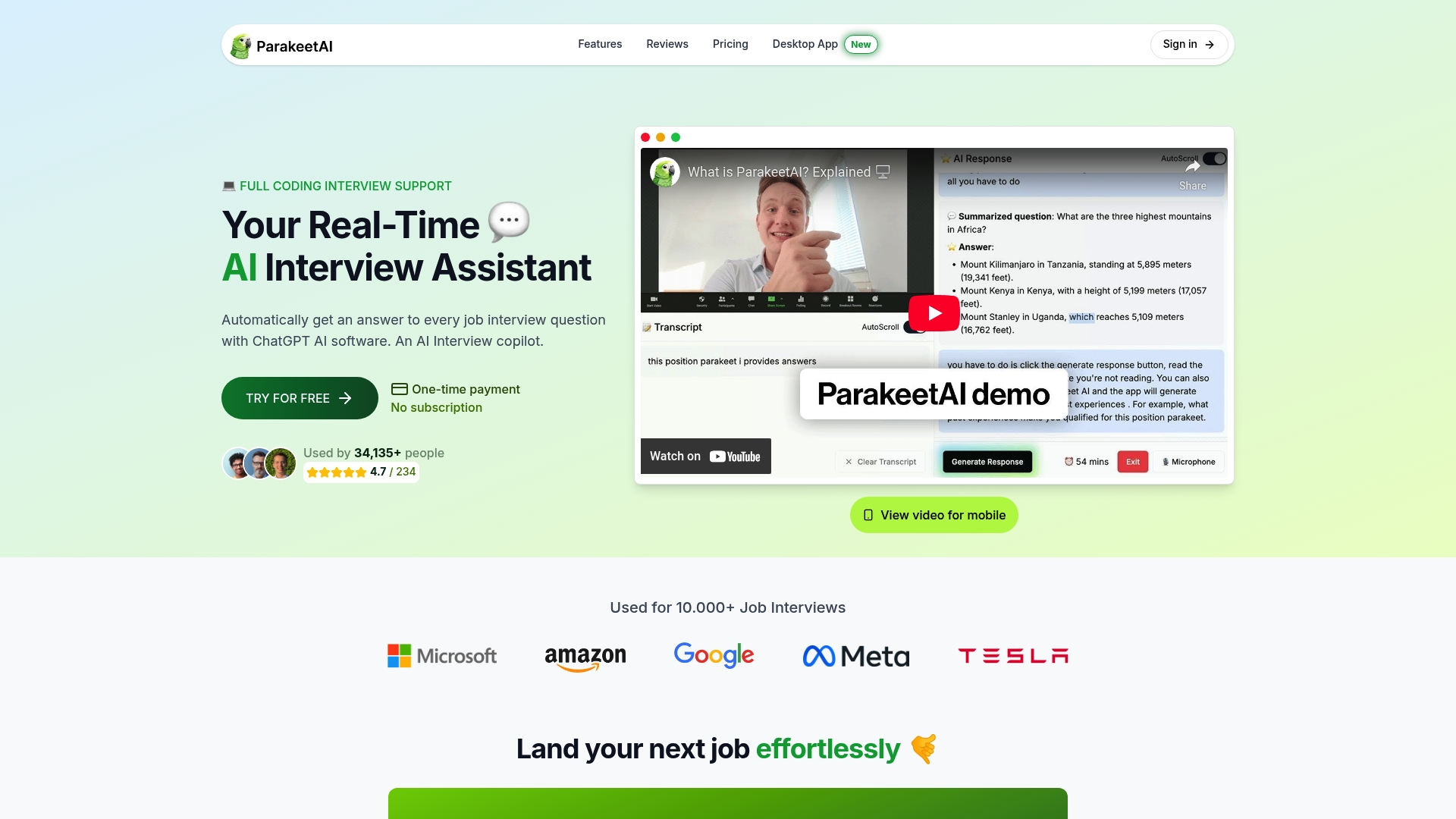
Parakeet-ai works during live interviews, giving candidates instant, AI-generated responses they can use to answer confidently and clearly. The tool supports multilingual interview scenarios where communication speed and accuracy matter most. Employers benefit too: when candidates perform better, hiring decisions reflect actual skill rather than language fluency. Explore Parakeet-ai to see how real-time AI support fits your interview process and helps your team hire across language lines without losing quality.
FAQ
What is live language translation in interviews?
Live language translation in interviews is the real-time conversion of spoken words from one language to another during a hiring conversation. It uses AI or human interpreters to let candidates and employers communicate clearly across language differences.
What is the difference between simultaneous and consecutive interpretation?
Simultaneous interpretation converts speech in real time with near-zero latency, while consecutive interpretation waits for the speaker to pause before delivering the translation. Simultaneous suits fast-paced interviews; consecutive suits legal or compliance-heavy settings.
How accurate is AI live translation in job interviews?
AI live translation is most accurate in structured interview settings with simple, direct questions and short sentences. Accuracy drops with idioms, heavy accents, and free-flowing conversation.
How much does live interpretation cost compared to AI tools?
Traditional human interpretation costs $200–$440 per hour. AI-powered live translation tools reduce that cost substantially, especially when embedded directly into hiring platforms.
Should employers rely solely on AI for interview translation?
No. For critical hiring decisions, combining AI translation with a confirm-first loop and human review produces the most reliable outcome and reduces the risk of costly miscommunication.