
Common HR interview questions: master answers with AI

TL;DR:HR interviews evaluate cultural fit, soft skills, and authenticity, not technical knowledge.Using structured frameworks like STAR and CAR improves clarity and impact of responses.AI-powered practice helps candidates refine answers, ensuring authenticity and confidence in interviews.
HR interviews trip up even well-prepared candidates because the questions feel familiar yet the right answers remain elusive. Most job seekers walk in knowing they’ll be asked about strengths, weaknesses, and career goals, yet still fumble when the moment arrives. The difference between a forgettable answer and one that lands comes down to preparation quality, not just preparation time. Across industries, HR interviews assess cultural fit, adaptability, and soft skills, which means the same core questions surface again and again. AI tools now give you a smarter way to prepare, personalizing feedback so your answers reflect who you actually are.
Table of Contents
- Understanding HR interviews and their purpose
- Top 10 most common HR interview questions
- How to craft strong answers: Frameworks and examples
- Common mistakes and what to avoid
- Our perspective: AI as your interview coach
- Next steps: Level up your interview prep with ParakeetAI
- Frequently asked questions
Key Takeaways
| Point | Details |
|---|---|
| Know the top questions | Familiarize yourself with the most asked HR interview questions for better performance. |
| Use answer frameworks | Applying response structures like STAR or CAR increases clarity and confidence. |
| Avoid common mistakes | Steer clear of generic and negative responses to maintain credibility. |
| Leverage AI support | AI tools personalize your interview practice for standout, authentic answers. |
Understanding HR interviews and their purpose
Before you can answer HR questions well, you need to understand what the interviewer is actually measuring. HR rounds are not about testing technical knowledge. They exist to evaluate your personality, communication style, and whether your values align with the company’s culture.
Interviewers repeat the same questions across candidates because consistency helps them compare fairly. When you hear “Tell me about yourself,” the recruiter is not looking for your life story. They want to see how you prioritize information, how clearly you communicate, and whether you understand what the role needs.
HR professionals are trained to spot inauthenticity quickly. A rehearsed, robotic answer signals that you prepared a script rather than reflected on your experience. What they genuinely want is a thoughtful response that shows self-awareness and growth.
Here is what HR interviews typically evaluate:
- Cultural fit: Do your values and work style match the team’s environment?
- Teamwork: Can you collaborate, navigate conflict, and support colleagues?
- Adaptability: How do you respond to change, ambiguity, or pressure?
- Motivation: Why do you want this specific role at this specific company?
- Communication: Can you explain complex situations clearly and concisely?
“HR interviews focus on assessing cultural fit, adaptability, and soft skills, which is why the same question types appear across nearly every industry and role level.”
Understanding this framework changes how you prepare. Instead of memorizing answers, you start thinking about real experiences that demonstrate these qualities. That shift makes your answers feel natural because they are grounded in truth. Learning more about cultural fit in tech interviews can help you understand how these principles apply even in specialized hiring contexts.
The best candidates treat HR interviews as a conversation, not a test. They listen carefully, pause before answering, and connect their responses to the role’s actual requirements. That level of intentionality is what separates strong candidates from average ones.
Top 10 most common HR interview questions
Knowing which questions to prepare for is half the battle. Typical HR questions cover strengths, weaknesses, and motivation, and these ten appear in virtually every industry.
- Tell me about yourself. This is your opening pitch. Keep it professional, relevant, and under two minutes.
- What are your greatest strengths? Pick strengths that directly relate to the role, then back them up with evidence.
- What is your biggest weakness? Choose a real weakness you have actively worked to improve. Avoid fake humility.
- Why do you want to work here? Research the company before the interview. Generic answers fail here.
- Where do you see yourself in five years? Show ambition while aligning your goals with the company’s growth.
- Tell me about a challenge you overcame. Use a specific story. Vague answers lose the interviewer’s attention fast.
- Why are you leaving your current job? Stay positive. Never criticize a former employer.
- How do you handle pressure or stress? Give a concrete example and explain what you learned.
- Describe your ideal work environment. Be honest, but research the company culture first so your answer fits.
- Do you have any questions for us? Always say yes. Asking thoughtful questions signals genuine interest.
For each question, the approach matters as much as the content. Your answer should be specific, concise, and connected to the role. Reviewing sample answers for tech interviews gives you a benchmark for what strong responses look like in practice.
Pro Tip: For every question, prepare one real story from your experience that you can adapt. One strong story, told well, can answer at least three different HR questions depending on how you frame it.
How to craft strong answers: Frameworks and examples
Knowing the questions is one thing. Answering them skillfully is another. Two frameworks dominate HR interview coaching: STAR and CAR. Both help you structure responses so they are clear, complete, and compelling.
Here is how each framework breaks down:
- STAR: Situation, Task, Action, Result. You describe the context, your responsibility, what you did, and what happened.
- CAR: Challenge, Action, Result. A shorter version that works well for direct behavioral questions.
| Framework | Best used for | Strength | Limitation |
|---|---|---|---|
| STAR | Complex behavioral questions | Full context and outcome | Can feel long if overused |
| CAR | Quick situational questions | Concise and punchy | Less context for nuanced stories |
For “Tell me about a challenge you overcame,” a STAR answer might look like this: You were managing a project when a key team member left mid-sprint (Situation and Task). You reorganized the workload, communicated the delay proactively to stakeholders, and brought in a contractor for two weeks (Action). The project launched only three days late and received positive client feedback (Result).

For “How do you handle pressure,” a CAR answer works well: A client deadline moved up by a week unexpectedly (Challenge). You reprioritized your task list, worked closely with your manager to cut scope, and delivered on time (Action). The client renewed their contract the following quarter (Result).
Behavioral answer frameworks are not just for HR rounds. They apply across panel interviews and even technical interview frameworks where you need to explain problem-solving approaches clearly.
Pro Tip: After telling your story, end with what you learned. Interviewers remember candidates who demonstrate self-reflection because it signals maturity and growth potential.
Common mistakes and what to avoid
Even candidates who prepare thoroughly make avoidable errors in HR interviews. Certain answers can unintentionally undermine your application, sometimes without you realizing it until the rejection email arrives.
Here are the most damaging mistakes:
- Generic answers: Saying “I’m a hard worker” without evidence tells the interviewer nothing. Every candidate says this.
- Negativity about past employers: Even if your last job was a disaster, criticizing it makes you look difficult and unprofessional.
- Rambling: Long, unfocused answers signal poor communication skills. Aim for 90 to 120 seconds per response.
- Not answering the actual question: Candidates sometimes pivot to what they want to say instead of what was asked. Interviewers notice.
- Overselling or underselling: Exaggerating your role in a success story is risky. So is being too modest about real achievements.
| Mistake | Impact on interviewer’s perception |
|---|---|
| Generic strengths claim | Forgettable, no differentiation |
| Criticizing former employer | Raises red flags about attitude |
| Rambling answers | Signals poor communication skills |
| Avoiding the actual question | Suggests evasiveness or lack of clarity |
| Exaggerating contributions | Damages credibility if probed further |
There are also questions to avoid in interviews when it is your turn to ask. Asking about salary too early, questioning how quickly you can get promoted, or asking about vacation before you have an offer all send the wrong signal. They suggest you are focused on what you get rather than what you contribute.
The fix for most of these mistakes is the same: practice with real feedback. Reading tips helps, but hearing how your answer actually lands is a different experience entirely.
Our perspective: AI as your interview coach
Traditional interview prep relied on guesswork. You practiced with a friend, rehearsed in the mirror, or read a list of tips online and hoped for the best. The problem is that none of those methods tell you how your answer actually sounds to a recruiter evaluating dozens of candidates.
AI changes that. Instead of guessing whether your answer is strong, you get real feedback based on actual HR evaluation criteria. You can test your response to “What is your biggest weakness” ten different ways and see which framing is clearest and most credible. That kind of iteration used to require a career coach charging hundreds of dollars per session.
What we find most powerful is how AI personalizes preparation. It does not give you a generic script. It helps you shape your own experiences into answers that feel authentic because they are. Reviewing AI-powered answer preparation shows how this approach produces candidates who sound confident and grounded rather than rehearsed.
The job seekers who use AI well do not outsource their preparation. They use it to sharpen what they already know.
Next steps: Level up your interview prep with ParakeetAI
Preparing for HR interviews does not have to feel like guesswork. ParakeetAI is built specifically to help job seekers practice common HR questions with real-time AI coaching that adapts to your responses.
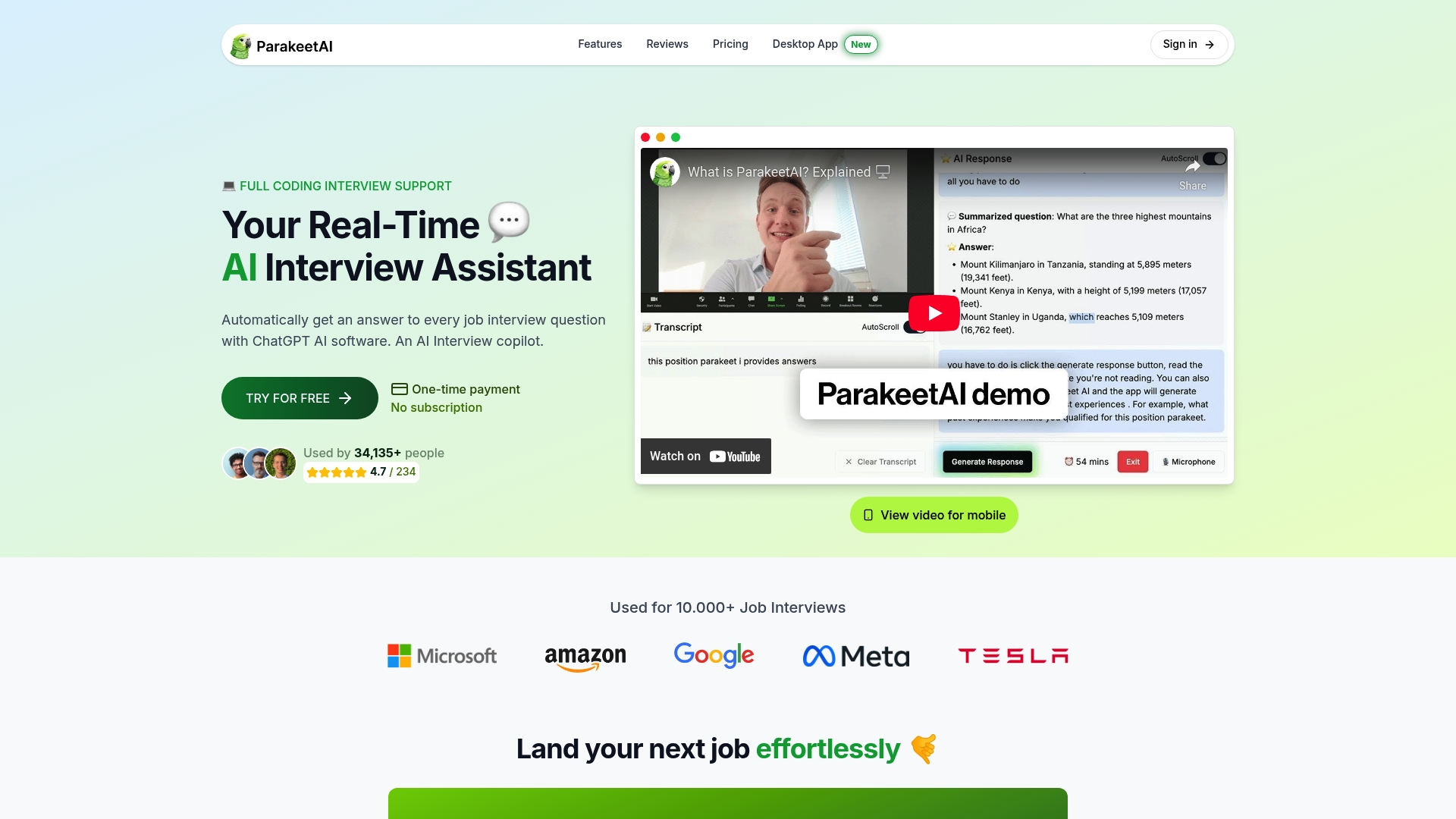
The ParakeetAI interview platform listens to your answers during practice sessions and provides instant, specific feedback so you can improve before the real interview. You get custom scenarios based on your target role, not generic prompts. Whether you are preparing for your first HR round or your tenth, ParakeetAI helps you walk in knowing your answers are sharp, authentic, and ready. Sign up today and turn your next HR interview into your strongest one yet.
Frequently asked questions
What are the most common HR interview questions?
The most repeated HR questions include those about strengths and weaknesses, motivations, previous experiences, and how you handle challenges. Typical HR questions cover these themes across virtually every industry and role level.
How can AI help prepare for HR interviews?
AI platforms analyze your responses, suggest targeted improvements, and simulate realistic interview situations so your practice is more effective than rehearsing alone.
Should I rehearse answers to HR questions word-for-word?
It is better to internalize the key points of your answer and adapt them naturally rather than memorize a script. Interviewers seek genuine, reflective responses, and a memorized answer often sounds flat under pressure.
What mistakes do candidates make in HR interviews?
Common mistakes include giving generic answers, speaking negatively about former employers, and not directly answering the question asked. These errors undermine your application even when your qualifications are strong.