
How to Prepare for an Amazon Interview in 2026

TL;DR:Amazon interviews combine behavioral storytelling based on the 16 Leadership Principles with technical problem-solving under pressure. Success depends on thorough preparation of STAR responses, understanding the interview loop structure, and practicing under real conditions to demonstrate individual actions and measurable results. Candidates who develop a broad story library, treat the process as a marathon, and engage genuinely tend to perform best and stand out to interviewers.
Amazon interview preparation means mastering two things at once: behavioral storytelling built around the 16 Leadership Principles and technical problem-solving under real pressure. The process is more structured than most companies run, and that structure is your advantage. Candidates who understand how to prepare for an Amazon interview before they walk in score significantly better than those who wing it. This guide covers the full loop format, the STAR method, Leadership Principles strategy, technical rounds, and the mistakes that knock out otherwise strong candidates.
How is the Amazon interview loop structured?
The Amazon interview loop consists of 4–5 back-to-back interviews over roughly 5 hours, with each session lasting 55–60 minutes. That is a full workday of sustained performance. Most candidates underestimate the stamina required.
The loop breaks down into distinct rounds:
- Coding rounds (2): Focused on data structures and algorithms. Expect arrays, strings, trees, and graphs.
- System design round (1): Tests your ability to architect scalable solutions and reason through trade-offs.
- Behavioral rounds (2): Anchored entirely to Leadership Principles, with deep follow-up questions.
Every round, including technical ones, includes behavioral questions tied to Leadership Principles. Those behavioral segments run 15–20 minutes inside coding and design interviews. You cannot treat behavioral prep as separate from technical prep.
One interviewer in the loop holds a special role: the Bar Raiser. The Bar Raiser assesses whether you perform better than 50% of current Amazon employees in your role. This person is trained to push back hard, test your conviction, and probe for inconsistency. Staying calm and evidence-backed under that pressure is not optional.
Pro Tip: Treat the loop as a marathon, not a sprint. Eat before you go in, sleep well the night before, and mentally prepare for 5 hours of focused engagement.
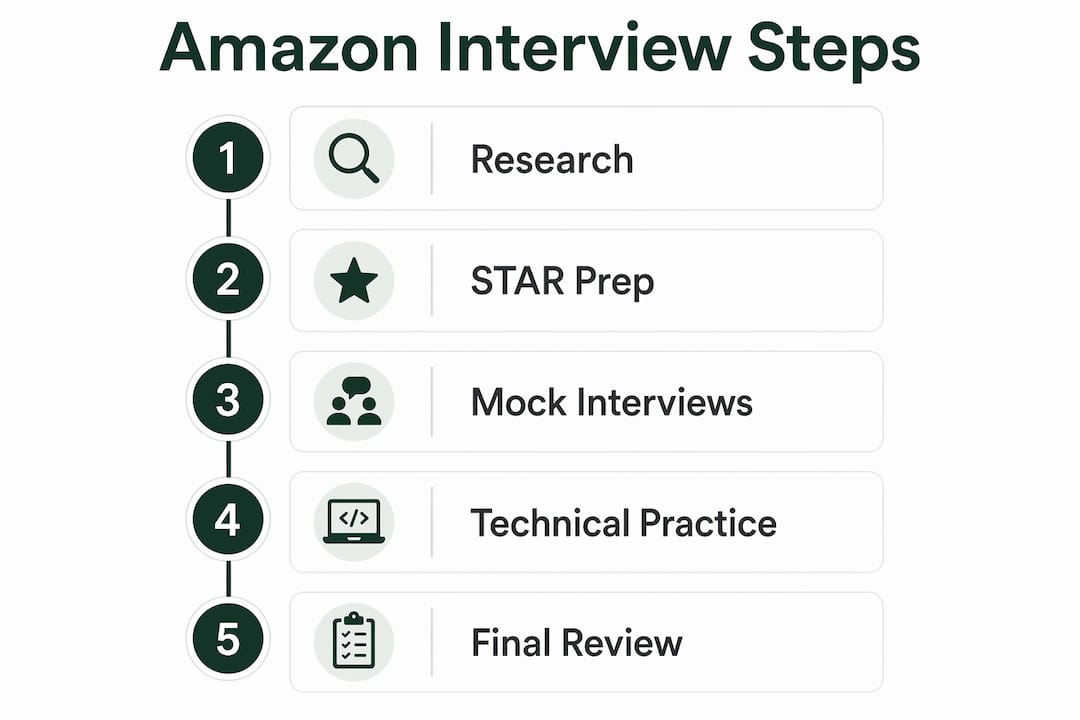
Interviews at Amazon are also a two-way street. Asking thoughtful questions about team challenges and priorities signals genuine interest and influences hiring managers positively. Prepare at least three strong questions before you arrive.
What is the STAR method and how do you use it at Amazon?
The STAR method is the required framework for all behavioral answers at Amazon. STAR stands for Situation, Task, Action, and Result. Amazon interviewers are trained to evaluate your responses against this structure, and deviating from it costs you points.
Here is how to build a strong STAR response:
- Situation: Set the context in two to three sentences. Give enough detail to make the story credible, but do not spend more than 10% of your answer here.
- Task: Clarify your specific responsibility. What were you personally accountable for?
- Action: This is the core of your answer. The Action section should take approximately 60% of your total response. Describe exactly what you did, step by step, in the first person.
- Result: Quantify the outcome. Revenue saved, time reduced, error rate dropped. Numbers matter here.
A well-built STAR story runs 2–3 minutes. Shorter than that and you lack depth. Longer and you risk losing the interviewer’s focus.
The most common failure in this framework is overusing “we.” Vague team-level language prevents interviewers from assessing your individual strength. Say “I built,” “I decided,” “I pushed back on” rather than “we delivered” or “our team achieved.”
Pro Tip: Record yourself answering a behavioral question out loud. Play it back and count how many times you say “we.” Replace every “we” with a specific personal action.
For deeper guidance on crafting these responses, the Amazon STAR method guide on the Parakeet-ai blog walks through full example answers mapped to real questions.
Which Leadership Principles matter most at Amazon?
The 16 Leadership Principles are the actual hiring rubric at Amazon. Interviewers do not evaluate you on a general impression. Each interviewer is assigned 2–3 specific Leadership Principles to assess, and they score you against those principles alone.
The three most frequently tested principles are:
| Leadership Principle | What interviewers look for |
|---|---|
| Customer Obsession | Decisions made with the customer’s outcome as the primary driver |
| Ownership | Taking responsibility beyond your defined role, especially when things go wrong |
| Bias for Action | Moving forward with incomplete information rather than waiting for certainty |
Preparing 15–20 behavioral stories mapped across multiple Leadership Principles is the standard for strong candidates. Repeated stories or too few examples raise concerns about your experience breadth. If you tell the same story twice in one loop, the interviewers will notice.
The most common mistake candidates make with Leadership Principles is treating them as an afterthought. They prepare their stories first, then try to tag a principle onto the end. The better approach is to start with the principle, identify what behavior it demands, and then find a story from your experience that genuinely demonstrates that behavior.
- Map each story to a primary principle and one or two secondary principles.
- Build a story library from your most significant projects and decisions.
- Practice switching between principles mid-story when a follow-up question shifts the focus.
The Amazon Leadership Principles guide on the Parakeet-ai blog covers how to integrate principles across coding, system design, and behavioral rounds in one preparation framework.
How to prepare for Amazon’s technical coding and system design rounds
Technical rounds at Amazon test both your coding ability and your communication style. Interviewers want to see how you think, not just whether you arrive at the correct answer.

Coding exercises often use platforms like Chime, and the problems focus on core data structures: arrays, strings, trees, and graphs. Before you write a single line of code, clarify the constraints. Ask about input size, edge cases, and expected output format. Interviewers score candidates who clarify requirements higher than those who rush into a solution.
Key preparation areas for technical rounds:
- Data structures: Arrays, hash maps, linked lists, trees, and graphs are the most tested.
- Algorithms: Sorting, searching, dynamic programming, and recursion appear regularly.
- System design: Practice designing systems like URL shorteners, notification services, or ride-sharing backends. Focus on trade-offs, not perfect answers.
- Behavioral within technical: Prepare two to three Leadership Principle stories specifically for technical contexts, such as a time you disagreed with a technical decision or pushed a project forward under constraints.
Timed mock interviews are the single best preparation tool for technical rounds. Practicing on LeetCode or HackerRank builds familiarity, but practicing under interview conditions, with someone watching and asking follow-up questions, builds the composure you need on the day.
Pro Tip: After solving a problem, explain your solution out loud as if the interviewer cannot see your screen. Amazon interviewers weight communication heavily. A clear explanation of a suboptimal solution often scores better than a silent perfect one.
For role-specific technical preparation, the Amazon software developer questions guide covers the seven most common coding problems with worked examples.
What are the most common Amazon interview mistakes?
Most candidates who fail Amazon interviews do not fail because they lack skills. They fail because of avoidable preparation errors.
The six most common mistakes are:
- Using “we” instead of “I”: Team language hides your individual contribution. Interviewers cannot assess what you personally did.
- Too few stories: Candidates with fewer than ten prepared stories repeat themselves. Repeated stories signal limited experience.
- No metrics in results: Saying “the project was successful” without numbers gives interviewers nothing to evaluate. Quantify every outcome.
- Underestimating the Bar Raiser: Bar Raisers test conviction with aggressive follow-ups. Candidates who interpret pushback as failure lose composure. Treat follow-up questions as an opportunity to add depth, not as an attack.
- Scripted answers: Memorizing exact scripts makes you sound rehearsed and breaks down under follow-up questions. Prepare flexible story frameworks, not word-for-word scripts.
- Not preparing questions to ask: Candidates who ask thoughtful questions about team challenges and business priorities demonstrate curiosity and cultural fit. Candidates who say “I think you covered everything” leave a weak final impression.
Successful candidates avoid generic answers by providing metrics, reasoning, and trade-offs that show real depth of experience. Every story you tell should include what you learned, not just what you did.
“The best Amazon candidates treat every follow-up question as a chance to show more evidence, not as a challenge to defend against.”
Key Takeaways
Preparing for an Amazon interview requires mastering the STAR method, building a broad story library mapped to Leadership Principles, and practicing both technical and behavioral rounds under realistic conditions.
| Point | Details |
|---|---|
| Know the loop format | The interview loop runs 4–5 rounds over 5 hours, including coding, system design, and behavioral sessions. |
| Master the STAR method | Spend 60% of each behavioral answer on your specific personal actions, with measurable results. |
| Build a story library | Prepare 15–20 stories mapped to multiple Leadership Principles to handle deep probing without repetition. |
| Prepare for the Bar Raiser | Stay calm under aggressive follow-up questions and support every claim with evidence and metrics. |
| Ask strong questions | Prepare at least three thoughtful questions for interviewers to show genuine interest and cultural fit. |
What I have learned from watching candidates prepare for Amazon
Most candidates spend 80% of their preparation time on LeetCode and 20% on behavioral prep. Amazon’s loop is the opposite of that ratio in terms of what actually determines your outcome. Behavioral performance, specifically how well you demonstrate Leadership Principles through specific, metric-backed stories, is what separates hired candidates from rejected ones at the same technical skill level.
The candidates I have seen succeed treat their story library like a product. They build it from real projects, refine each story through mock interviews, and map every story to at least two Leadership Principles. They do not memorize scripts. They internalize the structure and practice speaking naturally within it.
Mock interviews with real feedback are irreplaceable. AI simulation tools like Parakeet-ai let you practice under realistic conditions and get immediate feedback on your answers. That kind of repetition builds the composure you need when a Bar Raiser pushes back hard on your reasoning.
Mental preparation matters as much as content preparation. Candidates who walk in curious, engaged, and genuinely interested in the role perform better than candidates who walk in defensive and anxious. The loop is long. Your energy and tone in hour four matter as much as they do in hour one.
Prepare deeply, practice out loud, and treat every follow-up question as an opportunity to show more of what you know.
— Jure
Parakeet-ai can help you practice before the real thing
Knowing what to prepare is one thing. Practicing it under pressure is another.
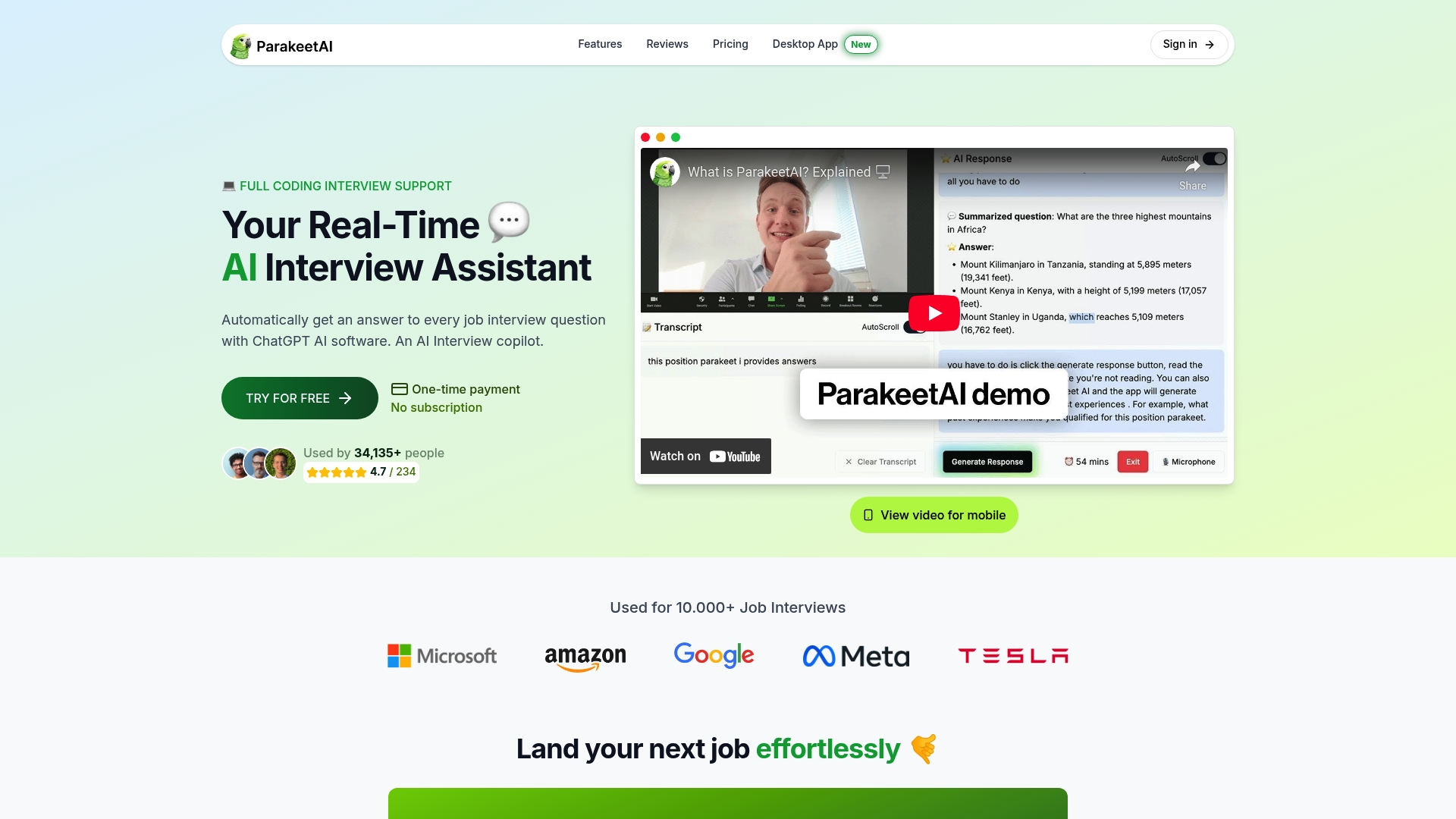
Parakeet-ai is a real-time AI interview assistant that listens to your interview and provides answers to every question as it happens. Before your Amazon loop, you can use Parakeet-ai to run full mock interview sessions that simulate the pace and pressure of real behavioral and technical rounds. The tool gives you immediate feedback on your STAR responses, flags when your answers lack specificity, and helps you build the story library you need to handle deep probing without repeating yourself. If you want to walk into your Amazon interview with genuine confidence, practicing with Parakeet-ai is the most direct way to get there.
FAQ
How long does the Amazon interview loop take?
The Amazon interview loop typically runs 4–5 back-to-back interviews over approximately 5 hours, with each session lasting 55–60 minutes.
What is the Bar Raiser at Amazon?
The Bar Raiser is a trained interviewer who assesses whether you perform better than 50% of current Amazon employees in your role. They test your conviction with aggressive follow-up questions and look for composure and evidence-backed reasoning.
How many behavioral stories should I prepare for Amazon?
Strong candidates prepare 15–20 behavioral stories mapped across multiple Leadership Principles. This prevents repetition and gives you flexibility when interviewers probe deeply.
What does the STAR method mean at Amazon?
STAR stands for Situation, Task, Action, and Result. Amazon requires this framework for all behavioral answers, with the Action section taking roughly 60% of your response and the Result section including measurable outcomes.
Do technical rounds include behavioral questions?
Yes. Technical rounds at Amazon include behavioral questions tied to Leadership Principles, typically running 15–20 minutes within each coding or system design session.