
What Is AI Resume Parsing? A Guide for Job Seekers and HR Pros

TL;DR:AI resume parsing automatically extracts data from resumes and converts it into searchable candidate profiles within applicant tracking systems. Its accuracy is about 87 percent, with formatting choices like single-column layouts and standard headers improving results. Parsing errors often cause qualified candidates to be filtered out before recruiters review their applications.
AI resume parsing is the automated process of extracting structured data from unstructured resume files and mapping it into searchable candidate profiles inside applicant tracking systems. Tools like Workday, Greenhouse, and iCIMS all rely on parsing engines to convert uploaded PDFs and Word documents into fields like name, contact details, skills, work history, and education. Parsing and mapping happen in seconds, giving recruiters the ability to search and filter candidates the moment an application arrives. For job seekers, that speed means a parser, not a human, decides whether your resume ever gets seen.
What is AI resume parsing and how does it differ from basic parsing?
Resume parsing is the technology that reads a resume file and pulls out structured data. Basic, rule-based parsers did this by matching fixed patterns, looking for words like “Education” or “Experience” in predictable locations. AI resume parsing goes further. The critical advance of AI parsing is the ability to semantically understand resumes beyond keyword matching, interpreting context, handling non-standard layouts, and categorizing experience accurately even when section headers are unconventional.

The difference matters practically. A rule-based parser fails when a candidate labels their work history “Career Timeline” instead of “Work Experience.” An AI parser recognizes the content and classifies it correctly. That distinction directly affects whether a qualified candidate appears in a recruiter’s filtered search results or disappears entirely.
How does resume parsing work? The five-stage process
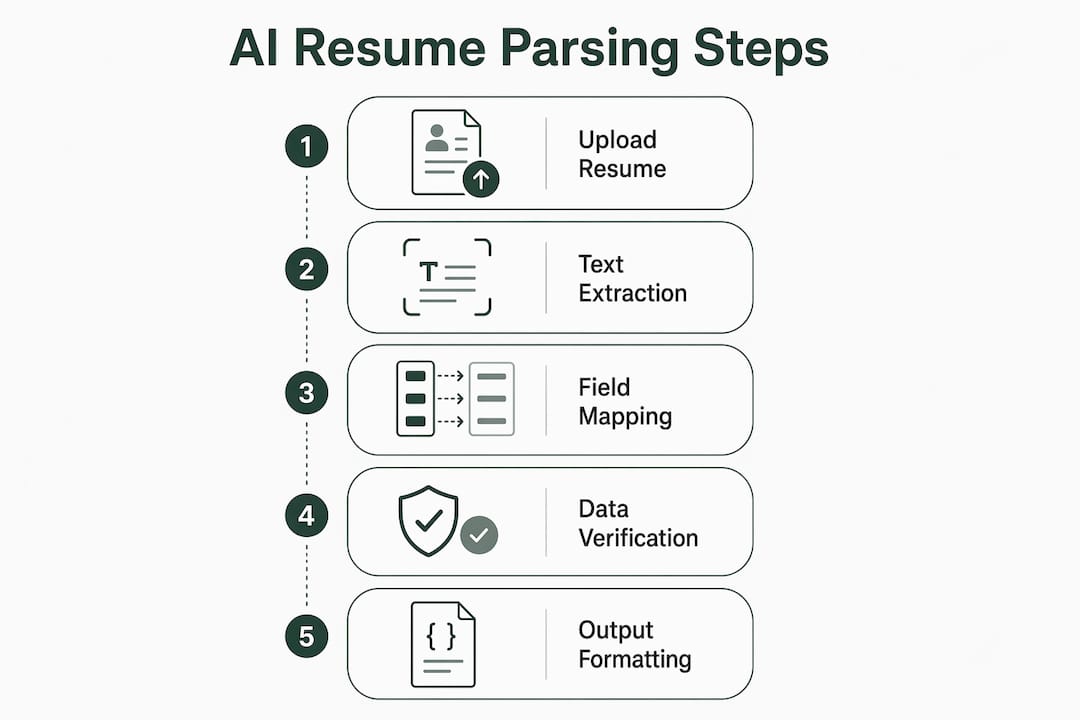
Every modern AI parsing engine runs a resume through five core stages before producing a structured output.
- Text extraction. The parser reads the raw file, whether a PDF, DOCX, or scanned image. Scanned PDFs require optical character recognition (OCR) to convert image pixels into readable text. OCR and layout analysis are the most difficult step for parsing engines, and scanned documents still produce the highest error rates.
- Tokenization. The extracted text is broken into individual words and phrases. This stage prepares the raw text for analysis by separating it into units the model can evaluate.
- Sectioning. The parser identifies which block of text belongs to which resume section. It uses natural language processing (NLP) to recognize that a block of dates and company names is work history, even if the header says something unexpected.
- Named entity recognition (NER). The model labels specific entities: person names, job titles, company names, dates, skills, and degree types. This is where AI outperforms rule-based systems most clearly, because NER models are trained on millions of resume examples.
- Structured output. The labeled data is written into standardized fields inside the ATS candidate profile. Recruiters can now filter by skill, years of experience, or education level.
Pro Tip: Test your resume in a plain text editor before submitting. If the text reads cleanly from top to bottom without scrambled sections, most parsers will handle it correctly.
Modern AI parsing achieves about 87% field-level accuracy, compared to roughly 96% for human data entry. That gap means approximately one in eight fields may contain an error after parsing. For a recruiter reviewing 500 applications, those errors are invisible. For a candidate, a single misread field can remove them from a filtered search entirely.
What are the benefits of AI resume parsing for job seekers and HR professionals?
AI resume parsing delivers measurable advantages on both sides of the hiring process.
For HR professionals and recruiters:
- Candidate profiles are created automatically, eliminating manual data entry for every application received.
- Recruiters can filter and rank candidates by specific skills, job titles, or experience levels within seconds of application submission.
- AI adoption in recruitment reduces time spent on administrative screening tasks, freeing recruiters to focus on interviews and candidate relationships.
- Skill inference features in advanced parsers identify implied competencies from job descriptions, not just explicitly listed keywords.
For job seekers:
- A correctly parsed resume reaches human review faster because it scores well in ATS ranking algorithms.
- AI-powered resume optimization tools improve ATS compatibility by up to 70%, significantly increasing the chance of passing initial digital screening.
- Understanding how parsers read resumes gives candidates a concrete advantage when formatting and writing their documents.
The role of AI in resume screening has expanded well beyond simple keyword matching. Modern systems analyze career trajectory, flag gaps, and infer seniority levels from context. That depth makes accurate parsing more consequential than ever.
What are the common challenges and limitations of AI resume parsing?
Parsing technology is powerful, but it fails in predictable ways. Knowing those failure modes helps both candidates and HR teams avoid costly errors.
- Multi-column layouts. Multi-column and sidebar resume designs frequently confuse parsers, causing garbled reading order. A parser reads left to right and top to bottom across the full page width, so a two-column resume may mix sidebar skills with main-column job titles into a single incoherent block.
- Non-standard date formats. Date extraction fails with formats like “2020-23”, causing the system to calculate experience duration incorrectly. A candidate with five years of experience may appear to have one year, or none at all.
- Section misclassification. Resume parsing is strictly data extraction, not candidate evaluation. When a section is misclassified, that data never reaches the ATS scoring engine. A skills section labeled “Core Competencies” may be ignored entirely by a weaker parser.
- Inconsistent ATS implementations. The same resume can produce widely different structured outputs depending on which ATS platform processes it. Workday’s parser and Greenhouse’s parser may read identical resumes differently.
- Infographic and graphic-heavy resumes. Skill bars, icons, and embedded charts are invisible to text-based parsers. Any information stored in a graphic simply does not exist in the candidate’s ATS profile.
Pro Tip: Run your resume through a free ATS checker like Jobscan before submitting to major employers. It simulates how parsers read your document and flags formatting issues before they cost you an interview.
Parsing errors are a major cause of early-stage application rejections. A qualified candidate can be filtered out before any human sees their name, purely because a parser misread their experience dates or missed their skills section.
How to optimize your resume for AI parsing accuracy
Formatting choices directly control how accurately a parser reads your resume. These steps raise compatibility without sacrificing readability.
- Use a single-column layout. One column eliminates the reading-order problem entirely. The parser reads straight down the page and never scrambles text between sections.
- Label sections with standard headers. Use “Work Experience,” “Education,” “Skills,” and “Certifications.” Avoid creative labels like “My Story” or “What I Bring.” Standard headers trigger correct section classification in every major ATS.
- Write dates in a consistent, conventional format. Use “January 2020 to March 2023” or “Jan 2020 to Mar 2023.” Avoid ranges like “2020-23” or “2020/2023,” which cause date extraction failures.
- Create a dedicated skills section. List skills as plain text, separated by commas or line breaks. Do not embed skills inside job descriptions only. Parsers look for a labeled skills block to populate the skills field in the candidate profile.
- Avoid tables, text boxes, and graphics. Any text inside a table cell or text box may be skipped entirely. Graphics are always skipped. Every piece of information you want a recruiter to see must exist as plain, flowing text.
- Test before you submit. Testing resumes against multiple parsing systems and following best practices can raise parsing accuracy from roughly 77% to over 90%. Tools that simulate ATS parsing give you direct feedback before the real submission.
Reviewing resume best practices for interview success alongside parsing optimization gives candidates the most complete picture of what it takes to move through a modern hiring funnel.
Key Takeaways
AI resume parsing is the critical first step in automated hiring, and formatting errors at this stage remove qualified candidates before any human reviewer sees their application.
| Point | Details |
|---|---|
| Parsing converts resumes to data | AI parsers extract fields like skills, dates, and job titles into structured ATS profiles within seconds. |
| Accuracy is high but imperfect | AI parsing reaches about 87% field accuracy, meaning roughly one in eight fields may contain an error. |
| Layout choices control outcomes | Single-column layouts and standard section headers prevent the most common parsing failures. |
| ATS and parser are not the same | The parser is the gateway step inside the ATS. A parsing failure means the candidate profile is incomplete or invisible. |
| Optimization tools close the gap | AI-powered resume tools can improve ATS compatibility by up to 70%, directly increasing interview chances. |
The part of hiring most candidates never think about
Most job seekers focus on what their resume says. The smarter focus is on whether the resume can be read at all. I have reviewed hundreds of resumes from strong candidates who were almost certainly filtered out before a recruiter ever opened their file. The formatting was the problem, not the experience.
The insight that changed how I think about this: parsing is a gateway, not an evaluator. The ATS is the full hiring system. The parser is the door. If the door does not open, nothing else matters. Candidates who understand this stop treating resume formatting as an aesthetic choice and start treating it as a technical requirement.
The next evolution in this space is semantic parsing, where AI infers skills from context rather than requiring explicit keyword matches. That shift will reduce the burden on candidates to game keyword lists. But it will not eliminate the need for clean, structured formatting. The underlying pipeline still requires readable text before any intelligence can be applied to it.
HR teams should audit their ATS parser regularly, especially after platform updates. The same resume that scored well in Greenhouse six months ago may parse differently after a system upgrade. Candidates cannot control which ATS a company uses, but they can control whether their resume is formatted to survive any of them.
— Jure
Parakeet-ai and the next step after your resume gets through
Getting parsed correctly is the first hurdle. The interview is the next one.
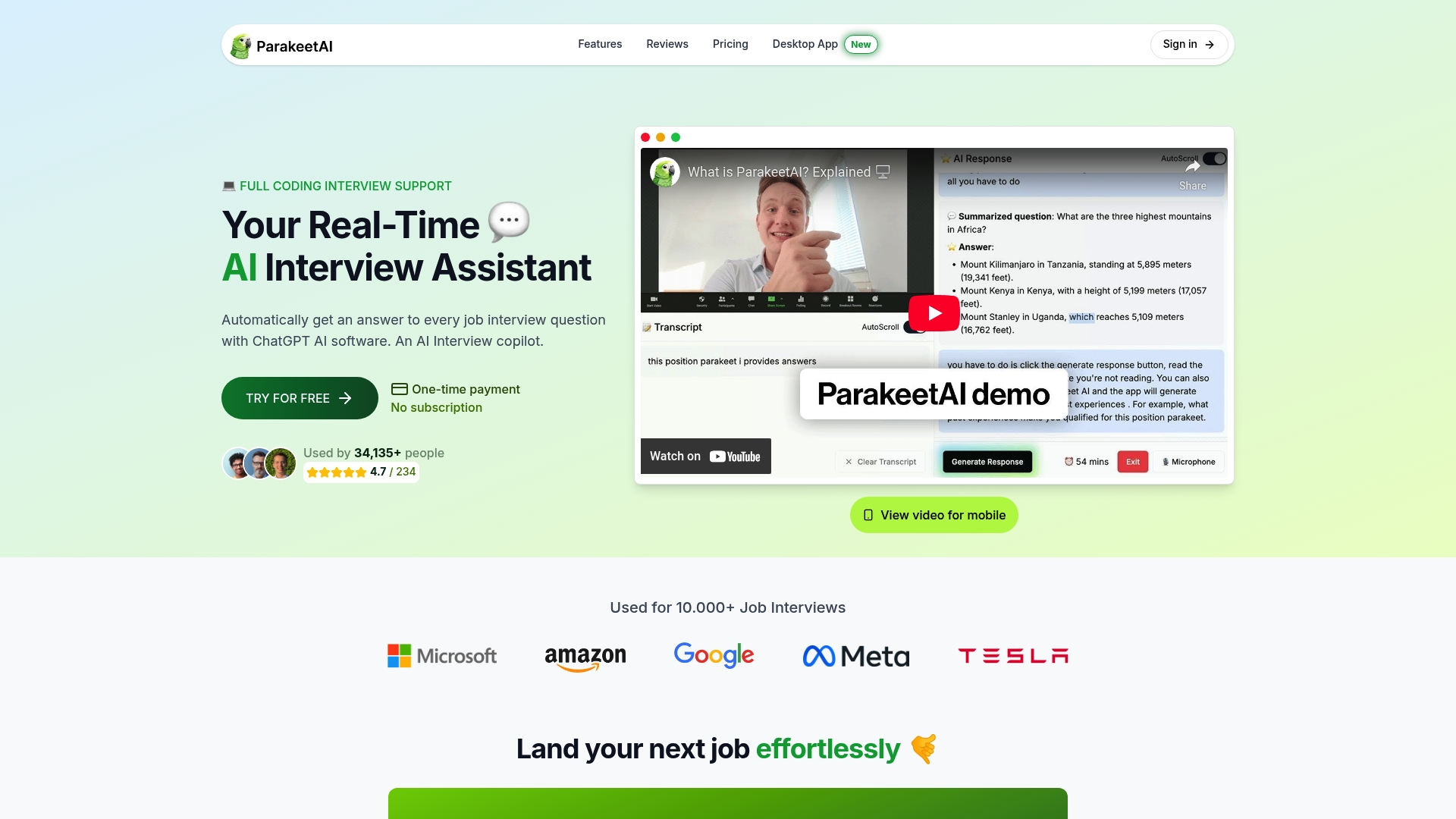
Parakeet-ai is a real-time AI interview assistant that listens to your interview and automatically generates answers to every question as it happens. Once your resume clears the ATS and lands you a call, Parakeet-ai helps you perform at your best when it counts. The platform is built for job seekers who want to walk into every interview prepared, confident, and ready for anything the recruiter asks. Visit Parakeet-ai to see how it works and get started before your next interview.
FAQ
What is AI resume parsing in simple terms?
AI resume parsing is the automated process of reading a resume file and extracting key information, like skills, work history, and education, into structured fields inside an applicant tracking system.
How accurate is AI resume parsing?
Modern AI parsers achieve about 87% field-level accuracy. That means roughly one in eight data fields may contain an error after automated extraction.
Why does my resume get rejected by ATS systems?
Parsing errors are a leading cause of early rejections. Multi-column layouts, non-standard date formats, and graphics all cause parsers to misread or skip critical information in your resume.
What is the difference between an ATS and a resume parser?
The ATS is the full hiring platform used to manage applications. The resume parser is a specific component inside the ATS that converts resume files into searchable candidate data.
How can I improve my resume’s parsing accuracy?
Use a single-column layout, standard section headers, plain text skills lists, and conventional date formats. Testing your resume with an ATS simulation tool before submitting can raise parsing accuracy from roughly 77% to over 90%.