
Resume best practices to boost interview success

Most resumes never reach human eyes. Automated systems reject 75% of applications before a recruiter even glances at them, and those that pass face just seven seconds of human attention. Job seekers worldwide struggle with this harsh reality, watching qualified applications vanish into digital black holes. The good news? Following proven resume best practices dramatically improves your odds. Tailoring your resume to each position, optimizing for applicant tracking systems, and showcasing achievements with concrete metrics can transform rejection into interview invitations. This guide walks you through the exact strategies that increase callback rates and help your resume stand out in competitive job markets.
Table of Contents
- Key takeaways
- Understand the resume screening process and preparation
- Crafting an ATS-friendly and tailored resume
- Writing accomplishment-driven bullet points with metrics
- Structuring core sections and managing resume length
- Enhance your resume with expert help
- Frequently asked questions
Key Takeaways
| Point | Details |
|---|---|
| ATS rejection rate | Automated systems reject about 75 percent of resumes before recruiters see them. |
| Tailored resumes boost callbacks | Tailoring your resume to each job description yields about 31 percent higher callback rates than generic versions. |
| Achievements with metrics | Bullet points that quantify achievements provide concrete evidence of impact. |
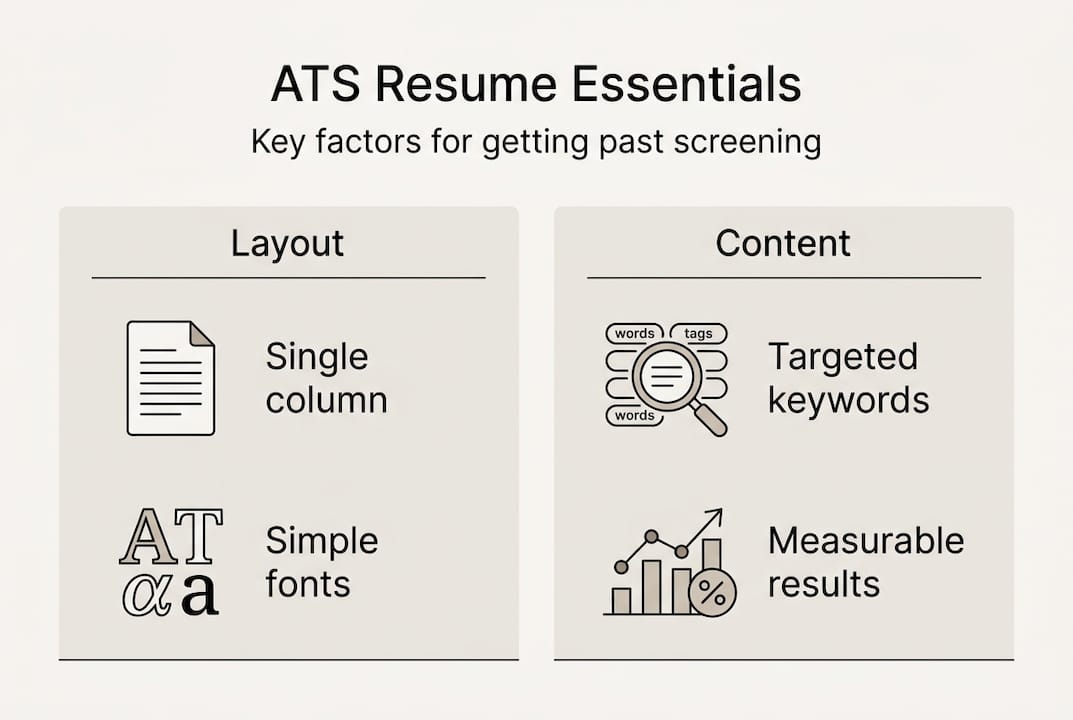
| ATS friendly formatting | Use a single column layout with standard fonts and a DOCX format to maximize ATS readability. |
Understand the resume screening process and preparation
Before crafting your resume, you need to grasp how modern hiring systems actually evaluate applications. This knowledge shapes every formatting and content decision you make.
Applicant tracking systems represent your first obstacle. These software platforms scan resumes for keyword matches, proper formatting, and relevant qualifications before any human sees your application. Research shows 75% of resumes get rejected by ATS before reaching recruiters, with the average resume scoring just 57.6% when employers typically require 70% or higher keyword match rates. This explains why qualified candidates often hear nothing back despite meeting job requirements.
The screening process operates in two distinct phases:
- ATS software parses your resume structure and content, extracting information into database fields
- Algorithms score your application based on keyword density, required qualifications, and formatting compatibility
- Human recruiters review only the highest-scoring resumes that pass automated filters
- Those lucky enough to reach human eyes get approximately seven seconds of initial attention
Formatting choices directly impact whether ATS systems can read your resume correctly. Complex layouts with multiple columns, graphics, tables, or unusual fonts confuse parsing algorithms, causing your qualifications to disappear or appear garbled in the database. Single-column layouts using standard fonts like Arial or Calibri in 10-12 point sizes ensure compatibility. Understanding the AI resume screening role helps you appreciate why these technical details matter as much as your actual experience.
Customization makes the difference between rejection and callbacks. Generic resumes rarely match enough keywords to pass ATS thresholds, while tailored applications that mirror job description language score significantly higher. Data reveals 31% higher callback rates for tailored resumes compared to generic versions, proving that the extra effort pays off. This preparation phase sets the foundation for everything that follows.
| Screening Stage | Key Challenge | Success Factor |
|---|---|---|
| ATS parsing | 75% rejection rate | Single-column format, standard fonts |
| Keyword matching | Average 57.6% vs 70% needed | Tailored job description language |
| Human review | 7-second scan window | Clear hierarchy, achievement focus |
The role of AI in resume screening continues evolving, but these fundamentals remain constant. Your resume must satisfy both algorithmic requirements and human preferences to advance through the hiring pipeline.
Crafting an ATS-friendly and tailored resume
Now that you understand the screening gauntlet, let’s build a resume that navigates it successfully. ATS optimization and customization work together to maximize your visibility.
Formatting for ATS compatibility starts with technical requirements. ATS optimization requires single-column layout, standard fonts, conventional section headings, no tables or graphics, and DOCX file format. These specifications ensure parsing algorithms can extract your information accurately. Avoid creative designs, text boxes, headers, footers, or images that look impressive to humans but create chaos for software. Stick with straightforward section labels like Experience, Education, and Skills rather than clever alternatives that confuse automated systems.
Tailoring your resume to each position dramatically improves match scores. Only 15% of resumes pass ATS screening, largely because most applicants submit identical documents to every employer. Follow these steps to customize effectively:
- Copy the complete job description into a separate document for reference
- Highlight all required skills, qualifications, and key phrases mentioned multiple times
- Review your resume and identify where you can naturally incorporate these exact terms
- Rewrite bullet points to mirror the job description language without fabricating experience
- Adjust your skills section to prioritize the most relevant technical and soft skills
- Modify your summary or headline to reflect the specific role and company focus
- Remove or minimize irrelevant experience that dilutes your keyword density
Keyword integration requires strategic thinking beyond simple copying. If a job description mentions project management repeatedly, ensure that phrase appears in your experience bullets where truthful. When employers specify software tools or methodologies, include those exact names if you’ve used them. This approach balances authenticity with optimization.
| ATS Element | Requirement | Common Mistake |
|---|---|---|
| Layout | Single column | Multi-column designs |
| Font | Arial, Calibri 10-12pt | Decorative or small fonts |
| Headings | Standard labels | Creative section names |
| File format | DOCX preferred | PDF or other formats |
| Graphics | None | Photos, charts, logos |
Pro Tip: While AI resume builders can suggest keywords and formatting improvements, human review ensures your resume maintains authentic voice and accurate representation. The human vs AI interview feedback comparison shows similar dynamics apply to resumes, where combining both perspectives yields superior results. Software tools help identify optimization opportunities, but your judgment determines whether changes genuinely reflect your qualifications or cross into misrepresentation.
Tailoring takes time, typically 20 to 30 minutes per application for thoughtful customization. This investment pays off through higher response rates and better-matched interview opportunities. Generic mass applications waste your time with near-zero success rates, while targeted submissions convert at dramatically higher percentages.
Writing accomplishment-driven bullet points with metrics
Your experience section determines whether recruiters see potential or mediocrity. Transforming duty descriptions into achievement statements separates strong candidates from the crowd.
Accomplishment formulas provide structure for powerful bullet points. Three frameworks help organize your achievements:
- TEAL: Task, Evidence, Action, Link to job requirements
- PAR: Problem, Action, Result with quantified outcomes
- STAR: Situation, Task, Action, Result showing context and impact
Each formula emphasizes results over responsibilities. Instead of listing what you were supposed to do, demonstrate what you actually accomplished and how it benefited your employer. This shift in perspective makes your contributions tangible and memorable.
Metrics transform vague claims into credible evidence. Achievement-focused bullets with metrics outperform duties lists, yet only 26% of resumes include quantified results. You possess more measurable accomplishments than you realize. Consider these metric categories:
- Percentage improvements in efficiency, quality, or performance
- Dollar amounts saved, earned, or managed
- Time reductions in processes or project completion
- Volume increases in production, sales, or customer satisfaction
- Team size managed or projects coordinated
- Frequency of tasks handled daily, weekly, or monthly
Even seemingly small roles offer quantification opportunities. A retail associate might note serving 50 customers daily with 95% satisfaction scores. An administrative professional could highlight managing schedules for 12 executives while reducing meeting conflicts by 40%. These specifics paint vivid pictures of your capabilities.

Compare these examples:
Weak: Responsible for social media marketing and customer engagement.
Strong: Grew Instagram following from 2,000 to 15,000 in six months through targeted content strategy, increasing website traffic by 35%.
Weak: Managed team projects and coordinated with stakeholders.
Strong: Led cross-functional team of eight to deliver $2M software implementation three weeks ahead of schedule, achieving 98% user adoption within first month.
The strong versions provide concrete evidence of impact using specific numbers and outcomes. They tell a story of value creation rather than task completion.
Pro Tip: When you lack obvious metrics, estimate conservatively or describe scope instead. If you supported customers but don’t have exact numbers, research typical volumes for similar roles and use phrases like approximately or an average of to indicate reasonable estimates. Showing initiative to quantify impact demonstrates analytical thinking even when perfect data doesn’t exist.
Resume length affects how many accomplishments you can showcase. Research indicates ideal resume length between 475-600 words for optimal ATS performance and recruiter engagement. This constraint forces prioritization of your most impressive achievements. Focus bullet points on recent, relevant accomplishments that directly support the target role rather than comprehensive career history. The tech job search tips with AI approach emphasizes strategic content selection over exhaustive documentation.
Structuring core sections and managing resume length
Organization and length decisions shape how effectively your resume communicates qualifications. Proper structure ensures recruiters find critical information instantly.
Core resume sections form the foundation every application needs. Core sections are Contact, Summary, Skills, Experience, Education, with Skills particularly critical since 60% of companies filter candidates by this section. Each serves a specific purpose:
- Contact: Name, phone, email, LinkedIn URL, and location city/state
- Summary or Headline: Two to three sentences capturing your professional identity and value proposition
- Skills: Technical abilities, software proficiencies, and relevant competencies matching job requirements
- Experience: Reverse chronological work history with accomplishment bullets
- Education: Degrees, institutions, graduation years, and relevant coursework or honors
Optional sections add value when relevant to your target role. Include Projects if you’re early career or transitioning fields and need to demonstrate capabilities beyond limited work history. Add Certifications when you hold industry-recognized credentials that strengthen your qualifications. Consider Publications, Speaking Engagements, or Professional Affiliations only if they directly support your candidacy for the specific position.
The Skills section deserves special attention given its filtering importance. List technical skills first, followed by relevant soft skills. Match terminology exactly as it appears in job descriptions to maximize ATS matching. Group related skills logically rather than random ordering. For technical roles, specify proficiency levels when appropriate, but avoid subjective self-ratings that lack meaning.
Resume length debates often distract from the real question: relevance. 1-page resumes for less than 10 years experience, 2 pages for more, with relevance over strict page count taking priority. This guideline provides a starting point, but customization matters more than rigid rules.
| Experience Level | Recommended Length | Key Consideration |
|---|---|---|
| Entry-level to 5 years | 1 page | Focus on education, projects, internships |
| 5-10 years | 1 page preferred, 2 acceptable | Prioritize most relevant roles |
| 10+ years | 2 pages | Include leadership and strategic contributions |
| Executive or academic | 2-3 pages or CV | Comprehensive accomplishments justified |
One-page resumes force ruthless prioritization, eliminating anything that doesn’t directly support your candidacy. This constraint actually strengthens applications by removing filler and focusing attention on your best qualifications. Two-page resumes allow more comprehensive coverage for experienced professionals with diverse accomplishments, but every line must earn its space.
Avoid these length mistakes:
- Shrinking fonts below 10 points or margins below 0.5 inches to cram content onto one page
- Including every job since high school regardless of relevance
- Padding with obvious skills or redundant descriptions to fill space
- Splitting naturally connected content across pages awkwardly
Customization drives length decisions. A marketing professional applying for content strategy roles might expand content marketing accomplishments to two pages while condensing unrelated sales experience. The same person targeting social media management could flip that emphasis. Tailor not just keywords but also the depth of coverage for different experience areas.
The interview best practices tech jobs article reinforces how resume customization connects to interview success. Your resume opens doors, but the substance behind those accomplishments determines interview performance. Structure your resume to tell a coherent story about why you’re the ideal candidate for this specific role.
Enhance your resume with expert help
Applying these resume best practices systematically improves your interview chances, but you don’t have to navigate this process alone. Professional resume assistance combines human expertise with AI-powered optimization to maximize your results.
The most effective approach blends human insight with technological tools. Pure AI resume builders often produce generic, obvious content that experienced recruiters recognize instantly. Manual resume writing without optimization tools misses keyword opportunities and ATS compatibility issues. Hybrid methods leverage AI for technical optimization while preserving authentic voice and strategic positioning through human judgment.
Parakeet AI offers tailored resume support alongside interview preparation tools. Whether you need resume review, ATS optimization guidance, or comprehensive job search strategy, expert resources help you implement these best practices effectively. Visit Parakeet AI to explore how professional assistance can accelerate your job search success and increase interview callbacks.
Frequently asked questions
How can I tailor my resume effectively for each job?
Start by analyzing the job description for required skills, qualifications, and repeated keywords. Incorporate these exact terms naturally throughout your resume, especially in your skills section and experience bullets. Focus on highlighting accomplishments and experiences most relevant to the specific role rather than including everything from your career history. Understanding the AI resume screening role helps you appreciate why this keyword matching matters so much for passing initial filters.
What is the ideal resume length for different experience levels?
Use one page if you have less than 10 years of experience, focusing on your most relevant and recent accomplishments. Extend to two pages for more extensive careers where additional context adds genuine value. Prioritize relevance over strict page counts, ensuring every line supports your candidacy for the specific role. Remove outdated or unrelated experience rather than cramming everything into insufficient space with tiny fonts.
How important are metrics in resume bullet points?
Metrics dramatically increase the impact of your accomplishments by providing concrete evidence of your contributions. Only 26% of resumes currently include quantified results, giving you a significant competitive advantage when you showcase percentage improvements, dollar amounts, time savings, or volume increases. Even approximate metrics demonstrate analytical thinking and results orientation that generic duty descriptions cannot convey.
Can AI tools improve my resume, or should I rely on human writing?
Hybrid approaches combining AI optimization with human judgment produce the best results. AI tools excel at identifying keyword gaps, formatting issues, and ATS compatibility problems, while human expertise ensures authentic voice, strategic positioning, and accurate representation. Pure AI-generated content often feels generic and obvious to experienced recruiters, while manual-only methods miss technical optimization opportunities. The human vs AI interview feedback comparison shows similar dynamics, where blending both perspectives maximizes effectiveness.