
Software Engineer Behavioral Interview Questions: 2026 Guide

TL;DR:Preparing 6 to 12 adaptable STAR stories that quantify impact and demonstrate ownership is essential for excelling in behavioral software engineering interviews.Use structured responses that highlight personal contribution, influence across teams, and measurable results to stand out to hiring managers.
Software engineer behavioral interview questions assess your ability to solve real problems, collaborate under pressure, and lead projects using concrete examples from your past. These questions are not a formality. Hiring managers at companies like Google, Amazon, and Meta use them to predict how you will perform on actual teams. The STAR method (Situation, Task, Action, Result) is the industry standard for structuring answers, and candidates who prepare 6–12 adaptable stories consistently outperform those who wing it. This guide gives you the questions, the frameworks, and the preparation strategy to walk in ready.
How to structure answers using the STAR method
The STAR framework is the industry standard for answering behavioral questions as of Q1 2026. STAR stands for Situation, Task, Action, Result. Each component serves a specific purpose: Situation and Task set the context, Action shows what you did, and Result proves the impact.

Timing matters. A strong answer runs under 3 minutes total. The Action section should take up roughly 50% of your response. Situation and Task combined should take only 10–20%. That ratio keeps your answer focused on what you actually did, not on background details the interviewer does not need.
STAR-L adds a fifth element: Learnings. This is especially useful when answering questions about failure or conflict. It signals self-awareness and growth, two qualities hiring managers actively look for in software engineering interviews.
Pro Tip: Always say “I” instead of “we” when describing your actions. Interviewers need to understand your specific contribution, not your team’s collective output.
Common mistakes to avoid:
- Spending too long on Situation and Task, leaving no time for Action
- Giving vague results like “the project went well” instead of quantified outcomes
- Describing what the team did without clarifying your individual role
- Skipping the Result entirely because you assume the interviewer can infer it
Top 10 behavioral questions software engineers face
The most frequent behavioral question in tech interviews asks how you solved a problem with unclear requirements. Interviewers expect you to quantify the impact using metrics like revenue generated, cost savings, time saved, or performance improvements. Vague answers without numbers signal a lack of ownership.
Here are the 10 questions you are most likely to face:
- Tell me about a time you solved a problem with unclear or changing requirements. Interviewers want to see how you handle ambiguity without freezing or waiting for someone else to decide.
- Describe a conflict with a teammate and how you resolved it. This tests your ability to work through disagreement without damaging relationships or project timelines.
- Tell me about a project you led from start to finish. For senior roles, this question shifts focus from what you built to how you enabled others to build it.
- Describe a time you failed and what you learned. Interviewers are not looking for perfection. They want to see honest reflection and a clear lesson applied afterward.
- Tell me about a time you disagreed with your manager. This tests whether you can advocate for your position professionally while still executing on decisions you did not choose.
- Describe a situation where you had to make a decision with incomplete information. Strong answers show a structured decision process, not just a lucky outcome.
- Tell me about a time you mentored or coached someone. For senior and staff engineers, this question is a direct test of leadership beyond individual contribution.
- Describe a time you improved a process or system. Quantified results matter here. “I reduced deploy time by 40%” beats “I made things faster.”
- Tell me about a time you had to balance multiple competing priorities. Interviewers want to see how you triage, communicate tradeoffs, and deliver under pressure.
- Describe a time you had to influence a decision without formal authority. This is a core senior engineer behavioral question because it tests cross-functional leadership and communication.
Story strength requirements increase with seniority. Mid-level engineers are judged on personal contributions. Senior engineers must show organizational impact and influence across teams.
How to select and tailor your stories
Candidates should prepare 6–12 adaptable stories covering key themes: technical challenges, conflict resolution, leadership, failure, and decision-making under uncertainty. The goal is not to memorize one answer per question. The goal is to build a story library you can pull from and adapt.
Story scope matters more than exact topical matching. A story about navigating a high-stakes architectural decision can answer questions about conflict, ambiguity, leadership, and failure depending on which angle you emphasize. Choosing a story with greater organizational scope gives you more flexibility and signals stronger impact.
Pro Tip: Map each story to at least three different behavioral questions before your interview. If a story only fits one question, it is not worth memorizing.
Use these criteria to evaluate whether a story is worth including:
- Scope: Did the outcome affect more than just your immediate task? Did it unblock a team, save a deadline, or change a product direction?
- Metrics: Can you quantify the result? Revenue, latency, error rate, time saved, and team velocity are all valid.
- Your role: Is your individual contribution clear and distinct from the team’s?
- Learning: Did you grow from this experience in a way you can articulate?
For junior engineers, stories about personal delivery and problem-solving are appropriate. For senior engineers, the bar shifts. Senior engineers must illustrate enabling others and driving broader outcomes, not just what they personally shipped. If your stories only describe what you built, you are leaving leadership signals on the table.
Pair your stories with software management context where possible. Framing a technical decision in terms of team capacity or delivery risk shows organizational thinking, which is exactly what senior hiring panels look for.
Common pitfalls and red flags to avoid
Interviewers watch for self-reflection and authentic learning as positive signals, especially in failure discussions. Canned answers that sound rehearsed without any personal texture are a red flag. If your answer could apply to any engineer at any company, it is not specific enough.
Avoid these patterns that hurt your score:
- Blaming others for failures. Saying “the team didn’t communicate well” without owning your part signals low accountability. Own your piece of the problem, even if others contributed.
- Skipping the result. Ending your answer at the Action step leaves the interviewer guessing whether your work actually mattered. Always close with a concrete outcome.
- Using “we” throughout. Collective language hides your individual contribution. Interviewers cannot assess you if they cannot tell what you specifically did.
- Giving generic answers to specific questions. “I always try to communicate clearly” is not a behavioral answer. A behavioral answer starts with “There was a specific situation where…”
- Ignoring metrics. Qualitative results are weaker than quantified ones. If you reduced a bug rate, say by how much. If you improved load time, name the number.
Passive Q&A style can hurt scores even when answers are technically correct. Experienced candidates lead their narrative actively, framing how solutions reduced costs or unblocked teams. Waiting for the interviewer to draw conclusions from your story is a missed opportunity.
Behavioral questions increasingly determine cultural and leadership fit because they predict real on-the-job collaboration. Hiring managers are not just checking a box. They are building a picture of how you will behave when a project goes sideways or a teammate disagrees with your approach.
Prepare core stories covering ownership, conflict, mentorship, failure, and decision-making to cover the most common themes. Add stories that fill gaps in communication, ambiguity, and perseverance. A library of 8–10 well-prepared stories covers the vast majority of questions you will face.
Key Takeaways
Mastering software engineer behavioral interview questions requires preparing 6–12 adaptable STAR stories that quantify impact, demonstrate ownership, and scale in scope to match your seniority level.
| Point | Details |
|---|---|
| Use the STAR or STAR-L framework | Structure every answer with Situation, Task, Action, Result, and optionally Learnings for failure questions. |
| Prepare 6–12 adaptable stories | Cover ownership, conflict, mentorship, failure, and decision-making to handle most behavioral questions. |
| Quantify your results | Use metrics like time saved, cost reduced, or performance improved to make your impact concrete. |
| Scale story scope to seniority | Junior engineers focus on personal delivery; senior engineers must show influence across teams. |
| Lead your narrative actively | Frame solutions in business terms and drive the conversation rather than waiting for the interviewer to interpret your answers. |
What behavioral interviews actually reveal about you
Behavioral interviews are the part of the process most engineers underestimate, and that is exactly why they separate candidates who are otherwise equally qualified on paper. After watching hundreds of engineers go through this process, I have come to believe that behavioral questions are not really about your past. They are about how you think about your past.
The engineers who perform best are not the ones with the most dramatic stories. They are the ones who have reflected on their experiences clearly enough to explain what they did, why they did it, and what they would do differently. That level of clarity is rare. Most people can describe what happened. Far fewer can explain the decision logic behind their choices.
The advice to “just be yourself” is incomplete. You need to be a prepared version of yourself. That means knowing your stories well enough to adapt them on the fly, not reciting them word for word. Selecting stories with greater organizational scope matters more than matching the exact theme of the question. A story about a hard architectural tradeoff can answer questions about conflict, leadership, and failure if you know which angle to emphasize.
One thing I tell every engineer I work with: drive the conversation. Do not wait for the interviewer to ask a follow-up before you mention the business impact. Frame your result in terms the hiring manager cares about, whether that is shipping speed, team unblocking, or cost reduction. That framing signals organizational awareness, and it is the single biggest differentiator between a good answer and a great one.
— Jure
Parakeet-ai: practice your behavioral answers in real time
Preparing strong behavioral answers takes more than reading a list of questions. You need to practice saying your stories out loud, under pressure, and get feedback on what lands and what falls flat.
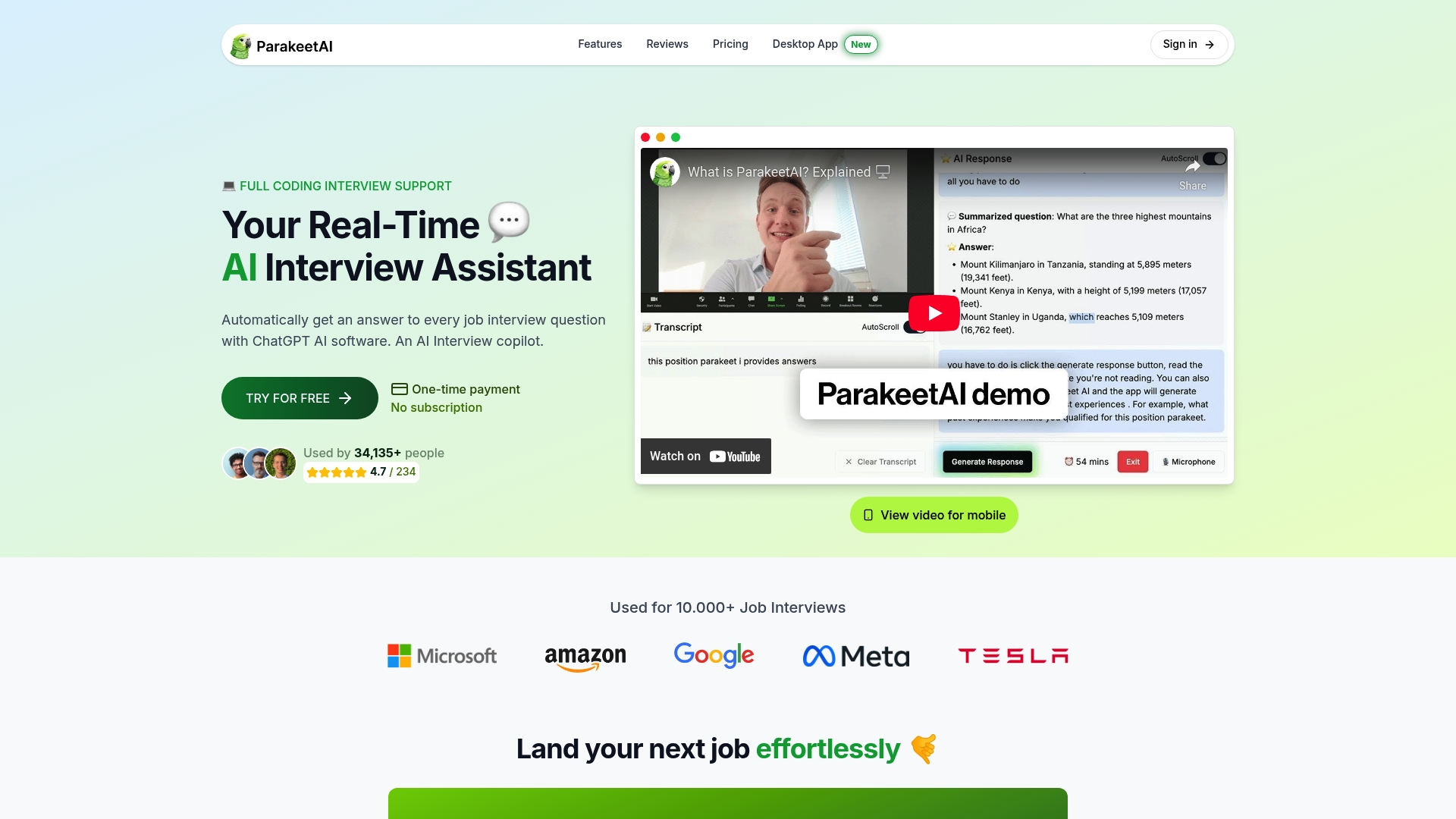
Parakeet-ai is a real-time AI interview assistant that listens to your interview and automatically provides answers to every question with AI. For behavioral prep, that means you can practice your STAR stories and get instant support when you blank on a metric or lose your thread mid-answer. Visit parakeet-ai.com to see how it works and start preparing for your next behavioral round with a tool built for the pressure of a live interview.
FAQ
What is the STAR method for behavioral interviews?
STAR stands for Situation, Task, Action, and Result. It is the industry standard framework for structuring behavioral interview answers, with the Action section taking up roughly 50% of your response time.
How many stories should I prepare for a software engineering interview?
Prepare 6–12 adaptable stories covering themes like ownership, conflict, failure, and leadership. Each story should be flexible enough to answer at least three different behavioral questions.
What do interviewers look for in behavioral answers?
Interviewers look for self-reflection, ownership of mistakes, quantified results, and clear individual contribution. Authentic answers with specific metrics consistently outperform generic or rehearsed responses.
How are behavioral questions different for senior software engineers?
Senior software engineer behavioral interview questions focus on organizational impact and influence across teams, not just personal delivery. Senior candidates must show how they enabled others and drove broader outcomes.
Should I use metrics in every behavioral answer?
Use metrics whenever you can. Quantified results like time saved, error rates reduced, or revenue impacted make your answers concrete and credible. If no metric exists, describe the outcome in specific, observable terms.