
What Is Dynamic Interview Feedback for Hiring Teams

TL;DR:Dynamic interview feedback provides real-time, rubric-based evaluations that adapt questions based on candidate responses. It enhances objectivity, candidate coaching, and reduces workload by combining AI with human oversight. Proper implementation focuses on role-specific rubrics, limited actionable feedback, and transparent data practices.
Dynamic interview feedback is the process of delivering adaptive, rubric-based evaluations of candidate responses in real time to improve hiring accuracy and candidate coaching. Unlike static post-interview summaries, this approach adjusts both questions and scoring criteria based on what a candidate actually says. The industry term for the broader method is adaptive evaluation, and dynamic interview feedback is its most practical application in structured hiring. Hiring managers who adopt this approach report more consistent decisions and more useful data for candidate development.

What is dynamic interview feedback, and how does it work?
Dynamic interview feedback is defined as a real-time evaluation method that uses rubric-aligned criteria to assess candidate responses and immediately adapt the interview path. The word “dynamic” signals that both the questions and the feedback shift based on candidate performance, rather than following a fixed script. This is a meaningful departure from traditional structured interviews, where every candidate answers the same questions in the same order regardless of their answers.
The mechanics rely on adaptive questioning techniques that simulate senior interviewer behavior. When a candidate answers a technical question well, the system raises difficulty or introduces edge cases. When a candidate struggles, the system stabilizes and probes for foundational understanding instead. The result is an interview path that reflects the candidate’s actual skill level, not a predetermined script.
Effective dynamic feedback also requires role-specific rubrics that cover technical accuracy, communication clarity, problem-solving approach, and answer completeness. These rubrics are the backbone of the system. Without them, adaptive questioning produces data that cannot be compared across candidates.
How does dynamic feedback differ from traditional interview feedback?
Traditional interview feedback relies on static questions and subjective scoring. An interviewer asks the same questions to every candidate, then writes notes afterward from memory. The feedback is often generic, delayed, and shaped by recency bias.
Dynamic feedback changes three things at once: the question path, the evaluation criteria, and the timing of the assessment. The table below shows the core differences.
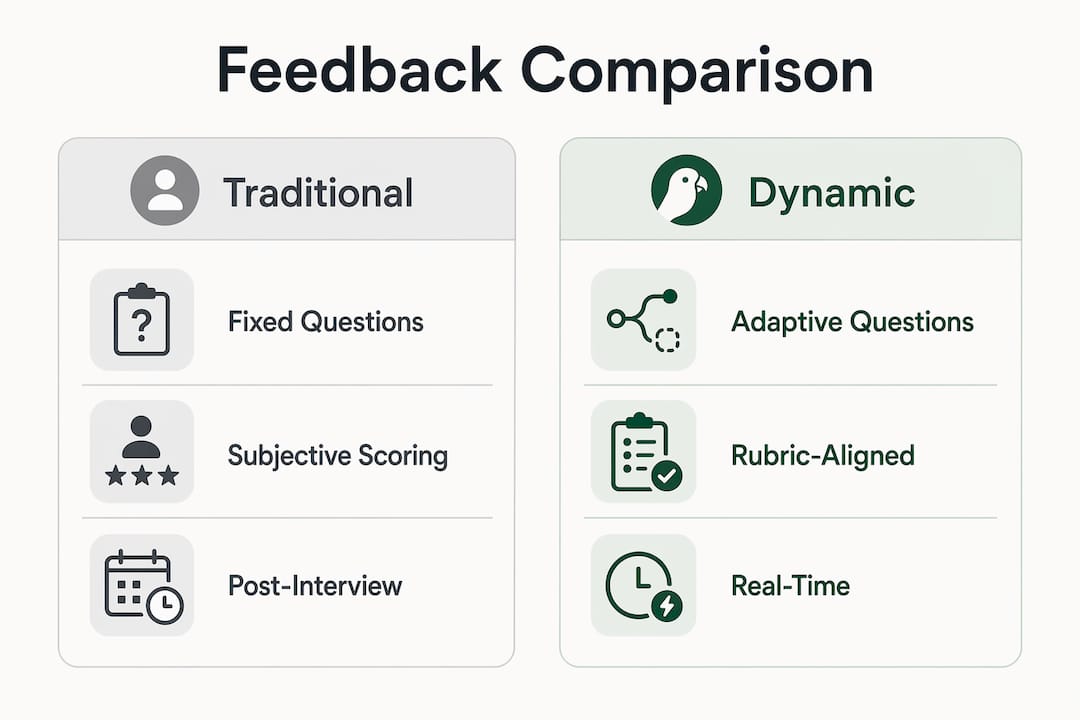
| Dimension | Traditional feedback | Dynamic feedback |
|---|---|---|
| Question path | Fixed for all candidates | Adapts based on each response |
| Scoring method | Subjective, post-interview recall | Rubric-aligned, real-time scoring |
| Feedback specificity | Generic comments | Transcript-linked, evidence-based notes |
| Bias exposure | High (interviewer memory and preference) | Reduced through structured rubrics |
| Candidate coaching value | Low | High, with specific improvement points |
Multimodal AI systems achieve about 89% accuracy in technical interview assessments and 84% in emotion detection. That level of consistency is not achievable through human recall alone. The gap between those two numbers also matters: technical accuracy is easier to score than emotional cues, which means human reviewers still add value in interpreting tone and context.
What are the benefits of using dynamic feedback in interviews?
Dynamic feedback in interviews delivers three measurable advantages: greater objectivity, better candidate coaching, and reduced workload for hiring teams.
Objectivity improves because rubric-aligned scoring removes the influence of interviewer mood, personal rapport, and memory gaps. Every candidate is evaluated against the same criteria, even when their interview paths differ. This is the foundation of fair hiring.
Candidate coaching becomes possible when feedback references specific transcript moments rather than vague impressions. Evidence-based feedback tied to actual responses gives candidates a clear picture of where they fell short and what to work on. Constructive feedback delivered with objective scoring improves candidate self-confidence and future performance. That outcome matters for employer brand as much as for individual candidates.
Workload reduction comes from AI assistance in generating and scoring feedback at scale. A hiring team running 50 interviews per week cannot write detailed, rubric-linked notes for every candidate. AI-generated feedback handles the volume while human reviewers focus on final decisions.
Key benefits at a glance:
- Consistent scoring across all candidates in the same role
- Specific, transcript-linked coaching points candidates can act on
- Reduced time spent writing post-interview summaries
- Higher-quality hiring decisions backed by structured data
- Improved candidate experience through transparent, fair evaluation
Pro Tip: Pair dynamic feedback with a short candidate debrief call. Candidates who receive specific feedback and a brief explanation are far more likely to view the process as fair, even when they are not selected.
How is dynamic interview feedback implemented effectively?
Implementation follows five steps, and skipping any one of them degrades the quality of the output.
- Build role-specific rubrics. Each rubric should cover technical accuracy, communication clarity, problem-solving approach, and answer completeness. Generic rubrics produce generic feedback. A software engineering role needs different criteria than a sales leadership role.
- Train interviewers on AI-generated output. AI feedback is a starting point, not a final verdict. Interviewers need to understand how to read rubric scores, identify where the AI may have misread context, and add human judgment where it matters most.
- Implement prompt versioning. Prompt versioning is the ability to update evaluation rubrics without breaking the interview engine. As job requirements change, rubrics must evolve. A system without version control produces inconsistent feedback across hiring cycles.
- Manage candidate data and consent transparently. Candidates should know their responses are being evaluated by an AI system. Transparent data practices build trust and reduce legal exposure. Document what data is collected, how long it is retained, and who has access.
- Use adaptive questioning for calibration. Adaptive question crafting combines prior answers, role criteria, resume signals, and response trajectories to tailor the interview path in real time. This is the mechanism that makes feedback dynamic rather than static.
Pro Tip: Run a pilot with 10–20 interviews before full deployment. Review the AI-generated feedback against human reviewer notes to identify rubric gaps before they affect hiring decisions at scale.
Dialogic feedback adds another layer of value. When candidates can query AI for clarifications and examples after receiving feedback, they move from passive recipients to active learners. This transforms a one-way evaluation into a coaching conversation.
What challenges and best practices apply to dynamic interview feedback?
The most common failure mode is feedback fatigue. When an AI system generates 15 granular feedback points per interview section, candidates and hiring managers stop reading. Limiting feedback to 1–2 prioritized, evidence-supported actions per section improves practical value. More data is not better data.
Signal leakage is a related problem. Overly detailed AI feedback can reveal scoring logic to candidates who share notes publicly, which undermines the integrity of the evaluation. Feedback should be specific enough to be useful but not so granular that it exposes the full rubric.
Best practices for avoiding these pitfalls:
- Cap feedback at two prioritized points per interview section
- Use constructive language that focuses on behavior, not personality
- Review AI output regularly for unsupported judgments or bias patterns
- Maintain human oversight on all final hiring decisions
- Calibrate rubrics quarterly using sample reviews and panel discussions
Emotional safety in feedback delivery is not optional. Candidates who receive blunt or poorly framed feedback disengage from the process and share negative experiences publicly. A constructive tone is a business requirement, not a courtesy.
Pro Tip: Assign one human reviewer per 10 AI-evaluated interviews during the first three months. This calibration period catches rubric errors before they compound across hundreds of candidates.
Maintaining feedback quality also requires ongoing rubric tuning, sample reviews, and administrative controls. A rubric that worked well six months ago may no longer reflect the role’s current requirements.
What role does AI play in delivering dynamic interview feedback?
AI is the engine that makes dynamic feedback scalable. Without it, adaptive evaluation requires a senior interviewer in every session, which is not feasible at volume.
Multimodal AI systems assess both technical content and emotional cues simultaneously. The 89% accuracy rate in technical assessment means the system catches most errors in candidate reasoning. The 84% accuracy in emotion detection adds a layer of insight that pure text analysis cannot provide.
Real-time streaming feedback, built on incremental JSON parsing, delivers candidate insights during the interview rather than hours later. That speed changes how hiring teams operate. Interviewers can see preliminary scores mid-session and adjust their follow-up questions accordingly.
| AI capability | Function in dynamic feedback |
|---|---|
| Adaptive question generation | Adjusts difficulty based on candidate performance |
| Rubric-aligned scoring | Evaluates responses against role-specific criteria |
| Emotion detection | Identifies confidence, hesitation, and engagement |
| Streaming feedback | Delivers real-time insights during the interview |
| Prompt versioning | Updates rubrics without disrupting the evaluation engine |
The interpretability of AI output is a growing concern in HR. Hiring managers need to explain why a candidate was rejected. AI systems that produce scores without reasoning trails create legal and ethical exposure. The best systems generate transcript-linked evidence for every score, making decisions reviewable and defensible.
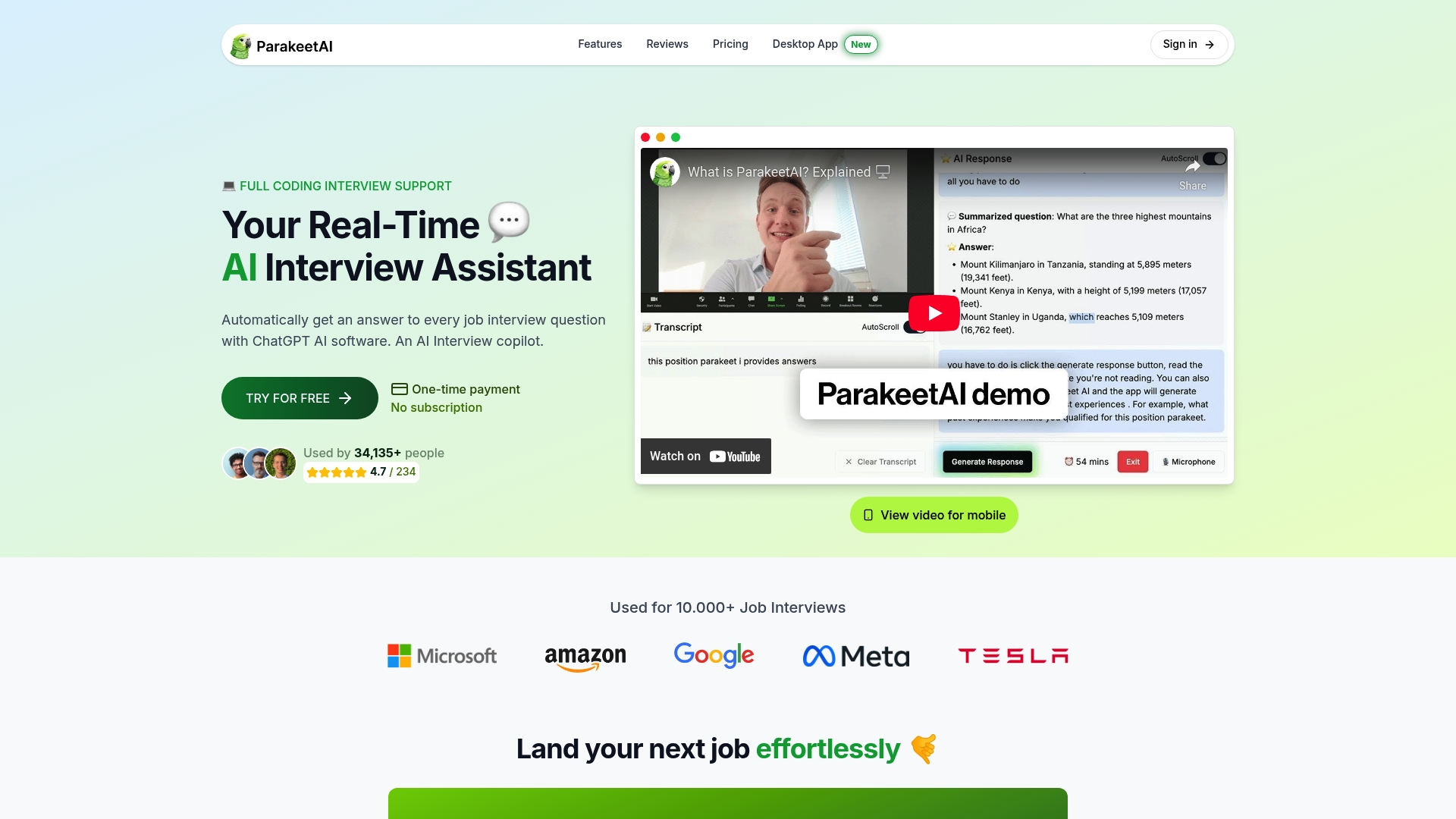
Parakeet-ai applies this model directly. It listens to live interviews and generates real-time interview insights that hiring teams can act on immediately, without waiting for post-interview processing.
Key Takeaways
Dynamic interview feedback produces better hiring decisions when it combines rubric-aligned scoring, adaptive questioning, and human oversight into a single, reviewable process.
| Point | Details |
|---|---|
| Definition matters | Dynamic feedback adapts questions and scoring in real time based on candidate responses. |
| AI accuracy is high but not perfect | Multimodal AI reaches 89% technical accuracy, so human review remains necessary. |
| Rubrics are the foundation | Role-specific rubrics covering technical accuracy, clarity, and completeness drive consistent results. |
| Less feedback is more effective | Limiting output to 1–2 prioritized points per section prevents fatigue and improves follow-through. |
| Prompt versioning protects quality | Updating rubrics without breaking the evaluation engine keeps feedback consistent across hiring cycles. |
The part of dynamic feedback most hiring teams get wrong
Most hiring teams treat dynamic interview feedback as a scoring tool. They focus on the numbers and miss the coaching layer entirely. That is the wrong frame.
The most valuable output from a dynamic feedback system is not the score. It is the transcript-linked evidence that explains why a candidate answered the way they did. A score of 6 out of 10 tells you nothing. A note that says “candidate described the problem correctly but skipped error handling in the solution” tells you exactly what to probe in the next round.
I have seen teams deploy AI evaluation systems and then ignore the qualitative output because the dashboard shows a clean numerical ranking. That ranking is only as good as the rubric behind it. If the rubric has not been updated since the role was first posted, the scores reflect an outdated job description.
The other mistake is treating AI feedback as final. AI systems that assess interview performance with high accuracy still miss context that a human reviewer catches in seconds. A candidate who sounds hesitant may be translating from a second language in real time. A candidate who gives a short answer may have been interrupted. Human oversight is not a backup plan. It is part of the system design.
Dynamic feedback works best when hiring teams treat it as a coaching tool for both candidates and interviewers. Candidates learn where they need to improve. Interviewers learn where their rubrics have gaps. That feedback loop is what separates a good hiring process from a great one.
— Jure
How Parakeet-ai supports dynamic interview feedback
Parakeet-ai is built for hiring managers who need real-time, rubric-aligned feedback without adding complexity to their interview process. It listens to live interviews and generates structured, evidence-based insights automatically, so your team spends less time writing notes and more time making decisions.
The platform supports multiple interview formats and integrates with existing workflows. Hiring managers who want to see how automated interview feedback works in practice can explore Parakeet-ai’s approach directly. For teams ready to move from static evaluation to adaptive, AI-powered assessment, Parakeet-ai is the starting point. Candidates preparing for interviews can also benefit from tools like ApplyGenius to align their resume signals with the criteria that dynamic feedback systems evaluate.
FAQ
What is dynamic interview feedback in simple terms?
Dynamic interview feedback is a real-time evaluation method that adapts questions and scoring based on each candidate’s responses, using rubric-aligned criteria to produce specific, evidence-backed insights.
How does dynamic feedback improve hiring decisions?
It removes subjective recall from the process by scoring responses against structured rubrics in real time, which produces consistent, comparable data across all candidates for the same role.
What is the difference between static and dynamic interview feedback?
Static feedback uses fixed questions and post-interview notes. Dynamic feedback adjusts the interview path based on candidate performance and generates transcript-linked scores during the session.
How many feedback points should a dynamic system deliver per section?
Best practice limits output to 1–2 prioritized, evidence-supported points per section. More than that causes feedback fatigue and reduces the practical value of the evaluation.
Does AI replace human judgment in dynamic interview feedback?
No. AI handles scoring at scale and reduces bias, but human reviewers remain necessary to interpret context, validate rubric alignment, and make final hiring decisions.