
What is chat-based interviewing: a complete guide

Chat-based interviewing sounds futuristic, but it’s already reshaping how companies find talent and how candidates land jobs. Many people assume AI interviews are cold, impersonal experiences that favor machines over humans. Others worry they’re too easy to game or too limited to assess real skills. The truth is more nuanced. This guide cuts through the noise to explain exactly what chat-based interviewing is, how it works, its proven benefits and real limitations, and how both job seekers and employers can use it effectively in 2026.
Table of Contents
- Key takeaways
- What is chat-based interviewing and how does it work?
- Benefits and efficiency of chat-based interviewing for employers and job seekers
- Challenges, limitations, and considerations of chat-based interviewing
- Practical tips and best practices for using chat-based interviewing effectively
- Explore AI-powered interview automation with Parakeet AI
- Frequently asked questions about chat-based interviewing
Key Takeaways
| Point | Details |
|---|---|
| Asynchronous AI screening | AI chatbots conduct initial screening and structured interviews via text without live scheduling. |
| Time and cost savings | It reduces time to hire by 50 to 75 percent and recruitment costs by 40 to 60 percent. |
| Scales for high volume | The approach scales for high volume roles such as retail and hospitality, processing thousands of applications with reduced recruiter workload. |
| Human follow up advised | Pair AI interviews with timely human evaluation to better assess complex soft skills. |
What is chat-based interviewing and how does it work?
Chat-based interviewing is an AI-driven recruitment method using conversational chatbots or text interfaces to conduct initial candidate screening and structured interviews asynchronously via text messages, web chat, SMS, or apps. Unlike traditional phone screens or face-to-face meetings, these interviews happen entirely through written exchanges between candidates and AI systems.
The technology relies on natural language processing to understand and evaluate candidate responses in real time. When you apply for a job using this method, you typically receive a text message or app notification inviting you to start the interview immediately or at your convenience. The AI asks sequential questions, analyzes natural language responses, applies knockout rules, ranks candidates, schedules interviews, and provides feedback without human intervention in the initial stages.
Most systems integrate directly with applicant tracking systems, creating a seamless workflow from application to final interview. This integration allows recruiters to review AI-generated candidate scores, transcripts, and recommendations alongside traditional application materials. Understanding what is interview automation helps clarify how these systems fit into broader recruitment technology ecosystems.
The asynchronous nature stands out as a defining feature. You don’t need to coordinate schedules or take time off work for initial screening. You can respond to questions during your lunch break, late at night, or whenever suits your schedule. The AI chatbot screening interviews explained process typically follows this pattern:
- AI sends initial greeting and explains the interview format
- Candidate receives questions one at a time or in batches
- System analyzes responses for keywords, sentiment, and relevance
- AI applies scoring algorithms based on employer-defined criteria
- Top-ranked candidates advance to human recruiters automatically
- Lower-ranked candidates receive automated feedback or rejection notices
The role of AI chatbots in interviews continues evolving as natural language processing improves and more companies adopt these tools for initial screening stages.
Benefits and efficiency of chat-based interviewing for employers and job seekers
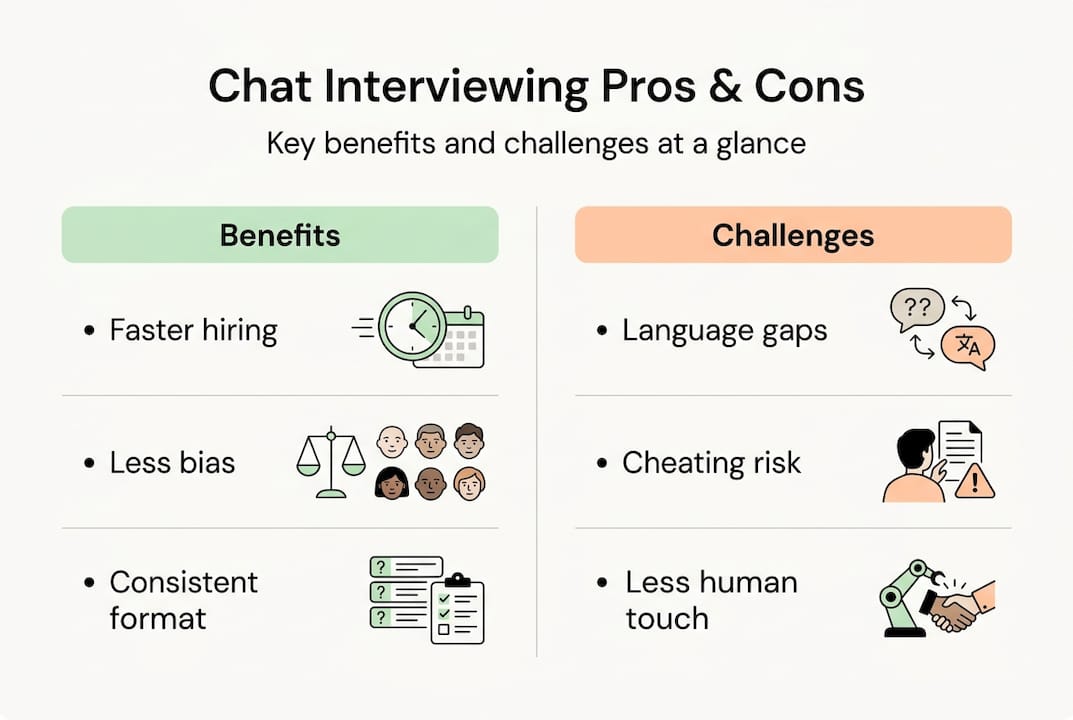
The numbers tell a compelling story. Research shows that chat-based interviewing reduces time-to-hire by 50-75%, cuts recruitment costs by 40-60%, and improves hire quality compared to traditional methods. These aren’t marginal gains. They represent fundamental shifts in how efficiently companies can build teams.

For employers managing high-volume hiring, the scalability alone justifies adoption. Major retailers and hospitality chains report high completion rates with faster application times after implementing chat-based systems. McDonald’s and Woolworths have successfully used these tools to screen thousands of applicants monthly, maintaining quality while dramatically reducing recruiter workload.
Job seekers gain unexpected advantages too. Mobile-friendly interfaces mean you can complete interviews from anywhere without dressing up, commuting, or taking time off work. The text-based format reduces anxiety for candidates who struggle with verbal communication or feel intimidated by traditional interviews. You get time to think through responses without the pressure of immediate verbal answers.
Pro Tip: Practice typing concise, clear responses on your phone before starting a chat-based interview. Most systems favor direct answers over lengthy explanations, so aim for 2-3 sentences per question unless specifically asked to elaborate.
The data reveals other meaningful benefits:
| Metric | Traditional Screening | Chat-Based Screening | Improvement |
|---|---|---|---|
| Average time-to-hire | 36 days | 12-18 days | 50-67% faster |
| Cost per hire | $4,000 | $1,600-2,400 | 40-60% cheaper |
| Candidate completion rate | 45-60% | 75-85% | 25-40% higher |
| Recruiter hours per hire | 20-25 hours | 5-8 hours | 68-75% reduction |
These efficiency gains free recruiters to focus on relationship building and final-stage interviews where human judgment matters most. Understanding why automate job interviews helps contextualize these benefits within broader talent acquisition strategies.
Candidates also appreciate transparency. Many systems provide immediate feedback on performance and clear timelines for next steps, reducing the frustrating silence that often follows traditional applications. The AI-assisted recruitment benefits data demonstrates that candidates who complete chat-based interviews report higher satisfaction with the process compared to those who wait weeks for phone screen callbacks.
Employers gain standardization too. Every candidate answers identical questions in the same format, reducing bias from interviewer mood, fatigue, or personal preferences. This consistency supports interview best practices for hiring managers by ensuring fair, comparable evaluations across all applicants.
Challenges, limitations, and considerations of chat-based interviewing
No technology is perfect, and chat-based interviewing carries significant limitations that both employers and candidates should understand. The chat-based interviewing struggles with non-native speakers, AI assistance or cheating, lack of nonverbal cues, and shows weaker predictive validity for some soft skills according to assessment psychologists who study these systems.
Language barriers present real challenges. AI systems trained primarily on native English speakers often misinterpret responses from candidates with different linguistic backgrounds or communication styles. Idioms, cultural references, and non-standard grammar can trigger false negatives, screening out qualified candidates who would excel in the actual role.
The cheating problem is growing. Candidates can easily use ChatGPT or other AI tools to generate polished responses, making it difficult to assess genuine capabilities. Some applicants have friends or family members answer questions on their behalf. Unlike video interviews where proctoring software can detect these behaviors, text-based systems offer limited detection capabilities.
Pro Tip: If you’re a job seeker, resist the temptation to use AI assistance during chat-based interviews. Companies increasingly use follow-up questions or in-person interviews that will expose inconsistencies, and getting caught using AI can permanently damage your reputation with that employer.
The absence of nonverbal communication eliminates crucial assessment dimensions. You can’t gauge enthusiasm through vocal tone, assess confidence through body language, or build rapport through facial expressions. Research indicates that lower organizational attractiveness and behavioral intentions compared to face-to-face interviews have been reported among candidates who complete only chat-based screening.
“The predictive validity for complex soft skills like leadership, creativity, and emotional intelligence remains questionable in text-only formats. These competencies often emerge through dynamic conversation and behavioral observation that chat interfaces cannot replicate.”
Key limitations include:
- Inability to assess verbal communication skills critical for customer-facing roles
- Difficulty evaluating problem-solving approaches that require back-and-forth discussion
- Limited insight into personality traits that influence team dynamics
- Reduced ability to detect red flags that emerge through conversational nuance
- Potential for technical issues that disadvantage candidates with poor internet access
The candidate experience concerns extend beyond assessment validity. Many applicants report feeling dehumanized by purely automated screening, especially for roles requiring high emotional intelligence or interpersonal skills. This perception can damage employer brand and cause top candidates to drop out of the hiring process.
Understanding the role of AI for interview fairness requires acknowledging these limitations alongside the benefits. The psychologists critique of AI interviews emphasizes that these tools work best as initial filters, not comprehensive assessment solutions. Recognizing AI chatbots interview limitations helps both employers and candidates set appropriate expectations.
Practical tips and best practices for using chat-based interviewing effectively
Success with chat-based interviewing requires deliberate preparation and strategic implementation. Whether you’re a candidate preparing for your first AI interview or an employer rolling out this technology, specific practices dramatically improve outcomes.
For job seekers, preparation looks different than traditional interview prep. Practice typing clear, concise responses on your mobile device since most chat interviews happen via smartphone. Focus on direct answers that address the question immediately, then provide supporting details. AI systems prioritize relevance and clarity over eloquence.
Employers must combine AI interviews with human follow-ups for complex roles and monitor for AI cheating using timing or opinion-based questions. The hybrid approach maximizes efficiency gains while preserving assessment quality for nuanced competencies.
Implementing chat-based interviewing effectively:
- Define role requirements precisely before configuring AI screening criteria to avoid false negatives
- Test your chat interview flow with internal team members to identify confusing questions or technical issues
- Communicate transparently with candidates about AI use, data privacy, and what happens with their responses
- Monitor completion rates and candidate feedback to identify friction points in the interview experience
- Review AI-generated scores alongside human judgment for final hiring decisions, especially for senior or specialized roles
- Include opinion-based or ethical dilemma questions that reveal authentic thinking patterns harder to fake with AI assistance
- Set reasonable response time expectations that allow thoughtful answers without enabling external research or AI consultation
Pro Tip: Employers should include at least two questions requiring personal experience or subjective judgment that AI tools struggle to answer authentically. Ask candidates to describe a specific failure and what they learned, or explain an unpopular opinion they hold about their industry.
Candidates should approach chat-based interviews with the same professionalism as traditional formats. Proofread responses before submitting, maintain professional tone, and provide specific examples rather than generic statements. The asynchronous format tempts some to rush through questions, but thoughtful, well-crafted responses stand out in AI scoring algorithms.
Understanding why automate job interviews from the employer perspective helps candidates tailor responses to what these systems prioritize. Similarly, reviewing the AI interview fairness guide provides insight into how leading companies implement these tools ethically.
The best practices for AI interviews emphasize transparency, hybrid approaches, and continuous monitoring. Employers who treat chat-based interviewing as one component of a comprehensive assessment strategy see better results than those attempting to replace all human interaction with automation.
Explore AI-powered interview automation with Parakeet AI
If you’re ready to implement chat-based interviewing or enhance your existing recruitment technology, Parakeet AI offers solutions designed for modern hiring teams. Our platform combines the efficiency of AI-driven screening with the insights that matter most to hiring managers.
Discover how the Parakeet AI interview automation platform uses chat-based automation to reduce hiring times by up to 75% while improving candidate experience. Our technology embeds fairness principles and best practices directly into the interview flow, helping you screen efficiently without sacrificing quality. Explore the benefits of automating job interviews and learn how our AI interview fairness practices ensure equitable screening for all candidates.
Frequently asked questions about chat-based interviewing
What is chat-based interviewing?
Chat-based interviewing uses AI-powered chatbots to conduct initial candidate screening through text messages, web chat, or mobile apps. Candidates answer structured questions asynchronously, and AI analyzes responses to rank applicants before human recruiters get involved.
What types of jobs are best suited for chat-based interviewing?
High-volume roles with clear qualification criteria work best, including retail associates, customer service representatives, hospitality staff, and entry-level administrative positions. These roles benefit from fast screening without requiring complex soft skill assessment that text-based formats struggle to evaluate.
How can job seekers prepare for a chat-based interview?
Practice typing concise, clear responses on your mobile device focusing on direct answers with specific examples. Review the job description carefully to understand key qualifications, and prepare brief stories demonstrating relevant experience. Avoid using AI assistance, as inconsistencies will surface in follow-up interviews.
What measures prevent cheating in chat-based interviews?
Employers use response timing analysis, opinion-based questions requiring authentic judgment, and follow-up interviews that verify consistency with initial responses. Some systems include questions designed to detect AI-generated answers by looking for patterns typical of language models rather than human candidates.
Can chat-based interviews replace all human interviews?
No, they work best as initial screening tools paired with human follow-up for final decisions. Complex roles requiring assessment of leadership, creativity, interpersonal skills, or cultural fit still need human judgment. The hybrid approach combines AI efficiency with human insight for optimal hiring outcomes.
How does chat-based interviewing improve fairness in hiring?
Standardized questions and consistent evaluation criteria reduce bias from interviewer mood, fatigue, or personal preferences. Every candidate answers identical questions, creating comparable data for fair assessment. However, systems must be carefully designed to avoid bias against non-native speakers or candidates with different communication styles.