What to Do in a Mock Interview: A Step-by-Step Guide
You've got an interview invite open on your laptop, three tabs of sample questions, and no clear idea whether your answers sound strong or rambling. Reading them to yourself doesn't tell you. You need to know what to do in a mock interview so one practice round gives you evidence you can fix, not just a vague feeling of readiness. Treat the mock as a measurable feedback loop. Perform, score, revise, and repeat the same question.
Set Up a Mock Interview That Matches the Real Round
Most candidates face four round types. Match your practice to the one that's scheduled, because each needs a different setup and answer shape.
| Round type | Typical question | Answer frame | Aim for |
|---|---|---|---|
| Behavioral | Tell me about a time you resolved a conflict with a colleague. | STAR: Situation, Task, Action, Result | 2-3 minutes |
| Situational | What would you do if a project deadline slipped by two days? | Decision first, then reasoning and trade-offs | 1-2 minutes |
| Technical | Explain how a hash map handles collisions. | Concept, short example, then trade-off | 3-5 minutes |
| Motivation | Why do you want this role? | Link the role to one concrete experience | 1-2 minutes |
Choose Competencies Before Questions
Read the job posting and list the three to five competencies it names, such as teamwork, problem-solving, communication, or one specific technical skill. Draft two questions for each competency. If you're preparing for sales work, a set of remote sales interview questions can help you draft prompts tied to that work instead of generic ones.
That sequence matters. The U.S. Office of Personnel Management guidance on structured interviews reports that questions tied to competencies identified through job analysis show strong validity and reliability, and that consistent rules for asking and evaluating improve fairness and rating reliability. In plain terms, you'll learn more from job-related questions scored the same way each time than from a friendly chat judged by confidence.
Reuse the same question set across sessions. A fixed set makes improvement visible, because any change comes from your answer, not from an easier prompt.
Set the Room Like the Real Day
Use a timer set to the actual round length, a quiet room, and the device and camera you'll use on the day. Write down your five strongest examples and map each one to a competency, so you're not hunting for a story mid-answer.
Ten-minute checklist: Role, competencies, question set, timer, and recorder. If one is missing, fix it before you start.
How to Run One Mock Round, Step by Step
This simple flow shows the loop you'll repeat for every question.
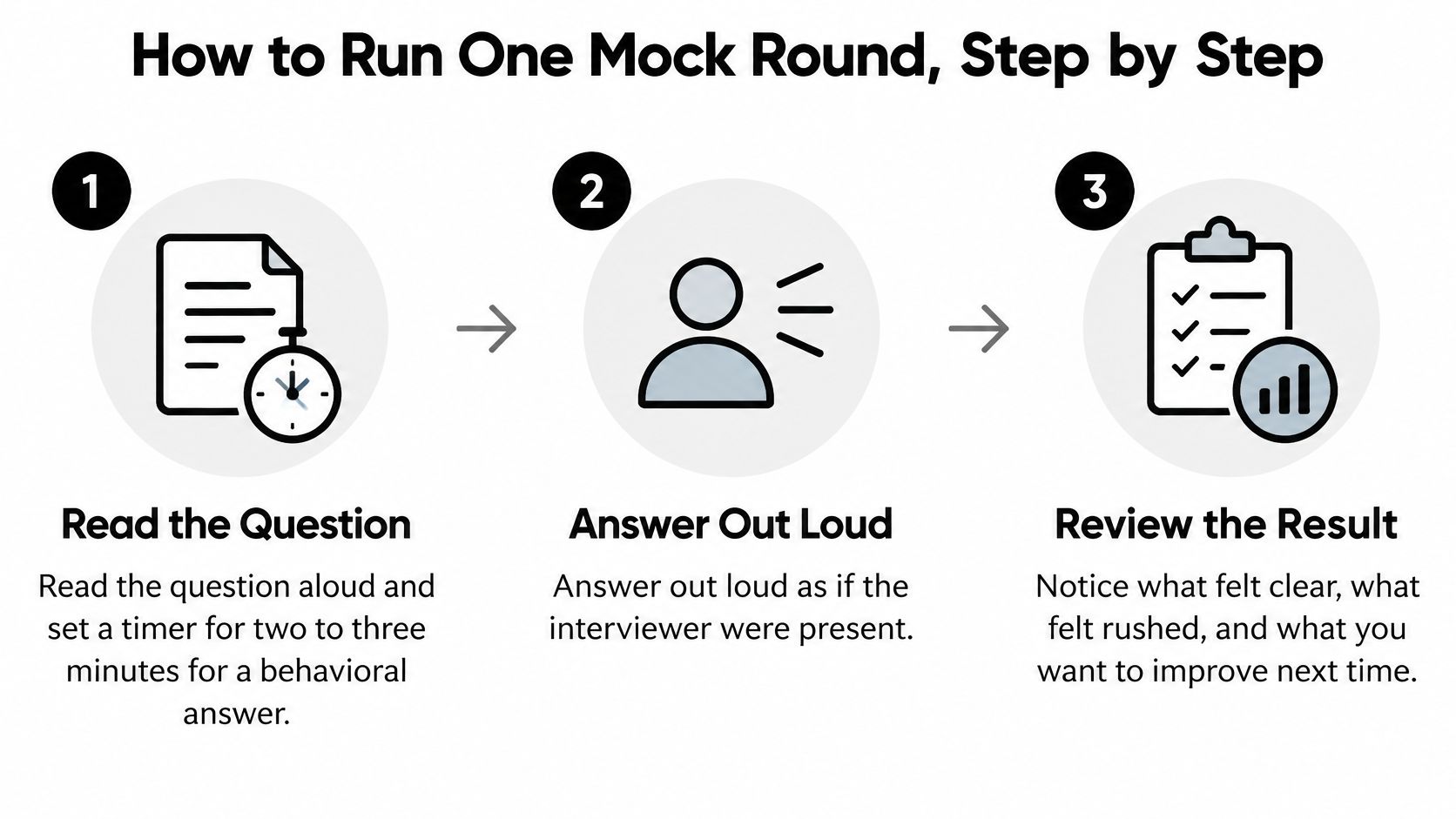
- Read the question aloud. Set a timer for the realistic length, usually two to three minutes for a behavioral answer. The timer shows your actual length, which your memory won't.
- Answer out loud. Speak as if the interviewer were present. Silent thinking hides rambling, rushed pacing, and sentences you can't finish.
- Record the whole answer. Use your phone or laptop and don't pause the recording. You'll need it to hear what you can't notice while speaking.
- Stop when the answer's complete. Don't restart, even if time remains. The common slip here runs both ways. Some candidates cut answers short to finish quickly, and others keep talking after the point of value.
- Replay and write one line. Note whether your first sentence answered the question. That single check catches the most common failure, which is opening with background instead of an answer.
- Move to the next question. Keep the same order as your set. Don't skip a hard one and come back later, because an interviewer won't let you reorder.
Why the Order Stays Fixed
The Society for Industrial and Organizational Psychology definition of a structured interview describes a prepared set asked of every applicant and evaluated with consistent criteria, and reports that structured interviews have been found to predict future job performance better than unstructured or mixed interviews. Your mock borrows that logic. Same prompts, same order, same criteria, so two rounds are comparable.
If you change the questions every time, you can't tell whether you improved or the prompt got easier. That's the difference between practice and measurement.
What a Good First Round Looks Like
You don't need polish on round one. Aim for three complete answers, each with a named example, a result, and a length under three minutes. Complete and imperfect beats polished fragments, because you can't score an answer you abandoned halfway.
Say your first behavioral answer runs long and buries the result. That's useful data, not failure. You've found the exact thing round two should test.
Score the Recording Against Criteria, Not Confidence
Practice alone doesn't guarantee you noticed what happened. In a Northwestern University assessment of mock-interview learning, 53% of participants correctly identified three key verbal and nonverbal communication techniques from a list of six after completing the mock interview. Nearly half didn't reach that level of recognition, so awareness isn't automatic. You need a scoring pass.
Use these six criteria on every recording.
| Criterion | Content or delivery | How to check it |
|---|---|---|
| Direct opening | Content | Does the first sentence answer the question that was asked? |
| Specific example | Content | Is there a named situation and an action you personally took? |
| Measurable result | Content | Does the answer state an outcome, with a number or a clear change where possible? |
| Filler words | Delivery | Count um, like and so in a two-minute answer |
| Answer length | Delivery | Is the answer about two to three minutes rather than a monologue? |
| Pacing and clarity | Delivery | Can you follow the answer on one listen without rewinding? |
Two Rules That Make Scoring Useful
First, pick only two or three behaviours to improve in the next round. If you try to fix everything at once, you can't see which change worked, and you'll likely fix none of them well.
Second, separate content from delivery. Content asks whether the answer has a clear action and a measurable result. Delivery asks whether it's concise and easy to follow. A strong example spoken too fast needs pacing work, not a new story. A calm, fluent answer with no result needs better evidence, not more confidence practice.
Don't rate how confident you sounded. Rate whether a listener can name your action and your result after one listen.
Prove the Fix Worked
Repeat the same question after revising, then compare the two recordings side by side on the same criteria. If your chosen criterion improved and the others held steady, the fix worked.
A revised answer should look simple on the page. A direct first sentence, one specific example, one result, and a clean finish. If you can't summarize it that way, the listener probably couldn't either.
Practice Calmly Without Losing Your Natural Style
Quiet preparation at your own pace is a valid way to start.

Generic advice to always smile, hold constant eye contact, and sound fully confident can disadvantage candidates who are neurodivergent, have speech differences, experience social anxiety, or are interviewing in a second language. It treats anxiety as a confidence problem when it's often a format problem.
A 2025 inclusion report on neurodivergent workers notes that unfamiliar settings and open-ended or hypothetical questions can make interviews inaccessible, and recommends explaining the process, offering questions in advance, and providing alternative formats such as one-to-one, phone, written, or small-group interviews. The useful question isn't how to perform confidence. It's which parts of your performance reflect job ability, and which reflect interview-format friction.
Practical Moves That Preserve Your Style
- Pause before answering: Take two seconds to think. That's normal in a real interview and prevents a false start.
- Write first if speaking is hard: Rehearse with written answers, then move to voice once the content is solid.
- Score second-language content separately: Practice in the interview language, but judge your reasoning apart from accent or grammar.
This short video gives you another way to hear pacing and pauses in practice answers.
Split your feedback into three notes per session: content quality and reasoning, delivery and pacing, and accommodation needs. If your score drops only on hypothetical or open-ended questions, the format may be the problem, not your ability. That's a reasonable basis to ask the process for a written, phone, or one-to-one alternative.
Feeling calmer in low-pressure practice is welcome, but it doesn't prove the simulation is valid. Judge the practice by whether your content scores improve, not by comfort alone.
Ask What Automated Screening Measures Before You Rehearse for It
You walk into an automated screen without a clear rubric, and every pause feels like a penalty. Analysts at Greenhouse found that pattern is common in a multi-market survey of 2,950 job seekers. In that group, 63% had experienced an AI interview, 70% were not clearly told beforehand that AI would evaluate them, and 21% learned only after the interview began.
Treat that gap as measurement error. Your rehearsal should separate what shows skill for the role from what only shows friction with the format. Practice concise answers in your natural speaking style. Rewriting yourself to match an imagined algorithm usually makes reasoning harder to follow.
Before the interview, ask the recruiter four questions:
- What data is collected?
- How is it used?
- Does a human review the result?
- Is an alternative process available?
Write the answers in your practice notes. Check where any practice tool stores recordings and transcripts before you rely on it for review, such as when you revisit your saved calls to compare delivery across rounds. Before uploading a real CV or recording a practice session anywhere, read the tool's privacy and data-handling information, and keep practice recordings private. If the employer cannot answer those four questions, request the alternative route instead of guessing how the screen scores you.
Debrief and Follow Up After Each Session
Within 24 hours of each session, write a short debrief while you still remember how the answers felt. Delay it and you'll only remember the recording, not the moments where you improvised.
- Note the two behaviours you worked on. Record whether their scores moved on the criteria table. A score that didn't move tells you to change the fix, not to try harder at the same one.
- Record one easy moment and one forced moment. The forced moment usually marks the next behaviour to fix. The easy one tells you which answer frame suits you.
- Ask a friend or mentor to score one answer. Give them the same criteria table, then mark each criterion where your score and theirs differ. Their disagreement shows where your self-assessment is unreliable, which is exactly what you can't detect alone.
- Save everything in one folder. Keep the question set, recordings, and debrief together so progress is visible at a glance.
After the Real Interview
Write a short thank-you note within a day. Then log every question you were asked while your memory is fresh.
Folder rule: Add only real questions you were asked to your set for the next round. Don't invent prompts about a company's process that you didn't experience.
That rule keeps your practice honest. Your next set improves because it's built on evidence from a real room, not on guesses about what an employer might ask.
Run Your Second Mock Interview This Week
Here's a visible way to plan the week and keep your notes beside your scores.
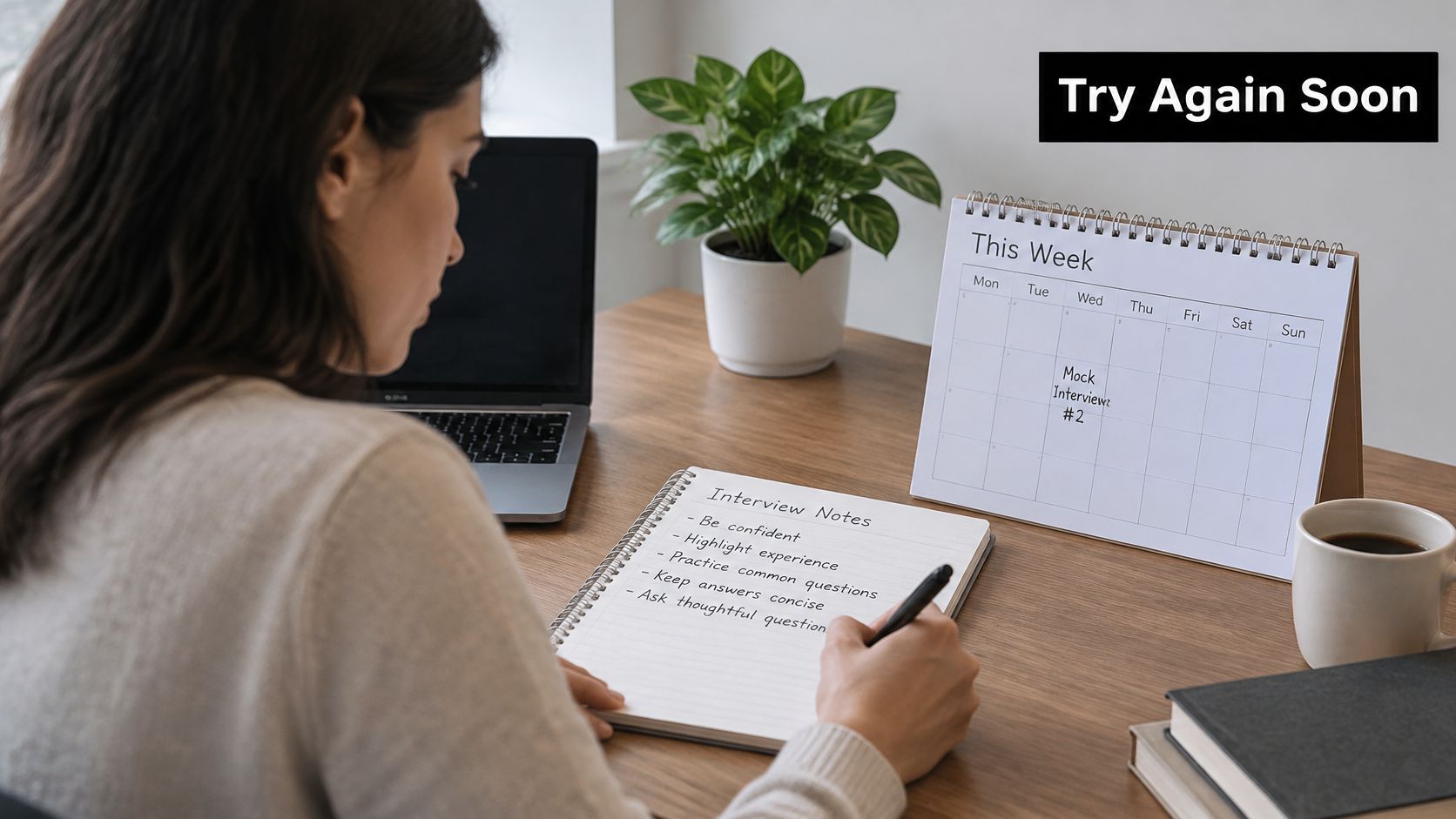
- Pick the two behaviours you chose from the last round.
- Re-run the same three questions within 48 hours, while the memory of round one still shapes round two.
- Compare the two recordings side by side on the criteria table.
- Branch on the result. If each chosen behaviour improved, add two unfamiliar questions from the role's competencies. If it didn't, change only one thing and run the round again.
This order works for a reason. The repeat tests whether the fix held. The new questions test whether the skill transfers to prompts you haven't memorized. Skip the repeat and you'll never know if the fix worked. Skip the new questions and you'll only be good at three answers.
You can have a friend read the questions aloud, or use ParakeetAI's Mock Interview to practice out loud against an AI interviewer that answers back, then read the transcript beside your scoring table. The first mock interview is free, and trying the product requires no credit card, so you can run one full loop before deciding if it fits.
Whichever route you choose, save the transcript or recording and the scoring table together. Before the interview, you should be able to open one folder and see your scores move. That's the whole point of knowing what to do in a mock interview. You're not rehearsing a performance. You're running a loop that shows you, in your own recordings, that your answers got clearer.
Run your loop this week with one free practice round, score the transcript against your criteria table, and fix just two behaviours before the next session. ParakeetAI lets you practice out loud against an AI interviewer that answers back, then read the transcript to check your opening, example, and result. Start your free mock today and walk into the interview with recordings that prove your answers improved.