
Best AlgoExpert.io Alternatives for Live AI Interview Help

TL;DR:Real-time AI interview assistance is limited to specialized tools like Parakeet-ai, not platforms like AlgoExpert.Choosing the right tool depends on identifying whether the need is for live help, problem volume, active construction skills, or human feedback.
If you want real-time AI assistance during an actual interview, AlgoExpert is not built for that. It is a curated prep course, not a live assistant. The fastest path to in-interview AI support runs through a different category entirely.
Here is where to start:
- Parakeet-ai — listens to your interview live and generates answers on the fly. The only tool here built specifically for real-time in-interview use.
- Repo/IDE platforms (HackerRank, LeetCode Interview) — simulate realistic multi-file coding environments with AI-enabled tools; best for practicing the format companies actually use.
- Active-construction platforms — force you to build solutions from scratch rather than watch walkthroughs; best for candidates who freeze on novel problems.
Most tools in this space offer a free tier or trial. Pricing ranges from free to paid packages for curated content. Check each platform’s audio-consent and data-retention policy before you start; the privacy section below covers what to look for.
Table of Contents
- What are the best AlgoExpert.io alternatives for live AI assistance?
- How do you pick the right alternative for your specific gap?
- Why Parakeet-ai stands out as a real-time interview assistant
- What are the ethical and privacy rules for using AI during interviews?
- Are these tools available in the United States?
- Key Takeaways
- The setup I would actually use in 2026
- Sources and further reading
What are the best AlgoExpert.io alternatives for live AI assistance?
The table below maps each alternative category to the features that matter most for AI-assisted interview prep.
| Category | Real-time AI assistance | Practice modes | Human mock interviews | Code execution / IDE | Answer generation quality | Privacy & audio policy | Pricing / free tier | Best for |
|---|---|---|---|---|---|---|---|---|
| Real-time AI assistant (e.g., Parakeet-ai) | Yes — listens and suggests live | Limited structured drills | No | No native IDE | High — context-aware, on-the-fly | Explicit consent modal required; check data retention | Free trial available | Live in-interview help |
| Repo/IDE interview platforms (e.g., HackerRank, LeetCode Interview) | Partial — AI tools within IDE | Timed challenges, repo-based mocks | Paired sessions available | Yes — multi-file repo, terminal | Moderate — IDE autocomplete + hints | Varies by platform; review recording policy | Free tier + paid plans | Realistic on-the-job simulation |
| High-volume problem banks (e.g., LeetCode free, HackerRank free) | No | Timed challenges, company-tagged sets | No | Browser-based judge | Community explanations; variable quality | Standard account privacy | Free / Premium | Breadth and company-specific targeting |
| Active-construction platforms | No | Identification lessons + progressive problems | No | Browser-based | Structured, pattern-first explanations | Standard | Free tier + paid | Candidates who freeze on novel problems |
| Human mock interview platforms (e.g., Interviewing.io, Pramp) | No | Recorded mock sessions | Yes — real engineers or peers | Shared coding environment | Feedback from human interviewers | Audio/video recording; explicit consent needed | Free (Pramp); Interviewing.io has paid tiers | Realistic pressure, human feedback |
| AI chat assistants (e.g., OpenAI ChatGPT) | Partial — reactive, not passive listener | None built-in | No | No | High for explanations; no live context | OpenAI data policy applies | Free / ChatGPT Plus | On-demand explanation and debugging |
Trust signals to verify before committing to any platform:
- Explicit audio-consent modal before any session recording begins
- Clear data-retention and deletion policy in the product docs
- Free trial or freemium tier so you can test before paying
- Verified user reviews on independent sites
- Documented encryption and security practices
High-volume banks provide breadth but typically lack adaptive ordering or identification training. Repo/IDE platforms like HackerRank Interview advertise shared repo environments, terminal access, and AI-enabled tools that reflect how developers actually work. Neither replaces a live AI assistant if your gap is the interview moment itself.
How do you pick the right alternative for your specific gap?
Diagnose your bottleneck first. The right tool depends entirely on where you are losing ground.
- You need live help during the interview itself. Go straight to a real-time AI assistant like Parakeet-ai. No amount of problem-bank drilling fixes the gap between knowing a solution and articulating it under pressure.
- You need more problem volume. Pair a free problem bank (LeetCode free tier, HackerRank free) with a structured pattern guide. Free structured resources plus high-volume practice are often sufficient to reach interview readiness without paying for a curated course.
- You freeze on problems you have never seen before. That is a construction gap, not a recognition gap. Active-construction training — identify the pattern before coding, then build incrementally — transfers better to novel problems than re-watching walkthroughs.
- You need realistic pressure with human feedback. Add Pramp (free peer mocks) or Interviewing.io (paid sessions with real engineers).
Questions to ask or test during a free trial:
- Does the AI listen passively and suggest answers, or does it only respond when you type a prompt?
- Can I practice inside a multi-file repo rather than a single-file editor?
- Where is my audio stored, and can I delete it after the session?
- Is there a timed mock mode with a penalty for hints?
Red flags:
- No audio-consent screen before a session starts
- No free trial or freemium option
- Data-retention language that says “indefinitely” or gives no deletion path
- No way to export or delete your session data
Many candidates switch platforms for three reasons: cost, volume, or the need for live interaction that pre-recorded courses cannot provide. Knowing which of those three drives your search narrows the field fast.
Why Parakeet-ai stands out as a real-time interview assistant
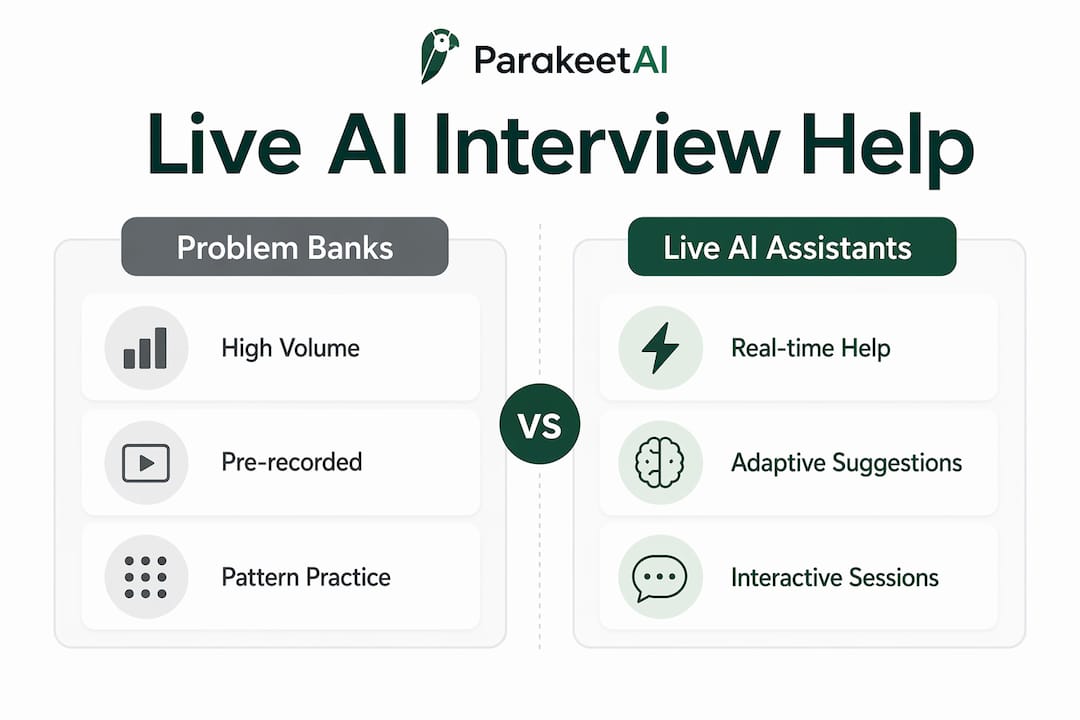
Parakeet-ai is built for one job: sitting invisibly in your interview and generating answers to questions as they are asked; it focuses on live in-interview assistance. That is a fundamentally different product category from a problem bank or a video course.
Core features:
- Listens to the interview audio in real time and surfaces answer suggestions automatically
- Works alongside your existing setup — no interviewer-facing interface
- Covers behavioral, technical, and system design questions
- Generates explanations you can verify and adapt, not scripts to read verbatim
- Audio-consent and privacy controls built into the session flow
When to choose Parakeet-ai vs. when to pair it with something else:
| Situation | Recommendation |
|---|---|
| You need live answer suggestions during the interview | Parakeet-ai as your primary tool |
| You need more problem volume before the interview | Pair Parakeet-ai with LeetCode free or HackerRank free |
| You freeze on novel problems | Add an active-construction course alongside Parakeet-ai |
| You want human feedback on your delivery | Add Pramp or Interviewing.io for mock sessions |

Pricing and trial details are on the Parakeet-ai website — public pricing is not listed here, but a trial option is available. If you are evaluating which AI model family powers a platform’s suggestions, an independent breakdown of top coding LLMs is worth a read before committing.
What are the ethical and privacy rules for using AI during interviews?
Using an AI assistant during an interview sits in a gray area. Here is how to stay on the right side of it.
Ethical checklist:
- Ask the recruiter or interviewer whether AI assistance is permitted before the session
- Treat AI-generated answers as drafts you verify, not scripts you read word for word
- Never submit AI-generated code as your own without understanding it
Privacy checklist:
- Confirm whether the platform records audio and who can access it
- Read the data-retention section of the privacy policy — look for a clear deletion timeline
- Check whether audio is processed by a third-party model provider (such as OpenAI) and what their retention terms are
- Ask support directly: “How do I delete my session audio after the interview?”
Pro Tip: Request session deletion immediately after each interview, use a browser profile with no persistent cookies, and avoid pasting identifiable code snippets into any AI tool unless you have confirmed the platform’s data handling.
This article is general information, not legal or professional advice. Confirm current platform policies and your employer’s rules directly before use.
Are these tools available in the United States?
Yes. Parakeet-ai, LeetCode, HackerRank, Interviewing.io, Pramp, and OpenAI’s ChatGPT are all available to users in the United States with no geographic restriction. Pricing is in USD. Most platforms support web access from any modern browser; mobile apps vary by platform. If you are preparing for a software engineering interview at a US-based company, all the tools covered here are accessible and actively used by candidates in the US market.
Key Takeaways
For live in-interview AI help, Parakeet-ai is the only tool in this roundup built specifically for that job; pair it with a high-volume problem bank or active-construction course to cover breadth and novel-problem gaps.
| Point | Details |
|---|---|
| Live AI assistance is a separate category | Problem banks and video courses do not replace a real-time assistant during the interview itself. |
| Diagnose your bottleneck first | Choose by gap: live help, problem volume, construction skill, or human feedback. |
| Repo/IDE practice matters | Platforms with multi-file repo environments better simulate how companies actually interview in 2026. |
| Privacy policy is non-negotiable | Always confirm audio-consent, data-retention terms, and deletion options before starting a session. |
| Free tiers exist across the board | Test before paying — most platforms, including Parakeet-ai, offer a trial or freemium option. |
The setup I would actually use in 2026
The conventional advice is to grind LeetCode until the patterns stick. That works for some people. But if your real problem is that you know the solution and still stumble when someone is watching, more drilling does not fix that. The gap is performance under pressure, not knowledge.
My honest take: start with a Parakeet-ai trial for two weeks and run it during mock sessions, not just real interviews. That tells you quickly whether live AI suggestions actually change how you perform. If you are also weak on problem breadth, add LeetCode’s free tier in parallel — high-volume practice covers what curated courses cannot. If you freeze on problems you have never seen, one focused block of active-construction training is worth more than a hundred re-watched walkthroughs.
A suggested multi-week plan involves trialing Parakeet-ai in simulated mock interviews, practicing relevant LeetCode problems in focused categories, and doing daily active-construction sessions on weak patterns to build solutions incrementally.
Check the Parakeet-ai landing page to start the trial. And before you commit to any platform, verify its audio-consent and deletion policy — that five-minute check is worth doing once.
Sources and further reading
- Best AlgoExpert Alternatives for Depth (2026) — Codeintuition
- Codeintuition vs AlgoExpert: Building vs Watching — Codeintuition
- Free Alternatives to AlgoExpert: Top Picks for 2026 — SkillFlow
- HackerRank Interview — HackerRank
- LeetCode Interview — Online Coding Interview Platform
- Best LLM for Coding: Top 10 Models for Developers — Polsia
- How to Prepare for Coding Interviews: Your Complete Guide — Parakeet-ai Blog