
Master analytical and problem solving interview questions

Seventy percent of interviewers care more about how you think through problems than whether you nail the perfect answer. That single insight changes everything about interview preparation. Most candidates freeze up trying to find flawless solutions, when interviewers actually want to see your reasoning process unfold in real time. This guide reveals proven frameworks for structuring analytical responses, mental models that simplify complex scenarios, and how AI assistance transforms your interview performance while maintaining authenticity.
Table of Contents
- Understanding Analytical And Problem Solving Questions
- Common Misconceptions About Interview Problem Solving
- Mental Models And Frameworks For Problem Analysis
- Answer Structuring Frameworks For Problem Solving
- Leveraging Ai Assistance In Interviews
- Preparing For Analytical And Problem Solving Questions
- Boost Your Interview Success With Parakeet Ai
Key takeaways
| Point | Details | |-------|---------|| | Structured frameworks like STAR improve answer clarity and boost interviewer ratings by up to 30% | | Interviewers prioritize your reasoning process over reaching perfect final answers | | Mental models like First Principles and MECE help decompose complex problems systematically | | AI assistance provides real-time guidance, reduces anxiety, and increases answer relevance | | Balancing AI support with personal insight ensures authentic, ethical interview performance |
Understanding analytical and problem solving questions
Analytical and problem solving questions assess how you process information, identify patterns, and develop logical solutions under pressure. These questions appear across industries, from consulting case studies to technical programming challenges. Interviewers use them to evaluate cognitive abilities that predict job performance better than traditional questions about past experience.
Common varieties include logic puzzles, data interpretation exercises, business case studies, and hypothetical scenarios. A consulting interview might ask you to estimate market size for a new product. A tech interview could present an algorithm optimization challenge. A management role might involve resolving a team conflict scenario with incomplete information.
These questions test specific cognitive skills:
- Logical reasoning to connect cause and effect relationships
- Quantitative analysis to interpret numerical data accurately
- Pattern recognition to identify trends and anomalies
- Creative thinking to generate multiple solution approaches
- Communication clarity to articulate complex ideas simply
Global employers increasingly rely on problem solving assessments because they reveal how candidates handle ambiguity and complexity. The questions don’t have single correct answers. Instead, they expose your analytical approach, decision making criteria, and ability to think strategically while explaining your process clearly to others.
Common misconceptions about interview problem solving
Many candidates believe they must deliver perfect, polished answers to impress interviewers. This misconception creates unnecessary pressure and often leads to worse performance. Seventy percent of interviewers prioritize the reasoning process over whether you arrive at the technically correct solution.
Interviewers want to see inside your mind. They’re evaluating how you break down problems, what questions you ask, which assumptions you validate, and how you adapt when initial approaches don’t work. A candidate who reaches the wrong answer while demonstrating clear, logical thinking often scores higher than someone who guesses correctly without showing their work.
Common errors sabotage otherwise strong candidates:
- Staying silent while thinking instead of verbalizing your reasoning
- Jumping to solutions before fully understanding the problem
- Overcomplicating answers with unnecessary jargon or complexity
- Failing to ask clarifying questions about ambiguous scenarios
- Giving up too quickly when initial approaches hit obstacles
Pro Tip: Treat problem solving questions as collaborative exercises. Say “Let me walk you through my thinking” and narrate each step. This transforms a nerve wracking test into an engaging conversation.
“The best candidates treat interviews as problem solving partnerships. They invite interviewers into their thought process, ask smart questions, and show intellectual curiosity. We’re not looking for perfect answers, we’re looking for people who can think on their feet.”
Correct these errors by practicing think aloud techniques before interviews. Record yourself solving practice problems while explaining your reasoning out loud. This builds the habit of clear verbalization that interviewers value most.
Mental models and frameworks for problem analysis
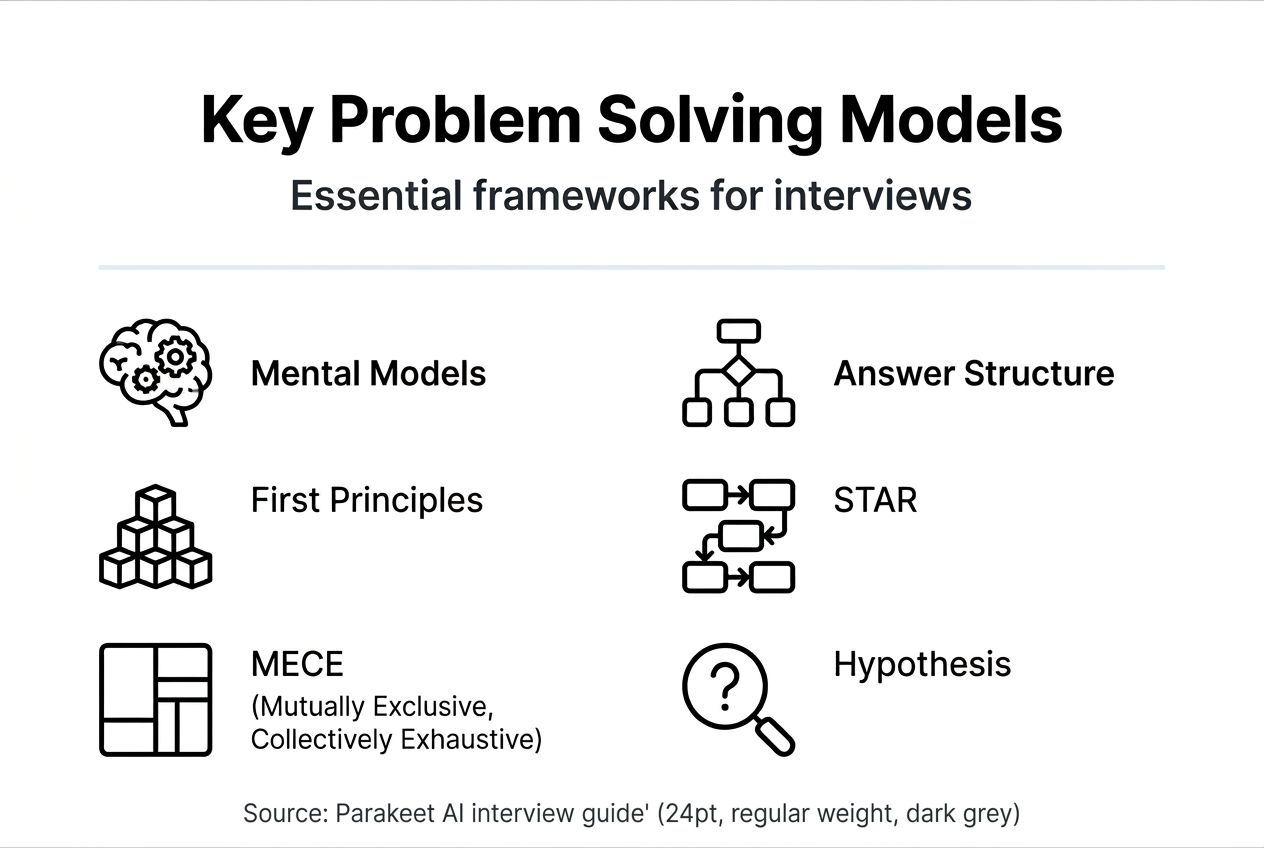
Mental models provide systematic approaches to break down complex problems into manageable components. They help you organize thinking, avoid cognitive biases, and communicate solutions clearly. Three powerful models work especially well in interview contexts.

First Principles Thinking strips problems to their fundamental truths. Instead of reasoning by analogy or precedent, you identify core assumptions and build solutions from basic principles. When asked to estimate rideshare demand in a new city, First Principles Thinking examines population density, transportation alternatives, and economic factors from scratch rather than just copying another market’s patterns.
The MECE Framework ensures your analysis is Mutually Exclusive and Collectively Exhaustive. This means breaking problems into categories that don’t overlap while covering all possibilities. Analyzing customer churn using MECE might segment by product issues, pricing concerns, competitor offerings, and service quality, ensuring no factor gets missed or double counted.
Hypothesis Driven Approach starts with educated guesses then tests them systematically. Rather than gathering data randomly, you form specific hypotheses about problem causes and design targeted analysis to validate or disprove each one. This approach saves time and demonstrates strategic thinking.
| Mental Model | Best Application | Key Benefit |
|---|---|---|
| First Principles | Complex estimation, innovation scenarios | Avoids false assumptions from analogies |
| MECE Framework | Market analysis, root cause identification | Ensures comprehensive coverage |
| Hypothesis Driven | Data interpretation, strategic planning | Focuses effort on highest impact factors |
Pro Tip: Match your mental model to question type. Use First Principles for creative challenges, MECE for analytical breakdowns, and Hypothesis Driven when you have data to interpret.
Real-time AI tools can suggest which framework fits specific questions and guide you through applying each model step by step during live interviews. This support helps you stay organized under pressure while maintaining authentic reasoning.
Answer structuring frameworks for problem solving
The STAR framework transforms rambling explanations into compelling narratives that interviewers remember and rate highly. STAR stands for Situation, Task, Action, and Result. Each component serves a specific purpose in building credible, structured answers.
Situation sets context by describing the background and challenges. Task clarifies your specific responsibility or goal. Action details the steps you took and why you chose that approach. Result quantifies outcomes and lessons learned. This structure works for behavioral questions and problem solving scenarios alike.
Benefits of using STAR include:
- Creates logical flow that’s easy for interviewers to follow
- Ensures you cover all essential elements without rambling
- Makes answers more memorable through clear storytelling
- Demonstrates professional communication skills
- Allows you to showcase both process and outcomes
Research shows candidates using structured frameworks score up to 30% higher in interviewer evaluations compared to those giving unstructured responses. The difference becomes especially pronounced in phone and video interviews where visual cues are limited.
| Answer Approach | Interviewer Rating | Recall After Interview | Perceived Competence |
|---|---|---|---|
| Unstructured response | 6.2/10 | 40% | Moderate |
| STAR structured answer | 8.3/10 | 78% | High |
Pro Tip: Practice telling concise stories using STAR. Aim for 90 seconds per answer. Record yourself and cut any filler words or tangents. Tight, focused storytelling impresses interviewers far more than lengthy explanations.
Adapt STAR for hypothetical problem solving questions by treating the scenario as your Situation, the question as your Task, then walking through your analytical Actions and expected Results. This maintains the same clear structure while addressing forward looking challenges instead of past experiences.
Leveraging AI assistance in interviews
AI interview assistants like Parakeet AI listen to questions in real time and provide adaptive answer suggestions based on your background and the specific role. This technology reduces anxiety, improves answer relevance, and helps candidates structure responses more effectively during high pressure conversations.
Real-time AI answers work by analyzing question content, accessing your resume and preparation materials, then generating framework based responses you can adapt in your own words. The technology doesn’t replace your thinking but acts as an intelligent coach sitting beside you during the interview.
Key benefits include:
- Instant access to relevant frameworks and mental models for each question type
- Reduced cognitive load so you can focus on authentic communication
- Lower anxiety levels leading to more confident, natural delivery
- Improved answer completeness by prompting important points you might forget
- Real-time adaptation as the conversation evolves
Data from beta users shows AI assistance helps candidates feel 40% more confident and improves perceived competence ratings by interviewers. The technology proves especially valuable for neurodivergent candidates or those who struggle with anxiety.
Balance AI input with personal insight by treating suggestions as starting points, not scripts. Review AI generated frameworks, select relevant elements, and express them using your own examples and language. This maintains authenticity while leveraging technological support.
“Future AI capabilities will tailor responses in real time based on interviewer reactions, industry specific jargon, and company culture signals. The technology will become an invisible partner that amplifies your best qualities rather than replacing your voice.”
Ethical considerations matter. Transparency about AI use varies by company and role. Some employers explicitly allow preparation tools. Others expect completely unassisted interviews. Research AI job interview ethics guidelines and consider fairness implications before deciding how to incorporate AI support. When in doubt, disclose your use of preparation technology to maintain trust and integrity.
Preparing for analytical and problem solving questions
Effective preparation combines traditional practice with AI powered coaching to maximize readiness. This blended approach builds both core skills and confidence for handling unexpected questions under pressure.
Follow these preparation steps:
- Research common problem solving questions in your target industry and role
- Practice 20 to 30 questions using different mental models and frameworks
- Record yourself answering while thinking aloud to build verbalization habits
- Review recordings to identify filler words, unclear logic, or missing steps
- Use AI coaching tools to get instant feedback on answer structure and completeness
- Conduct mock interviews with friends or mentors who ask follow up questions
- Practice explaining complex concepts simply to non expert audiences
- Build a personal library of examples and stories that demonstrate key skills
Verbalizing your reasoning process requires deliberate practice. Many candidates think clearly but struggle to articulate logic in real time. Set a timer for two minutes and explain your approach to everyday problems out loud. Describe how you’d organize a messy closet, plan a road trip, or debug a technical issue. This builds the muscle memory needed for interview think aloud performance.
Statistics show candidates who combine traditional practice with AI coaching demonstrate 50% better readiness scores compared to those using only one method. The combination addresses both content knowledge and delivery skills simultaneously.
Balance dependence on AI with personal skill development by gradually reducing AI reliance as your confidence grows. Start preparation heavily assisted, then practice with minimal prompting, finally attempting questions completely independently. This progression ensures you can perform without technology if needed while still benefiting from AI support during actual interviews.
Mindful AI use means understanding what the technology suggests and why, not just parroting responses. Question AI recommendations that don’t match your experience or values. Customize suggestions to reflect your authentic voice and perspective. This approach enhances rather than replaces genuine problem solving ability.
Boost your interview success with Parakeet AI
Mastering analytical and problem solving questions requires structured preparation, clear frameworks, and confidence under pressure. Parakeet AI provides real-time interview assistance that listens to questions and delivers adaptive answer suggestions using advanced AI technology. The platform combines the mental models and structured frameworks covered in this guide with intelligent, personalized coaching.
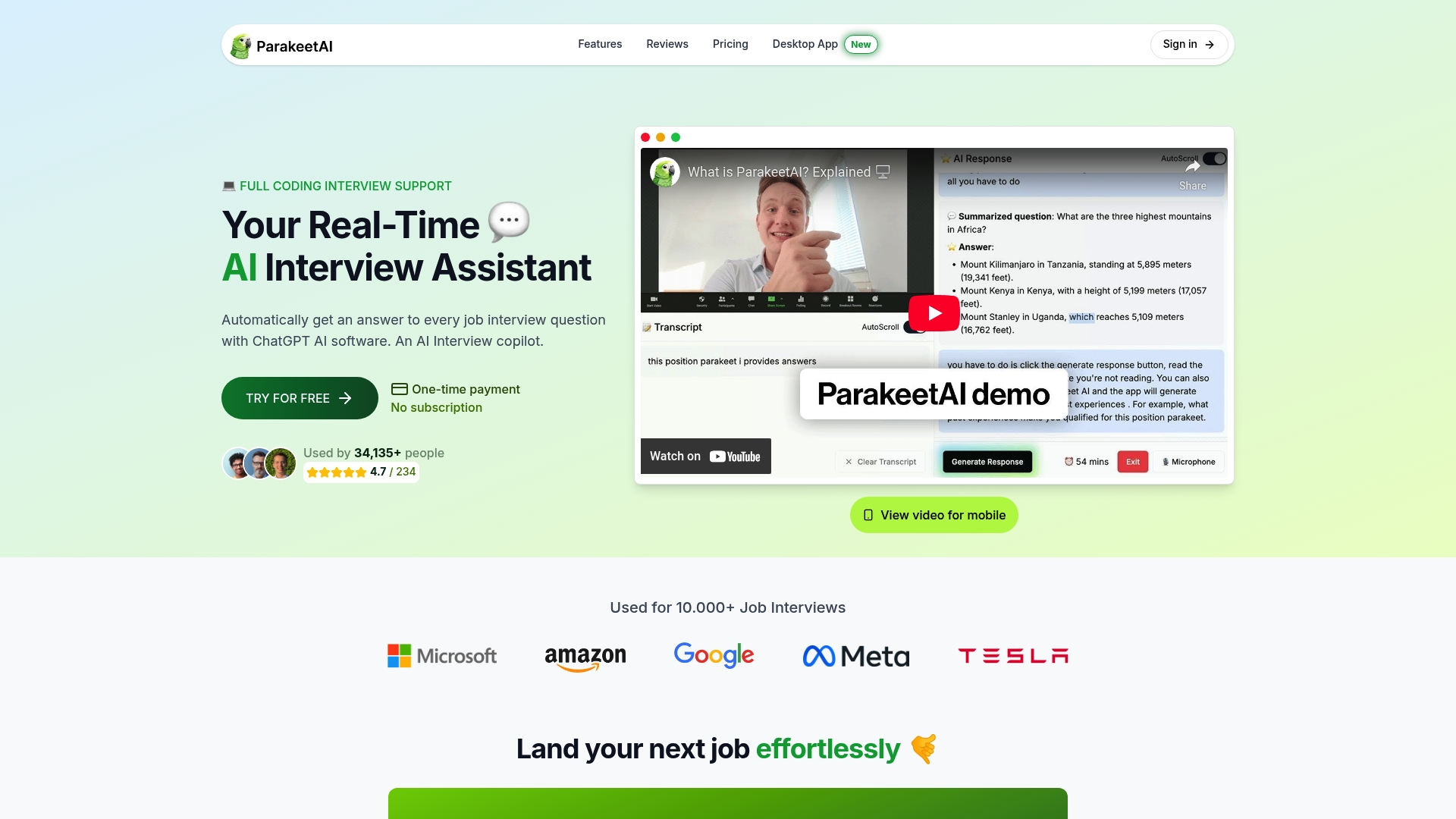
Parakeet AI supports your interview preparation from practice sessions through actual conversations. The system learns your background, strengths, and areas for improvement, then tailors suggestions to match your authentic voice and experience. This technology complements traditional preparation rather than replacing the critical thinking skills employers value most.
Pro Tip: Use Parakeet AI during mock interviews first to build comfort with the technology and refine how you translate suggestions into your own words. This practice ensures natural delivery during real interviews.
Ethical AI use enhances your performance while maintaining authenticity. The technology should amplify your strengths, not create a false persona. Review real-time AI answer strategies and ethical guidelines to understand how AI assistance fits your values and career goals. Transparent, thoughtful technology use demonstrates both innovation and integrity to forward thinking employers.
FAQ
What are the key cognitive skills tested in analytical interview questions?
Analytical interview questions assess logical reasoning, critical thinking, quantitative analysis, and pattern recognition abilities. Interviewers focus on how you process information, break down complex problems, and communicate your thought process rather than just evaluating final answers. These skills predict job performance across diverse roles and industries.
How can I effectively structure my answers during problem solving interviews?
Use the STAR framework to organize responses with Situation, Task, Action, and Result components. This structure creates logical flow, ensures comprehensive coverage, and makes answers memorable. Structured responses improve interviewer ratings by up to 30% compared to unorganized explanations, particularly in remote interview settings.
Is it ethical to use AI assistance during job interviews?
Ethical AI use requires transparency, fairness, and maintaining authentic communication. AI should support your reasoning process rather than replace genuine thinking. Research company policies on interview assistance tools and consider disclosing technology use when appropriate. Review comprehensive AI job interview ethics guidelines to make informed decisions that align with your values and the role’s expectations.
What common mistakes should I avoid when answering problem solving questions?
Avoid staying silent while thinking, instead verbalize your reasoning process continuously. Don’t overcomplicate answers with unnecessary jargon or jump to conclusions before understanding the full problem. Never rely solely on AI suggestions without ensuring you understand the logic behind recommendations. Ask clarifying questions and treat the interview as a collaborative problem solving conversation rather than a test with single correct answers.