
Best Pramp.com Alternatives for Live Interview Practice

TL;DR:AI on-demand simulators provide instant, repeatable practice with structured feedback, ideal for mid-stage prep. Paid human mocks offer the highest real-world signal for final polishing but are costly and less frequent. Combining coding reps, AI sessions, and limited paid mock interviews creates an effective, layered hiring prep strategy.
The most useful replacements for Pramp fall into three categories: AI on-demand simulators, paid human-review sessions, and coding-platform companions. If you have less than two weeks until your interview, skip the peer scheduling entirely and run AI simulator sessions today. If you have a month, build the full stack.
Quick picks:
- Parakeet-ai — Best for real-time AI assistance during live and mock interviews, on-demand, no scheduling required
- Interviewing.io — Best for anonymous mock interviews with engineers from top companies
- LeetCode — Best for high-volume coding reps and a massive problem library
- Exponent — Best for system design and behavioral interview prep with structured rubrics
- Pramp — Still viable for free peer practice, but scheduling friction and inconsistent feedback quality are real costs
MockExperts notes that, in 2026, the shift is toward proctoring-ready AI simulators that mirror real hiring environments with focus checks and copy-paste limits. IGotAnOffer flags the hidden opportunity cost of free peer platforms when you’re close to a deadline. Reviewer consensus across ShadeCoder, Skillora, and Edesy points to a layered hiring stack as the approach that actually moves candidates to readiness.
Start right now: run a 15–30 minute AI simulator session, or book a single paid expert mock if your interview is within a week.
Table of Contents
- How do these Pramp.com alternatives actually compare?
- What each alternative actually does and when to use it
- How do you pick the right alternative for your timeline?
- What does a practical hiring stack look like?
- Why these picks hold up: the evidence behind the recommendations
- Key Takeaways
- The gap between what interview prep promises and what actually moves candidates forward
- Parakeet-ai fits the AI-simulator step and goes further
- Useful sources and further reading
How do these Pramp.com alternatives actually compare?
| Dimension | Peer-scheduled (Pramp-style) | AI on-demand simulators | Paid human-review sessions | Coding-platform companions | Parakeet-ai |
|---|---|---|---|---|---|
| Best for | Free reps, social practice | Fast repetition, behavioral/system design | Final-stage polish | Algorithm depth | Real-time live interview support |
| Session format | Peer | AI | Human interviewer | Self-paced / AI | AI (real-time) |
| On-demand? | No — must schedule | Yes, 24/7 | No — book in advance | Yes | Yes |
| Coverage | Coding, some behavioral | Coding, behavioral, system design | Coding, behavioral, system design, case | Coding | Behavioral, coding, system design |
| Feedback quality | Variable, peer-dependent | Structured rubric, transcript, replay | High-signal, objective rubric | Automated hints | Real-time AI answers |
| Proctoring-ready | No | Yes — focus checks, copy-paste limits | Varies | No | Yes |
| Pricing | Free | Free tier or subscription | Pay-per-session ($50–$300+) | Free / subscription | Subscription |
| Anonymity / privacy | Anonymized peer | Session recordings vary | Recorded with consent | N/A | Session data per privacy policy |
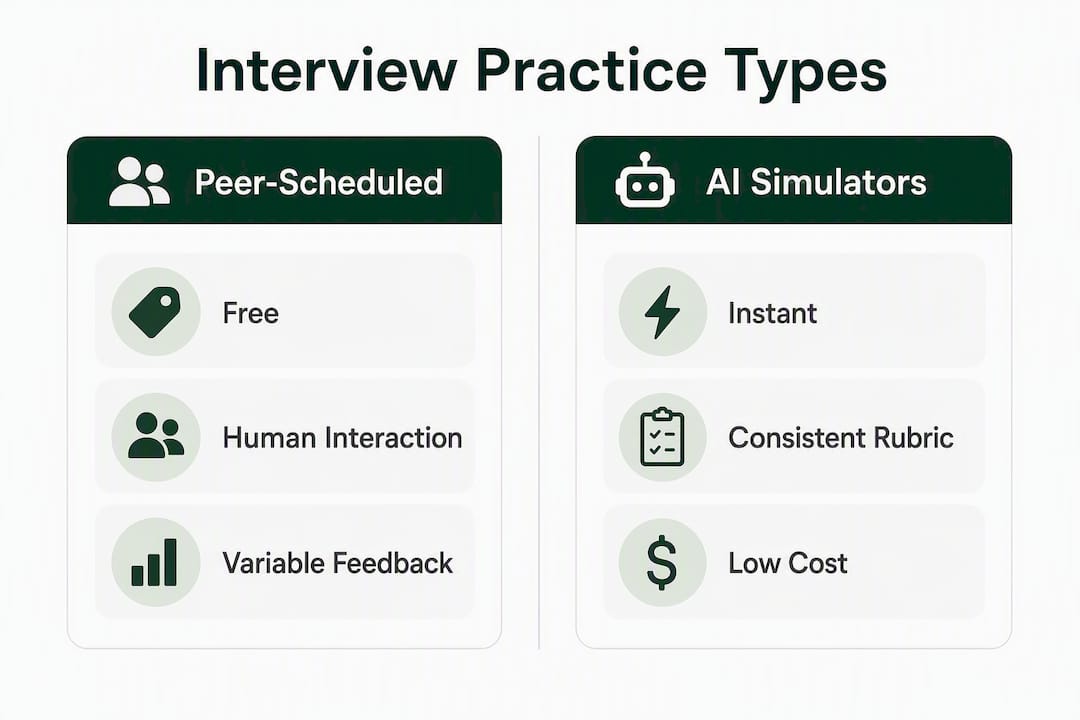
The core trade-off is speed versus fidelity versus cost. AI simulators give you instant, repeatable practice at low cost but can’t fully replicate the social pressure of a real conversation. Paid human mocks deliver the highest signal but are expensive and hard to repeat. Coding companions build raw algorithm muscle but don’t train communication at all. Read the option profiles below to match the right tool to your current prep stage.
What each alternative actually does and when to use it
AI on-demand simulators
These platforms let you start a mock interview in under a minute, any time of day. You get a structured rubric after each session, often with a transcript and replay. The feedback is consistent because it’s generated by the same model every time — no peer who zones out or gives vague encouragement. AI-driven mock interview platforms increasingly include proctoring features: browser focus checks and clipboard monitoring that mirror what you’ll face in a real proctored assessment. Best for mid-stage prep when you need volume on behavioral and system design questions. Most offer a free tier or trial.
Pros: On-demand, consistent rubric, replay available, proctoring simulation Cons: No human social friction, AI feedback can miss nuance in complex trade-off explanations
Paid human-review sessions
Platforms like Interviewing.io connect you with senior engineers from FAANG and similar companies for live mock interviews. The feedback is the closest thing to a real interview: strict timing, objective scoring, and follow-up questions that probe your reasoning. Paid coaching is recommended for the final polish stage, not for daily reps. At $50–$300+ per session, the cost adds up fast. One or two sessions in your final week is the sweet spot.
Pros: Highest signal, realistic pressure, objective rubric Cons: Expensive, requires scheduling, hard to repeat at scale
Coding-platform companions
LeetCode is the gold standard here. A massive problem library, a thriving community, and an interview-specific mode that supports video, voice, and collaborative coding. Use it daily for algorithm reps. It won’t train your communication or behavioral answers, but it will build the raw problem-solving speed you need. HackerRank and Codility serve a similar function, with HackerRank adding an AI Mock Interviewer feature for candidates who want guided practice.
Pros: Massive problem library, free tier, strong community signal Cons: No behavioral or system design coverage, no proctoring simulation
Peer-scheduled platforms (Pramp-style)
The original model: match with a peer, take turns interviewing each other. Free, human, and good for social practice. The main limitations are scheduling friction, inconsistent peer quality, and weak coverage outside coding. Candidates also report platform reliability issues: downtime, legacy compilers missing modern syntax, and audio dropouts. Worth using early in prep when you have time to absorb the scheduling overhead.

Pros: Free, human interaction, builds communication habits Cons: Scheduling required, feedback quality varies, limited non-coding coverage
Parakeet-ai
Parakeet-ai works differently from every other option here. It listens to your live interview in real time and surfaces AI-generated answers as questions come in. That makes it useful not just for mock practice but for actual interviews. It fits the AI-simulator step in the hiring stack and adds a layer of real-time support that no peer platform or coding companion provides.
How do you pick the right alternative for your timeline?
The fastest path to readiness depends on two things: how much time you have, and whether your weak point is communication, algorithm depth, or system design.
- Early stage (4+ weeks out): Start daily coding reps on LeetCode or HackerRank. Run peer sessions on Pramp-style platforms to build communication habits. Don’t worry about proctoring simulation yet.
- Mid stage (2–4 weeks out): Add AI on-demand simulators for behavioral and system design. Run multiple short sessions per week. Focus on rubric scores and replay to identify patterns in your answers.
- Final stage (under 2 weeks): Book one or two paid human mocks for high-fidelity feedback. Use AI simulators to fill gaps between sessions. If your real interview is proctored, practice with a platform that has focus checks and copy-paste limits turned on.
Checklist before committing to any platform:
- Does it offer on-demand sessions, or do you need to schedule?
- Does it cover the interview type you’re weakest in (behavioral, system design, case)?
- Does it provide a replay or transcript you can review afterward?
- Does it simulate proctoring if your real test is proctored?
- Is there a free trial or free tier so you can test it before paying?
Red flags: no replay or rubric, unclear pricing, session availability that depends on peer matching, no proctoring simulation when your real interview is proctored.
Pro Tip: If a platform doesn’t let you replay your session and see a structured rubric, you’re practicing without feedback. Volume without signal doesn’t move the needle.
What does a practical hiring stack look like?
The reviewer consensus for 2026 is clear: successful candidates combine tools rather than rely on one. Here’s the three-step stack.
- Daily coding reps (30–60 min/day): LeetCode or HackerRank for algorithm practice. Focus on medium-difficulty problems in your target domain.
- AI simulator sessions (20–40 min, 3–4x/week): On-demand behavioral and system design drills with rubric feedback. Use replay to catch filler words, weak transitions, and incomplete answers.
- Paid human mocks (60–90 min, 1–2 sessions in final week): Book with a senior engineer for high-signal final-stage feedback.
Two-week timetable:
- Days 1–4: LeetCode reps + two AI simulator sessions (behavioral focus)
- Days 5–8: LeetCode reps + two AI simulator sessions (system design focus)
- Days 9–11: AI simulator sessions with proctoring features on
- Days 12–14: One or two paid human mocks; review all rubrics and replays
One-month timetable:
- Week 1: Coding reps + peer sessions (Pramp-style) for communication baseline
- Week 2: Add AI simulators for behavioral and system design
- Week 3: Increase AI simulator frequency; start reviewing transcripts
- Week 4: Paid human mocks + final AI sessions with proctoring simulation
The benefits of mock interviews compound when you layer formats. One tool alone leaves gaps.
Why these picks hold up: the evidence behind the recommendations
AI on-demand simulators plus a hiring-stack approach represent the strongest candidate prep strategy for 2026, backed by consistent reviewer findings across multiple independent roundups.
MockExperts documents that proctoring-ready AI simulators now include focus checks and copy-paste limits that directly mirror real hiring environments. This matters because practicing without those constraints means your first exposure to them is during the actual test.
“Free platforms can incur an opportunity cost: scheduling friction and low-signal feedback create hidden costs for candidates close to interviews.” — IGotAnOffer
ShadeCoder’s 2026 roundup and Skillora’s analysis both recommend tool combinations organized by strength: AI speed and repetition, paid human review signal, and coding-platform depth. No single tool covers all three axes.
Parakeet-ai proof points: real-time AI answer generation during live interviews; on-demand availability with no scheduling; proctoring-compatible behavior; covers coding, behavioral, and system design question types.
One limitation worth naming: AI simulators, including Parakeet-ai, don’t fully replicate the social pressure of a human interviewer. Pacing, silence handling, and interpersonal cues require deliberate practice. That’s exactly why the final-stage human mock remains part of the stack.
Key Takeaways
The most effective prep strategy combines daily coding reps, on-demand AI simulator sessions, and one or two paid human mocks in the final week before your interview.
| Point | Details |
|---|---|
| Use a layered stack | Combine coding reps, AI simulators, and human mocks rather than relying on one platform. |
| AI simulators for volume | On-demand AI sessions give consistent rubric feedback and proctoring simulation without scheduling. |
| Save paid mocks for the final week | Paid human sessions deliver the highest signal but are expensive; one or two at the end is enough. |
| Practice proctoring features | If your real interview is proctored, run sessions with focus checks and copy-paste limits turned on beforehand. |
| Parakeet-ai for real-time support | Parakeet-ai fits the AI-simulator step and adds live answer assistance during actual interviews. |
The gap between what interview prep promises and what actually moves candidates forward
Most prep advice focuses on volume: do more problems, run more mocks. That’s not wrong, but it misses the variable that separates candidates who plateau from those who improve quickly. The variable is feedback quality, not session count.
A candidate who runs ten AI simulator sessions and reviews every rubric and replay will outpace someone who does twenty peer sessions with no structured debrief. The replay is where the real learning happens. You hear yourself say “um” fifteen times in two minutes. You notice you never actually answered the second part of the question. You see that your system design explanation ran four minutes over time.
The other mistake I see often: candidates treat AI practice as a substitute for human interaction rather than a complement to it. AI sessions are transactional by design. They won’t train you to handle a skeptical follow-up question, manage a long silence, or read whether the interviewer wants more depth or wants you to move on. Those skills require at least one or two human mocks, even if the rest of your prep is AI-driven.
The practical fix: during AI sessions, deliberately practice human cadence. Pause before answering. Narrate your thinking out loud. Treat the AI like a real interviewer, not a quiz machine. Then use the human mock to stress-test whether that habit actually holds under pressure.
Parakeet-ai fits the AI-simulator step and goes further
Every alternative in this article covers part of the prep problem. Parakeet-ai covers a different part: what happens when the real interview starts and you need support in the moment, not just in practice.
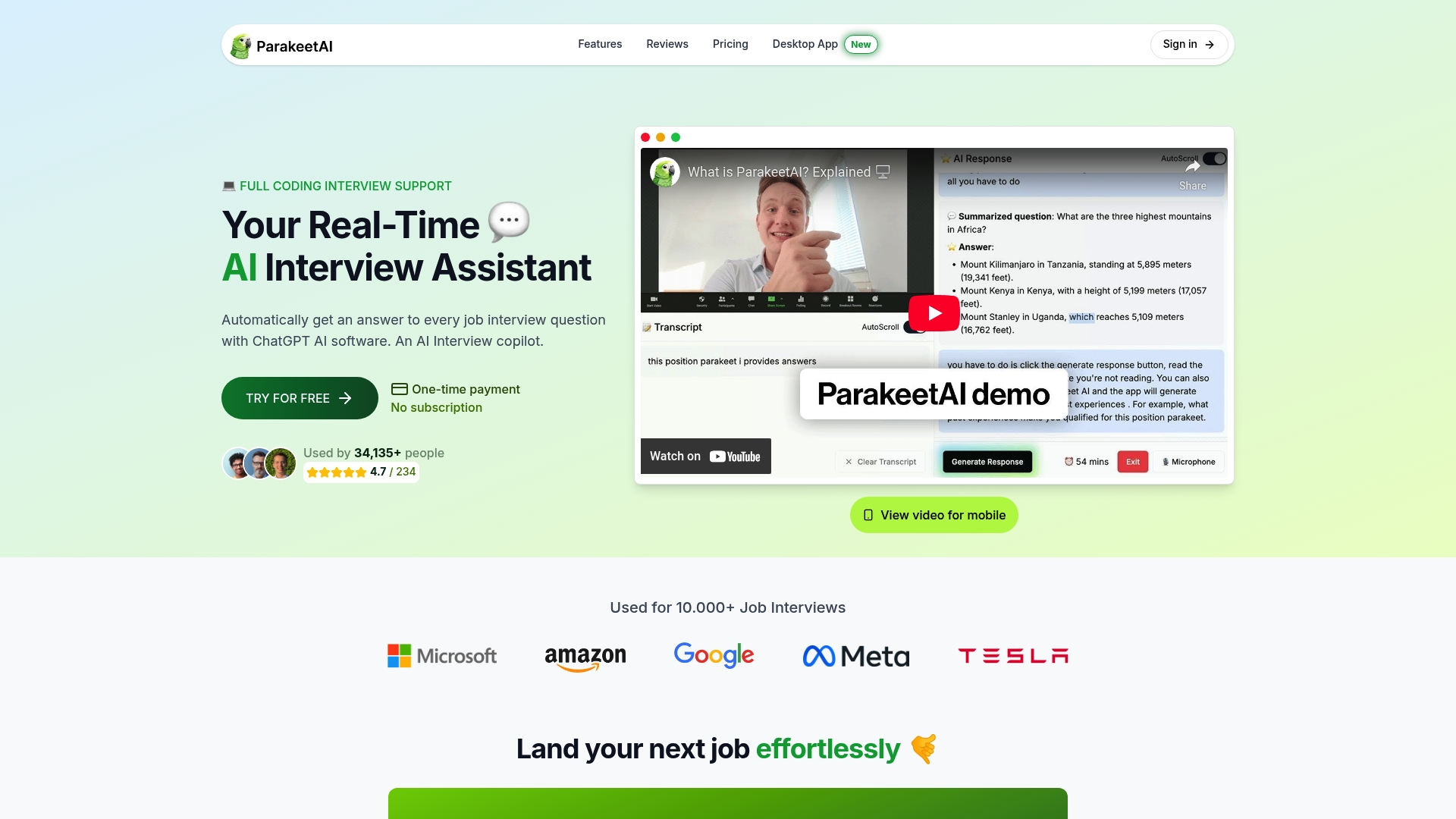
Parakeet-ai listens to your live interview and generates real-time answers to every question as it happens. No scheduling, no peer matching, no waiting. It fits directly into the AI-simulator step of the hiring stack and adds a layer no other tool here provides.
What it covers:
- Real-time AI answer generation during live and mock interviews
- On-demand availability, 24/7
- Behavioral, coding, and system design question types
- Proctoring-compatible design
- No peer scheduling required
Try a session at parakeet-ai.com to see how it fits your current prep stage. The AI-powered interview tools blog covers integrations and use cases if you want more context before starting.
Useful sources and further reading
External review sources:
- MockExperts: Pramp Alternatives 2026 — Covers proctoring-ready AI simulators, platform reliability issues, and candidate pain points with peer scheduling.
- IGotAnOffer: Pramp Review and Alternatives — Strong on the opportunity cost of free platforms and when to invest in paid coaching.
- ShadeCoder: Best Pramp Alternatives 2026 — Ranked roundup with hiring-stack consensus and category-strength analysis.
- Edesy: Best Pramp Alternatives 2026 — Positions AI platforms as instant, 24/7 alternatives; useful for on-demand availability framing.
- Skillora: 6 Best Pramp Alternatives 2026 — Category-strength breakdowns and tool combination recommendations.
Parakeet-ai blog resources:
| Resource | What it covers |
|---|---|
| AI-Driven Mock Interviews Explained | Feature breakdown: rubrics, transcripts, replay, and AI feedback mechanics |
| Benefits of Mock Interviews | Why layered mock practice builds readiness faster than single-tool prep |
| Technical Interview Prep | Practical prep plans and timelines for technical candidates |
Run one AI simulator session today. Follow the three-step hiring stack. The candidates who show up to final-round interviews having practiced with proctoring features turned on are the ones who don’t get rattled when the real thing starts.