
What is AI job fit analysis? How tech improves hiring

AI-selected candidates pass human interviews 54% of the time, compared to just 34% for traditional selection methods. That gap is not a coincidence. AI job fit analysis uses data-driven algorithms to evaluate how well a candidate’s skills, experience, and cultural signals align with a specific role, then assigns a match score. This article breaks down how the technology works, where it delivers real results, where it falls short, and exactly how both job seekers and HR professionals can use it to their advantage.
Table of Contents
- The basics: What is AI job fit analysis?
- How does AI evaluate job fit? The technology explained
- Evidence: Does AI job fit analysis actually work?
- Limitations and pitfalls: Where AI job fit analysis may fall short
- Best practices: Using AI job fit analysis for hiring and job search
- Ready to leverage AI for better hiring and interviews?
- Frequently asked questions
Key Takeaways
| Point | Details |
|---|---|
| AI boosts hiring success | AI job fit analysis raises interview pass rates and reduces hiring time when used properly. |
| Fit scores guide smart choices | Both HR and job seekers can use fit scores to focus on the best, most relevant opportunities. |
| Human oversight still needed | AI can miss candidates or reinforce biases, so expert review and fairness checks are essential. |
| Best for common roles | AI is most effective in standard roles with clear requirements but may underperform in niche areas. |
The basics: What is AI job fit analysis?
At its core, AI job fit analysis is the process where AI evaluates alignment between a candidate’s profile and job requirements, producing a match score that reflects how closely the two align. Think of it like a compatibility rating on a job application, except instead of gut instinct, it runs on structured data and machine learning.
Several key terms come up repeatedly in this space:
- Fit score or match percentage: A numerical value (often 0 to 100%) showing how well a candidate aligns with a role
- Resume parsing: The automated extraction of skills, job titles, education, and experience from a resume
- Skills overlap: The degree to which a candidate’s listed competencies match the job description’s requirements
- Cultural fit signals: Behavioral and language cues that suggest alignment with a company’s values
Scores are calculated by comparing a candidate’s parsed profile against the structured requirements of a job posting. The AI weighs factors like required skills, years of experience, education level, and sometimes even writing style or keyword density.
“AI job fit analysis gives HR teams a prioritized shortlist and gives job seekers a clear signal about where to focus their energy.”
For HR professionals, this means faster shortlisting and fewer hours spent reviewing unqualified applications. For job seekers, it means understanding which roles are worth applying to and which gaps to close before applying. Tools like AI resume screening have made this process faster and more consistent than manual review.
How does AI evaluate job fit? The technology explained
Behind every fit score is a multi-step process that goes far beyond simple keyword matching. Here is what actually happens when an AI system evaluates a candidate:
- Resume parsing: The AI reads the resume and extracts structured data, including job titles, skills, dates, and education.
- Job description parsing: The same process runs on the job posting, identifying required and preferred qualifications.
- Feature extraction: Machine learning models identify meaningful patterns, like whether a candidate’s experience level matches the seniority of the role.
- Vectorization: Both the candidate profile and job description are converted into numerical representations (vectors) so the AI can compare them mathematically.
- Semantic matching: Instead of just matching exact words, NLP for resume parsing allows the system to recognize that “managed a team” and “led cross-functional groups” mean similar things.
- Scoring and ranking: Candidates are ranked by their match percentage, with the highest fits surfaced first.
The mechanics involve NLP for resume parsing, machine learning for feature extraction, and semantic matching to understand context, not just keywords.
| Technology | What it does | Why it matters |
|---|---|---|
| NLP (Natural Language Processing) | Reads and interprets text | Understands meaning, not just words |
| Machine learning | Identifies patterns in data | Improves accuracy over time |
| Semantic matching | Compares meaning across phrases | Catches synonyms and related skills |
| Predictive modeling | Forecasts candidate success | Prioritizes high-potential applicants |
For example, a candidate with Python, SQL, and three years of data analysis experience applying to a data analyst role might receive an 85% match score because their skills overlap strongly with the job’s requirements, even if their resume uses slightly different terminology.

Pro Tip: If you understand that AI reads meaning rather than exact words, you can write your resume using the same language as the job description without keyword stuffing. That small shift can move your score from 65% to 80% or higher.
Evidence: Does AI job fit analysis actually work?
Understanding the technology is important, but do these algorithms make a real-world difference? The data says yes, and the numbers are significant.
AI-assisted hiring delivers a 30% reduction in time-to-hire, 44% fewer interviews needed, and candidates with high match scores are up to 3 to 4 times more likely to be interviewed than those flagged as low-fit. That is not a marginal improvement. That is a structural shift in how hiring pipelines operate.
54% of AI-selected candidates pass human interviews, versus 34% for traditionally selected candidates. That is a 20-percentage-point improvement in hiring accuracy.
| Metric | Traditional hiring | AI-assisted hiring |
|---|---|---|
| Interview pass rate | 34% | 54% |
| Time-to-hire reduction | Baseline | 30% faster |
| Interviews needed | Baseline | 44% fewer |
| Likelihood of interview (high match) | 1x | 3 to 4x |
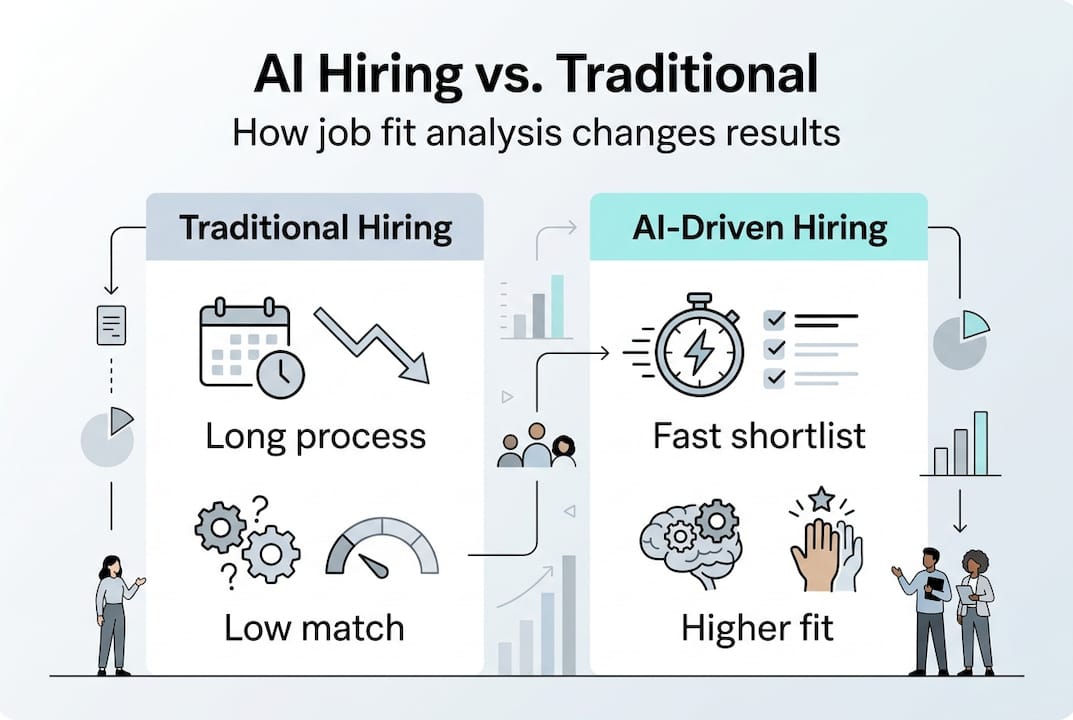
For HR professionals, fewer interviews means less time wasted on poor fits and more energy spent on candidates who are genuinely qualified. For job seekers, a high match score is a meaningful signal that your application will be seen. You can explore more about AI job matching results and what drives these outcomes in practice.
The efficiency gains are clearest in high-volume hiring, where companies receive hundreds of applications per role. AI fit analysis does not replace human judgment, but it dramatically narrows the field before humans ever get involved.
Limitations and pitfalls: Where AI job fit analysis may fall short
While AI brings big improvements, it has limitations every user should understand. Ignoring these risks leads to missed talent and unfair outcomes.
AI underperforms in niche sectors, can amplify historical biases, and is vulnerable to resume inflation and data mismatches. Here is where the cracks appear most often:
- Niche or creative roles: AI models trained on mainstream job data struggle with roles that require unconventional backgrounds or portfolio-based skills.
- Resume inflation: Candidates who stuff resumes with keywords can game the system, inflating their scores without having the actual skills.
- Location and format mismatches: If a resume is formatted unusually or contains location data the AI misreads, scores can drop unfairly.
- Bias amplification: If the AI is trained on historical hiring data that favored certain demographics, it will replicate those patterns at scale.
- The inverted-U of effectiveness: AI fit analysis works best for mid-complexity roles. For highly specialized or entry-level roles with little data, accuracy drops.
“An AI system trained on biased historical data does not just repeat past mistakes. It scales them.”
The risk of algorithmic bias in hiring is real and documented. Companies that deploy AI fit tools without regular audits risk systematically excluding qualified candidates from underrepresented groups. An AI fairness guide can help HR teams build the right checks into their process.
Pro Tip: Always review AI recommendations manually for unique, creative, or leadership roles. A 65% match score on a creative director role might still represent your best candidate if their portfolio is exceptional.
Best practices: Using AI job fit analysis for hiring and job search
Knowing the strengths and weaknesses lets you use AI fit analysis as an advantage. Here is how to do it right, whether you are a job seeker or an HR professional.
For job seekers:
- Target 80%+ match scores. Job seekers should target 80%+ fits and manually review gaps before applying. Roles below 60% are usually not worth the effort unless you have a strong internal referral.
- Mirror the job description language. Use the same terminology the job posting uses. If the role says “stakeholder management,” use that phrase, not “client relations.”
- Check role specificity manually. AI scores reflect keyword and skills overlap, not company culture or team dynamics. Always research the company independently.
- Combine AI tools with networking. A strong referral can override a lower match score. Use AI to identify the right roles, then activate your network to get in front of the right people.
For HR professionals:
- Keep a human in the loop. Use AI to shortlist, not to decide. Final hiring decisions should always involve human review.
- Conduct regular bias audits. Review your AI tool’s outputs quarterly to check for demographic skew in who gets shortlisted.
- Prefer domain-specific models. Generic AI tools trained on broad data perform worse than models trained on your industry’s specific roles and requirements.
- Set clear fit thresholds. Define what score qualifies a candidate for review and document that threshold so it can be audited.
Pro Tip: Use AI fit analysis to shortlist faster, not as a final authority. The best hiring decisions combine algorithmic efficiency with human insight, especially when evaluating AI ethics in interviews and candidate experience.
Ready to leverage AI for better hiring and interviews?
AI job fit analysis gives you a data-backed edge, whether you are screening hundreds of applicants or trying to land your next role. But fit scores are just one piece of the puzzle. What happens once you get into the interview room matters just as much.
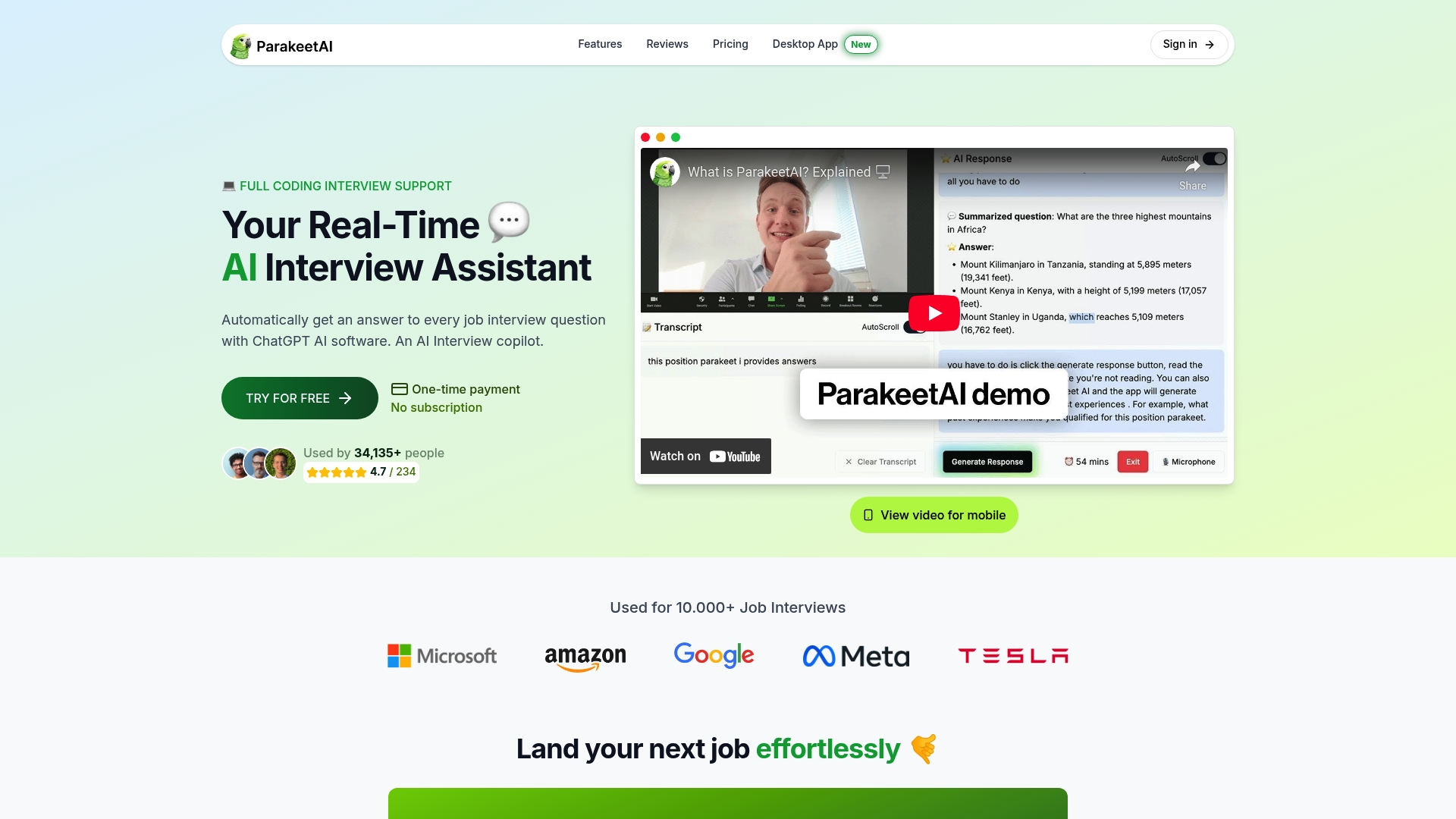
Parakeet AI is a real-time AI interview assistant that listens to your interview as it happens and automatically provides answers to every question using AI. For job seekers, it means walking into every interview prepared for anything. For HR teams exploring AI-driven hiring solutions, it demonstrates exactly how far real-time AI assistance has come. If you want to see AI work in your favor at every stage of the hiring process, from fit scoring to the final interview, Parakeet AI is built for that.
Frequently asked questions
How is an AI job fit score calculated?
AI evaluates your resume, skills, and career data against job requirements using NLP for parsing and ML for feature matching, then generates a percentage score. The higher the overlap between your profile and the job’s requirements, the higher your score.
Does a high AI match score guarantee an interview?
No, but candidates with 80%+ match scores are 3 to 4 times more likely to be interviewed according to current research. A high score improves your odds significantly but does not replace a strong application.
Can AI job fit analysis miss qualified candidates?
Yes, especially in niche roles or when AI uses biased historical data that underrepresents certain candidate profiles. Human review remains essential for catching these gaps.
How can job seekers use AI fit analysis to their advantage?
Target 80%+ fits and always manually review gaps and company-specific requirements before applying. Mirror the job description’s language in your resume to improve your match score organically.
Should HR professionals trust AI fit analysis results?
HR should use AI results as a guide, not a final decision, and combine them with human judgment and regular fairness audits to ensure equitable outcomes across all candidate groups.