
Conversational Context in Interviews: A 2026 Guide

TL;DR:Conversational context in interviews creates authentic dialogues that reveal how candidates think and communicate.AI tools enhance this process by analyzing real-time interactions and surfacing valuable insights.
What is conversational context in interviews?
Conversational context in interviews is the natural, dynamic framework that shapes how interviewer and candidate exchange information. Instead of moving through a rigid script, both parties respond to each other’s cues, adjust their questions and answers in real time, and build a genuine dialogue. The result feels less like an interrogation and more like a focused, purposeful conversation.
The key elements that define this approach:
- Organic flow: No predetermined script; the exchange develops naturally based on what each person says.
- Spontaneous follow-up: Questions arise from the candidate’s actual answers, not a checklist.
- Mutual tailoring: Both parties adapt their language and depth to match the other’s cues.
- Relaxed but purposeful rhythm: The pace stays lively without feeling rushed or formal.
- Low stress environment: Conversational interviews reduce stress scores to under 10 on a 100-point scale, compared to 20–50 in traditional formats.
The contrast with scripted interviews is sharp. A structured interview locks both parties into predetermined questions and scoring rubrics. Conversational interviewing trades that rigidity for depth, letting the dialogue reveal who a candidate actually is rather than how well they rehearsed.
How conversational and structured interviews actually differ
The difference goes beyond tone. It touches format, roles, and the kind of information each approach produces.
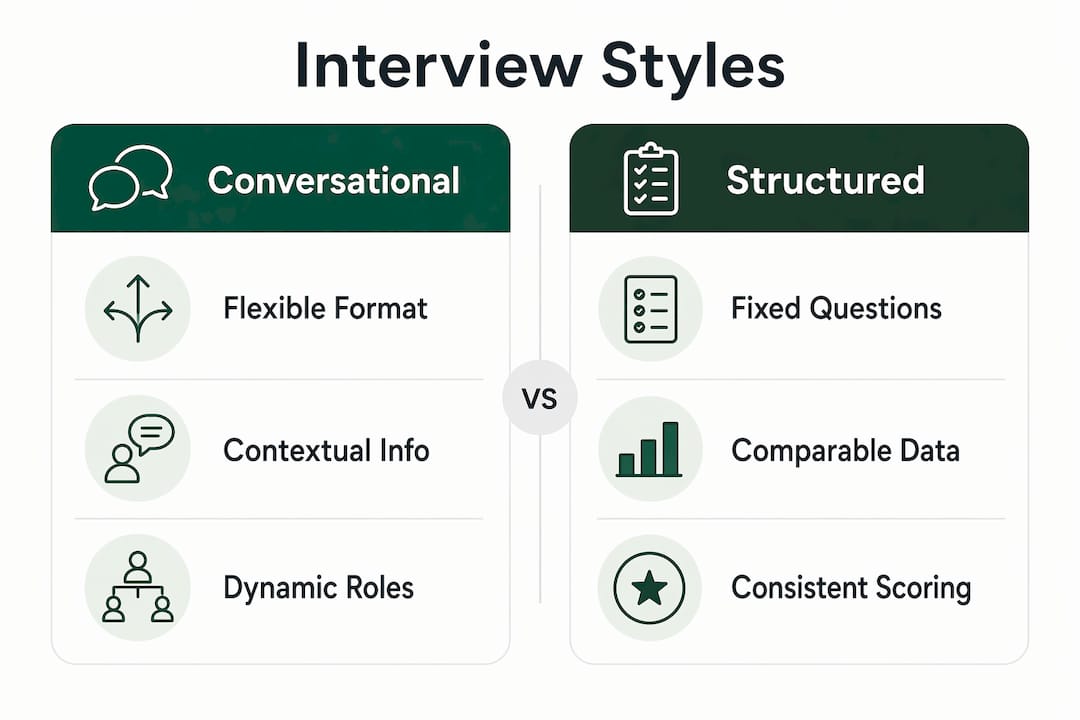
Structured interviews use consistent questions asked in the same order to every candidate, scored against fixed criteria. That standardization makes comparison easier and reduces some forms of bias. The tradeoff is that flexible conversational flow increases the depth of candidate insight in ways a rigid script cannot.
Conversational interviews flip the dynamic:
- Interviewer role: Facilitator and active listener, not question administrator.
- Candidate role: Participant in a dialogue, not a respondent working through a list.
- Question source: Answers themselves generate the next question, organically.
- Scoring: Relies on qualitative judgment and nuanced observation rather than a fixed rubric.
- Candidate comfort: Notably higher, which tends to produce more honest, detailed responses.
The practical implication is that structured interviews excel when you need defensible, comparable data across a large candidate pool. Conversational interviews excel when you need to understand how someone actually thinks, communicates, and adapts.
Tips and best practices for conducting conversational interviews
Good conversational interviewing looks effortless. It rarely is. The preparation behind it is what makes the spontaneity possible.
Before the interview
- Prepare 5–7 open-ended questions. Effective interviewers rely on a handful of broad questions and let natural follow-ups do the rest.
- Research the candidate’s background so you can connect their experience to your team’s real challenges.
- Set the tone in your opening. A brief, genuine introduction about the role and team signals that this will be a conversation, not an interrogation.
During the interview
- Listen more than you talk. The candidate’s words are your next question.
- Follow up on specifics. If someone mentions a project, ask what made it hard, not just what they did.
- Let pauses breathe. Silence gives candidates space to add depth they might otherwise skip.
- Avoid rescuing vague answers with leading questions. Ask “tell me more about that” instead.
After the interview
- Take notes on conversational cues, not just content. Did the candidate ask clarifying questions? Did their energy shift on certain topics?
- Reflect on alignment. Did their examples connect to your team’s actual context, or did they feel generic?
Pro Tip: Candidates who ask clarifying questions during the interview consistently demonstrate stronger contextual awareness. Treat that behavior as a positive signal, not an interruption.
Benefits of using conversational context and interviewing techniques
The advantages show up on both sides of the table.
For hiring managers, the biggest gain is information quality. When candidates feel at ease, they move past rehearsed answers and reveal how they actually think. Conversational interviewing creates a more positive candidate experience, which also strengthens employer brand perception among people who did not get the job.
For candidates, the lower-pressure environment makes it easier to demonstrate real skills rather than performance. Key benefits across both groups:
- Reduced stress produces more authentic, detailed responses from candidates.
- Deeper insight into adaptability, communication style, and cultural fit.
- Better mutual understanding of whether the role and candidate genuinely match.
- Stronger employer brand: Candidates respond favorably to the conversational style, making your organization more attractive as a place to work.
- Improved hiring decisions grounded in how a candidate engages with real job context, not just how they answer preset questions.
How AI enhances conversational context in interview settings
AI tools are changing what interviewers and candidates can do with conversational AI, enhancing conversational context. The shift is not about replacing human judgment but sharpening it.
Modern context-aware interviewing technology analyzes live interview dialogue, detecting spontaneous speech elements like fillers, self-repairs, and topic shifts. These features, far from being flaws, are natural markers of authentic interaction that signal how a candidate processes and communicates under real conditions.

Parakeet-ai takes this further. It listens to the interview in real time and generates responses aligned with the conversational dynamics already in play, giving candidates context-aware support precisely when they need it. The system does not just transcribe; it reads the flow of the exchange and responds to it.
For interviewers, conversational analytics surfaces patterns across multiple conversations: which questions generate depth, where candidates disengage, and how emotional tone shifts across the dialogue. That kind of analysis used to require hours of manual review. AI compresses it to minutes.
The role of natural language processing in this process is worth understanding. NLP models parse not just what candidates say but how they say it, including pacing, hedging language, and the structure of their reasoning. Combined with conversational context, that produces a far richer picture of candidate fit than any scoring rubric alone.
Real examples of conversational context applied in interviews
Abstract principles land differently when you see them in action.

Scenario 1: The misaligned context. A senior engineering candidate interviews with a team focused on sprint-level execution. She leads with high-level architecture examples from her current role. The team cannot connect her experience to their daily work, and the interview stalls. The fix is simple: ask the team what they are currently building before the interview, then frame your examples in that context. Misaligned conversational contexts have caused hiring teams to perceive strong candidates as unsuitable, even when those candidates came in with strong recommendations.
Scenario 2: The clarifying question that changed everything. A candidate in a technical interview faces a vague question about database management. Instead of guessing at scope, she asks: “Are you looking for experience with specific databases, or is this more about general data management practices?” That one question refocuses the conversation, signals thoughtfulness, and gives the interviewer exactly what they need to evaluate her accurately.
Scenario 3: The STAR method with tight context. MIT’s Career Advising and Professional Development program recommends that candidates spend roughly 20% of a behavioral answer on situation context, 10% on the task, 60% on actions, and 10% on results. Candidates who over-explain the background lose the interviewer before they reach the part that actually matters.
How conversational context shapes candidate evaluation and decisions
Interviewers make judgments based on impressions formed during the conversation, and those impressions are heavily shaped by context. Research from the Journal of Individual and Social Sciences shows that interviewers tend to treat candidate behavior during the interview as a stable indicator of future performance, often without accounting for how much the interview setting itself shapes that behavior.
Conversational context corrects for this. When the dialogue connects to real job challenges, the candidate’s responses become more predictive. A candidate who asks about the team’s current projects and tailors their examples accordingly gives the interviewer far more useful signal than one who delivers polished but generic answers.
The evaluation impact is concrete. Keeping behavioral answers tight on value, obstacle, and orientation, rather than lengthy background, keeps interviewers engaged through the action and results portions. That is where hiring decisions actually get made.
How candidates can recognize and adapt to a conversational interview style
You will usually know within the first two minutes. The interviewer introduces themselves informally, offers context about the team, and asks an open question rather than jumping straight to “tell me about yourself.” That is your signal to shift out of presentation mode.
Practical ways to adapt:
- Match the register. If the interviewer is conversational and informal, drop the rehearsed speech patterns. Speak the way you would to a knowledgeable colleague.
- Ask questions early. Proactively asking about the team’s current challenges shows contextual awareness and turns the interview into a genuine exchange.
- Let your answers breathe. You do not need to fill every pause. A brief pause before answering reads as thoughtfulness, not hesitation.
- Adapt your examples in real time. If you learn mid-interview that the team is focused on a specific problem, pivot your next example to address it directly.
Candidates who treat situational interview questions as conversation prompts rather than test questions consistently come across as more genuine and more prepared.
Key Takeaways
Conversational context in interviews produces better hiring decisions by replacing scripted exchanges with authentic dialogue that reveals how candidates actually think and communicate.
| Point | Details |
|---|---|
| Stress drops sharply | Conversational interviews reduce stress to under 10 on a 100-point scale compared to 20–50 in traditional formats, leading to a more comfortable candidate experience. |
| Preparation enables spontaneity | Effective interviewers prepare 5–7 open questions and let natural follow-ups drive depth. |
| Context alignment is critical | Misaligned conversational contexts cause strong candidates to appear unsuitable; always connect examples to the team’s real challenges. |
| AI sharpens the analysis | Tools like Parakeet-ai analyze live conversational dynamics to surface insights that manual review misses. |
| Candidates should ask first | Proactively seeking role context during the interview improves performance and signals genuine engagement. |