
Explaining Conversational AI in Interviews: Clear Answers

You’re sitting across from the hiring manager when they lean forward and ask, “Can you explain conversational AI in simple terms?” Your mind races. You know it involves chatbots and natural language processing, but how do you articulate it clearly without sounding like you’re reading a textbook? This moment can make or break your interview, especially as conversational AI uses NLP, NLU, dialogue management, and ML to enable natural human-like conversations. Whether you’re interviewing for a tech role or simply want to demonstrate AI literacy, mastering this explanation gives you a competitive edge. This guide breaks down conversational AI into interview-ready answers that showcase your understanding while keeping things refreshingly simple.
Table of Contents
- What is conversational AI? A simple explanation
- How conversational AI works: The interview-ready breakdown
- Strengths and limitations of conversational AI: What interviewers look for
- Applying conversational AI: How to use it for interview prep
- Master your next interview with real-time AI support
- Frequently asked questions
Key Takeaways
| Point | Details |
|---|---|
| Conversational AI basics | It lets computers understand and respond to human language like people do. |
| Explaining simply | Use real-world analogies and highlight key technologies when asked in interviews. |
| Know strengths and limits | Be honest about what conversational AI does well and where it can break down. |
| Real interview benefits | Practicing with AI tools can boost your confidence and improve your actual interview results. |
What is conversational AI? A simple explanation
With the stage set, let’s clarify what conversational AI actually means and how to explain it simply.
Conversational AI is technology that enables machines to understand, process, and respond to human language in a natural way. Think of it as AI that chats like a human customer service representative, understanding your questions and providing relevant answers. The magic happens through several interconnected technologies working together seamlessly.
At its core, conversational AI uses natural language processing, natural language understanding, dialogue management, and machine learning to create fluid interactions. Natural language processing (NLP) breaks down the words you say or type into data the computer can analyze. Natural language understanding (NLU) goes deeper, figuring out what you actually mean, including context and intent. Dialogue management keeps track of the conversation flow, remembering what was said earlier. Machine learning allows the system to improve over time by learning from thousands of interactions.
You encounter conversational AI daily. Chatbots answering customer questions on websites, voice assistants like Siri or Alexa, and even AI interview basics tools that help job seekers practice responses all rely on this technology. The key difference between basic automated responses and true conversational AI is the ability to handle unexpected questions and maintain context across multiple exchanges.
Pro Tip: When explaining conversational AI in interviews, use a relatable analogy. Say it’s like having a knowledgeable assistant who never sleeps, can handle thousands of conversations simultaneously, and gets smarter with every interaction.
Here’s how the main components compare:
| Component | Function | Interview Example |
|---|---|---|
| Natural Language Processing | Breaks down language into analyzable data | Converts “Tell me about your experience” into structured input |
| Natural Language Understanding | Interprets meaning and intent | Recognizes the interviewer wants career history, not personal life |
| Dialogue Management | Maintains conversation context | Remembers previous answers to ask relevant follow-ups |
| Machine Learning | Improves accuracy over time | Learns industry-specific terminology and patterns |
When summarizing for interviewers, focus on three key points:
- Conversational AI enables natural, human-like interactions between people and machines
- It combines multiple technologies to understand context, not just keywords
- Real-world applications range from customer service to AI interview analogies that help candidates prepare
The beauty of conversational AI lies in its accessibility. You don’t need a computer science degree to grasp the concept. It’s simply teaching computers to communicate the way humans do, understanding nuance, context, and intent rather than just matching keywords to pre-programmed responses.
How conversational AI works: The interview-ready breakdown
Now that you can define conversational AI, here’s how to explain the nuts and bolts in a way that impresses interviewers.
Understanding the step-by-step process of conversational AI helps you articulate its value clearly. In job interviews for AI roles, explain conversational AI simply: subfield of AI for natural human-software communication, including NLP for understanding input, dialogue management for context, and generation for responses. Here’s the complete cycle:
- User Input: You ask a question or make a statement, either by typing or speaking
- Input Processing: The system converts your words into a format it can analyze, cleaning up filler words and identifying key terms
- Intent Recognition: Natural language understanding determines what you’re actually asking for, considering context from earlier in the conversation
- Context Maintenance: Dialogue management tracks the conversation history, ensuring responses make sense based on what’s already been discussed
- Response Generation: The system formulates an appropriate answer using natural language generation (NLG), pulling from its knowledge base
- Output Delivery: The response is converted back into natural language and delivered to you via text or speech
This cycle happens in milliseconds, creating the illusion of instant understanding. In HR applications, conversational AI is tested rigorously. Systems must handle multi-turn dialogues where candidates ask clarifying questions, change topics mid-conversation, or provide incomplete information. The importance of AI in interviews has grown as companies seek efficient, unbiased screening methods.
Pro Tip: Always emphasize the input/output cycle when explaining conversational AI in interviews. It demonstrates you understand the complete process, not just buzzwords.
Recent benchmarks reveal both strengths and weaknesses:
| Performance Area | Success Rate | Notes |
|---|---|---|
| Basic conversation | 85-90% | Simple question-answer exchanges work well |
| Context retention | 70-75% | Maintains thread across 3-5 exchanges |
| Complex requests | 45-55% | Struggles with multi-step instructions |
| Repair sequences | 40-50% | Difficulty recovering from misunderstandings |
| Closing sequences | 60-65% | Can awkwardly end conversations |
“Large language models excel in basic conversation but falter with complex tasks requiring multiple steps or sophisticated context management.”
This limitation matters in interview settings. A conversational AI might handle straightforward screening questions brilliantly but struggle when a candidate provides an unexpected answer that requires nuanced follow-up. Understanding these boundaries shows interviewers you think critically about technology rather than accepting marketing hype.
The dialogue management component deserves special attention. It’s what separates a basic chatbot from true conversational AI. Imagine asking, “What benefits does your company offer?” followed by “How does that compare to industry standards?” The system must remember “that” refers to the benefits just discussed. This contextual awareness requires sophisticated memory and reasoning capabilities.

Strengths and limitations of conversational AI: What interviewers look for
After describing how conversational AI works, be ready to discuss its real strengths and where it sometimes falls short.
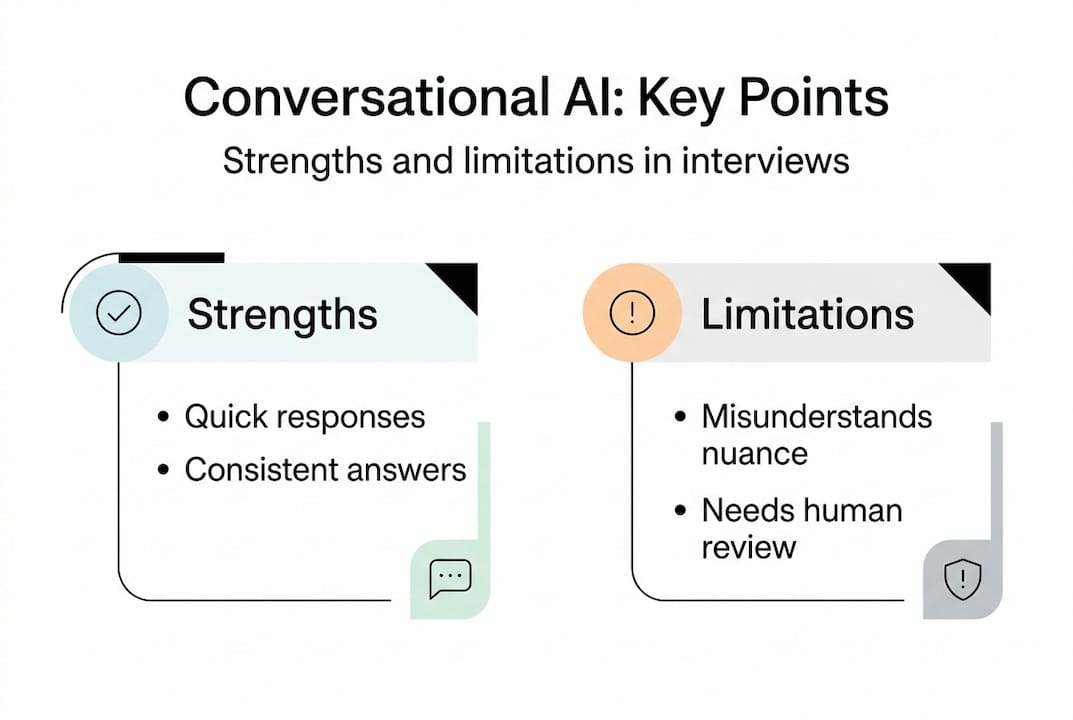
Interviewers value candidates who present balanced perspectives. Acknowledging both advantages and limitations demonstrates maturity and critical thinking. Let’s examine what conversational AI does exceptionally well.
Key strengths include:
- Scalability: A single conversational AI system can handle thousands of simultaneous conversations, impossible for human teams
- 24/7 Availability: No breaks, no time zones, no holidays, providing consistent service around the clock
- Unbiased First-Pass Screening: When properly designed, AI evaluates candidates based on qualifications rather than unconscious human biases
- Consistent Feedback: Every candidate receives the same quality of interaction and evaluation criteria
- Data-Driven Insights: Systems track patterns across thousands of interactions, identifying what works and what doesn’t
The numbers back this up. Empirical data shows micro1 AI systems improved hiring accuracy by 20 percentage points and halved recruiter time per hire. That’s not incremental improvement, it’s transformational efficiency.
However, conversational AI faces real limitations:
- Hallucinations: Systems sometimes generate confident-sounding but completely incorrect information
- Context Challenges: LLMs perform well on basic conversation but struggle with repair tasks, closing sequences, and complex multi-turn requests
- Nuance Blindness: Sarcasm, humor, and cultural references often confuse AI systems
- Rigid Frameworks: Conversations that deviate from expected patterns can derail the interaction
- Lack of Emotional Intelligence: AI can’t truly empathize or read emotional cues the way humans do
Ethical considerations add another layer. Transparency matters, candidates deserve to know when they’re interacting with AI rather than humans. Bias remains a concern despite claims of objectivity, AI systems trained on biased data perpetuate those biases. Fairness requires ongoing monitoring to ensure AI and interview fairness standards are maintained across diverse candidate pools.
Pro Tip: When discussing conversational AI limitations in interviews, always pair each weakness with how it’s being addressed. This shows you understand both the problem and the solution space.
The most impressive candidates acknowledge that conversational AI is a powerful tool, not a perfect replacement for human judgment. It excels at handling routine interactions and providing consistent initial screening, but complex decision-making still benefits from human oversight. Understanding AI ethics in interviews demonstrates you’re thinking beyond technical capabilities to real-world implications.
Interviewers particularly appreciate when candidates discuss the balance between automation and human touch. Conversational AI should augment human capabilities, not eliminate human involvement entirely. The best implementations use AI to handle repetitive tasks, freeing humans to focus on nuanced evaluation and relationship building.
Applying conversational AI: How to use it for interview prep
Balanced awareness helps you not just answer interview questions, but also use these tools to your advantage as a job seeker.
Conversational AI isn’t just something to discuss in interviews, it’s a powerful tool for preparing for them. Smart job seekers leverage these systems to practice responses, identify weaknesses, and build confidence before the real thing.
Here’s your step-by-step approach:
- Choose Your Platform: Select an AI-powered interview practice tool that matches your target industry and role level
- Set Up Realistic Scenarios: Input the job description and company information to generate relevant questions
- Conduct Practice Sessions: Engage with the AI as if it’s a real interview, answering questions out loud or in writing
- Review Detailed Feedback: Analyze the AI’s assessment of your responses, noting patterns in areas needing improvement
- Iterate and Improve: Practice the same questions multiple times, tracking how your scores improve with each attempt
- Simulate Pressure: Use timed sessions to replicate the stress of real interviews
Top conversational AI tools measure multiple dimensions:
- Fluency: How smoothly you articulate ideas without excessive filler words or long pauses
- Clarity: Whether your answers directly address the question with logical structure
- Job Fitness: How well your responses align with the specific role requirements
- Confidence Indicators: Tone, pace, and word choice that signal self-assurance
- Content Quality: Depth of examples, use of specific metrics, and relevance to the question
The evidence supporting AI-powered practice is compelling. GPT-4 Turbo scores as well as humans at interview scoring, meaning the feedback you receive from these tools matches what human recruiters would say. This validation gives you confidence that the practice translates to real-world improvement.
“Empirical data demonstrates that AI interviewers improved hiring accuracy by 20 percentage points while cutting recruiter time per hire in half, proving these systems deliver measurable value.”
Practical applications extend beyond just answering questions. Conversational AI can help you understand AI interview feedback tools and what evaluators look for in strong candidates. You can practice explaining technical concepts in simple terms, a crucial skill when interviewing for roles that require translating complex ideas to non-technical stakeholders.
The efficiency gains matter too. Traditional interview prep might involve scheduling mock interviews with friends or career counselors, coordinating calendars and hoping for quality feedback. Conversational AI provides instant, detailed analysis whenever you’re ready to practice. This accessibility means you can fit preparation into your schedule rather than working around others’ availability.
Some job seekers worry that using AI for practice feels artificial or won’t translate to human interactions. The data suggests otherwise. The skills you develop, clear articulation, structured thinking, confident delivery, transfer directly to real interviews. Think of it like athletes using video analysis to improve their form. The practice environment differs from game day, but the improvements are real.
Understanding AI for HR efficiency also helps you appreciate what companies value. When you demonstrate knowledge of how AI streamlines hiring processes, you signal that you understand modern business operations and can contribute to efficiency initiatives.
Master your next interview with real-time AI support
You’ve learned how to explain conversational AI clearly and use it for preparation. But what if you could have that AI expertise supporting you during the actual interview? That’s where having an intelligent assistant makes all the difference.
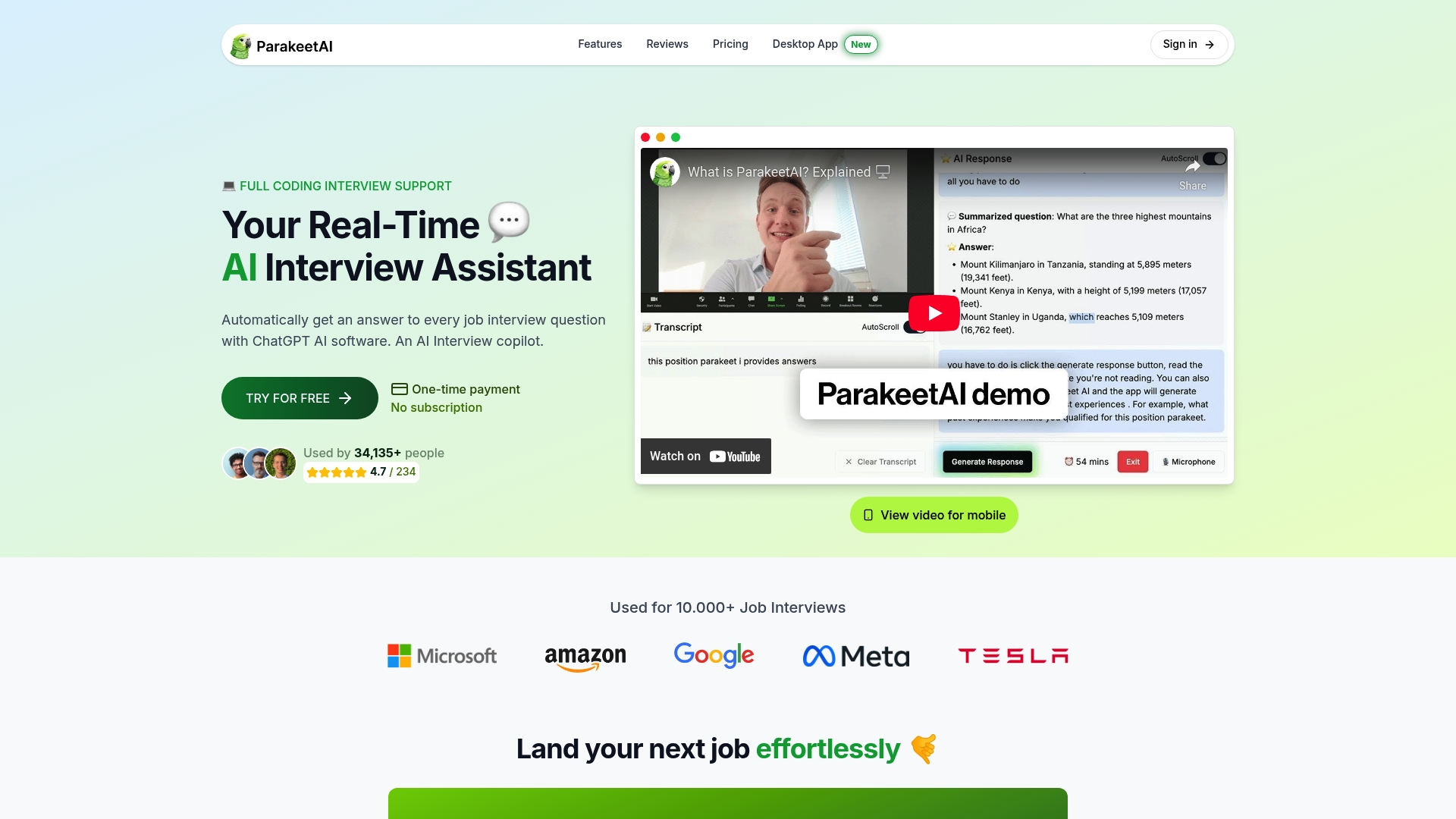
Parakeet AI listens to your interview in real time and automatically provides answers to every question using AI. Instead of hoping you remember everything from your practice sessions, you get instant, relevant responses tailored to each question as it’s asked. The system understands context, maintains conversation flow, and helps you articulate complex ideas with confidence. Whether you’re explaining conversational AI itself or discussing your experience with machine learning projects, Parakeet AI ensures you never struggle for the right words. It’s like having an expert coach whispering perfect answers in your ear, transforming interview anxiety into interview excellence.
Frequently asked questions
How should I explain conversational AI if asked during a job interview?
State that conversational AI enables computers to interact naturally with people through language, using technologies like NLP and machine learning for understanding and responding. Keep it simple and relatable.
What is an example of conversational AI used in hiring?
A common example is an AI-powered chatbot that asks candidates screening questions and provides instant feedback. These systems handle initial interviews at scale while maintaining consistency.
What are the limitations of conversational AI in interviews?
Conversational AI can misunderstand complex, multi-step questions and may give inaccurate answers. LLMs perform well on basic conversation but struggle with complex requests requiring nuanced understanding.
Does practicing with conversational AI actually improve my interview performance?
Yes, studies show AI interviewers can boost hiring accuracy by 20 percentage points and halve recruiter time while providing useful feedback. The practice translates to real improvement.
How do I balance technical accuracy with simplicity when explaining conversational AI?
Use analogies that relate to everyday experiences, like comparing it to a smart customer service representative. Mention the key technologies (NLP, NLU, machine learning) but focus on what they accomplish rather than how they work internally.