
What Is Dynamic Interview Adaptation? A 2026 Guide

TL;DR:Dynamic interview adaptation involves changing questions in real time to obtain deeper insights during hiring. It improves decision accuracy, fairness, and candidate experience by focusing on genuine reasoning over rehearsed answers. Implementing it requires gradual process changes and fostering a culture that values flexibility and emergent themes.
Dynamic interview adaptation is the process of adjusting interview questions and conversation flow in real time based on how a candidate responds, producing deeper and more accurate hiring decisions. Unlike static interviews that follow a fixed script, adaptive interviewing methods treat each conversation as a living assessment that evolves with the candidate. The field now draws on behavioral psychology, psychometrics, and AI to make that evolution systematic rather than improvised. For both job seekers and HR professionals, understanding this shift changes how you prepare for and conduct interviews in 2026.
What is dynamic interview adaptation, and how does it differ from static interviews?
Dynamic interview adaptation is a structured departure from the traditional fixed-question model. In a static interview, every candidate answers the same questions in the same order, regardless of what they say. That uniformity sounds fair, but it creates a ceiling on insight. A candidate who gives a shallow answer to question three gets the same follow-up as one who reveals a complex, nuanced situation.
Adaptive interviewing methods remove that ceiling. The interviewer, or an AI system, reads the response and selects the next question based on what was just said. This creates a branching conversation rather than a linear checklist.
The contrast between retrospective and prospective behavioral questions captures this shift well. Traditional interviews rely on retrospective prompts: “Tell me about a time you led a team.” Prospective behavioral simulations ask candidates to reason through a scenario that has not happened yet. Organizations are shifting from retrospective questions to prospective simulations because they measure cognitive adaptability more reliably. That matters because real jobs demand forward thinking, not just polished stories about the past.
The core limitations of static interviews include:
- Rehearsed answers win. Fixed question banks reward memorization over genuine thinking.
- Shallow responses go unchallenged. Without adaptive probing, a vague answer ends the thread.
- Irrelevant questions waste time. Every candidate gets every question, even when some are clearly not applicable.
- Bias compounds. Interviewers fill gaps in fixed scripts with gut instinct, which is where bias enters.
Pro Tip: If you are a job seeker preparing for an adaptive interview, practice reasoning through unfamiliar scenarios out loud. Interviewers using dynamic techniques are listening for how you think, not whether you recall a specific story.
How do AI and psychometrics power adaptive interviewing?
The technology behind dynamic interview adaptation combines AI question selection, psychometric modeling, and semantic analysis. Each layer serves a distinct purpose.

AI-driven question selection uses algorithms rooted in Item Response Theory (IRT) and the Rasch Model, both established psychometric frameworks. IRT estimates a candidate’s ability level from each response and selects the next question at the right difficulty. The Rasch Model maps responses onto a single scale, making comparisons across candidates more consistent. These are not experimental ideas. They have been used in standardized testing for decades and are now being applied to hiring.
Semantic analysis adds a second layer. AI-based interview simulators assess the semantic relevance and coherence of responses, adjusting question difficulty to reduce redundancy and improve efficiency. This means the system is not just tracking whether an answer is long or short. It is evaluating whether the answer actually addresses the question’s intent.
Multi-agent AI systems take this further by balancing predefined topic coverage with emergent theme discovery. Adaptive systems simulate conversation rollouts and select high-utility question trajectories, enabling exploration of unexpected but relevant interview themes. That is a meaningful capability. A human interviewer might miss a thread that reveals a candidate’s strongest competency. A multi-agent system can detect it and pursue it.
| Technology | Function | Outcome |
|---|---|---|
| Item Response Theory (IRT) | Estimates candidate ability per response | Calibrates question difficulty in real time |
| Rasch Model | Maps responses to a single measurement scale | Enables fair cross-candidate comparison |
| Transformer-based semantic analysis | Evaluates response relevance and coherence | Reduces redundant questions, improves focus |
| Multi-agent conversation simulation | Balances topic coverage with emergent themes | Discovers unexpected but relevant competencies |
| AI debiasing tools | Detects rating inconsistencies in real time | Reduces judgmental variability across interviewers |
One distinction worth understanding is the difference between dynamic questioning and true adaptive moderation. Dynamic questioning uses deterministic trees, while adaptive moderation generates novel questions non-deterministically based on the full candidate history. Deterministic trees are easier to build but easier to game. True adaptive moderation is harder to prepare for because no two conversations follow the same path.
What are the key benefits of dynamic interview adaptation?
The benefits of dynamic interviews fall into three categories: better data for hiring decisions, a stronger candidate experience, and greater fairness.
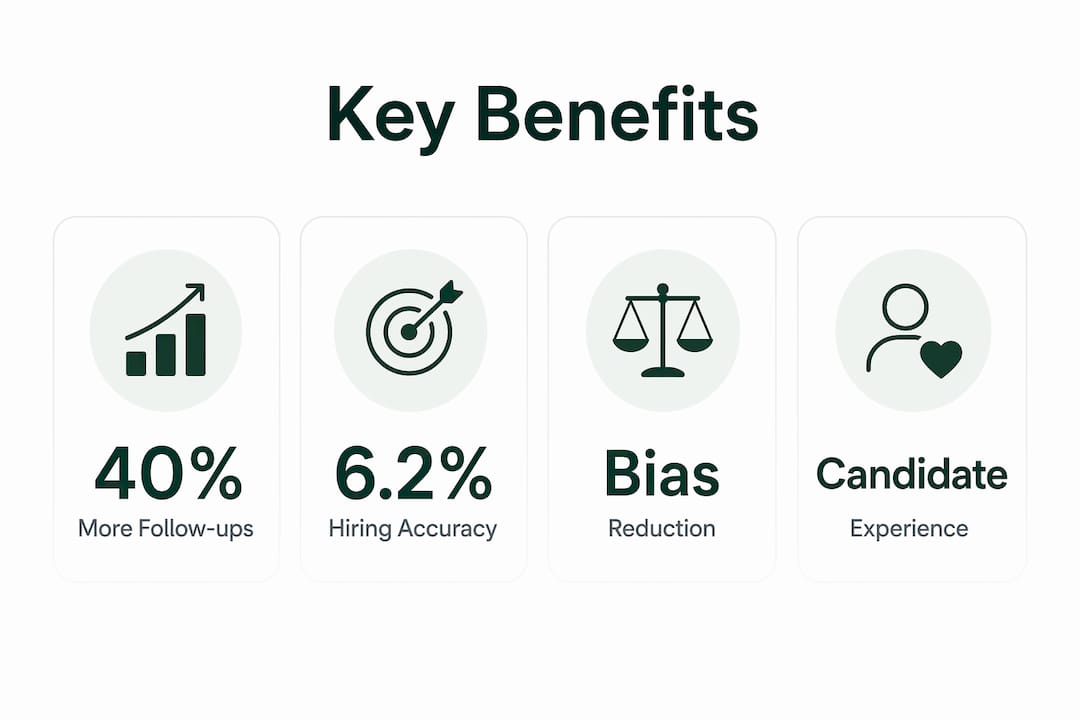
On decision accuracy, adaptive AI interviews integrate follow-up questions based on candidate responses in about 40% of interview interactions, improving decision accuracy by 6.2% (45.5% versus 39.3% accuracy with versus without follow-up-derived evidence). A 6.2% accuracy gain sounds modest, but across hundreds of hires, it translates to meaningfully fewer costly mis-hires.
The candidate experience also improves. AI-driven adaptive questioning in technical interviews dynamically adjusts complexity and content based on performance, increasing top-talent acceptance rates by up to 50%. Top candidates disengage when interviews feel generic or too easy. Adaptive pacing signals that the organization takes assessment seriously, which attracts the people who take their own performance seriously.
Key benefits for HR professionals and job seekers include:
- Personalized pacing. Questions match the candidate’s demonstrated level, keeping the conversation productive.
- Reduced irrelevance. Adaptive branching skips questions that no longer apply given earlier answers.
- Stronger predictive validity. Prospective behavioral simulations and contextual probing predict real-world performance better than rehearsed STAR stories.
- Measurable fairness gains. AI tools can serve as real-time debiasing partners during behavioral interviews, reducing judgmental variability by over 50%.
That last point deserves emphasis. Bias in interviews is not always conscious. Interviewers make snap judgments and then construct post-hoc rationales. AI debiasing tools interrupt that pattern by flagging inconsistencies before they harden into decisions. Understanding why AI matters in interviews helps both recruiters and candidates see this not as a threat but as a correction mechanism.
How to implement dynamic interviewing strategies effectively
HR professionals adopting dynamic interview techniques need a phased approach. Wholesale replacement of existing processes rarely works. Gradual integration does.
- Audit your current interview guides. Identify which questions are truly fixed and which could branch based on candidate responses. Most guides have more flexibility than they appear to.
- Replace generic rubrics with adaptive ones. Contextual Fluidity and Negative Capability rubrics better capture candidate adaptability and comfort with ambiguity than standard scorecards. Contextual Fluidity scores how well a candidate adjusts mid-scenario. Negative Capability measures comfort with unresolved complexity.
- Design dynamic probe libraries. For each core competency, write three to five follow-up probes at different depth levels. Train interviewers to select probes based on response quality, not habit.
- Integrate AI tools for debiasing and question selection. Start with AI-assisted debiasing before moving to fully adaptive question generation. The former is easier to implement and delivers immediate fairness gains.
- Train interviewers on listening for specificity. The most common failure in adaptive interviews is interviewers who nod and move on instead of probing. Specificity in a candidate’s answer is the signal to go deeper, not to advance.
- Review and iterate. After each hiring cycle, compare outcomes for candidates assessed with adaptive versus static methods. Use that data to refine your probe libraries and rubrics.
For job seekers, the practical implication is clear. Behavioral interview success is less about reciting rehearsed answers and more about demonstrating flexibility and the ability to adjust to evolving scenarios. Cognitive flexibility predicts better adaptive interview outcomes. Practicing with varied, unfamiliar scenarios builds that flexibility more effectively than memorizing STAR responses.
Pro Tip: HR professionals piloting adaptive interviews should start with one role or department. Collect structured feedback from both interviewers and candidates after each session. Small-scale pilots reveal friction points before they become organization-wide problems.
Pairing these strategies with AI-driven interview best practices gives HR teams a concrete framework for modernizing their hiring process without discarding what already works.
Key Takeaways
Dynamic interview adaptation outperforms static interviewing because it adjusts question flow in real time, producing more accurate, fair, and candidate-specific assessments than any fixed script can deliver.
| Point | Details |
|---|---|
| Core definition | Dynamic adaptation adjusts questions in real time based on candidate responses, not a fixed script. |
| Accuracy improvement | Adaptive follow-up questions improve hiring decision accuracy by 6.2% compared to non-adaptive methods. |
| Fairness gains | AI debiasing tools used in adaptive interviews reduce judgmental variability by over 50%. |
| Key rubrics to adopt | Contextual Fluidity and Negative Capability rubrics predict real-world performance better than generic scorecards. |
| Candidate preparation | Practicing cognitive flexibility and scenario reasoning matters more than memorizing rehearsed answers. |
The human element that technology cannot replace
I have spent years watching hiring processes evolve, and the most persistent mistake I see is treating dynamic interview adaptation as a purely technical upgrade. Organizations buy an AI platform, configure a question bank, and expect the results to improve automatically. They rarely do, at least not fully.
The real value of adaptive interviewing is that it restores a conversation to what an interview was always supposed to be: a genuine exchange where one person tries to understand how another thinks. AI handles the pattern recognition and the bias correction. But the interviewer still has to be present enough to notice when a candidate’s answer opens a door worth walking through.
The shift from retrospective to prospective behavioral questions is where I see the biggest gains. Asking someone what they would do in a scenario they have never faced strips away the rehearsed answer and forces real reasoning. That is where you find out whether someone can actually do the job, not just talk about having done something similar once.
The challenge for HR teams is not the technology. It is the culture change. Interviewers who have used the same scorecard for five years resist fluid rubrics because fluidity feels like subjectivity. The data says otherwise. Contextual Fluidity scores are more predictive than generic rubrics, not less rigorous. That argument, made with evidence, is how you bring skeptical interviewers along.
The future of this field points toward AI systems that can detect emergent themes in real time and surface them to human interviewers mid-conversation. That is not science fiction. Multi-agent systems already approximate it. The organizations that will hire best in the next five years are the ones building interviewer skills and AI capabilities at the same time, not choosing between them.
— Jure
How Parakeet-ai supports adaptive interview preparation
Parakeet-ai is a real-time AI interview assistant that listens to your interview and automatically generates answers to every question as it happens. For job seekers navigating adaptive interviews, that kind of live support changes the dynamic entirely.
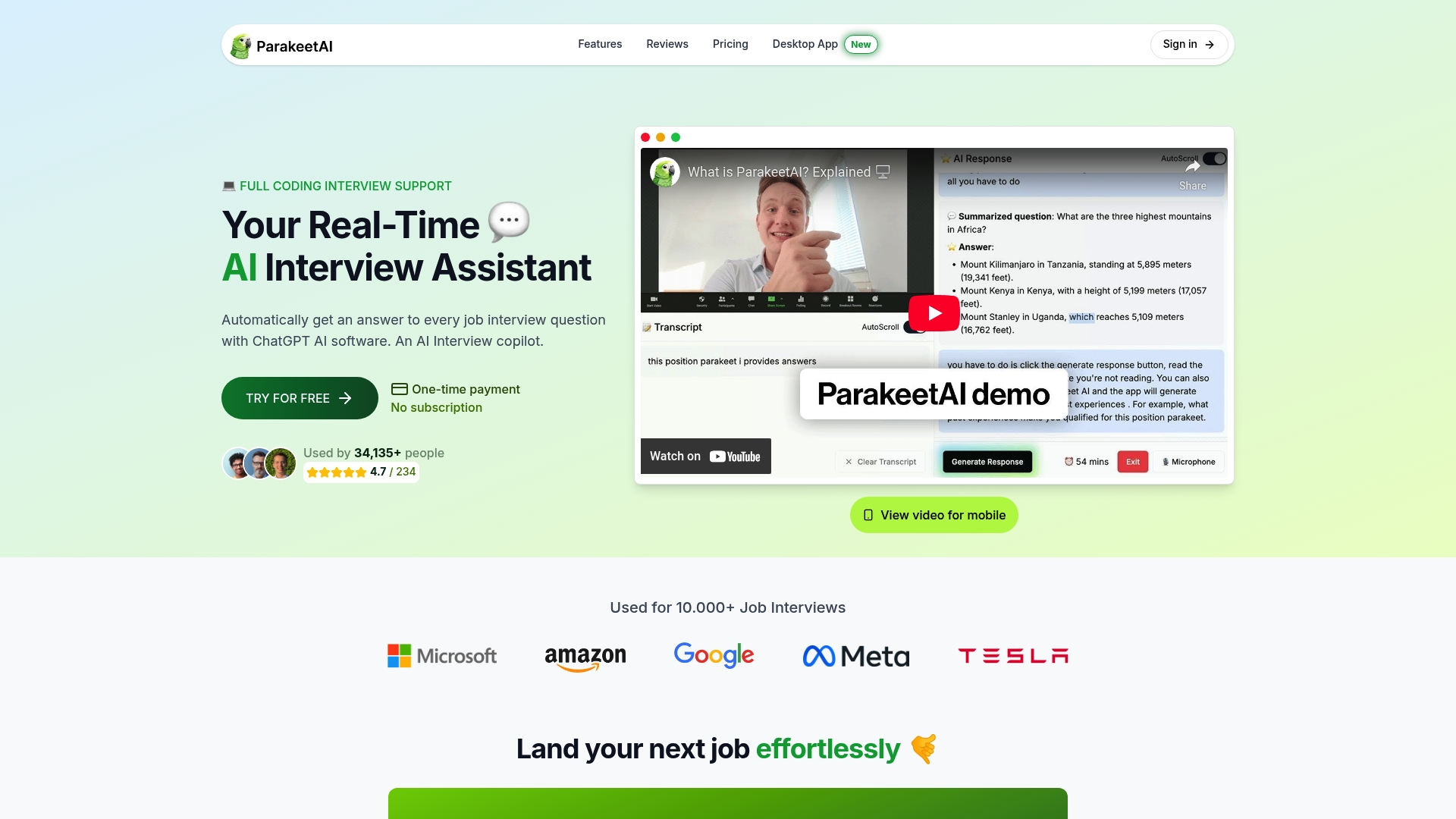
Where adaptive interviews are designed to probe beyond rehearsed answers, Parakeet-ai helps you respond with clarity and specificity in the moment. The assistant processes the question being asked and surfaces a relevant, structured response you can build on. That is not a shortcut. It is a way to stay composed when an interviewer pivots unexpectedly. Explore how Parakeet-ai works in real interviews and see whether it fits your preparation approach.
FAQ
What is dynamic interview adaptation in simple terms?
Dynamic interview adaptation is the practice of changing interview questions in real time based on what a candidate says, rather than following a fixed list. The goal is to get more accurate and relevant information from each conversation.
How does adaptive interviewing improve hiring accuracy?
Adaptive AI interviews that integrate follow-up questions based on candidate responses improve decision accuracy by 6.2% compared to non-adaptive methods. That gain comes from pursuing the specific evidence each candidate’s answers reveal.
What is the difference between dynamic questioning and adaptive moderation?
Dynamic questioning follows a deterministic branching tree, while adaptive moderation generates novel questions based on the full conversation history. Adaptive moderation is harder to game because no two interviews follow the same path.
How should job seekers prepare for adaptive interviews?
Focus on practicing scenario-based reasoning rather than memorizing STAR stories. Cognitive flexibility and the ability to adjust mid-scenario predict better outcomes in adaptive interviews than rehearsed answers do.
What rubrics work best for evaluating candidates in dynamic interviews?
Contextual Fluidity and Negative Capability rubrics outperform generic scorecards in adaptive settings. Contextual Fluidity measures how well a candidate adjusts mid-scenario, while Negative Capability scores comfort with unresolved ambiguity.