
Interview Data Security: What Candidates Using AI Must Know

TL;DR:Interview data security involves practices that protect all information generated during a hiring process from unauthorized access or misuse. Using AI assistants during interviews increases data exposure risks, making it crucial to check privacy policies, isolate assessment environments, and prevent data leaks through device controls. Candidates must actively manage their data by asking vendors about storage, retention, and deletion policies while being aware of legal protections and the impact of AI tools on privacy.
Interview data security is the set of practices that keep everything created, transmitted, or captured during a hiring interaction — audio, video, transcripts, screen shares, code samples, platform logs, and behavioral signals — safe from unauthorized access, misuse, or persistent retention. If you use a real-time AI assistant like Parakeet-ai during live interviews, your data flows through more systems than a traditional call, which raises the stakes considerably.
Three things you can do right now:
- Check the vendor’s privacy policy before your next session. Look specifically for retention timelines and whether your audio or transcript is used to train AI models.
- Run coding assessments on a dedicated device or VM, isolated from your main machine and personal credentials.
- Disable clipboard sync and cloud auto-backup before the session starts so nothing you paste or type leaves your device silently.
Table of Contents
- What counts as interview data?
- What are the real risks to you as a candidate?
- What U.S. law says about your interview data
- How responsible employers and platforms handle your data
- Your practical checklist for AI-assisted interviews
- How real-time AI assistants like Parakeet-ai change the security model
- Key Takeaways
- Why candidates underestimate this risk
- Useful sources for deeper reading
What counts as interview data?
The category is broader than most candidates realize. Here is what you are actually generating during a modern hiring process:
- Audio and video recordings: Every spoken word and camera frame, including background details that reveal your home address or family situation.
- Transcripts and AI summaries: Text versions of your answers, sometimes processed by third-party transcription services before the hiring team ever reads them.
- Identity verification photos and biometrics: Uploaded ID scans, facial-recognition checks, and liveness-detection data that one-way video platforms store as sensitive biometric records.
- Platform metadata and logs: Login timestamps, IP addresses, device fingerprints, and session duration.
- Screen shares and live system views: Any browser tab, terminal session, internal dashboard, or URL visible during a shared screen — including things you did not intend to show.
- Code samples, take-home assignments, and repository links: Companies sometimes copy assessments from production logic, which means the code you interact with may contain real customer data or proprietary architecture.
- Behavioral and biometric signals: Some AI-driven platforms capture gaze direction, micro-expressions, keystroke timing, and response latency as part of automated scoring.
What are the real risks to you as a candidate?
Privacy exposure and identity risk
Recordings and transcripts can be leaked, sold, or retained far longer than the hiring decision requires. If identity-verification photos are stored without strong access controls, they become a vector for identity fraud.
Intellectual property exposure
You may accidentally share proprietary information from your current employer. Pasting a real client’s code into an external AI model, or screen-sharing a dashboard you use at work, can create legal liability under trade-secret law. The risk runs both ways: companies sometimes overshare for realism during assessments, exposing their own architecture to a candidate who has not yet signed an NDA.
Malware via coding assessments
This one surprises most candidates. Microsoft Defender Experts observed the “Contagious Interview” campaign, where attackers used recruiter outreach and malicious NPM packages to deliver payloads to developer endpoints. Running an install command from an unverified assessment repository can compromise your entire machine.
Biased or inaccurate AI processing
An AI-generated summary of your interview can be wrong, and you may never see it. Persistent flagged content in a platform’s database can follow you across applications if the vendor shares data between clients.
Pro Tip: Before any coding assessment, search the repository name and the recruiter’s company on LinkedIn. If the company has no verifiable presence, treat the assessment as a potential social-engineering attempt.
What U.S. law says about your interview data
Recording consent rules vary sharply by state. Federal law requires only one-party consent, but states like California, Florida, and Illinois require all parties to consent before a call is recorded. If you and your interviewer are in different states, the stricter state’s law generally applies. Always check before you record anything yourself.
California residents have specific rights under the CCPA/CPRA: you can request access to personal data a vendor holds about you, ask for deletion, and opt out of the sale of your information. Platforms operating with California data subjects must support these data-subject requests and disclose how AI processing works.
- Trade secrets: Never paste client code, customer data, or proprietary architecture into an external AI tool. Your employment agreement almost certainly prohibits it, and doing so can expose you to civil liability independent of any breach.
- Breach notification: If you suspect your interview data was exposed, you are entitled to notification under most state breach-notification laws. Document the incident, note the date, and contact the platform’s security team in writing.
- Legal caveat: State laws change. Verify the recording-consent rules in your state and consult an attorney before taking action in an employer-level dispute.
Pro Tip: California’s CCPA deletion right applies to vendors, not just employers. If a platform processed your interview data, you can submit a deletion request directly to them, regardless of whether you got the job.
How responsible employers and platforms handle your data
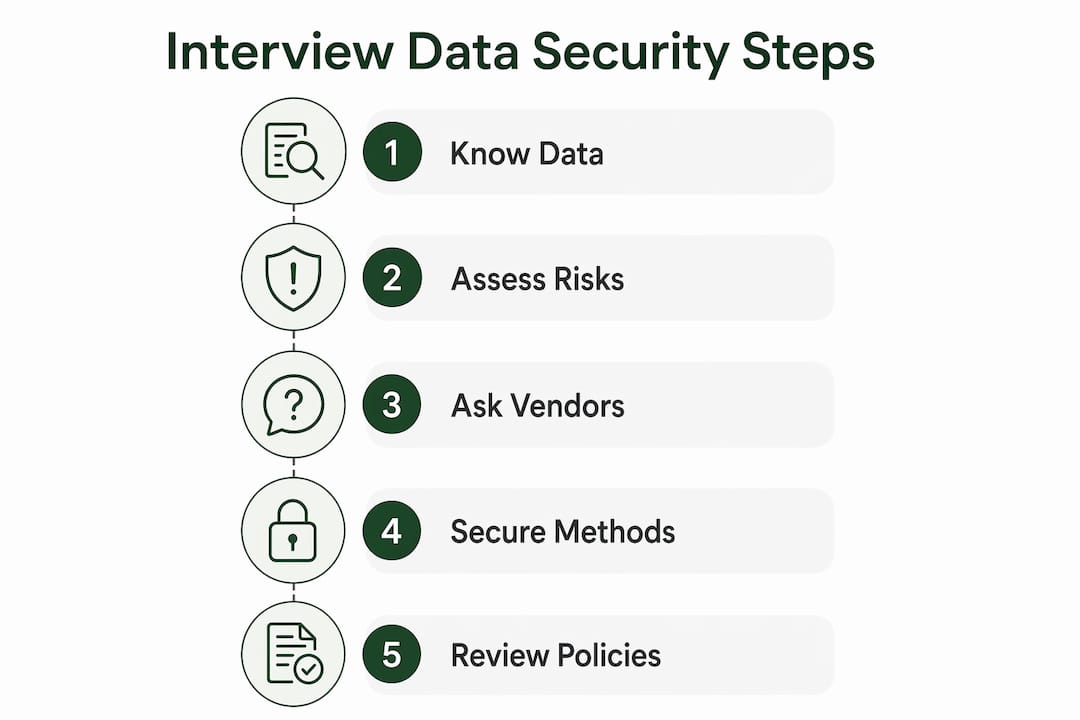
Good practice on the employer side starts before the interview. Practitioners recommend removing customer names, scrubbing datasets, and avoiding live production screenshots in assessments. Stage-appropriate disclosure means a first-round candidate sees far less sensitive material than a finalist under NDA.
On the platform side, the signals worth asking about:
- Encryption in transit and at rest (TLS for data moving between systems, AES-256 or equivalent for stored files)
- MFA and role-based access controls so only the hiring team can view your recording
- Configurable retention windows and explicit deletion workflows, including support for CCPA/GDPR data-subject requests
- SOC 2 Type II or ISO 27001 certification as evidence of a mature, audited security program
- Annual penetration testing and continuous monitoring, both listed as baseline expectations in technical privacy checklists
For sensitive contractor interviews, some organizations move to proctored or in-person sessions specifically to reduce the attack surface.
Your practical checklist for AI-assisted interviews
Before the interview:
- Read the platform’s privacy and retention policy. If it says data “may be used to improve our models,” treat that as a red flag.
- Run the session on a dedicated device or VM, separate from your work machine and personal accounts.
- Update your OS and antivirus software.
- Turn off cloud auto-sync and clipboard-sharing tools (e.g., universal clipboard on macOS/iOS).
During the interview:
- Do not paste proprietary code or client data into any external AI model, including your AI assistant.
- Decline to screen-share windows that contain sensitive work material.
- Ask directly: “Is this session being recorded, and how long is the recording retained?”
For coding assessments:
- Request a sandboxed environment. Microsoft recommends isolated, non-persistent VMs for exactly this reason.
- Use synthetic or anonymized examples instead of real employer code.
- Verify the repository source and check dependencies before running any install command.
After the interview:
- Request the platform’s retention policy in writing and submit a deletion request if you want your data removed.
- Delete any temporary files, test repositories, or credentials created during the session.
- Rotate any API keys or tokens you used in a live test environment.
If you suspect a breach:
- Isolate the device from your network immediately.
- Change passwords and rotate tokens for any accounts accessed during the session.
- Notify the interviewing company’s security contact in writing and keep a copy.
How real-time AI assistants like Parakeet-ai change the security model
Traditional interviews generate data on the employer’s platform. When you add a real-time AI assistant, a second data pipeline opens. That assistant is capturing your audio, generating transcripts, and potentially sending both to cloud inference endpoints, all in parallel with the interview itself.
The questions worth asking any AI assistant vendor before you use them:
- Where are transcripts stored, and for how long?
- Is my audio processed on-device or sent to a cloud server?
- Does my data train your models, or any third-party model?
- Can I request deletion after the session ends?
Parakeet-ai is built around the candidate’s session experience, and its AI interview ethics approach reflects the principle that candidates should retain control over what happens to their data. For candidates evaluating any real-time assistant, look for explicit opt-outs, transient session buffers rather than persistent logs, and a published privacy page that answers the four questions above directly.
On-device processing is the strongest mitigation available. Tools that run inference locally, like those built by privacy-first AI developers, never send your audio to a remote server at all. That eliminates the cloud-retention risk entirely, though it typically requires more capable hardware.
Pro Tip: Frame your vendor questions as short, direct asks: “Where are transcripts stored? Can you delete them on request? Does my data train any model?” A vendor that cannot answer all three clearly is not ready to handle your data responsibly.
The AI accountability standards candidates should expect from any vendor include auditability, explainability, and a clear chain of custody for recorded data.
Key Takeaways
Interview data security protects every signal you generate during a hiring process, and candidates using AI assistants must actively manage both the interview platform and their AI tool’s data practices.
| Point | Details |
|---|---|
| Know what you generate | Audio, video, transcripts, behavioral signals, and code samples all count as interview data requiring protection. |
| Isolate test environments | Run coding assessments on a dedicated VM, verify repository sources, and never run unverified install commands. |
| Avoid pasting proprietary content | Never paste client code or employer data into an external AI tool — it creates trade-secret and legal risk. |
| Ask vendors four direct questions | Where is data stored, how long is it kept, does it train models, and can you delete it on request? |
| Know your California rights | CCPA/CPRA gives California residents the right to access, correct, and delete personal data held by interview platforms. |
Why candidates underestimate this risk
The conventional wisdom treats interview data security as an employer problem. Employers hold the platform contracts, so they bear the compliance burden. That framing misses something important: you are the one generating the data, and you are the one with the most to lose if it is mishandled.
A recruiter whose platform gets breached faces a compliance headache. You face potential identity exposure, a biased AI summary following you to the next application, or malware on the machine where you keep your banking credentials. The asymmetry is real.
What I find underappreciated is how much the AI assistant layer changes this. Most candidates think about what they say in an interview. Fewer think about the second data stream their AI tool is creating simultaneously, often with different retention rules, different sub-processors, and a privacy policy they have never read. That gap is where the real exposure lives.
Parakeet-ai’s approach to digital interview ethics starts from the premise that candidates deserve transparency about what their tools are doing with their data. Use the checklist in this article, ask your vendors the four direct questions, and treat your interview session the same way you would treat any sensitive professional communication.
Useful sources for deeper reading
These are the primary references worth bookmarking, sharing with counsel, or sending to a security team:
- Contagious Interview: Microsoft Security Blog — The definitive account of malware delivered through fake developer assessments and malicious NPM packages. Required reading before any coding interview.
- How to Protect IP During Contractor and Developer Interviews | SecureInterview — Practitioner guidance on sanitization, synthetic datasets, and stage-appropriate disclosure for both employers and candidates.
- Video Interview Platform Security Checklist | ScreeningHive — Technical checklist covering encryption, MFA, RBAC, retention controls, SOC 2/ISO 27001, and GDPR/CCPA compliance touchpoints.
- Data Privacy and Security in Virtual Interview Platforms — Overview of regulatory frameworks including CCPA/CPRA and candidate rights in AI-processed hiring workflows.
- Data Privacy in 2026: What Business Leaders Must Know — Broader context on evolving privacy expectations useful for candidates who want to understand where regulations are heading.
Save these links and share them with your legal counsel or security team if you need to escalate a data concern after an interview.