
What Is AI Question Sequencing? A 2026 Guide

TL;DR:AI question sequencing dynamically orders and generates interview questions in real time to enhance data quality and engagement. It uses probabilistic models and task-planning logic to adapt questions based on participant responses, distinguishing itself from fixed, deterministic questioning methods. By employing classification, semantic clustering, and depth triggers, AI systems optimize follow-up probes, reduce bias, and enable deeper discovery in qualitative research.
AI question sequencing is the practice of using artificial intelligence to dynamically order and generate questions during interviews, surveys, or assessments to maximize information quality and participant engagement. Unlike fixed question lists, AI sequencing adapts in real time based on what a respondent says, filling knowledge gaps and probing where depth is needed. Platforms like Qualz.ai and Talkful have pushed this technology from simple branching logic into genuinely adaptive conversation. For educators designing assessments, researchers running qualitative studies, or professionals building automated interview tools, understanding how AI question sequencing works is now a practical necessity, not a theoretical curiosity.
What is AI question sequencing and how does it work?
AI question sequencing combines probabilistic modeling, natural language processing, and task-planning logic to decide which question comes next, and why. The system does not simply follow a script. It evaluates what the participant has already said, identifies what information is still missing, and selects the next question to close that gap most efficiently.

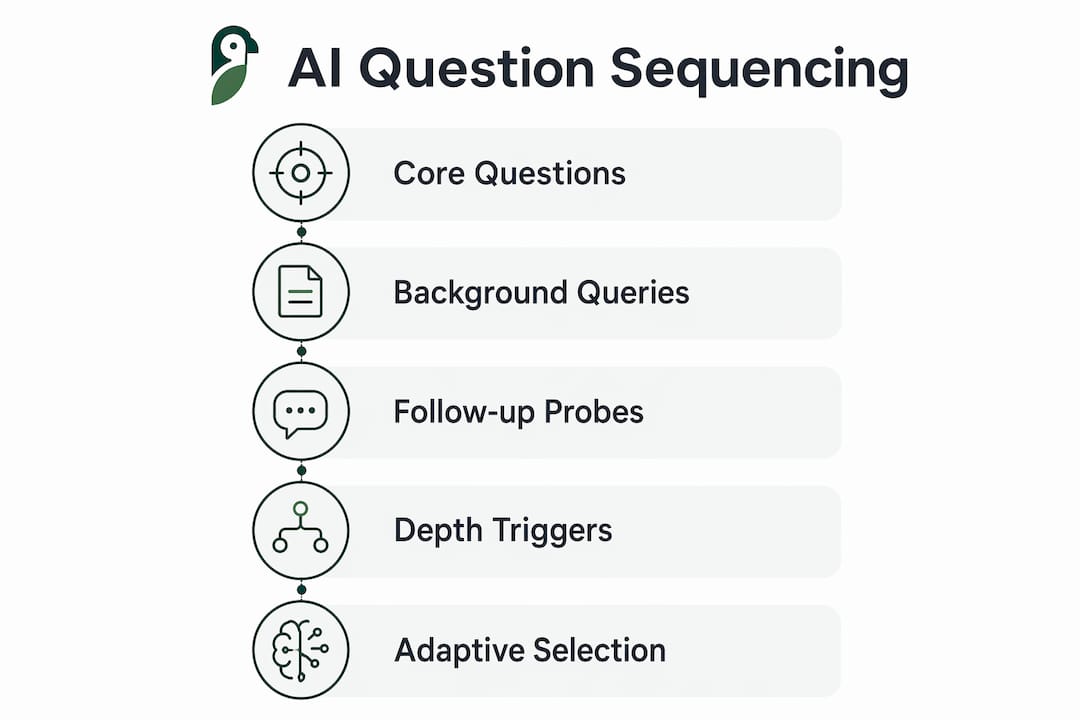
At the core of most modern systems, questions are classified into three types: core questions that anchor the topic, background questions that establish context, and follow-up questions that probe for detail. A task-planning module monitors the conversation in real time, scores each question type by descending probability of relevance, and selects the next prompt accordingly. This means the system is always asking the question most likely to recover missing or unclear information.
AI question generation pipelines also use semantic clustering to ensure question banks cover conceptual, practical, scenario-based, and case-based types evenly. This prevents the system from repeatedly drawing on the same data cluster and generating repetitive questions. The result is a conversation that feels varied and purposeful rather than mechanical.
The key structural elements of a well-designed AI sequencing system include:
- Core questions: Anchor each topic and are always asked regardless of prior responses
- Background questions: Establish participant context before deeper probing begins
- Follow-up questions: Generated or selected based on response richness and detected gaps
- Depth triggers: Qualitative thresholds that stop probing once sufficient context is reached, preventing fatigue
Depth triggers are particularly significant. Rather than stopping after a fixed number of questions, the system evaluates whether the response is contextually complete. This means a participant who gives a thorough answer moves on quickly, while someone who gives a vague answer receives additional probing. The interview adapts to the person, not the other way around.
Dynamic questioning vs. adaptive AI moderation
These two terms are often used interchangeably, but they describe fundamentally different approaches to AI question structuring. Understanding the distinction matters because it determines what your system can and cannot discover.
Dynamic questioning navigates a pre-written decision tree. A researcher authors every possible question in advance, and the system routes participants through branches based on their answers. It is deterministic: the same input always produces the same next question. This approach works well for structured surveys where all relevant topics are known ahead of time, but it cannot ask a question the researcher never thought to write.
Adaptive AI moderation is non-deterministic. The system generates novel follow-up questions in real time based on participant responses, study context, and research hypotheses. It can probe five to seven levels deep on an unexpected topic that no pre-written branch anticipated. This is where genuine discovery happens.
| Feature | Dynamic questioning | Adaptive AI moderation |
|---|---|---|
| Question source | Pre-authored by researcher | Generated in real time by AI |
| Determinism | Deterministic (same input, same output) | Non-deterministic (context-dependent) |
| Discovery potential | Limited to pre-authored topics | Can surface unanticipated insights |
| Depth of probing | Fixed by branch structure | Up to 5-7 levels contextually |
| Setup complexity | Higher (requires full question tree) | Lower (seed questions only) |
| Best use case | Structured surveys, compliance interviews | Qualitative research, exploratory studies |
Dynamic questioning is now the baseline expectation for any serious survey or interview tool. Adaptive moderation is what separates tools that collect data from tools that generate insight. For researchers and educators designing automated interviews, the practical implication is clear: if your questions are fully written before the conversation starts, you are leaving discovery on the table.
Pro Tip: When designing an AI-moderated study, write five strong seed questions rather than fifty branching questions. The AI handles depth; your job is to set the right starting direction.
How AI follow-up questions are classified and controlled
The taxonomy of AI-generated follow-up questions is more structured than most users realize. Talkful’s research identifies four core probe types used in AI question sequencing, often described through the DICE framework:
- Descriptive probes: Ask the participant to describe an experience or process in more detail (“Can you walk me through what happened?”)
- Idiographic memory probes: Prompt recall of a specific instance or example (“Can you think of a time when this occurred?”)
- Clarifying probes: Resolve ambiguity in a prior response (“When you said X, did you mean Y or Z?”)
- Explanatory probes: Seek the reasoning behind a statement (“Why do you think that happened?”)
The AI monitors input richness and selects the probe type that best addresses what is missing from the current response. A vague answer triggers a clarifying probe. A factual claim with no supporting example triggers an idiographic memory probe. This contextual selection is what makes AI-generated follow-ups feel natural rather than formulaic.
Depth control is equally important. Most platforms recommend a maximum of two to three follow-up probes per topic for standard interviews. Depth caps based on context completeness, rather than fixed question counts, improve both participant experience and data quality. For expert-level interviews or complex research topics, the system can be configured to allow deeper probing before moving on.
The practical goal of this entire taxonomy is to recover missing details optimally, avoiding redundant probing and participant fatigue. A well-configured AI sequencing system knows when it has enough. That judgment, applied consistently across hundreds of interviews, is something no human moderator can replicate at scale.
Pro Tip: For a 10 to 15 minute automated interview, cap your study at five core topics. Each topic can support two to three follow-ups before participants begin to disengage.
Challenges and best practices in AI question sequencing
AI question sequencing solves several problems that have plagued traditional interviews and surveys for decades, but it introduces its own configuration challenges. Knowing both sides helps you deploy it effectively.
The most documented problem in traditional interviewing is the question order effect. Priming, anchoring, and fatigue all distort responses based on what came before. AI adaptive interviews produce variable sequences across participants, which transforms systematic bias into manageable noise rather than a consistent distortion. No two participants experience the exact same interview, which makes aggregate findings more reliable.
Here are the best practices that experienced researchers and educators apply when configuring AI question sequencing systems:
- Define required topics explicitly. Mark the core questions that must be asked regardless of conversation flow. This prevents the AI from skipping critical areas when a participant gives unusually rich early responses.
- Set boundary conditions. Specify topics the AI should not pursue. In sensitive research or compliance-driven interviews, this prevents the system from probing areas outside the study scope.
- Limit follow-ups per topic. Most effective platforms recommend a maximum of three follow-up questions per topic and five core topics for a 10 to 15 minute session. Exceeding these thresholds increases dropout rates.
- Write seed questions with precision. The AI generates follow-ups based on the framing of your initial question. A vague seed produces vague probes. A specific, open-ended seed question produces targeted, useful follow-ups.
- Review conversation transcripts for drift. Even well-configured systems occasionally pursue tangents. Regular transcript review lets you tighten boundary conditions and improve seed question quality over time.
- Use randomization for order-sensitive topics. For surveys where question order could prime responses, configure the system to randomize core question sequence across participants while keeping follow-up logic intact.
The importance of AI question order extends beyond research quality. In automated job interviews, for example, a poorly sequenced conversation can make a qualified candidate feel interrogated rather than engaged. AI sequencing, configured well, creates a conversation that feels responsive and respectful. That directly affects completion rates and the quality of data you collect.
For those applying AI sequencing to video interview settings, the same principles apply with an added layer of real-time audio processing. The system must parse spoken responses, not just text, which increases the importance of clear seed question framing and robust depth trigger configuration.
Key takeaways
AI question sequencing works because adaptive, probabilistic models generate and order questions in real time, producing more reliable data and better participant experiences than any fixed question list can achieve.
| Point | Details |
|---|---|
| Core mechanism | Task-planning modules classify questions and select the next prompt by probability of filling a knowledge gap. |
| Dynamic vs. adaptive | Dynamic questioning uses pre-authored branches; adaptive moderation generates novel questions in real time for deeper discovery. |
| DICE probe taxonomy | AI selects descriptive, idiographic, clarifying, or explanatory probes based on what is missing from each response. |
| Depth control | Depth triggers stop probing when context is complete, not after a fixed number of questions, reducing fatigue. |
| Bias reduction | Variable question sequences across participants convert systematic order bias into distributed, manageable noise. |
Why adaptive questioning changed how I think about research design
I spent years designing interview guides the traditional way: writing every question, mapping every branch, and hoping participants would stay on the path I had laid out. They rarely did. The most interesting insights always came from an unexpected comment that I had no follow-up question prepared for. I would note it, move on, and lose the thread entirely.
When I first worked with adaptive AI moderation, the shift felt disorienting. Handing control of follow-up generation to a system felt like giving up rigor. What I found instead was the opposite. The AI asked follow-up questions I would not have thought to write, and it asked them consistently across every participant. The data was richer and more comparable at the same time.
The part that surprised me most was how much the AI question fairness argument holds up in practice. Human moderators, even experienced ones, probe differently depending on how much they like a participant’s answer. AI does not. It applies the same depth trigger logic to every response, which removes a source of variability that most researchers never account for.
My honest advice: stop treating seed question design as a lesser task. The AI handles depth, but it cannot compensate for a poorly framed starting question. The researchers who get the most from adaptive moderation are the ones who invest the most in writing precise, open-ended seeds. That is where your expertise still matters most.
— Jure
How Parakeet-ai supports smarter interview question sequencing

Parakeet-ai is a real-time AI interview assistant that listens to your interview as it happens and automatically generates answers to every question the interviewer asks. For candidates preparing for automated or AI-moderated interviews, understanding how question sequencing works gives you a direct advantage. Parakeet-ai processes the conversation in real time, so when an AI system deploys adaptive follow-up probes, you receive contextually relevant response guidance immediately. Explore Parakeet-ai’s interview tools to see how real-time AI assistance pairs with modern AI-driven question generation to improve your interview performance and consistency.
FAQ
What is AI question sequencing in simple terms?
AI question sequencing is the process of using artificial intelligence to decide which question to ask next during an interview or survey, based on what the participant has already said. The system fills knowledge gaps and adjusts depth in real time rather than following a fixed script.
How does adaptive AI moderation differ from dynamic questioning?
Dynamic questioning routes participants through pre-written question branches deterministically. Adaptive AI moderation generates entirely new follow-up questions in real time based on participant responses, allowing it to probe topics no researcher pre-authored.
How many follow-up questions should an AI sequencing system ask per topic?
Most platforms recommend a maximum of two to three follow-up questions per topic for standard interviews. For a 10 to 15 minute session, five core topics is the practical ceiling before participant fatigue affects response quality.
Can AI question sequencing reduce bias in interviews?
Yes. AI adaptive interviews produce variable question sequences across participants, which converts systematic order bias into distributed noise rather than a consistent distortion affecting all respondents in the same direction.
What are depth triggers in AI question sequencing?
Depth triggers are qualitative thresholds that tell the AI to stop probing a topic once the response contains sufficient context. They operate on content completeness rather than a fixed question count, which improves both data quality and participant experience.