
Top phone interview questions list to land your next job

Phone interviews are the gatekeepers of the modern hiring process, yet most candidates walk into them underprepared. 79% of employers use phone screens as their first filter, with calls averaging around 30 minutes. That’s half an hour to prove you’re worth an in-person conversation. The candidates who make it through aren’t necessarily the most qualified. They’re the most prepared. This guide gives you a categorized phone interview questions list, proven answer frameworks, AI-powered prep strategies, and a follow-up plan to help you move from screening to offer.
Table of Contents
- What to expect in a phone interview
- The must-ask phone interview questions list
- Expert frameworks to answer phone interview questions
- The role of AI tools in interview preparation
- Preparation and mistake-proofing for your phone interview
- Questions to ask your interviewer (and why they matter)
- Follow-up: securing your advantage after the call
- Take your interview prep further with ParakeetAI
- Frequently asked questions
Key Takeaways
| Point | Details |
|---|---|
| Know the common questions | Understanding top phone interview questions helps you prepare targeted responses. |
| Use STAR or SOAR frameworks | Structured frameworks keep your answers clear, concise, and impactful. |
| Leverage AI for practice | AI tools simulate real interviews, provide feedback, and boost your confidence. |
| Avoid common mistakes | Steer clear of multitasking, rambling, and failing to ask questions for best results. |
| Follow up promptly | A brief, timely thank-you email can increase your chances of moving forward. |
What to expect in a phone interview
Phone interviews exist for one reason: to cut the candidate pool fast. Recruiters use them to check for basic fit, communication skills, and genuine motivation before investing time in face-to-face meetings. Understanding this purpose changes how you prepare.
Most calls follow a predictable structure. The recruiter introduces themselves and the role, asks 5 to 8 screening questions, and leaves a few minutes for your questions. According to phone screening data, these calls typically run 20 to 30 minutes. That’s not much time to make an impression, so every answer counts.
Here’s what interviewers are actually evaluating:
- Communication clarity: Can you explain yourself without rambling?
- Motivation: Do you actually want this specific role, or are you mass applying?
- Cultural fit signals: Does your energy and tone match the team?
- Basic qualifications: Do you meet the minimum requirements?
- Professionalism: Are you prepared, punctual, and engaged?
Poor preparation is the number one reason candidates drop off at this stage. Reviewing a solid phone screening checklist before your call can help you avoid the most common traps and walk in with real confidence.
The must-ask phone interview questions list
Knowing the structure, here’s your go-to list of questions to expect and prepare for. Employers tend to cluster their questions into predictable categories. Recognizing the category tells you exactly what they’re looking for.
The most common phone interview questions include “Tell me about yourself,” “Why are you interested in this position?”, “What are your strengths and weaknesses?”, “What are your salary expectations?”, and “Do you have any questions for us?”

| Category | Sample questions | What the employer wants |
|---|---|---|
| Introductory | “Tell me about yourself” | A concise, relevant career summary |
| Motivation | “Why this role?” / “Why our company?” | Genuine interest and research |
| Behavioral | “Tell me about a challenge you overcame” | Evidence of real-world competence |
| Situational | “How would you handle a difficult client?” | Problem-solving and judgment |
| Compensation | “What are your salary expectations?” | Budget alignment |
| Closing | “Do you have any questions for us?” | Engagement and preparation |
“Tell me about yourself” trips up more candidates than any other question. It feels open-ended, but it’s actually a structured opportunity. Employers want a 60-second career highlight reel, not your life story. Learning to master phone interview answers for this one question alone can dramatically shift how the rest of the call goes.
For deeper practice with real phone interview Q&A examples, reviewing sample responses by category helps you internalize the patterns rather than memorizing scripts.
Expert frameworks to answer phone interview questions
Armed with the key questions, let’s drill into strategies for answering them with confidence. Two frameworks dominate interview coaching: STAR and SOAR.
STAR stands for Situation, Task, Action, Result. You set the scene, explain your role, describe what you did, and share the measurable outcome. SOAR is a variation: Situation, Obstacle, Action, Result. Use SOAR when the story centers on overcoming a specific barrier rather than completing a task.
The STAR method is ideal for behavioral questions and keeps your answers in the 45 to 90 second sweet spot that recruiters prefer. Going longer risks losing their attention. Going shorter signals a lack of depth.
For “Tell me about yourself,” skip STAR entirely. Use the Present-Past-Future structure instead:
- Present: Your current role and key responsibilities
- Past: The experience that got you here
- Future: Why this role is the logical next step
This structure takes about 60 seconds, sounds natural, and immediately frames you as a purposeful candidate rather than someone winging it.
“The best answers aren’t the longest ones. They’re the ones that make the interviewer feel like they already understand you.”
Pro Tip: Record yourself answering two or three behavioral questions using STAR. Play it back. If you’re going past 90 seconds or using filler words like “um” and “basically,” tighten the story. Reviewing behavioral interview tips can help you identify patterns in your answers that need work. Pairing this with resources on improving interview answers accelerates your progress significantly.
The role of AI tools in interview preparation
Once you’ve mastered effective answers, AI tools can help you sharpen your delivery and get detailed feedback with less stress. Traditional prep methods like practicing in front of a mirror or asking a friend to quiz you have real limits. AI changes the game.
Modern AI interview tools simulate phone interview practice by mimicking recruiter prompts, analyzing your tone, pacing, and word choice, and giving you instant feedback after each response. It’s like having a personal interview coach available at 11 PM the night before your call.
The results are measurable. Candidates who use AI-assisted screening convert to the next interview stage at 80%, compared to just 50% for those using traditional self-prep methods. That’s a 30-percentage-point difference that comes down to structured, feedback-driven practice.
| Feature | AI-driven prep | Traditional self-prep |
|---|---|---|
| Feedback speed | Instant | Delayed (if any) |
| Availability | 24/7 | Limited |
| Tone analysis | Yes | No |
| Consistency | Every session | Varies |
| Conversion rate boost | Up to 80% | ~50% |
Pro Tip: Combine AI mock calls with your STAR story library. Run through each story in a simulated session, then use the AI feedback to trim, sharpen, and refine. Exploring phone interview AI practice tools gives you a structured starting point. You can also find targeted drills under improve interview answers to focus on your weakest areas.
Preparation and mistake-proofing for your phone interview
With technology supporting your prep, the final, crucial step is mastering your performance during the actual call. Preparation isn’t just about knowing your answers. It’s about controlling every variable you can.
Here’s a step-by-step prep sequence:
- Research the company deeply: mission, recent news, products, and culture
- Prepare 5 to 7 STAR stories covering leadership, failure, conflict, and collaboration
- Practice answers aloud 5 to 10 times each, not just in your head
- Set up your environment: quiet room, full phone charge, strong signal
- Print or open your notes: key talking points, company facts, your questions
- Confirm the call details the day before: time zone, number, and contact name
Common mistakes that kill otherwise strong candidates:
- Rambling: No structure, no endpoint. Use STAR to stay focused.
- Multitasking: Recruiters hear it. Close every tab and give the call your full attention.
- No questions prepared: Saying “I think you covered everything” signals disengagement.
- Poor signal or background noise: Test your setup in advance.
Pro Tip: Stand and smile during your call. It sounds simple, but standing opens your diaphragm and projects more energy. Smiling changes your vocal tone in ways the interviewer can actually detect. Use the screening checklist to run through every item the morning of your interview. For quick answer review, the Q&A common questions resource is a fast refresher.
Questions to ask your interviewer (and why they matter)
Standing out isn’t just about your answers. It’s also about the questions you ask. Candidates who ask thoughtful questions are perceived as more engaged, more strategic, and more serious about the role.
Here are five questions that consistently land well, with the reason each one works:
- “What does success look like in the first six months?” Shows you’re already thinking about delivering results, not just getting hired.
- “What are the biggest challenges the team is currently facing?” Signals that you’re realistic and want to contribute solutions.
- “How would you describe the team culture?” Demonstrates that fit matters to you, not just the paycheck.
- “What are the next steps in the process?” Practical, professional, and keeps the momentum moving.
- “What do you enjoy most about working here?” Builds rapport and gives you genuine insight into the environment.
Asking smart questions signals that you’ve done your homework and that you’re evaluating them as much as they’re evaluating you. That dynamic shift makes you memorable. Reviewing how to avoid interview pitfalls can also help you identify what not to ask, which matters just as much.
“The candidate who asks the best questions often gets the job over the candidate with the best resume.”
Follow-up: securing your advantage after the call
Even after hanging up, you have one more opportunity to stand out and influence the employer’s decision. Most candidates skip this step entirely. That’s your opening.
Here’s the follow-up sequence that works:
- Send a thank-you email within 24 hours. Reference a specific topic from the conversation to prove you were engaged.
- Reaffirm your fit in one sentence. Connect your background to the role’s key need.
- Express enthusiasm without desperation. Confident interest, not pleading.
A timely thank-you email that references specific discussion points increases the interviewer’s recall of you by 18%. In a competitive pool, that’s a meaningful edge. The same data shows that poor candidate experience causes 55% of offer rejections, meaning how you make people feel matters at every stage.
Pro Tip: Draft a customizable thank-you template now, before your next call. Leave blank spaces for the interviewer’s name, a specific discussion point, and the role title. After the call, fill in the blanks and send within the hour. For more on positioning yourself effectively, best tech interview answers offers strong examples of how to frame your value clearly.
Take your interview prep further with ParakeetAI
Ready to put everything in this guide into action? Knowing the right questions and frameworks is a strong start, but real confidence comes from practice with feedback.
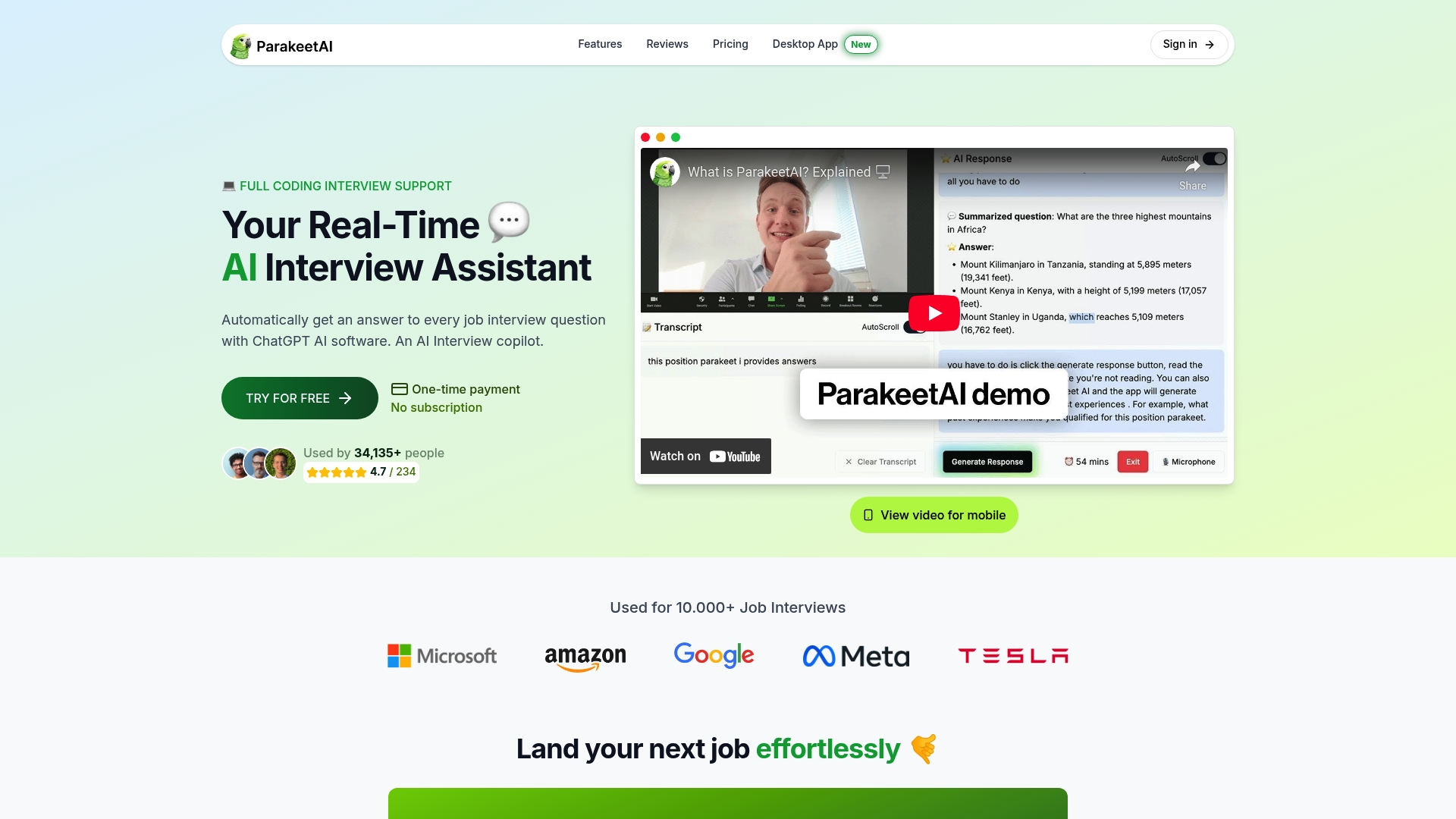
ParakeetAI is a real-time AI interview assistant that listens to your interview and automatically provides answers to every question using AI. You can use it to run realistic mock phone interview sessions, get instant feedback on your tone and structure, and build the kind of muscle memory that makes answering under pressure feel natural. Whether you’re prepping for your first phone screen or your tenth, ParakeetAI gives you a personalized edge that traditional prep simply can’t match. Start practicing today and walk into your next call ready to convert.
Frequently asked questions
What are the top 5 questions to expect in a phone interview?
Expect “Tell me about yourself,” “Why this role?”, “Strengths and weaknesses,” “Salary expectations,” and at least one behavioral question. These five cover the vast majority of phone screens across industries.
How long should my phone interview answers be?
Aim for 45 to 90 seconds per answer. The STAR or SOAR framework keeps your responses structured and prevents you from rambling past the point where recruiters stop listening.
Is it okay to use notes during a phone interview?
Absolutely. Notes boost recall without the interviewer knowing, but keep them as bullet points rather than full scripts so your answers still sound natural and conversational.
How soon should I send a thank-you email after a phone interview?
Send it within 24 hours, ideally within a few hours of the call. A timely follow-up email that references your conversation increases how well the interviewer remembers you by 18%.
How can AI tools help with my phone interview practice?
AI tools simulate interviewer prompts and provide real-time feedback on your tone, pacing, and structure, giving you the kind of targeted coaching that turns nervous candidates into confident ones.
Recommended
- Master Phone Interview Questions and Answers Effectively
- How to Answer Phone Interview Questions & Ace Your Interview
- Phone Screening Checklist for Confident Interview Success
- Top Common Interview Questions and Answers for 2025
- 10 tips voor een sollicitatiegesprek: voorbereiding & vragen - Bogaers Taleninstituut Tilburg