
What is automated interview help? A 2026 guide

Job interviews feel different in 2026. You might have heard about AI tools that help candidates prepare, practice, and even respond during interviews. Some job seekers worry these tools are cheating, while others wonder if they actually work. The truth sits somewhere in between. Commercial claims suggest 2x faster job offers and salary bumps around 40% for users of AI interview help. This guide cuts through the noise to show you what automated interview help really is, how it works, and how to use it effectively without compromising your authenticity.
Table of Contents
- Understanding Automated Interview Help: What It Is And How It Works
- Assessing The Impact And Evidence Behind Automated Interview Help
- Nuances And Best Practices For Using Automated Interview Help
- Applying Automated Interview Help In Your Job Search Strategy
- How Parakeet AI Can Enhance Your Interview Preparation
- Frequently Asked Questions About Automated Interview Help
Key takeaways
| Point | Details |
|---|---|
| AI interview tools assist prep | Automated interview help uses AI to provide practice sessions, feedback, and response suggestions for candidates. |
| Evidence shows promising outcomes | Users report 2x faster job offers and 40% higher salaries, though peer-reviewed candidate data remains limited. |
| Balance AI with human practice | Combining AI structure with human authenticity yields the best interview readiness and genuine performance. |
| Ethical use matters | Transparency about AI assistance is critical, especially in proctored or recorded interview settings. |
| Strategic application wins | Start with AI mock interviews, then apply suggestions to resume tailoring and follow-up preparation. |
Understanding automated interview help: What it is and how it works
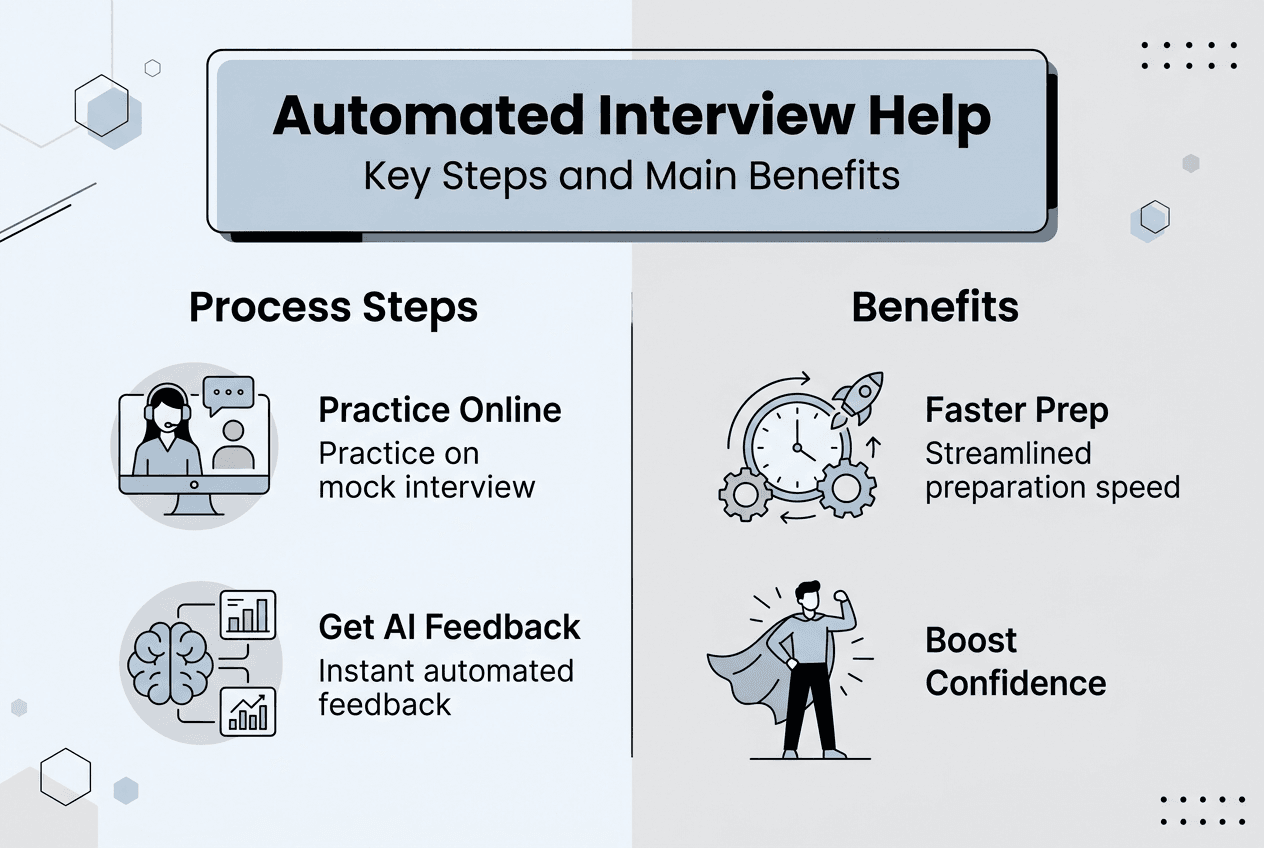
Automated interview help refers to AI-driven tools that assist candidates in preparing for and improving their job interviews. These platforms analyze your responses, provide real-time feedback, suggest improvements, and simulate common interview scenarios. Think of them as personal interview coaches available 24/7, powered by machine learning algorithms that have processed thousands of successful interview patterns.
These tools offer several core features that distinguish them from traditional prep methods. Mock interview sessions let you practice answering questions in a realistic environment. Feedback on tone, clarity, pacing, and word choice helps you refine your delivery. Resume tailoring suggestions align your application materials with specific job descriptions. Some advanced platforms even provide industry-specific question banks and behavioral interview frameworks.
The benefits stack up quickly for job seekers. You get structured practice without scheduling conflicts or geographic limitations. Preparation cycles shrink because you receive instant feedback instead of waiting for human mentors. Data-driven insights target your specific weaknesses, whether that’s filler words, rambling answers, or weak storytelling. Commercial claims include 2x faster job offers, 40% higher salaries for candidates using AI interview help.
The technology behind these tools combines natural language processing, speech recognition, and behavioral analysis. When you speak, the system transcribes your words, analyzes sentence structure, identifies key competencies you mention, and compares your response against successful patterns. Some tools track facial expressions and body language through your webcam. Others focus purely on verbal content and delivery metrics like speaking rate and pause frequency.

Pro Tip: Record your first few AI practice sessions and watch them back. You’ll spot nervous habits and verbal tics that even the best AI might miss, giving you a complete picture of your interview presence.
Assessing the impact and evidence behind automated interview help
The evidence landscape for automated interview help splits into two distinct categories: employer-side AI and candidate-side tools. AI-led interviews improve hiring outcomes by 12-20% when companies use AI to screen and evaluate candidates. This data comes from peer-reviewed studies tracking thousands of hiring decisions. The candidate side tells a different story.
Direct peer-reviewed benchmarks for candidate AI interview help remain sparse. Most effectiveness claims come from vendor data and user testimonials rather than controlled academic studies. This doesn’t mean the tools fail to work. It means we lack rigorous independent verification of the specific performance improvements these platforms advertise. The gap matters because job seekers deserve transparent information about what they’re buying.
Here’s how the evidence breaks down:
| Metric | Employer-Side AI Data | Candidate-Side AI Claims |
|---|---|---|
| Job offer speed | Not measured | 2x faster (vendor data) |
| Salary outcomes | Not measured | 40% higher (vendor data) |
| Hiring quality | 12-20% improvement | Not measured |
| Study rigor | Peer-reviewed | Mostly anecdotal |
| Sample size | Thousands | Hundreds to low thousands |
The promising news comes from consistent user reports across multiple platforms. Job seekers describe increased confidence, better answer structure, and more successful interviews after using AI prep tools. Recent graduates particularly benefit because they often lack extensive interview experience. The tools provide a structured framework that compensates for limited real-world practice.
Transparency and ethical use emerge as critical factors in this discussion. Using AI to practice before an interview differs fundamentally from using AI during a live interview without disclosure. Some companies explicitly prohibit undisclosed AI assistance in proctored interviews. Others view it as a natural evolution of candidate preparation. The ethical line gets blurry, especially with real-time AI tools that listen and suggest answers during actual interviews.
Pro Tip: Always check a company’s interview policies before using any AI tool during a live session. When in doubt, use AI for preparation only and rely on your own knowledge during the actual interview.
Nuances and best practices for using automated interview help
The most effective approach combines AI for structure and humans for authenticity. AI excels at providing consistent feedback, identifying patterns in your responses, and suggesting proven frameworks like the STAR method for behavioral questions. Human mentors catch subtleties that algorithms miss: reading room dynamics, adjusting tone for different interviewers, and demonstrating genuine enthusiasm that resonates emotionally.
Using AI for structured practice delivers measurable benefits. You can run through 20 practice questions in an hour, getting immediate feedback on each response. The system tracks your improvement over time, showing you which question types you’ve mastered and which still need work. This speed and structure accelerate your learning curve dramatically compared to sporadic practice with friends or family.
Human practice remains essential for several reasons. Authenticity shines through when you’ve internalized concepts rather than memorized AI-generated scripts. Emotional intelligence requires reading subtle cues that current AI can’t fully replicate. Nuanced feedback from experienced professionals often addresses strategic career positioning that generic AI tools overlook. Your mentor might suggest reframing a weakness as a growth area, while AI simply flags the negative phrasing.
Ethical considerations deserve serious attention as these tools become more sophisticated. Transparency matters most in proctored or recorded interviews where companies expect unassisted performance. Some organizations view undisclosed AI use as dishonest, similar to bringing hidden notes. Others accept it as inevitable technological progress. The safest approach treats AI as a preparation tool, not a live assistance device, unless explicitly permitted.
Recent graduates should first use AI for practice, then apply AI suggestions to resume tailoring and follow-up preparation. This sequence builds genuine competence rather than dependence. You develop the muscle memory of strong responses through repeated AI-guided practice. Then you customize your resume based on AI analysis of job descriptions and successful application patterns. Finally, you use AI to prepare thoughtful follow-up questions and thank-you notes.
Pro Tip: Create a feedback loop by recording your AI practice sessions, then reviewing them with a human mentor. This hybrid approach captures both data-driven insights and intuitive human wisdom that neither source provides alone.
Best practices for maximizing AI interview help effectiveness:
- Start with baseline assessment to identify your specific weaknesses and track improvement over time
- Practice daily in short sessions rather than marathon cramming to build consistent skills
- Customize AI feedback settings to match your target industry and role level
- Balance AI suggestions with your authentic voice to maintain genuine personality
- Review and critique AI feedback rather than accepting every suggestion blindly
- Combine AI practice with human mentorship for comprehensive preparation
- Use AI for technical skill verification but rely on humans for career strategy guidance
- Document your progress to stay motivated and identify patterns in your improvement
Applying automated interview help in your job search strategy
Integrating automated interview help into your job search requires a systematic approach that balances efficiency with authenticity. Here’s a practical workflow that recent graduates and experienced job seekers can adapt to their specific situations:
- Conduct an initial AI assessment to establish your baseline interview performance across common question types.
- Review the AI feedback to identify your top three weaknesses, whether that’s rambling answers, weak examples, or poor body language.
- Practice targeted improvement by focusing each session on one specific weakness until you see measurable progress.
- Record practice sessions and compare your early attempts to current performance to visualize your growth.
- Apply AI resume suggestions to tailor your application materials for each specific job posting.
- Prepare AI-generated follow-up questions that demonstrate genuine interest and research about the company.
- Conduct final mock interviews combining AI feedback with human mentor review before actual interviews.
- Iterate based on real interview outcomes, feeding that experience back into your AI practice sessions.
Different AI interview help tools serve different purposes in your preparation strategy. Understanding which tool fits which need prevents wasted time and money:
| Tool Type | Best For | Key Features | Ideal User |
|---|---|---|---|
| Mock interview platforms | Behavioral question practice | Question banks, response analysis, STAR method coaching | Entry-level candidates |
| Real-time AI assistants | Live interview support | Answer suggestions, confidence boosting | Experienced professionals |
| Resume optimization tools | Application materials | Keyword matching, ATS optimization | All job seekers |
| Industry-specific trainers | Technical interviews | Coding challenges, domain knowledge | Specialized roles |
Anecdotal user success stories confirm positive impact of AI interview prep tools on confidence and job offers. Recent graduates report feeling significantly more prepared after systematic AI practice compared to traditional methods. One common pattern emerges: candidates who use AI tools for at least two weeks before interviews perform better than those who cram in a few sessions the night before.
The key to effective application lies in adaptive interview preparation that evolves with your progress. Early sessions focus on basic response structure and eliminating obvious mistakes. Middle sessions refine your storytelling and develop compelling examples. Advanced sessions polish delivery, timing, and strategic positioning for salary negotiations. This progression mirrors how athletes train, building foundational skills before advancing to complex techniques.
Your job field and experience level should guide how heavily you lean on AI tools. Technical roles benefit from AI-powered coding interview practice and system design frameworks. Creative positions need more human feedback on portfolio presentation and cultural fit. Entry-level candidates gain more from structured AI guidance, while senior professionals might use AI primarily for industry-specific question preparation and salary negotiation strategies.
Balance remains crucial throughout your job search. AI tools accelerate preparation and provide valuable structure, but they can’t replace genuine competence or authentic personality. Use AI as an interview automation job assistant that enhances your natural abilities rather than a crutch that replaces them. The most successful candidates treat AI like a personal trainer: following the program consistently while maintaining their unique style and voice.
Continuous learning separates good candidates from great ones. After each real interview, whether successful or not, analyze what worked and what didn’t. Feed those insights back into your AI practice sessions. Adjust your preparation focus based on actual interview experiences rather than generic best practices. This feedback loop creates a personalized improvement system that compounds over time.
How Parakeet AI can enhance your interview preparation
Now that you understand how automated interview help works and why it matters, consider how the right platform can accelerate your success. Parakeet AI offers real-time interview assistance that listens to your conversations and provides intelligent answer suggestions when you need them most. Unlike static practice tools, Parakeet AI adapts to each unique interview situation, helping you respond confidently to unexpected questions.
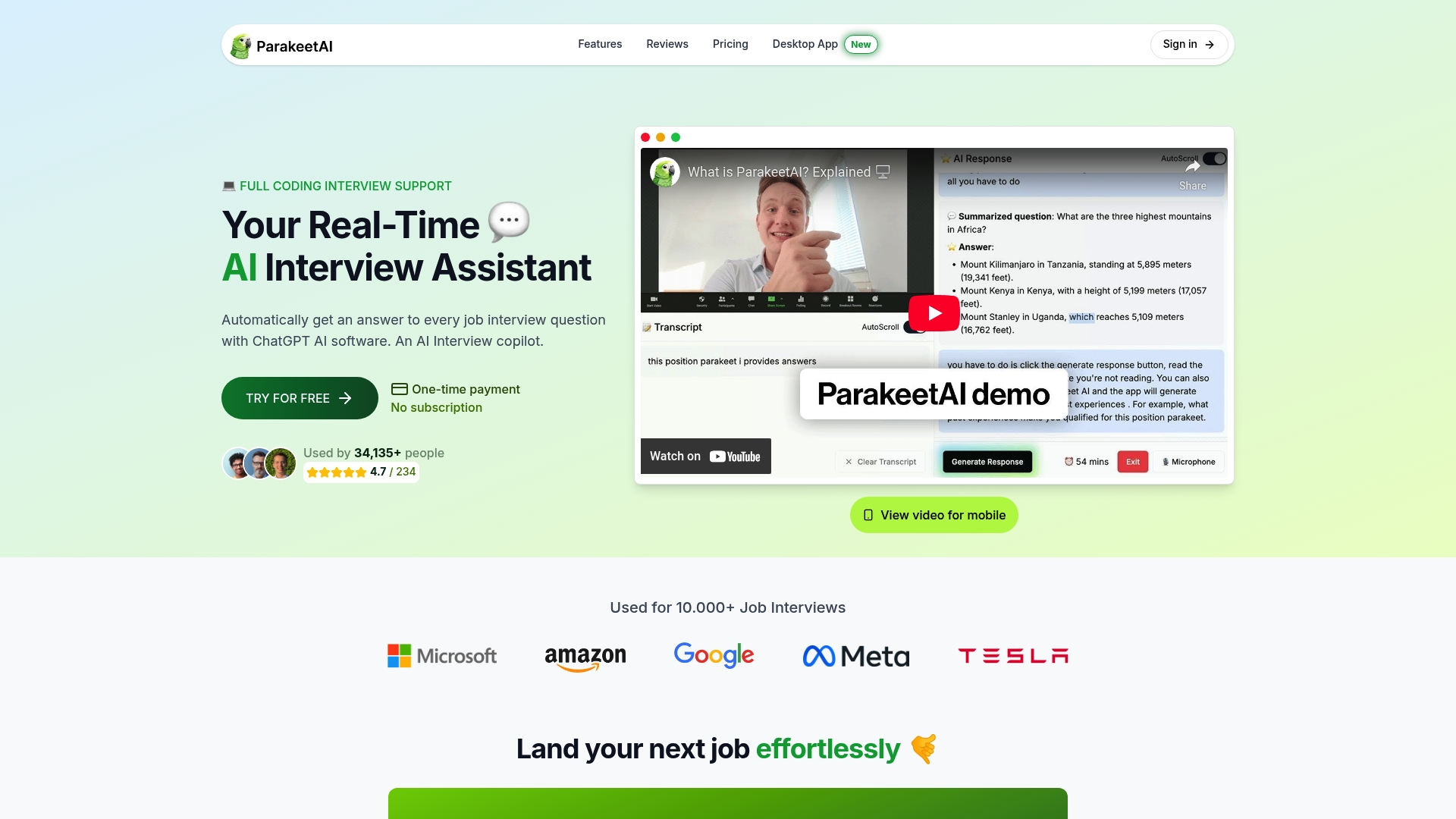
The platform balances AI efficiency with practical application, giving you the structure and support that traditional prep methods can’t match. Whether you’re a recent graduate facing your first professional interviews or an experienced job seeker navigating a career transition, Parakeet AI provides the adaptive support you need. The 2026 job market moves fast, and having an AI assistant that understands your specific situation gives you a genuine competitive edge.
Pro Tip: Integrate AI-powered platforms like Parakeet AI into a comprehensive prep strategy that includes human mentorship, industry research, and company-specific preparation for the best results.
Frequently asked questions about automated interview help
What is automated interview help?
Automated interview help refers to AI-powered tools that assist job seekers in preparing for and performing during interviews. These platforms provide mock interview practice, real-time feedback on your responses, resume optimization suggestions, and sometimes live assistance during actual interviews. The technology uses natural language processing and machine learning to analyze your answers and suggest improvements based on successful interview patterns.
How does automated interview help differ from employer AI interviews?
Employer AI interviews use algorithms to screen and evaluate candidates, often replacing human recruiters in initial rounds. Automated interview help works from the candidate side, providing tools and coaching to improve your interview performance. Think of employer AI as the judge and candidate AI as your coach. Understanding both perspectives helps you navigate modern hiring processes more effectively.
Is using AI interview help ethical?
Ethical use depends on context and transparency. Using AI to practice before interviews is universally accepted and beneficial. Using AI during live interviews without disclosure enters gray ethical territory. Some companies explicitly prohibit undisclosed AI assistance, while others view it as acceptable technological adaptation. Always check company policies and when in doubt, use AI for preparation only.
How do I choose the right AI interview help tool?
Match the tool to your specific needs and experience level. Entry-level candidates benefit most from comprehensive mock interview platforms with structured feedback. Experienced professionals might prefer specialized tools for salary negotiation or industry-specific technical questions. Consider factors like cost, feature set, user reviews, and whether you need practice tools or live assistance. Evaluate advantages of different AI interview tools before committing.
What realistic outcomes can I expect from using automated interview help?
Expect improved confidence, better answer structure, and faster preparation cycles. Commercial vendors claim 2x faster job offers and 40% salary increases, though independent verification of these specific numbers remains limited. Most users report feeling significantly more prepared and performing better in actual interviews. Results vary based on how consistently you practice, how well you integrate AI suggestions with your authentic voice, and your overall job search strategy. Understanding why people use AI for job interviews helps set realistic expectations.
Should I rely entirely on AI for interview preparation?
No. The most effective approach combines AI structure with human authenticity and mentorship. Use AI for consistent practice, instant feedback, and identifying patterns in your responses. Supplement with human mentors for strategic career advice, emotional intelligence development, and nuanced feedback that algorithms miss. This hybrid approach delivers better results than either method alone, building genuine competence rather than memorized scripts.