
What Is Instant Interview Evaluation? A 2026 Guide

TL;DR:Instant interview evaluation utilizes AI to analyze candidate responses in real time, offering immediate, objective feedback on communication and structure. This technology reduces bias, speeds up assessment, and helps candidates identify specific areas for improvement quickly. Candidates should focus on voice practice, track key metrics, and balance AI tools with human feedback to maximize interview performance.
Instant interview evaluation is a real-time, AI-powered assessment method that analyzes candidate performance during interviews by measuring communication clarity, speaking pace, answer structure, and competency alignment the moment you speak. Unlike traditional post-interview scoring, this technology delivers quantitative feedback within minutes rather than days. Tools like the Instant Interview app, platforms built on Eightfold AI, and AI mock interview services from Revarta have made this approach accessible to both hiring teams and individual job seekers. For candidates, understanding how this system works is no longer optional. It is the difference between walking into an interview blind and walking in with a data-backed preparation advantage.
What is instant interview evaluation and how does it work?
Instant interview evaluation is the automated process of scoring a candidate’s interview responses in real time using AI that listens, transcribes, and analyzes spoken answers against predefined competency benchmarks. The system operates through voice-based AI that conducts or monitors the interview, processes your speech continuously, and generates a structured scorecard before the conversation even ends.

The core mechanics of real-time analysis
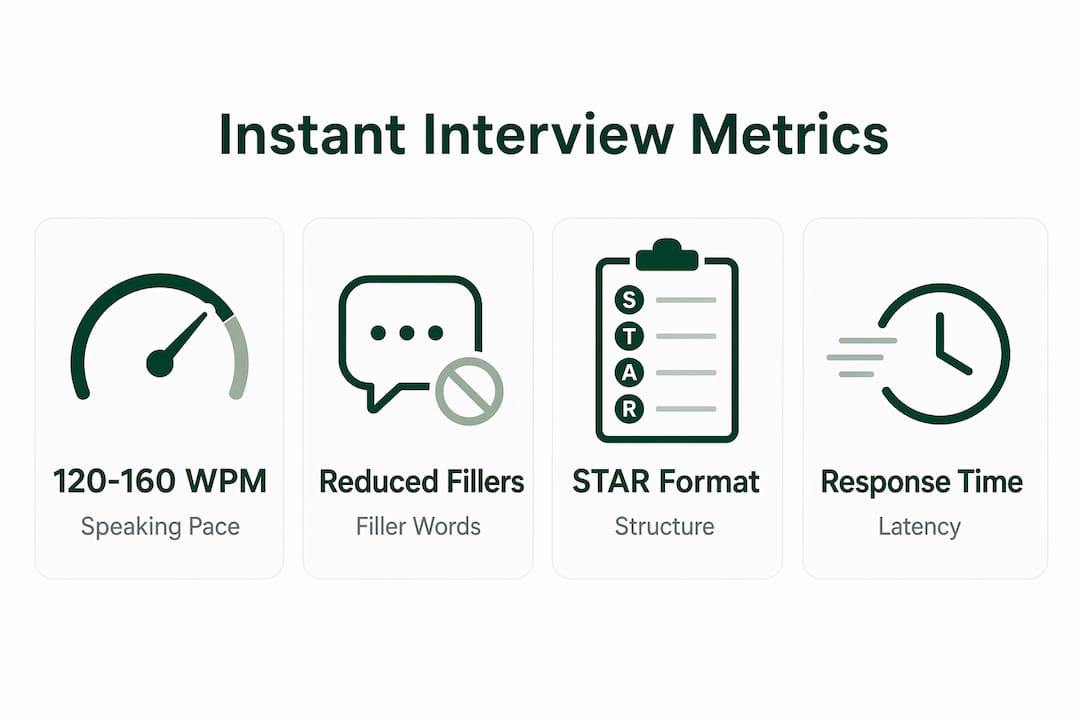
The AI captures your audio, converts it to a transcript, and runs multiple simultaneous analyses. It checks whether your answer follows a logical structure like the STAR method (Situation, Task, Action, Result), measures vocabulary diversity, flags filler words like “um” and “like,” and tracks speaking pace. Ideal speaking pace sits between 120 and 160 words per minute, with fewer than one filler word per minute as the benchmark for fluent delivery. Candidates who consistently exceed 160 WPM are flagged for rushed delivery; those under 120 WPM may be scored lower for hesitancy.
Advanced systems go further. AI interview platforms analyze temporal dynamics such as response latency and conversational rhythm to assess confidence and natural flow. The AI waits through pauses rather than interrupting, and it adapts follow-up questions based on what you just said, simulating a real interviewer’s behavior. This is not a static quiz. It is a dynamic, responsive conversation that generates auditable data throughout.
Key metrics tracked during evaluation
The specific performance indicators most AI evaluation systems measure include:
- Speaking pace: Measured in words per minute, with the 120 to 160 WPM range as the target
- Filler word frequency: Tracked per minute, with less than one per minute as the standard
- STAR structure adherence: Whether your answer contains all four components of the framework
- Answer relevance: How closely your response aligns with the competency the question targets
- Vocabulary diversity: Range of word choice as a proxy for communication sophistication
- Response latency: The time between the question ending and your answer beginning
AI tools analyze communication clarity, pacing, and competency alignment in real time, then compile these into a scorecard that hiring managers can review in 5 to 10 minutes rather than the 30 to 45 minutes a traditional review requires.
Pro Tip: Record yourself answering one practice question without any preparation, then run it through an AI mock interview tool. The gap between your self-perception and the actual metrics is almost always larger than you expect, and that gap is exactly where your preparation should focus.
How does instant evaluation compare to traditional interview feedback?
Traditional interview feedback arrives late, varies by interviewer, and often reflects memory more than reality. Instant evaluation changes all three of those variables simultaneously.
| Factor | Traditional feedback | Instant interview evaluation |
|---|---|---|
| Speed | Days to weeks after the interview | Minutes after each response |
| Consistency | Varies by interviewer mood and memory | Identical criteria applied to every candidate |
| Bias exposure | High, driven by subjective gut reactions | Reduced through uniform scoring criteria |
| Evidence trail | Notes, often incomplete | Full transcript with timestamped scorecard |
| Hiring manager time | 30 to 45 minutes per candidate | 5 to 10 minutes per candidate |
The bias reduction point deserves specific attention. AI evaluation applies identical criteria consistently and generates auditable evidence, replacing subjective gut feelings with objective, transcript-backed data. This matters for you as a candidate because it means your score reflects what you actually said, not how the interviewer felt that afternoon. You can read more about how this plays out in practice in this breakdown of bias in AI interview systems.
That said, the technology is not a replacement for human judgment. AI interview summaries function as navigation tools, not final decision-makers. They highlight key themes and flag areas for a human reviewer to investigate further. The hiring manager still makes the call. What changes is the quality and speed of the information they use to make it.
Traditional methods also suffer from memory bias. An interviewer who meets eight candidates in one day will recall the first and last most clearly, a well-documented cognitive pattern known as the serial position effect. Instant evaluation records everything with equal fidelity regardless of interview order, which levels the playing field for candidates who happen to interview in the middle of a long day.
How can you prepare using instant interview evaluation tools?
Preparation with AI evaluation tools works best when you treat the feedback as a training loop rather than a report card. Each session gives you specific, measurable data. Your job is to act on it and repeat.
- Start with voice-based practice, not text. Candidates who practice speaking answers aloud build the conversational muscle memory needed to maintain ideal pacing and reduce fillers under real pressure. Reading answers silently or typing them out does not replicate the cognitive load of speaking in a high-stakes setting.
- Track one metric at a time. After your first AI mock session, identify your weakest metric. If your filler word count is high, spend three sessions focused exclusively on eliminating “um” and “like” before moving to structure. Trying to fix everything at once produces marginal improvement across the board instead of real gains in specific areas.
- Use the 90/10 split. 90% of mock interview preparation can be done with AI tools, with the remaining 10% reserved for human mock interviewers who can assess social nuance, emotional tone, and conversational chemistry. AI is excellent at measuring what it can quantify. Humans catch what it cannot.
- Use AI phrasing suggestions selectively. Most platforms offer alternative phrasings for weak answers. Treat these as options, not scripts. Adapt the suggestion to your natural voice so the answer sounds like you, not like a template.
- Review your transcripts after every session. The transcript reveals patterns you will not notice in the moment. You might see that you consistently skip the “Result” component of STAR answers, or that your strongest answers all share a specific opening structure you can replicate.
Pro Tip: Do not practice the same question more than three times in a single session. After three repetitions, you stop improving and start memorizing. Over-rehearsed responses receive lower authenticity scores from AI systems because the delivery pattern becomes too uniform. Internalize the structure, not the words.
Common pitfalls when using instant interview evaluation
The technology gives you real data, but how you interpret and act on that data determines whether it actually helps you.
- Treating AI scores as final verdicts. A low score on one response does not mean you failed. AI evaluation flags patterns, not isolated moments. One weak answer in a 20-minute session matters far less than a consistent structural gap across five answers.
- Ignoring pace and filler data. Most candidates focus on content and overlook delivery metrics. Speaking pace and filler word frequency are among the first signals a human interviewer notices, even unconsciously. A technically correct answer delivered at 190 WPM with frequent “ums” reads as nervous and unprepared.
- Skipping voice practice entirely. Text-based preparation feels productive but does not build the physical and cognitive habits that control your delivery under pressure. The only way to improve your spoken pace is to practice speaking.
- Over-rehearsing to the point of scripting. Candidates who memorize answers word-for-word produce responses that AI systems flag for low authenticity. The STAR framework gives you a structure to fill in the moment, not a paragraph to recite.
- Neglecting temporal dynamics. Response latency and conversational rhythm are measured by advanced AI systems. Answering too quickly signals you are not processing the question. Pausing naturally for one to two seconds before responding actually improves your score on confidence and thoughtfulness metrics.
Pro Tip: After each AI mock session, identify the one response you are least satisfied with and rewrite it using the STAR structure on paper. Then practice delivering that rewritten version aloud three times before your next session. This targeted repair approach produces faster improvement than repeating full mock interviews from start to finish.
Key takeaways
Instant interview evaluation gives candidates measurable, real-time data on their performance, making it the most precise preparation tool available for modern job seekers.
| Point | Details |
|---|---|
| Real-time scoring | AI analyzes pace, structure, and filler words during the interview, not after. |
| Bias reduction | Uniform criteria applied to every candidate replaces subjective interviewer impressions. |
| Preparation split | Use AI tools for 90% of practice and human mock interviewers for the remaining 10%. |
| Authenticity matters | Over-rehearsed, scripted answers receive lower scores; internalize structure, not wording. |
| Human judgment remains central | AI summaries guide reviewers but do not replace the final hiring decision. |
Why instant evaluation is reshaping how candidates prepare
I have watched job seekers spend weeks rehearsing answers in front of mirrors, getting feedback from friends who are too polite to be useful, and then bombing interviews because nobody told them they speak at 185 WPM when nervous. Instant interview evaluation fixes that specific problem in a way nothing else does.
What strikes me most is not the efficiency gain for hiring teams, though cutting review time from 45 minutes to under 10 is genuinely significant. It is the democratization effect for candidates. Before this technology, the only people who got rigorous, structured interview feedback were those who could afford career coaches or happened to know someone in HR. Now a first-generation college graduate preparing for their first professional role has access to the same quality of performance data as an executive using a boutique coaching firm.
The counterintuitive insight I keep coming back to is this: the candidates who benefit most from AI evaluation are not the ones who are already polished. They are the ones who have real substance but poor delivery habits. A brilliant answer buried under 15 filler words and a 200 WPM pace is invisible to most interviewers. AI evaluation makes that problem visible and fixable in a way that a friend saying “you seemed a little nervous” never could.
My one caution is against using AI evaluation as a crutch that removes all human interaction from your preparation. The technical interview prep resources that work best combine AI-driven metric feedback with at least some human practice. Social intelligence, reading the room, and adapting to an interviewer’s energy are skills that only develop through human interaction. AI tells you what you said. A human tells you how it landed.
— Jure
Get instant interview feedback with Parakeet-ai
Parakeet-ai is a real-time AI interview assistant that listens to your interview as it happens and automatically provides answers to every question using AI. You do not need to install anything. It runs in your browser and works during live interviews, not just practice sessions.
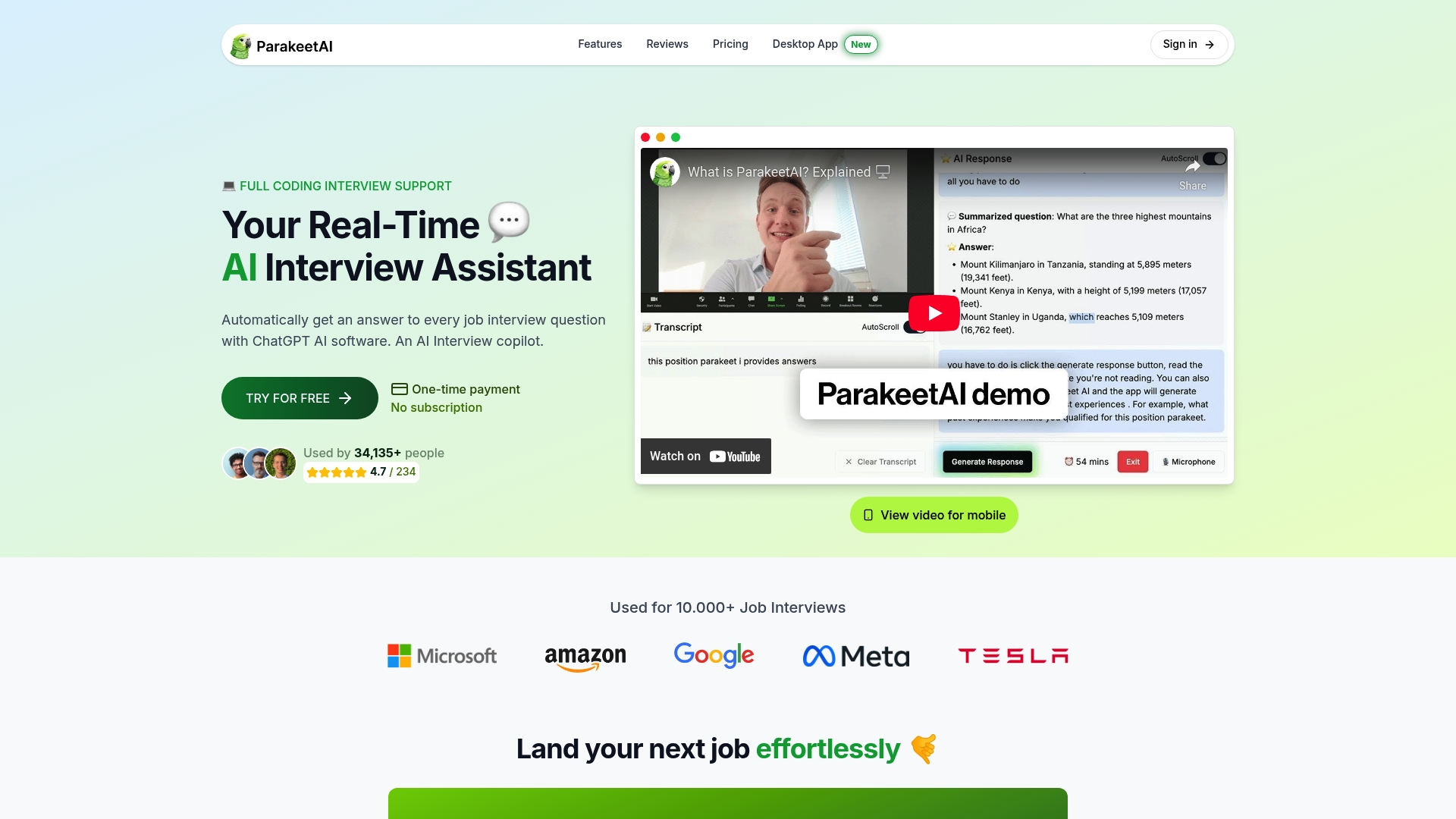
For job seekers who want to understand how AI scores interview performance before their next interview, Parakeet-ai provides detailed scoring on communication clarity, answer structure, and delivery quality. The feedback is specific, immediate, and built for candidates who want to improve fast. Visit Parakeet-ai to try the tool and see your performance data in real time.
FAQ
What is instant interview evaluation?
Instant interview evaluation is an AI-powered process that analyzes a candidate’s spoken interview responses in real time, measuring metrics like speaking pace, filler word frequency, and answer structure to generate immediate feedback and scoring.
How is instant interview feedback different from traditional feedback?
Traditional feedback arrives days after an interview and reflects the interviewer’s subjective memory. Instant feedback is generated within minutes using consistent, objective criteria applied equally to every candidate.
What metrics does AI use to score interview responses?
AI evaluation systems track speaking pace (targeting 120 to 160 words per minute), filler word frequency, STAR structure adherence, answer relevance, vocabulary diversity, and response latency.
Can AI evaluation replace human interviewers?
No. AI summaries are navigation tools for human reviewers, not final decision-makers. They highlight patterns and flag areas for further investigation, but the hiring decision remains with the human interviewer.
How should job seekers use instant evaluation tools to prepare?
Spend 90% of your practice time with AI mock interview tools to build measurable skills, and reserve 10% for human mock interviews to develop social nuance and conversational adaptability.