
Interview personality analysis: boost job success by 76%

AI no longer just reads your resume. During a live interview, it watches your face, listens to your tone, and scores your personality traits in real time, often before a human interviewer has formed a first impression. Interview personality analysis refers to the use of AI-powered tools and methods to evaluate personality traits during job interviews, and it is reshaping how companies decide who gets hired. This guide breaks down exactly what it is, how it works, what the models measure, and how you can use this knowledge to walk into your next interview with a real edge.
Table of Contents
- What is interview personality analysis?
- How does AI interview personality analysis work?
- Methodologies: Big Five, DISC, MBTI, and AI models
- Benefits of interview personality analysis for job seekers
- Limitations and ethical concerns you need to know
- Interview personality analysis vs traditional assessments
- How to improve your interview results with AI tools
- Level up your interview skills with ParakeetAI
- Frequently asked questions
Key Takeaways
| Point | Details |
|---|---|
| AI shapes interview outcomes | Understanding interview personality analysis helps you anticipate and excel in modern job interviews. |
| Practice boosts performance | Using AI tools for feedback can increase interview success and job fit confidence. |
| Balance benefits and caution | AI analysis brings powerful insights but requires ethical awareness and human judgment. |
| Tool choice matters | Selecting validated, bias-reducing platforms ensures your best results. |
What is interview personality analysis?
Interview personality analysis is not a personality quiz you fill out at home. It is a live, AI-driven evaluation that happens while you speak, move, and respond during an actual interview. The technology assesses Big Five personality traits using multimodal data, meaning it pulls from your video feed, your speech patterns, and the actual content of your answers all at once.
The Big Five model, also called OCEAN, covers five core traits:
- Openness: Your curiosity and willingness to try new things
- Conscientiousness: Your reliability, organization, and follow-through
- Extraversion: Your energy in social settings and tendency to speak up
- Agreeableness: Your warmth, cooperation, and empathy toward others
- Neuroticism: Your emotional stability under pressure
Companies use these scores to predict job fit, culture alignment, and long-term success in a role. The goal is not to label you but to match you to environments where you will actually thrive. Platforms like Mind Interview have built entire analysis systems around this framework, combining it with AI-powered interview tools that give both employers and candidates actionable data. A striking 78% of HR professionals report improved hires when personality analysis is part of the process.
How does AI interview personality analysis work?
The process sounds complex, but it follows a clear sequence. Here is how a typical AI-powered session breaks down:
- Record the interview: Your video and audio are captured in real time during the session.
- Run multimodal processing: The AI simultaneously analyzes your speech-to-text transcript, voice tone, facial micro-expressions, and body posture.
- Detect emotions and traits: Algorithms flag sentiment shifts, confidence markers, and behavioral patterns tied to specific personality traits.
- Generate a report: Results are returned fast, often within 1.5 to 2 seconds per response segment.
The accuracy here is not trivial. Multimodal AI processing can achieve up to 97% eye-tracking accuracy and detect up to 48 distinct emotions during a single session. That level of granularity goes far beyond what any human interviewer can consciously track.
| AI feature | Method used | What it detects |
|---|---|---|
| Voice tone analysis | Acoustic modeling | Confidence, anxiety, enthusiasm |
| Facial recognition | Computer vision | Micro-expressions, engagement |
| Speech-to-text | NLP processing | Word choice, sentiment, clarity |
| Posture tracking | Video analysis | Openness, nervousness, energy |
Understanding AI interview analysis at this level helps you stop guessing and start preparing with intention. Tools like AceInterview let you run practice sessions and receive the kind of structured feedback that actually changes behavior.
Pro Tip: Record yourself answering three common interview questions using an AI practice tool. Review the feedback on tone and word choice before your next real interview. Small adjustments in delivery can shift your trait scores significantly.
Methodologies: Big Five, DISC, MBTI, and AI models
Not all personality frameworks are built the same, and knowing which one a company uses changes how you should think about your results. Methodologies draw from the Big Five model but also incorporate DISC and MBTI, often combining them with AI for higher accuracy.
| Framework | Traits measured | Best used for |
|---|---|---|
| Big Five (OCEAN) | 5 broad dimensions | Predicting job performance |
| DISC | Dominance, Influence, Steadiness, Compliance | Team dynamics and communication |
| MBTI | 16 personality types | Self-awareness and career exploration |
| AI hybrid models | All of the above plus behavioral signals | Real-time interview scoring |
Here is why the Big Five dominates in hiring contexts:
- It is backed by decades of peer-reviewed research
- Its traits are measurable, not just categorical
- It predicts actual job performance better than type-based systems
- It integrates cleanly with AI tools and models for automated scoring
- Platforms like AssessFirst use it as the backbone of their hiring assessments
MBTI and DISC still have value for self-reflection and team building, but if you are preparing for an AI-screened interview, the Big Five is the framework to understand first.
Benefits of interview personality analysis for job seekers
This technology is not just a tool for employers. Used correctly, it gives you a serious advantage in your job search. Personality analysis cuts turnover by 30% and can boost interview success by 76% for candidates who use it proactively.
Here is what that looks like in practice:
- Sharper interview skills: AI feedback pinpoints exactly where your delivery weakens, whether that is filler words, flat tone, or low eye contact.
- Better role targeting: Knowing your trait profile helps you apply for roles where your natural strengths are actually valued.
- Stronger self-awareness: AI-personality research shows that candidates who understand their own profiles perform more consistently under pressure.
- Faster improvement: Feedback loops from AI tools compress weeks of coaching into a few focused practice sessions.
The key is combining tool use with honest self-reflection. Data alone does not change behavior. But data plus deliberate practice does.

Pro Tip: After each AI practice session, write down one trait score you want to improve and one specific behavior you will change. Tracking this over time turns abstract feedback into real growth.
Limitations and ethical concerns you need to know
While the benefits are clear, it is equally important to recognize the boundaries and responsibilities tied to AI-powered analysis. AI analysis is limited by self-report bias, technical skill gaps, and the risk of over or under-estimation by models.
Here are the core limitations every job seeker should understand:
- Response faking: Candidates can game self-report elements, which skews results and reduces validity.
- Context blindness: AI may misread nervousness as low conscientiousness, or cultural communication styles as disengagement.
- Technical skill gaps: Personality scores say nothing about whether you can actually do the job’s technical tasks.
- Legal and ethical exposure: Tools must comply with ADA requirements and anti-discrimination laws, and human oversight is not optional.
“The most accurate personality assessments combine AI-driven analysis with structured human review. Neither alone is sufficient for fair, valid hiring decisions.”
Research on LLM benchmarking for personality confirms that even advanced language models carry measurable bias when scoring personality traits. Understanding AI job interview ethics and interview compliance is not just for employers. As a candidate, knowing your rights around AI fairness in hiring helps you advocate for yourself if something feels off.
Interview personality analysis vs traditional assessments
To complete your understanding, let’s compare AI-driven approaches to techniques you might already know, like behavioral questions and STAR-format responses.
| Criteria | AI-powered analysis | Traditional methods |
|---|---|---|
| Time to results | 1 to 2 seconds | Days to weeks |
| Bias risk | Algorithmic bias possible | Human bias likely |
| Context sensitivity | Limited | High |
| Scalability | Handles thousands at once | Limited by interviewer capacity |
| Accuracy on soft skills | High | Moderate |
AI methods provide objectivity and scalability, while behavioral methods offer context and nuance that algorithms still struggle to capture. The smartest companies use both. They run AI screening early in the process and bring in structured behavioral interviews for final rounds.
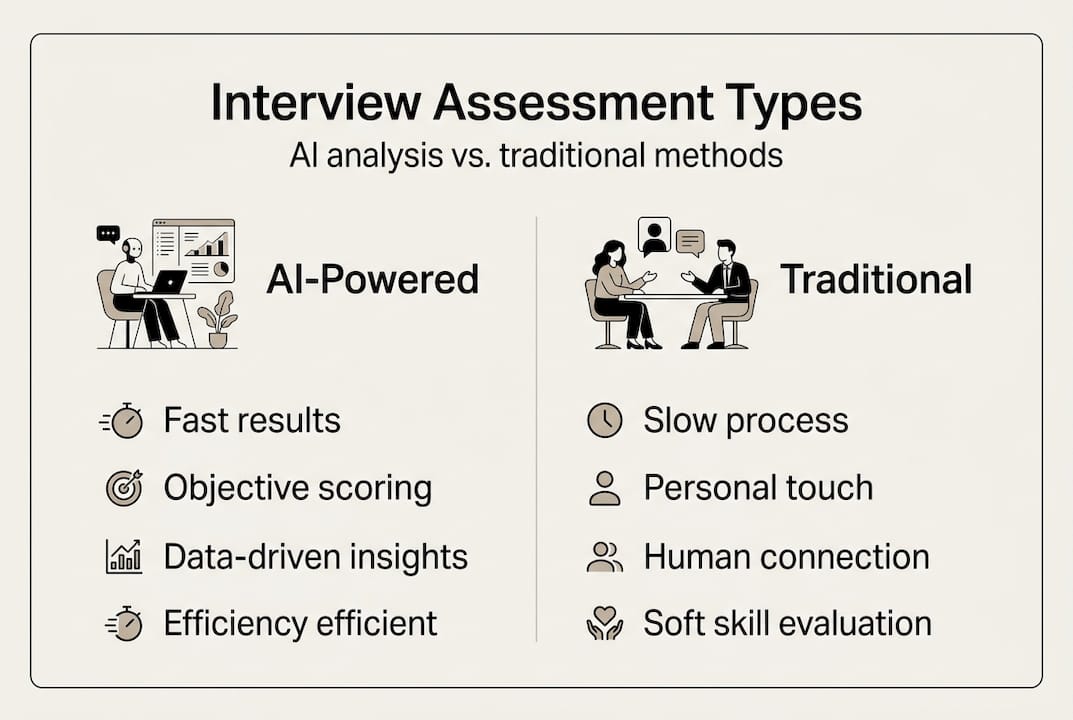
As a job seeker, this means you need to prepare for both. Platforms like Eightfold AI Interviewer show how hybrid approaches are becoming the industry standard. Knowing AI versus traditional analysis helps you tailor your preparation to whatever format you are walking into.
When to lean on each method:
- Use AI tools for early-stage practice and self-assessment
- Use STAR-format prep for behavioral and panel interviews
- Use both when you know a company runs a hybrid screening process
How to improve your interview results with AI tools
Armed with knowledge, here is how you can immediately apply AI tools for job interview success. The process is straightforward and repeatable.
- Take a Big Five personality test: Start with a free, validated assessment to establish your baseline trait profile.
- Record a practice interview: Use a tool like AceInterview to simulate a real session and capture your responses on video.
- Review AI feedback carefully: Look at tone scores, sentiment analysis, and any flagged behaviors. Do not just skim the summary.
- Target one improvement per session: Trying to fix everything at once leads to nothing changing. Pick one trait area and work on it deliberately.
- Repeat before every real interview: Consistency compounds. Three focused practice sessions beat one marathon prep day every time.
Platforms worth exploring include PredictiveHire for structured assessments and practice AI interview tools that simulate real screening environments. The candidates who use these tools consistently show up to interviews with a level of self-awareness that is immediately visible to interviewers.
Pro Tip: Run your practice session the evening before your real interview, not the morning of. You want the insights to settle overnight so you can apply them naturally, not nervously.
Level up your interview skills with ParakeetAI
Everything covered in this guide points to one practical truth: preparation backed by real-time AI feedback is what separates candidates who get offers from those who keep interviewing. Understanding your personality profile is step one. Practicing with tools that give you live, actionable feedback is step two.
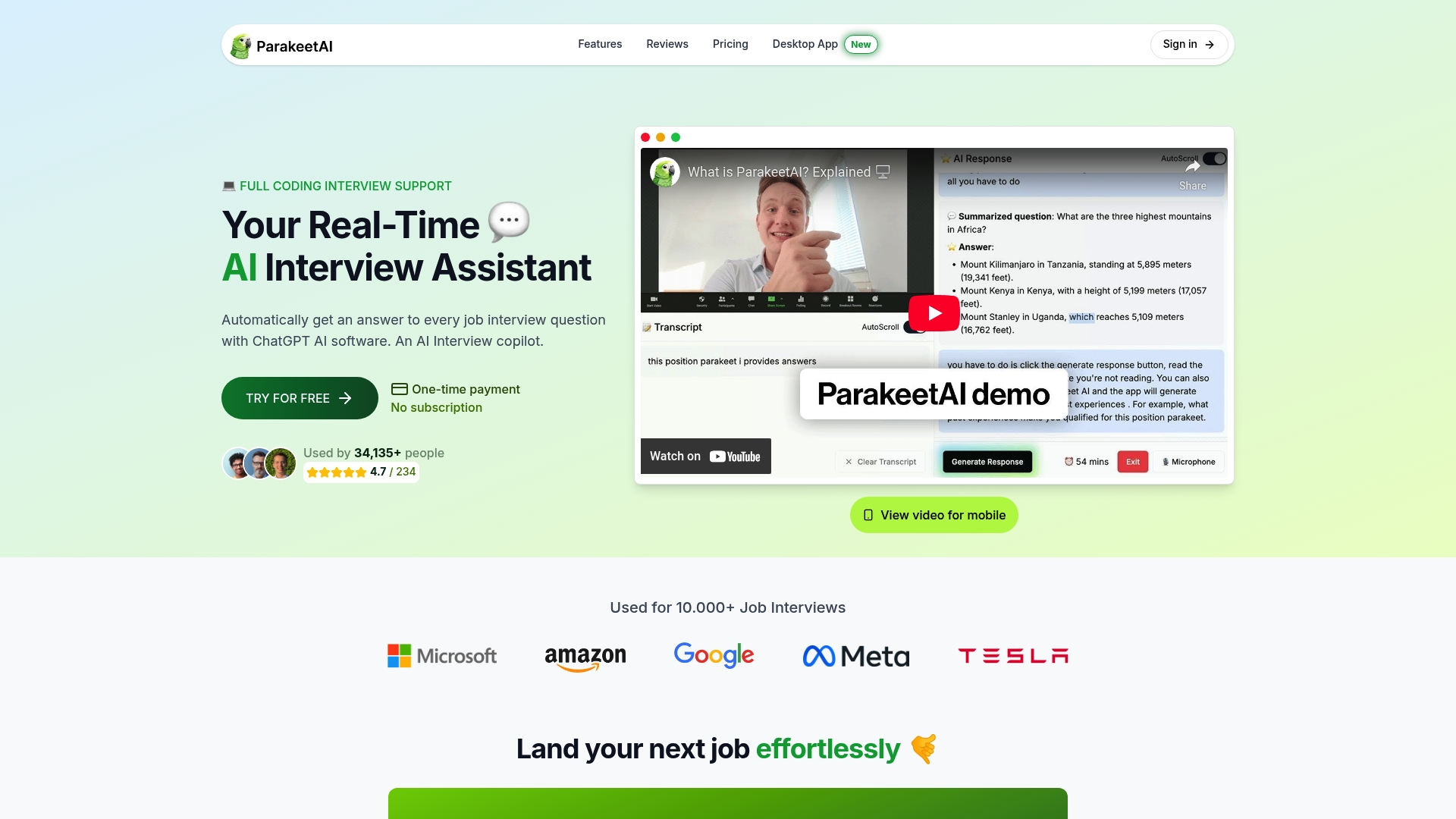
ParakeetAI is built exactly for this. It listens to your interview in real time and automatically surfaces answers and coaching cues as questions come at you, so you are never caught off guard. Whether you are preparing for an AI-screened first round or a high-stakes panel interview, ParakeetAI gives you the kind of in-the-moment support that turns preparation into performance. Try it before your next interview and feel the difference that real-time AI assistance makes.
Frequently asked questions
What traits are measured in interview personality analysis?
Most tools measure the Big Five traits: Extraversion, Agreeableness, Conscientiousness, Neuroticism, and Openness. These five dimensions give employers a reliable picture of how you work, communicate, and handle pressure.
Can AI interview analysis improve my chances of getting hired?
Yes. AI tools boost success rates by up to 76% for candidates who use them to prepare, because targeted feedback helps you fix specific weaknesses before the real interview.
Are AI-powered interviews fair and unbiased?
AI can reduce some traditional human biases, but ethical risks remain. The best tools include fairness safeguards and require human oversight to ensure results are used responsibly.
How can I practice for AI-based interview analysis?
Platforms like AceInterview for self-assessment let you run realistic practice sessions and receive structured feedback on tone, word choice, and behavioral signals before your next real interview.